Login

Soft optical sensor offers new way to map the heart and brain
A team of biomedical engineers have developed a fully flexible light sensor that precisely detects changes in the

The iPhone X is a testament to device longevity, and durability. I gave mine to a family member when upgrading to an Xs Max in Late 2018, who held onto it all these years through a few different protective cases. Today I got it back where it’ll remain in my collection, after they upgraded to […]
The post The X, a Pro, and Air: 10 Years of iPhone design appeared first on Low End Mac.
TerraMaster’s F4-425 is a fast, versatile, four-bay storage, backup and media streaming NAS box that’s every bit as good as, if not better than similar units from QNAP and Synology. Especially as the company doesn’t gouge you for IP cam licenses.
Price When Reviewed
This value will show the geolocated pricing text for product undefined
Best Pricing Today
I’m always surprised how few people own a NAS (Network Attached Storage) box such as the highly capable F4-425 Pro reviewed here. NAS requires a bit more tech savvy than cloud services and storage, plus some upfront cost, but there’s one particular reason it’s worth it: complete and private control of the apps, services, and most importantly –the data you store on it.
Internet outage? Doesn’t affect your NAS. Online data breech? Doesn’t affect your NAS. Monthly payments? Only to your power company. Simply put, NAS is fantastic for data backup and streaming media about the house and can also serve as the engine for a home surveillance network.
We like NAS, and TerraMaster has quickly become one of our favorite consumer flavors thanks to excellent hardware and apps, a newly faster OS, and the lack of surcharges vendors such as QNAP and Synology hit you up with for things such as additional IP cam licenses.
That said, there was the occasional immaturity in the apps and operating system.
The F4-425 Pro is a silver and black hued, mostly metal, four-bay NAS box with quick swap, non-locking 3.5-inch drive trays. It measures approximately 7.1-inches wide by 8.6-inches deep, by 5.9-inches tall and weighs around 6.5 pounds bare. That will of course increase as you add drives.
If you remove the four screws on the bottom holding the aluminum body to the chassis, you’ll find three PCIe 3.0 NVMe M.2 slots that accept NVMe SSDs. There’s enough space for heat sinks, which would be a good idea to prolong SSD life. Note that you can use PCIe 4.0/5.0 SSDs but they’ll be limited to PCIe 3.0 speed.
The front of the unit provides access to the four drive bays, as well as the power button and a single 10Gbps USB Type-A port. The back is home to an additional pair of 10Gbps Type-A USB ports, twin 5Gbe Ethernet ports, and HDMI port (console use only), and a single Type-C port for diagnostics and the like. There’s also the power jack, a pinhole reset button, and a rather massive exhaust fan.
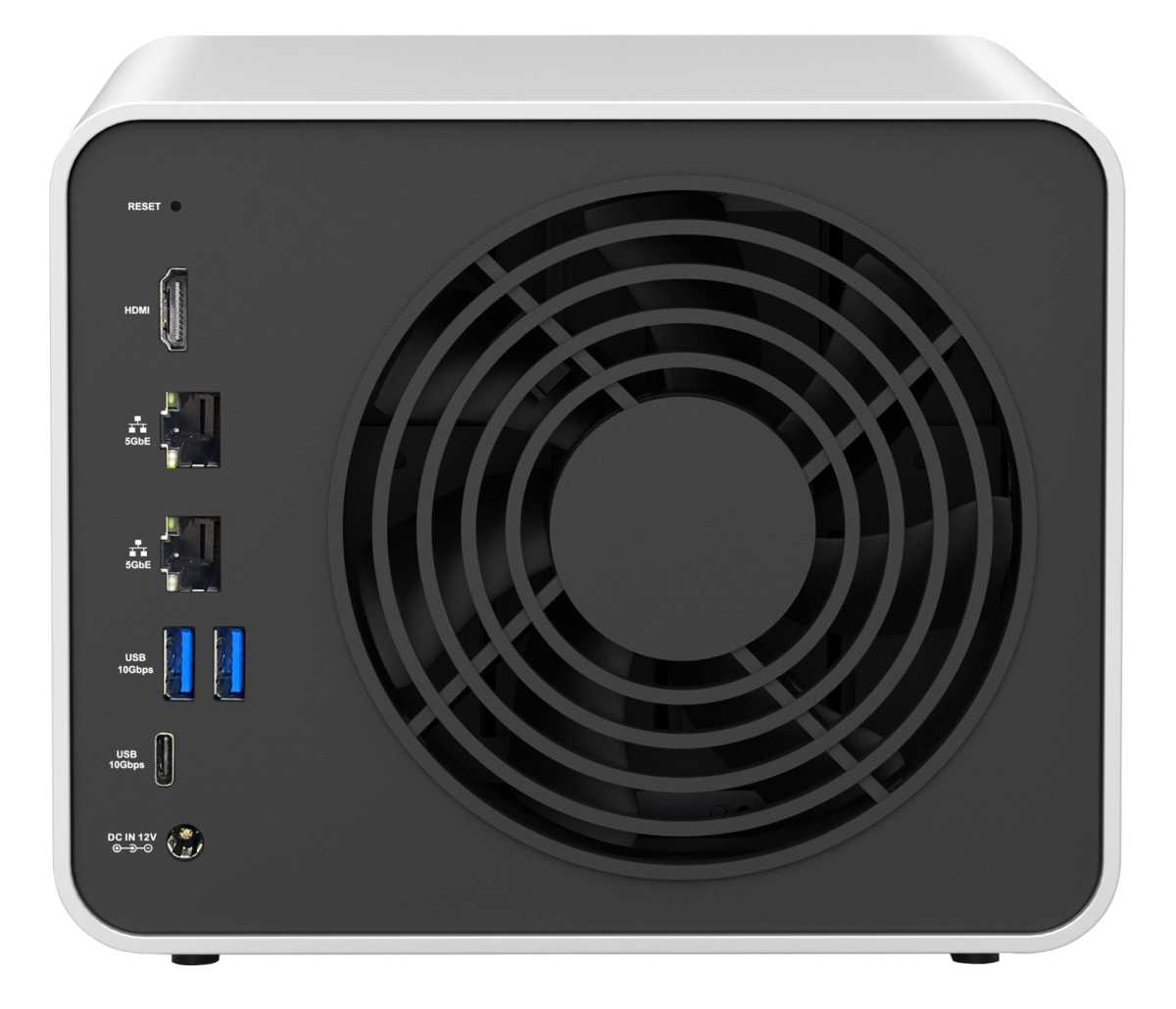
The processor inside of our test unit was a capable 8-core Intel N350 with a substantial 16GB of DDR5 onboard. That’s plenty of power for advanced tasks like virtual machines and Docker.
TerraMaster also provides several apps for backup up mobile devices, and even controlling the box.
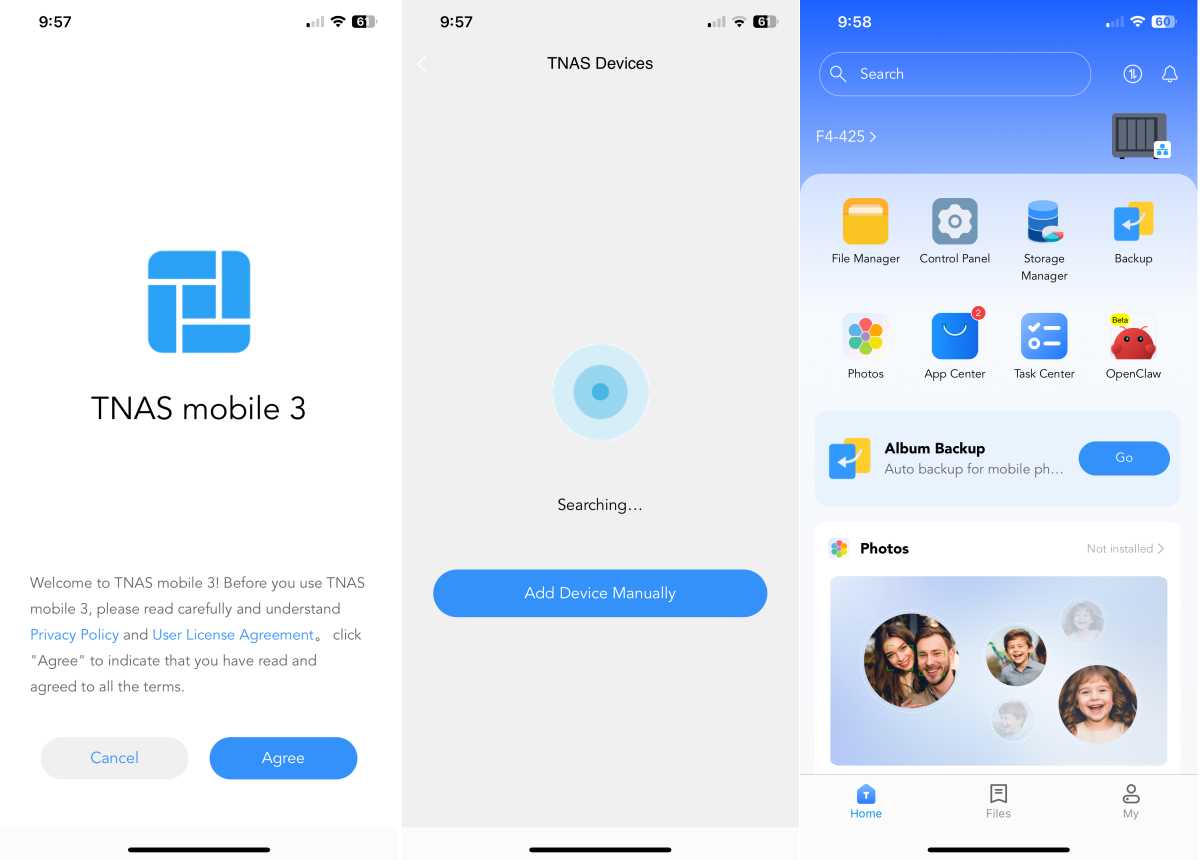
TerraMaster provides 2-year warranty on the F4-425 Pro. And thankfully, the company now also provides a downloadable PDF user’s guide.
Adding drives to the tool-less trays is largely painless: slide them out, pop out the side rails, slip in the 3.5-inch HDD and replace the side rails. Screws are provided for 2.5-inch hard drives or SATA SSDs. As described above, you’ll need to remove the outer shell to access the three PCIe 3.0 NVMe slots.
lWhen you first boot the F4-425 (and most TerraMaster NAS) it presents a dialog asking for your email address to receive a code. That’s of course after you find its IP address (E.g. 192/168.1.110) and visit with your browser. Below the email field, in very light lettering, is the ability to bypass this step.
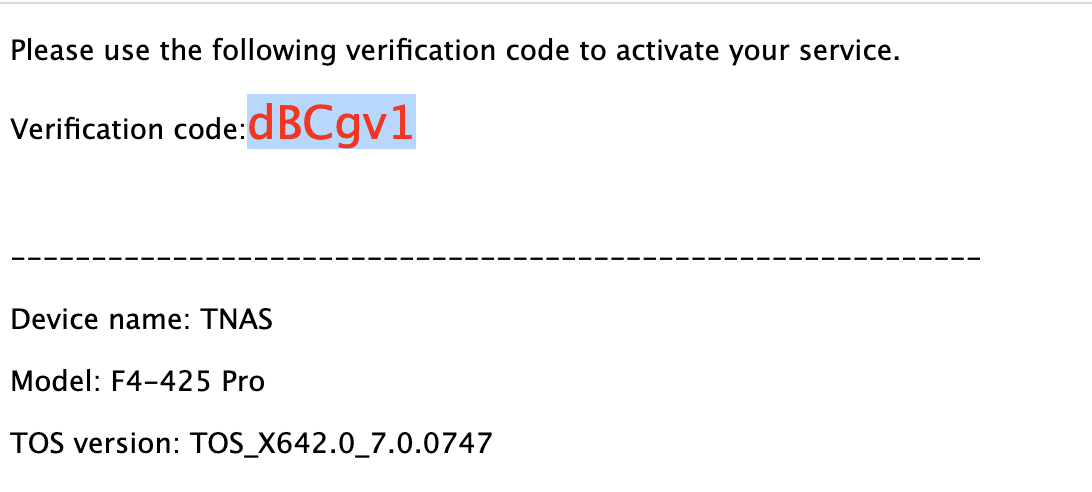
Alas, you still have to enter your email. I don’t like sending info to a company until I’m very familiar with the hardware and said company. I wish TerraMaster would abandon this practice ad to be blunt–it’s none of their darn business.
To be fair, you can put the F4-425 Pro into “Security Isolation Mode” (Control Panel / Security/ Security Isolation Mode) after setup, to prevent any further traffic outside of your local network. The F4-425 also features a highly configurable firewall if that’s too drastic a measure for you.
The F4-425 Pro delivered our first look at the latest version 7 of TOS (TerraMaster Operating System), a substantially feature-equivalent but far better-performing version of the operating system (version 6) than I tested with the F2-425. Especially in regards multitasking.
Beyond that, it appeared to me to be more evolutionary than revolutionary, despite heralding itself as the first AI-enabled NAS OS. It does allow you to install OpenCLAW which enables normal language access to various features.
TerraMaster says OpenCLAW makes things easier, but the real issue with most new NAS users is that they don’t know what to ask, let alone how to ask it. Actually, thinking about it, that’s the issue with just about any AI system. Note also that the minute I opened OpenCLAW, the F4-425 Pro’s fan kicked into high gear. It takes some juice.
That said, I quite like TOS, it’s as well laid out as the QNAP and Synology equivalents, and perhaps a bit more intuitive. However, I found version 7 a bit buggy. Rough around the edges, as it were.
I stuck with TOS 7 as it’s so much quicker at everything than version 6 but there were some annoyances such as the inability to include spaces in a backup job name, and not automatically resuming jobs that were not completed in the last session. I’d also be careful doing searches and deleting the results with the file manager.
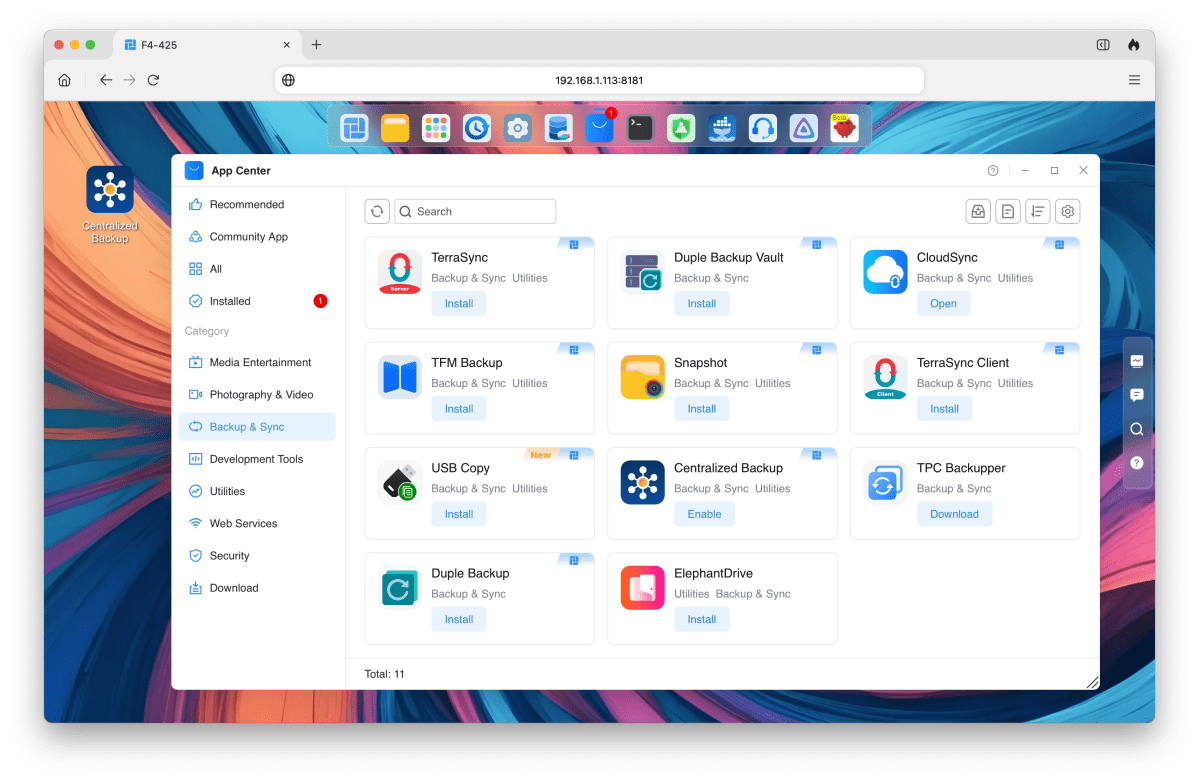
There are also tons of apps for backup, surveillance, development, and multimedia streaming. Below is my favorite: Centralized Backup, which can back up from numerous sources (SMB, FTP, etc.) without the need to install clients on every machine. Simply share the folders or files you want across the network, locate them and create a job to back them up.
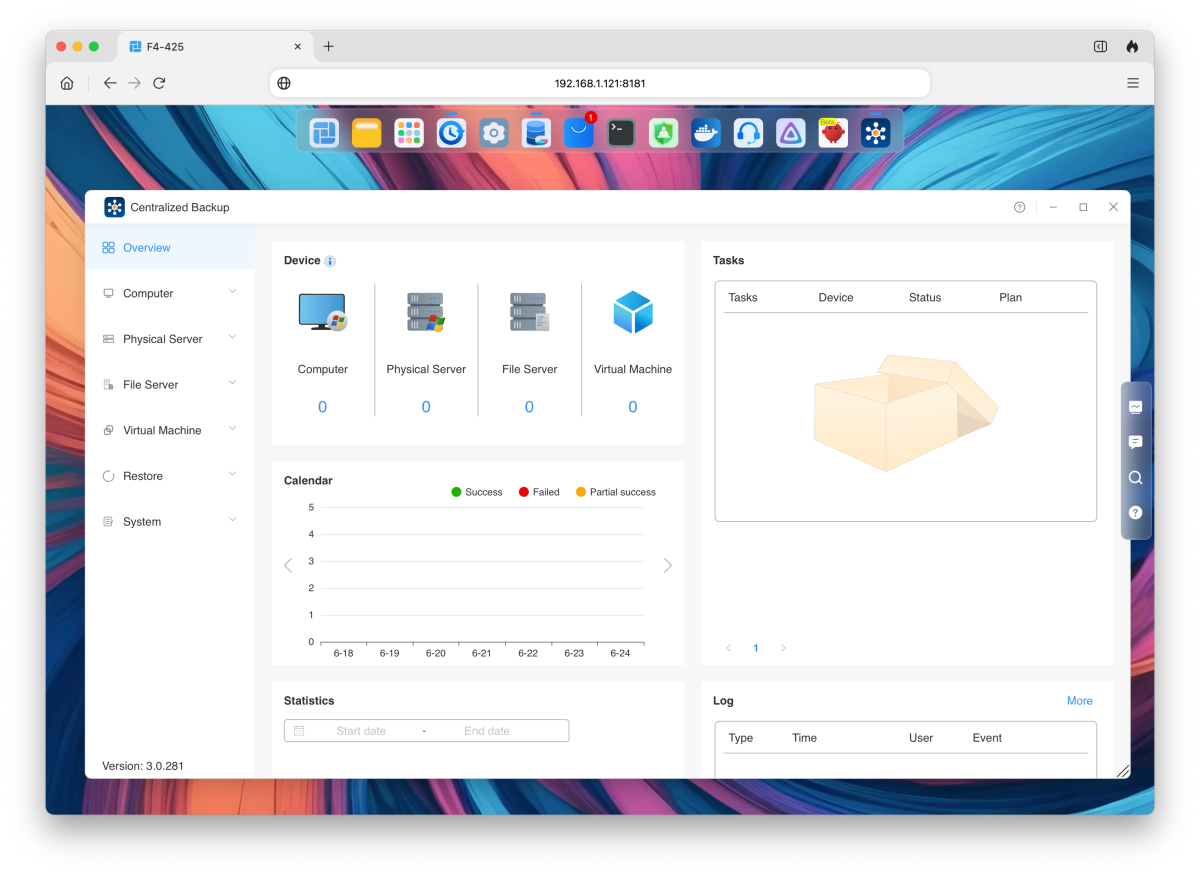
Centralized Backup, along with CloudSync (back up to a host of online services) are my favorite TOS backup apps, but there are quite a few others (Duple Vault, Elephant Drive, etc.) as well as TerraMaster’s own client-based, portal driven TerraSync. There’s also a handy folder mirroring utility (TFM) that you can use across volumes.
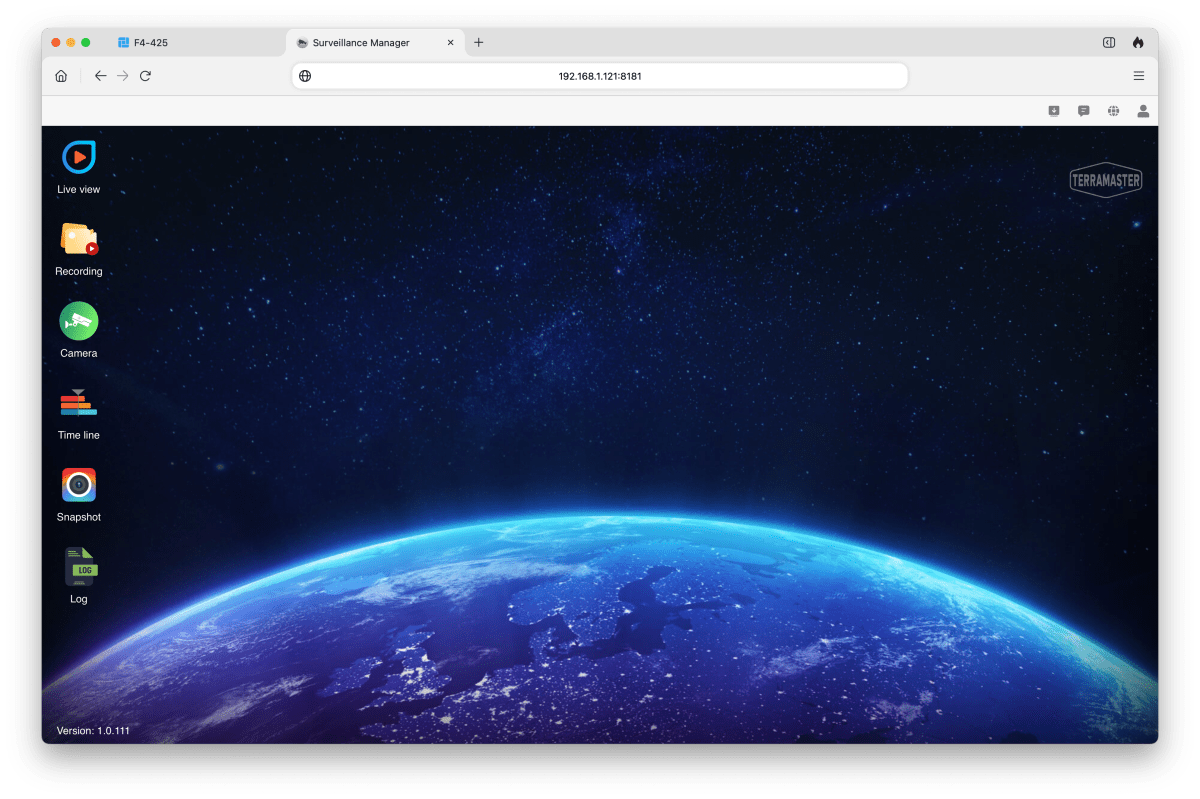
Want to keep tabs on your house? TerraMaster includes Surveillance Manager (shown below), which offers support for unlimited cameras. This is in distinct contrast to Synology and QNAP which limit you to one or two cameras so they can sell you more licenses. This is one of the best reasons to opt for a TerraMaster NAS box, however, note that you’ll have to configure your router to reach the app remotely.
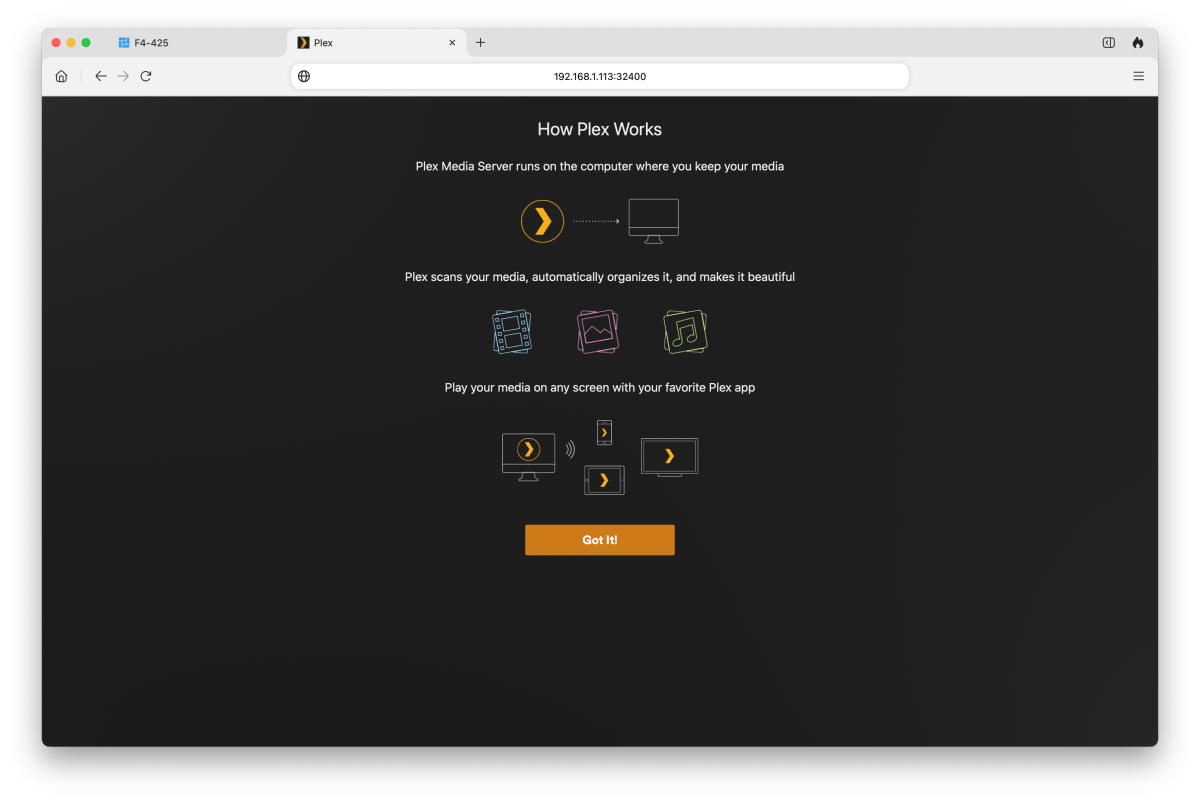
While I use TOS’s DLNA Multimedia Server to stream movies to my TV, TerraMaster also includes the extremely popular Plex (shown below), as well as Jellyfin and Emby for fans of those systems.
TRAID is TerraMaster’s hybrid RAID solution (all NAS vendors have one these days) that combines mirroring (RAID 1) and parity (RAID 5). It allows you to combine drives of different sizes while using more of their capacity than standard RAID modes do.
Generally speaking, most RAID modes allow you to use only the capacity of each drive in the array equal to that of the smallest drive in the array. Combine a 4TB HDD and an 8TB HDD in RAID 0 (striping) or RAID 1 (mirroring), and only 4TB of the 8TB drive is used, while the rest just sits there. TRAID and similar solutions let you employ the otherwise wasted capacity as another volume, or part of one.
The F4-425 Pro with the Intel N350 retails for $799, but was on sale at TerraMaster’s site for $639 at the time of this writing. From TerraMaster’s Amazon store make that $699.
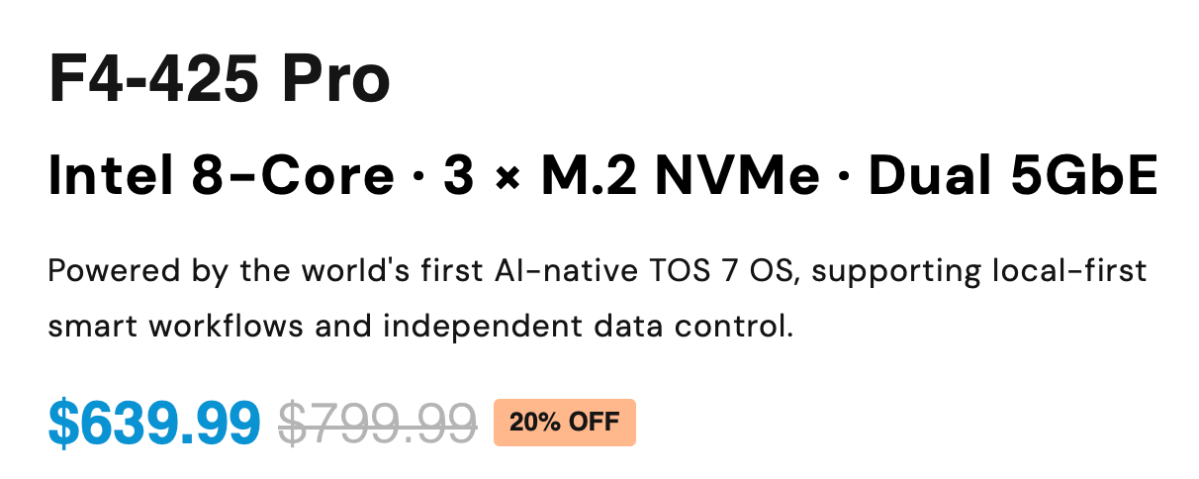
There’s a cheaper $569 Intel N305/8GB version of the F4-425 Pro available, as well as less endowed $599 F4-425 Plus (Intel N150 processor, 16GB), and $429 F4-425 (quad-core, 4GB) models if the Pro is too pricey for you, or you don’t need to run VMs, Docker, etc.
The Plus and plain versions were discounted to $480 and $344 respectively at the time of this writing. All use the same operating system and offer the same applications.
The F4-425 Pro’s price is roughly on par for a NAS box with this grade of processor, 16GB of memory and NVMe slots, but as always — shop around, though we’re fairly sure you’d be happiest with the TerraMaster.
The F4-425 Pro features dual 5Gbpe (Multi-gig) so it’s capable of nearly 600MBps when using that protocol, and around 1GBps if you aggregate the two 5Gbps Ethernet adapters. At 2.5Gbps, expect around 290MBps, and on gigabit, around 140Mbps.
There’s no Wi-Fi, but that’s not the best way to use a NAS box. You can with some (and an add-in card), but commonly NAS is connected via Ethernet directly to a router or switch.
I populated the F4-425 with a single 1.92GB Seagate IronWolf SATA SSD and two Crucial T710 PCIe 5.0 NVMe SSDs (running at PCIe 3.0 speed) and formatted with the Btrfs file system. All those SSDs are massively faster than 5Gbpe or even 10Gbpe. The test network consisted of my M4 Max Studio, an EnGenius ECS2512FP 12-port switch (8 x 2.5Gbe/4 x 10Gbe), and PCWorld’s 10Gbe Intel testbed.
I tested with both a single 5Gbe Ethernet connection and both 5Gbe Ethernet ports bonded using TOS 7. However, there was so little improvement with the ports bonded, I’m showing only the 5Gbe results. As to that…
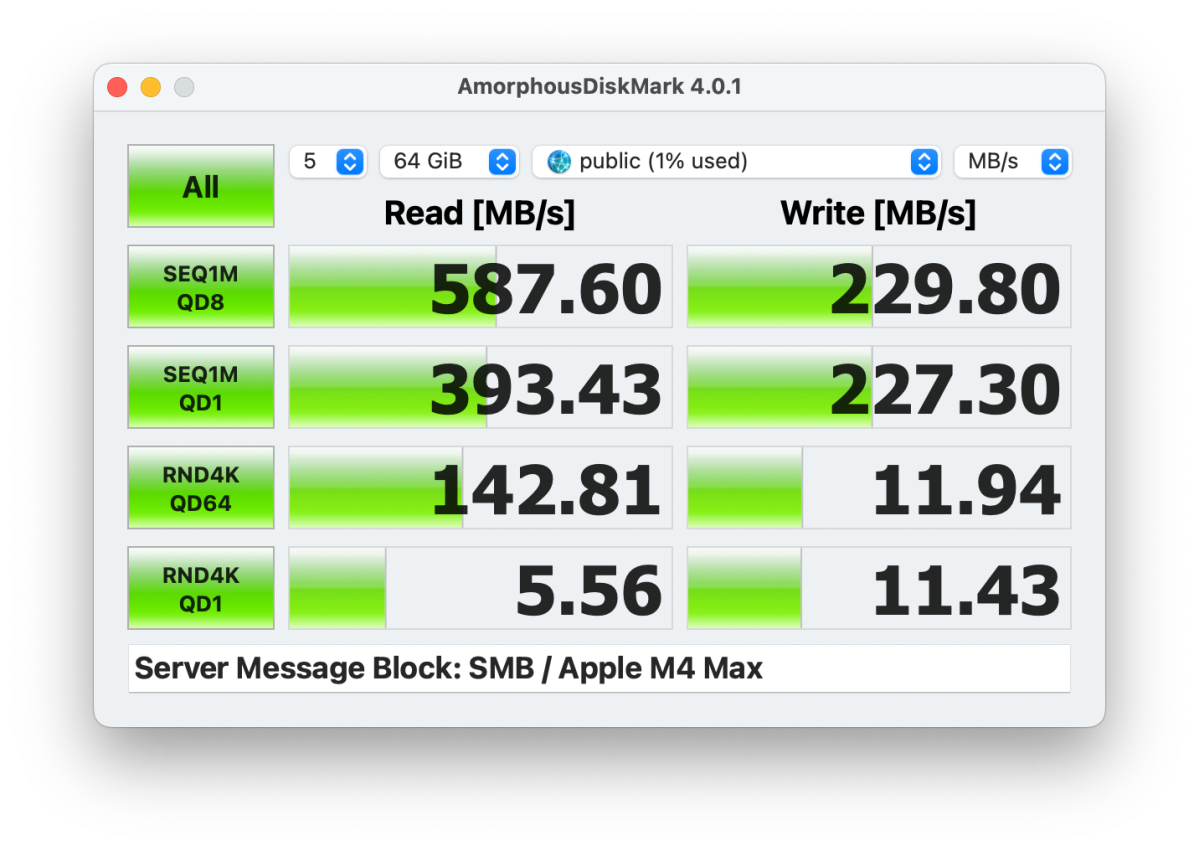
Disk Speed Test was quite complimentary of the F4-425’s throughput, and more so than AmorphousDiskMark.
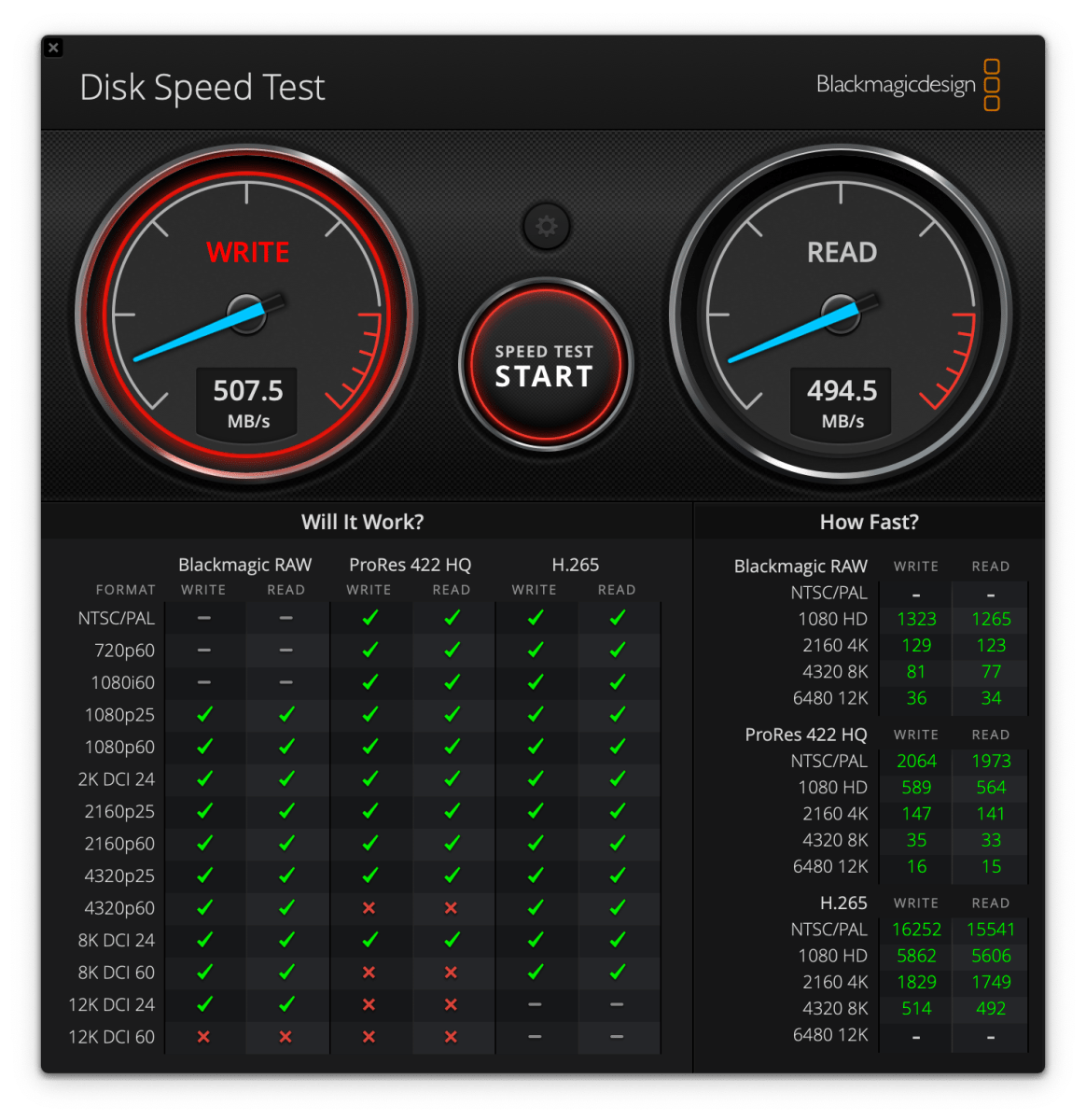
AmorphousDiskMark writes more data at a time than Disk Speed Test, which may be the reason for the lower write number. That said, CrystalDiskMark on the PC showed even greater performance that Disk Speed Test — 587MBps reading and 580GBps writing.
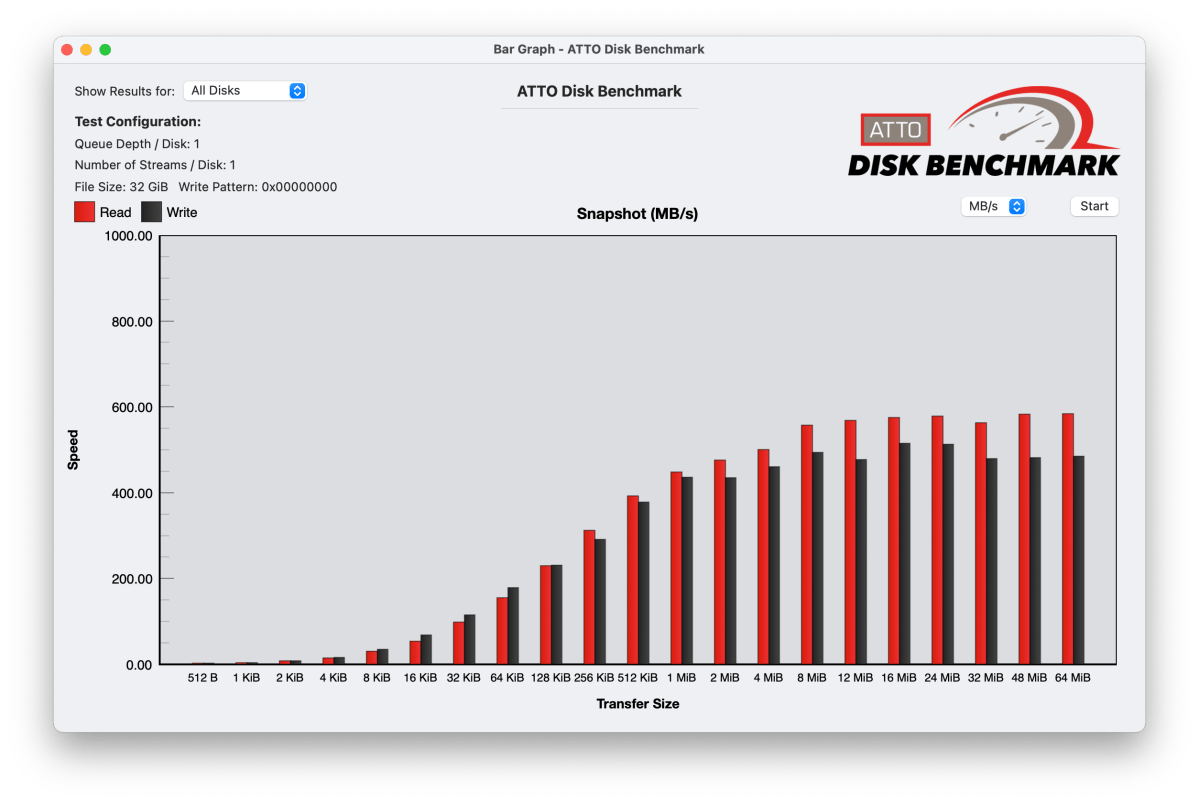
ATTO was more in line with Disk Speed Test than AmorphousDiskMark.
As to sprightlyness, I banged on the interface and apps pretty hard. The F4-425 Pro was extremely responsive. Tasks completely quickly, including firmware updates and reboots. The latter were far faster than what I’m used to with my older NAS boxes. Multi-tasking, which I complained about with TOS 6 on the F2-425 was light years better. Thank you TOS 7! And of course, more memory and a faster processor.
TerraMaster’s advertising teases over 1GBps performance. However, that’s simply totaling two separate 500GBps connections working separately. Expect what you see above.
Note also that there is a list of compatible NVMe SSDs found here. I’ve had issues with the F8 SSD Plus with some that weren’t supported, though the F4-425 seems fine with the same SSDs. I also found that some software required re-enabling after reboots or shutdowns in TOS 7.
If you need a very fast 4-Bay NAS box, the TerraMaster F4-425 fits the bill. Though you should expect a couple of software glitches here and there with TOS 7 that QNAP and Synology don’t suffer. That said, for creating a surveillance system, the lack of additional fees makes it top dog in that department.

Apple lawsuit against OpenAI has reached its first major procedural challenge, with the ChatGPT developer asking a US federal judge to dismiss allegations that it acquired or used trade secrets taken by former Apple employees.
OpenAI submitted its 31-page dismissal motion on Wednesday in the US District Court for the Northern District of California. The filing argues that Apple has not adequately identified protectable trade secrets or alleged facts showing that OpenAI misappropriated confidential information.
Apple filed the case on July 10 against OpenAI, its io Products hardware operation, former Apple Vice President Tang Yew Tan, and former electrical engineer Chang Liu. The complaint accuses the defendants of obtaining information connected to Apple’s product development, manufacturing, components, testing, and supply chain operations.
The allegations have not been proven, and OpenAI denies possessing or seeking Apple’s trade secrets. US District Judge Edward Davila must now decide whether Apple’s complaint contains enough factual detail for the litigation to continue.
OpenAI’s motion focuses initially on how Apple described the information it claims was stolen. According to OpenAI, the complaint relies on generalized product-development categories without identifying the protected information with enough precision.
Trade secret plaintiffs face a difficult balance at the beginning of litigation. Apple must describe the protected material sufficiently to establish a plausible legal claim, but revealing the material publicly could expose the same information it is trying to protect.
Sensitive details can later be handled under seal or through a protective order. At the dismissal stage, however, Apple must still provide enough information for the court to distinguish genuine trade secrets from general engineering knowledge, employee experience, or skills acquired through years of work.
OpenAI argues that Apple has not crossed that threshold. Its motion says the complaint fails to establish ownership of a protectable trade secret and does not plausibly allege that OpenAI acquired, disclosed, or used such information.
The filing also disputes the commercial premise behind Apple’s accusations. OpenAI says it is developing products that are different from Apple’s hardware and has no need or desire to use the iPhone maker’s confidential material.
That position does not settle whether information was taken. A company can potentially misappropriate trade secrets even when its eventual product has a different design. The court’s immediate task is narrower: determining whether Apple has alleged facts that could support its claims if those facts are later proven.
Apple’s complaint centers partly on Chang Liu, who spent eight years working as a senior system electrical engineer at the company before joining OpenAI in January 2026.
Apple alleges that Liu retained an Apple-issued computer and accessed confidential technical information after leaving. It claims he exploited residual authentication access on multiple occasions to obtain internal documents while already working for OpenAI.
OpenAI presents a different explanation. It says Apple employees contacted Liu after his departure and asked him to help locate files needed for ongoing Apple work. The company published redacted messages that it says support this account.
OpenAI argues that Apple’s systems and policies allowed personal and corporate information to become intermingled through iCloud accounts. Former employees, it says, could retain access to Apple files without requesting it or realizing that access remained active.
The motion maintains that Apple cannot treat the foreseeable effects of its own access-management practices as proof that former employees intentionally stole data. Apple, in contrast, alleges that its records document repeated access to restricted information rather than an accidental discovery of lingering permissions.
These competing accounts are likely to become central if the case enters discovery. Authentication logs, downloaded files, device records, internal communications, and employment timelines could establish whether access was deliberate, what information was obtained, and whether it reached anyone working on OpenAI products.
A dismissal motion normally tests whether the complaint states a legally sufficient claim. It is not a trial, and the judge is not expected to resolve every factual disagreement using competing evidence at this point.
Apple separately accuses Tang Tan, OpenAI’s chief hardware officer, of seeking confidential information from Apple employees during recruiting conversations.
Tan spent more than 24 years at Apple and worked on products including the iPhone, Apple Watch, AirPods, and iPod. He later helped establish io Products with former Apple design chief Jony Ive and other collaborators. OpenAI acquired the hardware company as part of its effort to create a family of devices built around artificial intelligence.
Apple alleges that Tan used confidential project names, retained internal materials, and encouraged job candidates to discuss unreleased components or bring physical parts to interviews. OpenAI rejects the claim that these interactions formed a coordinated effort to collect Apple secrets.
OpenAI says Tan repeatedly instructed employees that confidential information from previous employers could not be brought into its organization. It also offers an alternative explanation for an Apple offboarding document found in his possession, arguing that Tan retained it to help incoming employees comply with Apple’s departure procedures.
Apple’s position is that the document and recruiting communications must be examined alongside the other alleged conduct. It describes the events as part of a connected campaign rather than isolated employment or administrative issues.
The dispute comes during intense competition for engineers capable of developing consumer AI hardware. Apple alleges that more than 400 former employees have moved to OpenAI, although hiring people from a competitor does not by itself establish trade secret misappropriation.
A company must generally connect recruitment to the acquisition, disclosure, or use of protected information. OpenAI is relying heavily on that distinction, presenting Apple’s lawsuit as an attempt to respond to employee departures and its difficulties competing for AI talent.

OpenAI’s dismissal request arrives shortly after Apple asked the court for a preliminary injunction. Apple wants restrictions imposed while the lawsuit proceeds, arguing that it could suffer harm if its confidential information is used during OpenAI’s hardware development.
The requested relief would prevent OpenAI and the individual defendants from acquiring, accessing, using, or disclosing the alleged trade secrets. Apple has also requested expedited discovery and forensic examination of relevant devices and accounts.
OpenAI says those restrictions are unnecessary because it does not possess or want Apple’s protected information. It has described Apple’s request as based on false information and has offered to cooperate in addressing specific concerns.
The two companies also disagree over their communications before the lawsuit. Apple initially said its concerns had been raised with OpenAI months earlier. OpenAI responded that Apple’s outside lawyers contacted the wrong person after confusing names and incorrectly described a conversation with OpenAI’s general counsel.
OpenAI says Apple did not present the specific accusations before filing the case and that the companies had previously discussed resolving any access issues. Apple has since provided additional information in support of its injunction request, including allegations involving other former employees.
These disputes have moved beyond ordinary court filings. OpenAI published messages and emails on its website to support its version of events, calling Apple’s lawsuit aggressive and poorly investigated. Apple has primarily presented its account through formal legal submissions.
Judge Davila could dismiss some or all of Apple’s claims, deny the motion, or allow Apple to amend its complaint with more specific allegations. Even a dismissal would not necessarily end the case if permission to revise the complaint is granted.
The next scheduled public test is an October 1 hearing covering Apple’s preliminary injunction and request for early discovery. That proceeding may determine whether OpenAI faces immediate limits on its hardware work before the underlying trade secret claims receive a full evidentiary review.
The post Apple Lawsuit: OpenAI Seeks Dismissal of Trade Secrets Case appeared first on AppleMagazine.
Apple has increased its estimated trade-in values for most current iPhone, iPad, Mac, and Apple Watch models in the United States. The adjustments give customers slightly more credit toward a new device, although some older Apple hardware and several Android phones have moved in the opposite direction.
The updated values are maximum estimates rather than guaranteed payments. Apple calculates the final credit after confirming the model and inspecting its condition. A damaged display, enclosure problems, missing functionality, or an inaccurate description can reduce the amount offered.
Most of the increases are modest, but they arrive across several of Apple’s largest product categories at the same time. Recent iPhones receive between $10 and $25 more, every iPad category listed in Apple’s summary gains value, and several popular Macs receive larger increases.
The revisions also reinforce the role of trade-ins within Apple’s retail operation. Credit can reduce the cost of a regular purchase, be delivered through an Apple Gift Card, or lower payments at the beginning of an eligible Apple Upgrade lease.

Every iPhone 16 model included in the update receives a higher maximum estimate. The iPhone 16 Pro Max moves from $685 to $695, retaining the highest listed value among the affected iPhones.
The iPhone 16 Pro increases from $550 to $560, while the iPhone 16 Plus moves from $455 to $465. The standard iPhone 16 receives the largest increase within the family, rising by $25 from $435 to $460.
These changes narrow the difference between the standard iPhone 16 and the larger Plus model. The Pro models retain substantially higher estimates, reflecting their higher original prices and stronger position in the used-device market.
An additional $10 or $25 will not transform the cost of an upgrade, but it can offset part of a case, charger, AppleCare plan, or storage upgrade. The difference also becomes more relevant for customers comparing Apple’s direct program with a third-party reseller offering a similar amount.
Apple’s iPad adjustments are more consistent. The maximum estimate for an iPad Pro rises from $670 to $690, an increase of $20. The iPad Air moves from $445 to $460, while the standard iPad rises from $220 to $235.
The iPad mini also gains $15, moving from a maximum of $250 to $265. That means every current iPad category displayed in Apple’s trade-in summary receives a higher estimate.
Apple’s direct trade-in values are generally lower than the prices an owner might obtain through a private sale. The program instead emphasizes convenience: the device can be returned at an Apple Store or sent using Apple’s online process, with the credit connected directly to a new purchase.
A private sale can produce a better return, especially for a recent device in excellent condition. It also requires the owner to set a price, find a buyer, manage payment, and handle the transfer independently. Apple’s program trades some resale value for a simpler exchange.
Mac trade-in values receive some of the largest increases, but the category also includes notable reductions.
The MacBook Air rises from a maximum of $485 to $520, adding $35. The Mac mini receives the same increase, moving from $340 to $375. The MacBook Pro changes only slightly, increasing from $685 to $690.
Apple leaves the current iMac estimate unchanged at $355. The Mac Studio receives a larger increase from $975 to $1,045, reflecting the higher value retained by recent desktop configurations.
Older professional desktops move in the other direction. The iMac Pro falls from $325 to $315, while the top Mac Pro estimate declines from $2,090 to $2,045.
That $45 reduction at the top of the Mac range means Apple’s maximum Mac trade-in offer decreases even though several mainstream models receive more credit. The changes appear more closely connected to the resale position of individual product families than to a uniform increase across every computer.
Mac estimates can vary considerably because one model name can cover different years, processors, memory configurations, storage capacities, and physical designs. Apple asks for a serial number before producing a more specific estimate for a Mac.
The Apple Watch adjustments are similarly mixed. Apple Watch Ultra 2 rises from $295 to $305, while Apple Watch Series 9 increases from $120 to $130.
Apple Watch Series 10 remains unchanged at a maximum of $150. The original Apple Watch Ultra falls from $215 to $205, losing $10.
Wearable trade-in values can decline quickly because watches receive frequent updates and are exposed to greater physical wear than many computers or tablets. Battery condition, display damage, case wear, and working buttons can influence whether the device receives the estimated credit.
Apple also accepts devices that no longer qualify for monetary value. Those products can be returned for recycling, including older hardware and accessories that would otherwise remain unused.
Apple accepts selected smartphones from Samsung, Google, and other manufacturers when customers move to an iPhone. The latest revisions are less favorable to several Android devices.
The maximum Android estimate across Apple’s displayed range decreases from $370 to $360. Individual changes vary by model.
The Samsung Galaxy S23 Ultra drops from $230 to $200, a $30 reduction. Google’s Pixel 8 Pro declines from $170 to $165.
Other devices remain unchanged. The standard Galaxy S23 continues to carry an estimated value of up to $125, while the OnePlus 12 remains at up to $200.
Apple’s Android offers are primarily designed to remove friction for people moving to the iPhone. They do not necessarily match the amount available from the manufacturer, a carrier promotion, or a private buyer.
Carrier promotions can advertise considerably higher trade-in credits than Apple, particularly around a new iPhone launch. Those offers commonly require an eligible unlimited plan, a new line, monthly bill credits, or a commitment lasting two or three years.
Apple’s direct credit is easier to understand because it is tied to the assessed value of the device rather than a long carrier agreement. The best choice depends on whether the customer values flexibility, immediate credit, or the largest possible promotional discount.
Apple’s published figures represent the maximum available for qualifying devices in suitable condition. The online estimate is based on the answers supplied before the product is inspected.
After receiving the device, Apple or its trade-in partner verifies its identity and checks whether it powers on, functions properly, and matches the reported condition. A difference can produce a revised offer.
Customers can accept or reject a lower revised value. Rejecting it cancels the trade-in and returns the device, although the payment arrangement for the accompanying purchase may also be adjusted. If the inspected value is higher than the original estimate, Apple says it automatically increases the credit.
The way the credit is delivered depends on the purchase. When a customer pays in full for a new iPhone, iPad, Mac, or Apple Watch, the confirmed value can be returned to the original payment method up to the price of the new product. Any remaining amount can be issued through an Apple Gift Card.
With an eligible monthly payment arrangement, the estimated credit can be applied directly to the new device’s purchase price. Under Apple Upgrade, a qualifying trade-in owned by the customer can reduce payments across the initial lease term. Another device cannot be traded in each time the customer exercises the lease’s upgrade option.
Values also differ between countries and can change without a product announcement. The revised dollar amounts apply to Apple’s United States program, while local market prices, available models, currencies, and trade-in partners determine estimates elsewhere.
Anyone considering an exchange should obtain a fresh estimate shortly before purchasing. Apple requires the trade-in device to arrive within the specified return period and says an online estimate is generally protected for 14 days after the customer receives the new product.
The post Apple Raises Trade-In Values for Most iPhone, iPad, Mac, & Watch Models appeared first on AppleMagazine.
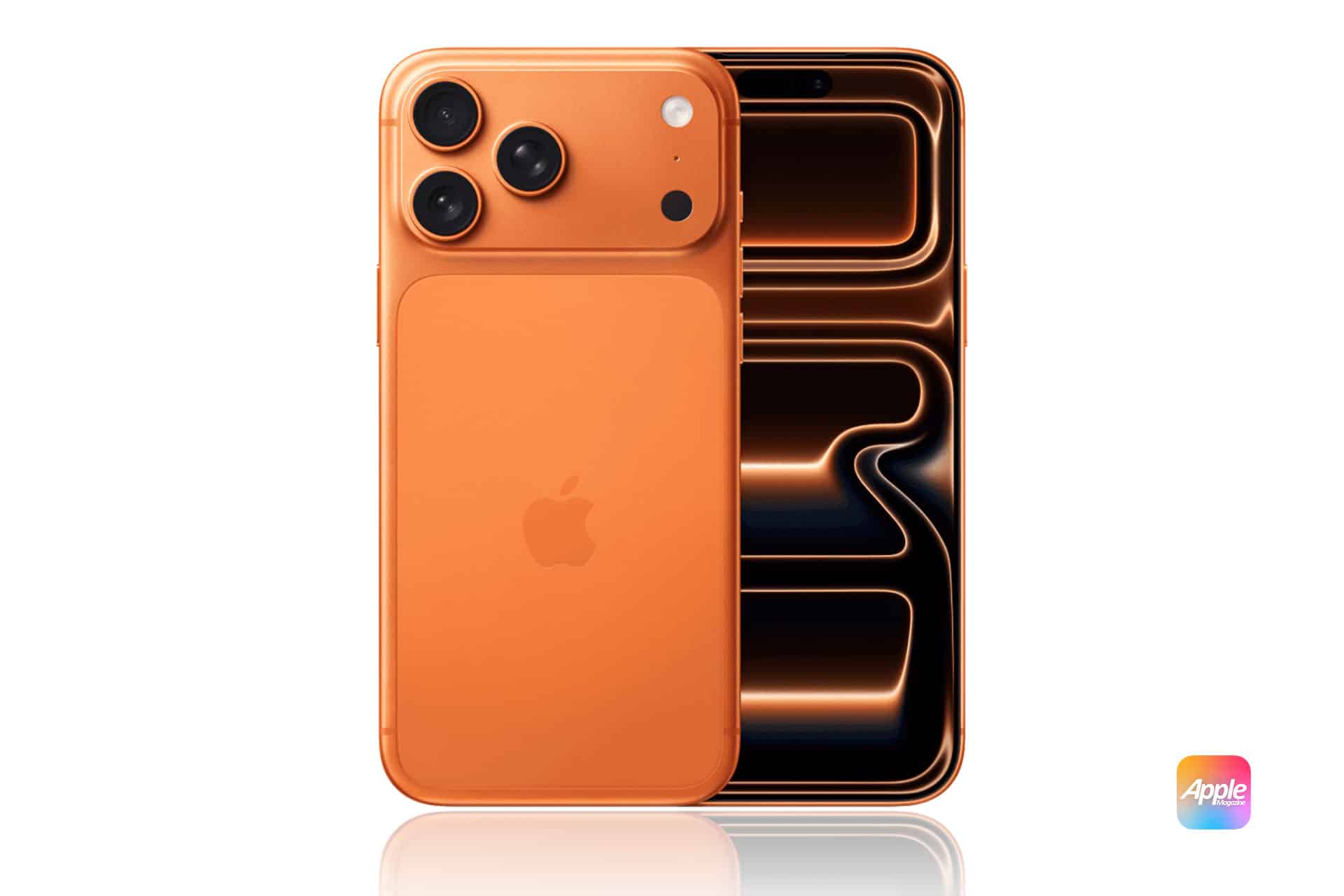
The iPhone Ultra price could establish an entirely new tier within Apple’s smartphone range. Current estimates place the company’s first foldable iPhone above $2,000, with some industry forecasts suggesting an average selling price near $2,500 and higher-storage configurations approaching $3,000.
Apple has not confirmed the device, its name, or its retail price. The iPhone Ultra branding also remains unofficial, although it has appeared repeatedly in reports concerning Apple’s planned expansion beyond the Pro and Pro Max levels.
The foldable is expected to join the iPhone 18 Pro family during Apple’s fall hardware cycle. Rather than replacing the iPhone Pro Max, it would sit above it as a separate model built around a book-style design and a display that expands to approximately the size of a small tablet.
A price beyond $2,000 would make it the most expensive iPhone Apple has released. The current iPhone 17 Pro Max starts at $1,199 in the United States, leaving a difference of at least $800 between Apple’s established flagship and the lowest estimates for the foldable.
Recent projections have pushed that gap even wider. Reports citing analyst Ming-Chi Kuo have discussed a possible range between $2,300 and $2,500, while an IDC estimate cited in supply-chain coverage placed the average selling price at approximately $2,500. Storage upgrades could take selected configurations closer to $3,000.
Apple has spent years arranging the iPhone range around a price ladder. Standard models serve the center of the market, while Air and Pro devices address different preferences involving weight, cameras, materials, performance, and display size.
A foldable iPhone would require another level. Its internal display, hinge, structural materials, battery arrangement, and manufacturing tolerances introduce costs that do not exist in a conventional iPhone.
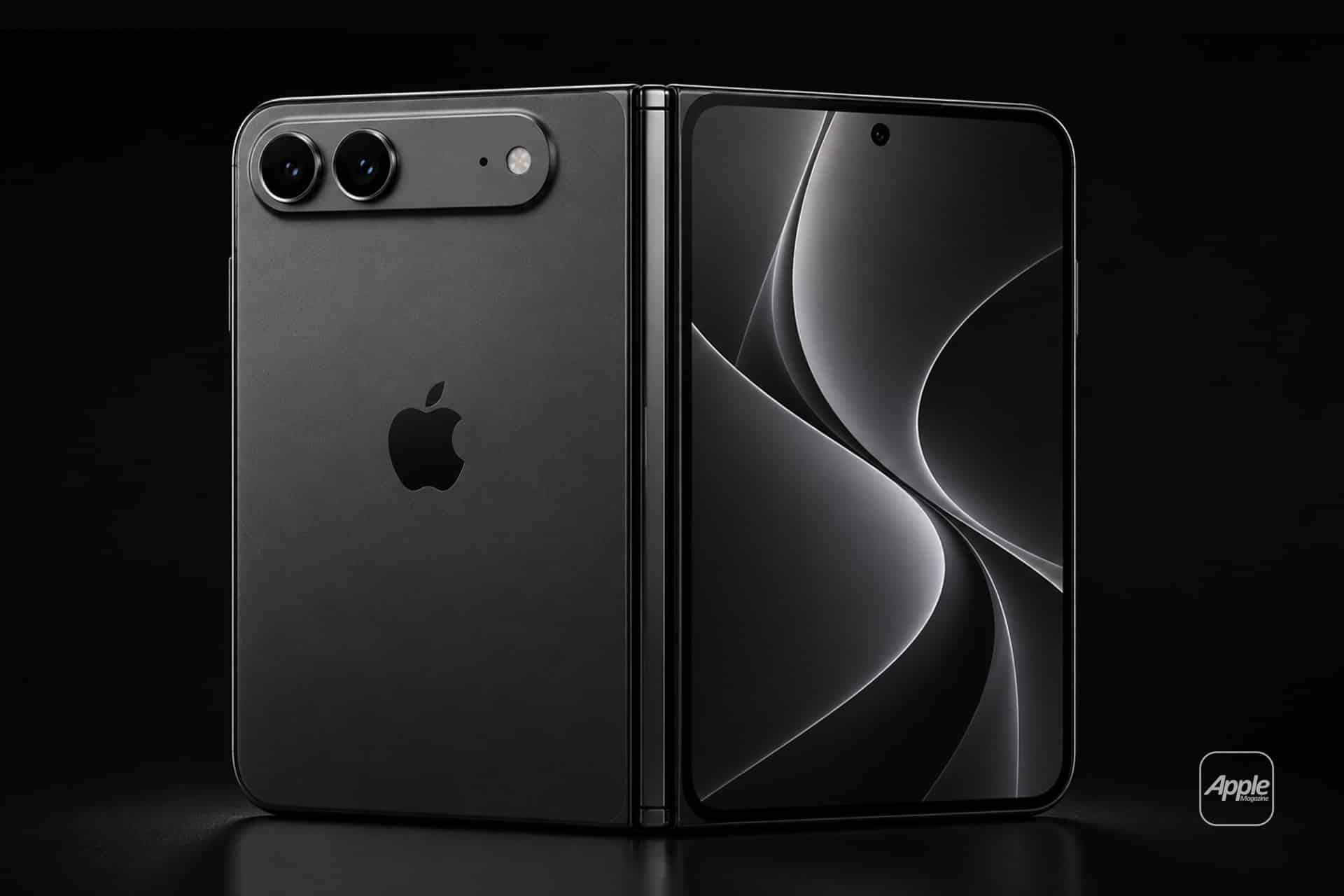
The rumored hardware points to a device intended to combine phone and tablet functions. Reports describe an outer screen measuring about 5.5 inches and an internal display of approximately 7.8 inches. When closed, the product would operate as a compact iPhone. Opening it would provide enough space for larger applications, side-by-side content, expanded video, and an iPad-style software interface.
Apple is reportedly developing interface changes that would let applications take greater advantage of the internal display instead of simply enlarging an iPhone layout. That software work may become one of the main distinctions between the device and existing foldables, particularly if Apple can connect it closely with iPad multitasking conventions.
The hinge is expected to use liquid metal, an amorphous alloy chosen for strength and resistance to deformation. Apple has also reportedly focused on reducing the visible display crease, one of the most recognizable compromises found on current folding phones.
Those elements help explain a premium price without guaranteeing that customers will accept it. A $2,000-plus phone would compete for spending that could otherwise purchase an iPhone and an iPad, a high-end Mac, or several years of conventional smartphone upgrades.
The device would therefore need to offer more than the novelty of a folding screen. Durability, battery life, camera performance, application behavior, repair costs, and long-term display reliability will influence whether buyers view the iPhone Ultra as a versatile computer or an unusually expensive phone.
Rumors suggest Apple may use Touch ID in the side button instead of Face ID. The change would not necessarily represent a retreat from facial authentication across the rest of the iPhone range. A foldable chassis has limited internal space, and eliminating the TrueDepth camera hardware could help Apple manage thickness around the outer and inner displays.
The reported design includes two rear cameras and front-facing cameras accessible in both folded and unfolded positions. That arrangement may leave the iPhone 18 Pro Max with the more extensive photography system, despite the foldable carrying a much higher price.
Such a decision would position the iPhone Ultra around form factor and productivity rather than making it the automatic leader in every specification. Apple has used similar distinctions elsewhere, allowing one product to command a premium for its design while another retains advantages in cameras, battery endurance, or sustained performance.
Display production is another source of expense. Folding OLED panels require flexible materials, protective layers, specialized hinges, and tighter assembly controls. Apple’s reported pursuit of a nearly crease-free screen may increase component costs and reduce early manufacturing yields.
The company is also entering the category after competitors have spent several generations addressing hinge failures, screen damage, dust protection, and application scaling. Arriving later gives Apple access to a more mature supply chain, but its design standards may create additional production challenges.
Industry estimates suggest Apple’s arrival could help raise the average selling price of book-style foldables throughout 2026. Competitors already sell premium folding phones, yet a model priced near $2,500 would push the category further away from mainstream flagship pricing.
Apple Upgrade could make the iPhone Ultra price appear less intimidating at checkout. The Klarna-backed program lets eligible US customers lease selected Apple devices through fixed monthly payments rather than covering the entire retail price upfront.
Current iPhones can be leased for 12 or 24 months. At the end of the term, customers may return the device, move into another eligible Apple product, or pay the remaining amount required to keep it.
That structure can produce lower monthly payments than traditional financing because the customer is not necessarily paying the entire purchase price during the lease. Part of the product’s value remains in the device at the end of the agreement.
A future iPhone Ultra could fit naturally into this model. Its high retail price and expected resale value would give Apple and Klarna room to separate the cost of using the phone for two years from the cost of owning it permanently.
No monthly figure has been announced for the foldable. Apple cannot price an Apple Upgrade lease until it establishes the phone’s retail cost, residual value, eligible term, and trade-in conditions. A simple calculation that divides $2,000 or $2,500 by 24 months would therefore be misleading.
The monthly charge may be considerably lower than a standard purchase installment, but the customer does not automatically own the iPhone after making the scheduled lease payments. Keeping it requires an additional payment based on the remaining value specified by the agreement.
AppleCare+ is also separate from the current Apple Upgrade lease price. That differs from the former iPhone Upgrade Program, which bundled AppleCare+ coverage into its monthly payments. Protection could be particularly relevant for an expensive first-generation foldable containing a flexible display and complex hinge.
Trade-in credit may reduce the monthly charge, while storage selection would push it higher. Sales tax, cellular service, accessories, and optional protection would remain additional costs. Apple Upgrade changes when and how customers pay, but it does not turn a $2,000-plus product into a lower-priced iPhone.
Apple is reportedly preparing millions of foldable units, but production may be heavily weighted toward the final months of 2026 and 2027. Supply-chain estimates have ranged from 7 million to 10 million devices, with different reports using different production periods and assumptions.
The foldable may be announced alongside the iPhone 18 Pro and iPhone 18 Pro Max but reach customers later. That would resemble the 2017 launch of the iPhone X, which was introduced with the iPhone 8 family in September and released in November.
A delayed retail date would give Apple more time to accumulate inventory while preserving the device’s place in its fall presentation. It could also place the iPhone Ultra into the holiday quarter with considerable demand concentrated around a relatively small supply.
High pricing does not necessarily prevent shortages during the first weeks of an Apple product launch. Early adopters, developers, collectors, and customers waiting specifically for an Apple foldable represent a smaller audience than the conventional iPhone market, but they may still outnumber the units available at release.
Apple Upgrade could add another source of demand by replacing the full retail figure with a monthly lease price inside the Apple Store. That presentation may make the phone accessible to customers who would reject a $2,500 purchase while accepting a recurring payment and returning the device later.
Kuo expects only 500,000 to 1 million foldable iPhones to ship during the third quarter, a supply level that could push some deliveries four to six weeks beyond the opening preorder window.
The post iPhone Ultra Price Could Take Apple’s Foldable Beyond $2,000 appeared first on AppleMagazine.
When the Federal Aviation Administration shut down air traffic to El Paso Airport earlier this year, nobody could have guessed than an experimental high-energy laser weapon was the cause. After days of chaos and speculation, it was revealed that Customs and Border Patrol officials had fired off a laser volley from a US Army base adjacent the El Paso Airport.
Though the trigger-happy Border Patrol grunts evidently thought they were firing at drug-smuggling drones, their real target turned out to be a kids’ party balloon. Regardless, it was later reported that the cutting-edge weapon was taken for a test-drive a week before FAA and Pentagon officials had a chance to discuss how to safely implement the laser device, making it a small miracle that nobody in the air was killed.
Not every use of an experimental aerospace weapon goes off without a hitch, however.
New bombshell reporting by Wired reveals an incident in which the testing of an experimental GPS jammer resulted in a medical plane crashing into the side of a mountain.
The horrifying incident happened in May, the publication reports, when a small twin-engine medevac aircraft carrying two pilots and two medical workers departed from Roswell, New Mexico. Heading West for the small mountain village of Ruidoso, the crew became the victim of an electronic warfare exercise being conducted at the nearby White Sands Missile Range, a test which rendered their navigational system inoperable.
Due to a combination of low visibility and an air-traffic control that was stretched far beyond capacity — at least three other planes reported navigation disruptions due to the GPS jamming — the pilots failed to register a mountainous formation between their plane and the landing strip.
As airline pilot and aviation crash analyst Juan Browne told Wired, the visual effect of that approach would have been stupefying. “When those lights go out, man, you know you are in big trouble,” Browne explained.
Unfortunately, the disoriented crew ran straight into the side of a mountain they likely never saw, resulting in the loss of every life on board. It’s the first known instance where military GPS jamming played a role in downing a civilian plane in US airspace. Reported incidents of GPS jamming within the continental US have skyrocketed in recent years. According to the Aircraft Owners and Pilots Association, the number of GPS interference events went from four in 2020 to 50 in 2024, and 40 across 2025.
After the initial publication of this piece, a spokesperson for the US Army provided a statement in response.
“The Army is aware of the release of the NTSB’s preliminary report into the crash of a civilian medical evacuation flight on May 14 in the vicinity of Ruidoso, New Mexico,” it read. “As the incident remains under investigation, we cannot comment at this time.”
Though the crew involved in the New Mexico crash was warned that GPS interference may be present, there evidently weren’t enough safeguards or air traffic control personnel in place to prevent a tragedy.
Updated with comment from the US Army.
More on military tech: The US Military Has Been Using Elon Musk’s Grok AI to Bomb Iran
The post It Appears That the US Military Accidentally Killed Everybody on Board a Civilian Medevac Flight in New Mexico appeared first on Futurism.