
❌

Reading view

A two-nanometer crystal stretch uncovers magnetism long hidden in ruthenium dioxide

For years, ruthenium dioxide (RuO₂) has kept physicists confused. Depending on which experiment they looked at, the metallic oxide either appeared magnetic or not magnetic at all. 

This uncertainty has made it difficult to determine whether RuO₂ belongs to an unusual new class of materials known as altermagnets, which could one day power faster and more energy-efficient electronics.

Now, in a new study, researchers have shown that the missing piece may not be the material itself—but how tightly it is stretched. By growing an ultrathin RuO₂ film just two nanometers thick and keeping its crystal lattice under strain, they detected clear signs of magnetic order that had remained hidden in thicker, relaxed samples. 

The findings suggest that magnetism in RuO₂ is not a fixed property but something scientists may be able to switch on simply by engineering the material’s atomic structure. “RuO2 has attracted renewed interest due to expectations of prominent altermagnetic spin splitting,” the researchers said.

The debate over an unusual magnetic material

RuO₂ is already widely used as an industrial catalyst and is valued for its excellent electrical conductivity. 

However, over the past few years, it has become the focus of an intense debate because some experiments suggested it might be an altermagnet—a recently proposed type of magnetic material that combines features of conventional magnets and nonmagnetic materials.

Unlike an ordinary bar magnet, an altermagnet has almost no overall magnetization even though its electrons remain magnetically ordered. Previous studies, however, produced conflicting results. 

Some reported magnetic order, unusual Hall effects, and efficient spin-charge conversion, while others found no evidence of magnetism in bulk crystals or relaxed thin films. A recent study even concluded that RuO₂ showed no altermagnetic behavior down to films 5 nanometers thick. 

However, no one had directly examined fully strained films thinner than about four nanometers using techniques capable of measuring both the motion and spin of electrons at the same time.

“The spin structure of RuO2 remains largely unexplored in the ultrathin limit,” the study authors note.

Stretching atoms to uncover hidden magnetism

To explore that missing regime, the researchers grew atomically smooth RuO₂ films only two nanometers thick on titanium dioxide-based substrates. Since the substrate’s atomic spacing differs slightly from that of RuO₂, the ultrathin film is forced to stretch to match it—a condition known as epitaxial strain.

You can think of it like laying a small wire mesh over a frame with slightly different spacing. The mesh has to stretch to fit, subtly changing the positions of every junction. In a crystal, those tiny shifts alter how electrons move and interact.

The team then used spin-resolved angle-resolved photoemission spectroscopy (spin-ARPES), which shines light on the material to eject electrons. By measuring each electron’s energy, momentum, and spin, scientists can map the material’s electronic structure in remarkable detail.

To ensure the results were genuine, they repeated the measurements in two different experimental geometries to separate real magnetic signals from possible measurement artifacts. Additional X-ray and optical experiments confirmed that the films remained fully strained and revealed their crystal symmetry.

Hidden magnetic signals emerge

The measurements uncovered an unusual momentum-dependent spin texture, meaning the direction of an electron’s spin changed systematically depending on how it moved through the crystal.

After performing a detailed symmetry analysis, the researchers ruled out nonmagnetic explanations, including effects caused by the crystal’s polar structure or by the measurement process itself.

As the study authors note, “A comprehensive symmetry analysis rules out nonmagnetic origins of this spin texture. These findings suggest an emergent nonrelativistic spin structure enabled by epitaxial strain in the ultrathin limit, marking a distinct departure from the behavior of relaxed or bulk RuO₂.”

The observed behavior was consistent with either weak ferromagnetism or altermagnetism, indicating that strain fundamentally changes the electronic ground state of RuO₂.

Strain as a new control knob

The findings suggest that strain could become a practical way to switch magnetic properties on in materials that normally do not display them, opening new possibilities for low-power spintronic devices based on electron spin instead of electric charge.

However, the experiments were carried out at around 15 kelvin (about −258°C), so it is still unknown whether the same behavior persists at room temperature. 

Future studies will need to determine exactly which magnetic state emerges and whether it can be reliably controlled in real-world devices.

The study is published in the journal Science Advances.
  •  

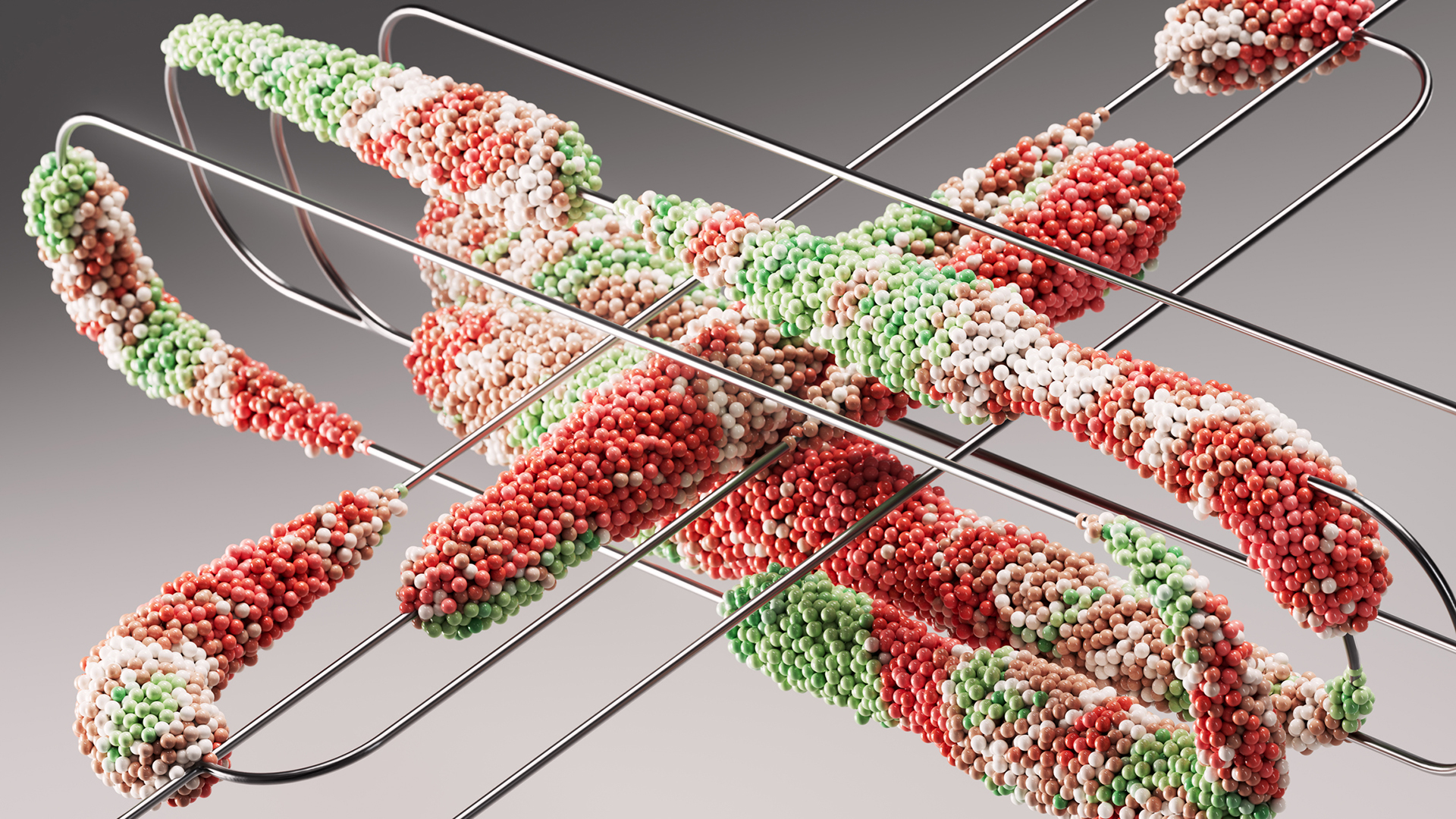
‘Dumbbell’ atomic pairs tackle decades-old ethanol chemistry problem for everyday products

From perfumes and synthetic flavorings to plastics and resins, acetaldehyde is a chemical used to make countless everyday products. 

However, producing it efficiently has remained a challenge because the catalysts that convert ethanol into acetaldehyde gradually lose activity, generate unwanted byproducts, or break down over time.

Now, researchers have developed a three-metal catalyst that tackles those long-standing problems in an unusual way. By pairing platinum and chromium atoms inside a silver matrix, they created tiny dumbbell structures known as heterometallic pair sites. 

These atomic pairs selectively remove only the hydrogen atoms needed to convert ethanol into acetaldehyde while suppressing the deactivation pathways seen in comparable platinum-silver and chromium-silver catalysts. 

“Our catalyst solves an important problem in chemistry because it completes a selective dehydrogenation: Instead of stripping away all of the hydrogen atoms, it removes just the ones necessary,” Anatoly Frenkel, one of the study authors and a chemist at Stony Brook University, said.

Moreover, since the process starts with ethanol that can be produced from biomass such as crop residues, forestry waste, and food waste, it could also provide a more sustainable alternative to conventional petrochemical production.

Breaking the limits of conventional catalysts

Catalysts speed up chemical reactions without being consumed, but making one that is both fast and selective is difficult. In ethanol dehydrogenation, conventional catalysts often keep reacting after removing the required hydrogen atoms, triggering unwanted reactions. 

Over time, they can also become coated with carbon deposits, known as coking, or undergo structural changes that reduce their performance.

To overcome these problems, the researchers turned to quantum mechanical calculations, which predicted that platinum and chromium atoms would naturally pair up when dispersed inside silver. 

“Prior quantum chemical calculations and surface science experiments by our collaborators showed that platinum-chromium pairs form preferentially in silver and exhibit electronic structures distinct from isolated platinum and chromium sites, enabling unique surface chemistry,” Jason Weaver, one of the study authors and a chemist at the University of Florida, said.

The team then fabricated thin films of the alloys to test whether these predicted atomic pairs actually formed.

Building the atomic picture

The researchers combined several advanced techniques to examine the catalyst from the inside out. At Brookhaven National Laboratory’s National Synchrotron Light Source II, X-ray absorption fine structure (XAFS) measurements confirmed that platinum and chromium atoms had indeed paired together throughout the silver host.

The catalyst’s surface was then analyzed at Sweden’s MAX IV synchrotron using surface-sensitive XAFS and ambient-pressure X-ray photoelectron spectroscopy (AP-XPS), which allowed scientists to observe the catalyst while it was actively converting ethanol. 

These measurements showed that only catalysts containing platinum-chromium pairs efficiently produced acetaldehyde. 

Additional scanning transmission electron microscopy (STEM) mapped the distribution of platinum and chromium atoms inside the silver matrix, providing further evidence that the unusual atomic arrangement was responsible for the catalyst’s behavior.

“Combining this with the local bonding information from surface-sensitive XAFS gives a really complete picture of the state of the catalyst and how this affects its performance,” Lindsay Merte, one of the study authors and an associate professor of physics at Malmö University, said. 

Tiny atomic pairs, major gains

Catalytic tests showed that the trimetallic platinum-chromium-silver catalyst became active at around 200°C and steadily increased its activity up to 350°C, where it selectively converted ethanol into acetaldehyde and hydrogen, with mass spectrometry identifying these as the dominant gaseous products.

In contrast, platinum-silver catalysts accumulated carbon deposits that blocked active sites, while chromium-silver catalysts became less effective because of oxidation. 

The platinum-chromium pairs greatly suppressed both of these deactivation pathways, allowing the catalyst to remain active for longer. 

The researchers also found that these heterometallic pair sites stayed stable even at relatively high active-metal loadings, addressing a common limitation of many atomically dispersed catalysts.

Previous studies had suggested that carefully designed pairs of different metals could outperform isolated single atoms, but this work provides experimental evidence that such heterometallic pair sites can operate under realistic reaction conditions.

A new strategy for catalyst design

The study offers a new blueprint for catalyst design. Instead of searching for entirely new materials, scientists may be able to create longer-lasting, more selective catalysts simply by arranging familiar metals in new atomic partnerships—a strategy that could benefit not only ethanol dehydrogenation but many other industrial chemical reactions as well.

However, the catalyst has so far been demonstrated only as a model thin-film system, so additional work will be needed before it can be adapted for industrial reactors. 

The researchers’ next goal is to translate the same atomic design into high-surface-area nanoparticles, which are better suited for large-scale chemical manufacturing.

The study is published in the journal Angewandte Chemie.

  •  
❌