❌

Reading view

China’s 40,000-ton amphibious assault ship showcases battle power in live-fire tests
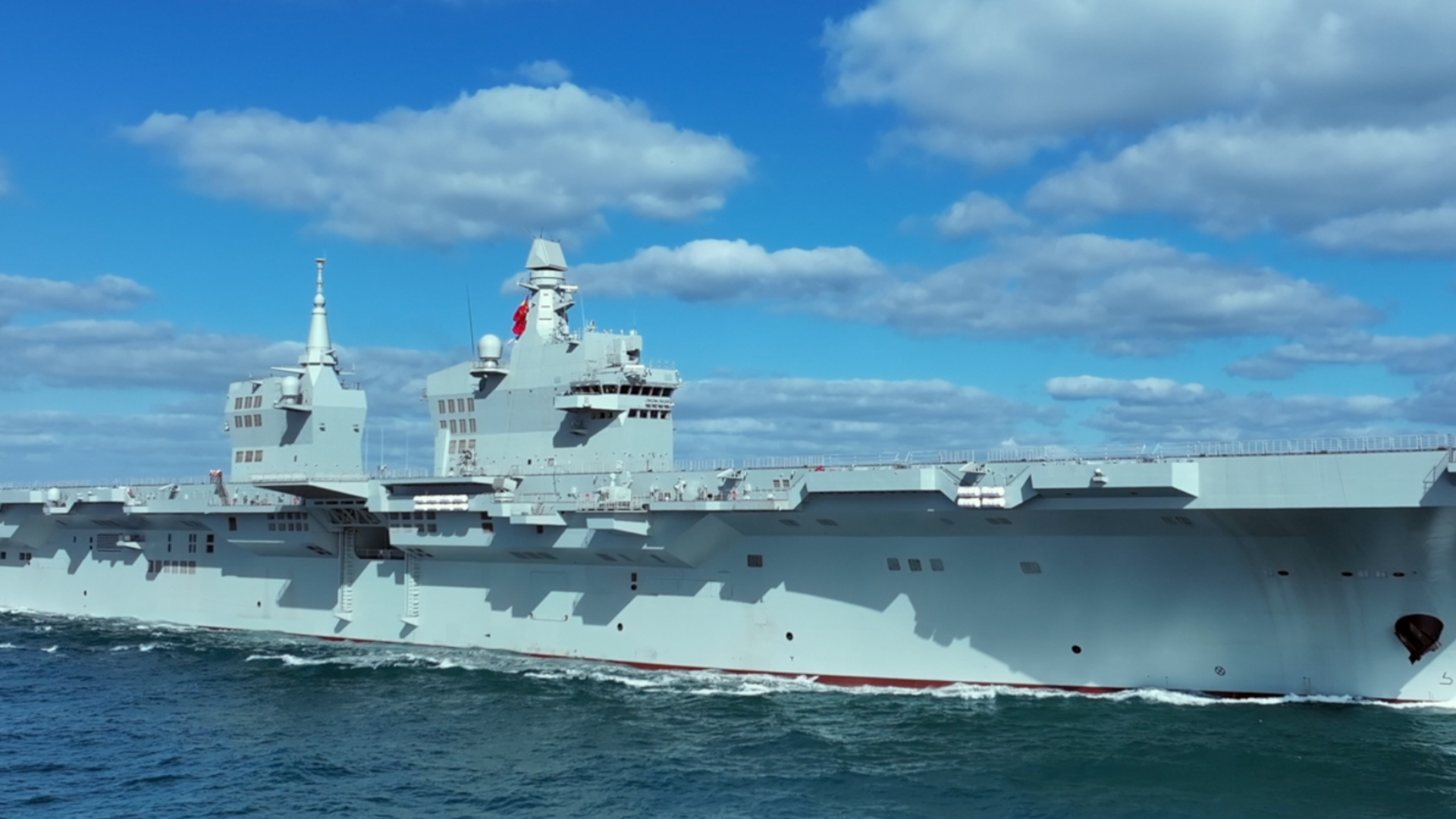
China has released new footage highlighting tests aboard its Type 076 amphibious assault ship Sichuan, including the vessel’s first publicly disclosed live-fire launch of countermeasures and an electromagnetic catapult test using a dead load.

The Sichuan features a new propulsion system and an electromagnetic catapult designed to support future unmanned operations at sea, marking a step toward expanding China’s naval aviation capabilities beyond traditional carrier-based platforms.Β 

Military observers noted that the dead load test represents an early-stage evaluation carried out before full aircraft launch trials, helping validate the performance and reliability of the electromagnetic launch system.

Operational readiness with electromagnetic catapult trial

The successful completion of the electromagnetic catapult test during the construction phase of the Type 076 amphibious assault ship suggests that the system has reached an operational and reliable stage, according to military observers.Β 

The vessel has already completed multiple sea trials, fueling expectations that it could soon enter service. Observers also anticipate the future release of footage showing the ship conducting launches of actual carrier-based aircraft, which would provide further insight into its capabilities, Global Times reported.

Chinese military affairs expert Song Zhongping said the Type 076 amphibious assault ship marks a significant technological advance, introducing new possibilities for naval operations. Speaking to the Global Times on Saturday, he noted that the vessel addresses the challenge of deploying carrier-based aircraft from amphibious assault ships while also driving innovation in future maritime operational concepts.

The Type 076 combines technologies developed for China’s Type 075 amphibious assault ship and Type 003 aircraft carrier, bringing together existing systems to create a more advanced naval platform. According to Song, the integration of these technologies improvaes the ship’s overall capabilities and demonstrates China’s progress in electromagnetic catapult systems and related technologies.

Enabling longer-range drone missions with heavier payloads

The electromagnetic catapult system aboard the Type 076 is expected to expand the range of aircraft the ship can deploy, supporting both manned fighter jets and larger unmanned aircraft. According to Song, the technology could allow drones to operate with heavier payloads and greater endurance, enabling them to carry additional equipment or weapons for longer-range missions.

Launched in December 2024, the Sichuan began its first sea trials in November 2025, according to Xinhua News Agency. The vessel has a full-load displacement of more than 40,000 tons and features a twin-island superstructure, a full-length flight deck, and newly integrated electromagnetic catapult and arrestor systems.

These technologies are designed to improve aircraft launch and recovery capabilities while expanding the operational flexibility of the ship. Furthermore, the vessel is designed as a multi-role naval platform capable of supporting a range of operations, including the deployment of fixed-wing aircraft, helicopters, and amphibious equipment.Β 

Chinese media note that the ship has successfully completed multiple rounds of sea trials, allowing engineers and naval crews to evaluate its systems, performance, and operational readiness ahead of its expected commissioning.

πŸ’Ύ

China’s Type 076 amphibious assault ship Sichuan has been shown testing its defensive countermeasures and electromagnetic catapult system.
  •  

Over 99.99% of oil removed from seawater with higher evaporation rate using new membrane

Growing populations and expanding industries are intensifying freshwater shortages across parts of Africa, the Middle East, and Southeast Asia, increasing the need for sustainable water supplies. Solar desalination has emerged as a promising solution, using sunlight to convert seawater into freshwater with relatively low energy requirements.

But real-world conditions pose a challenge. Seawater near ports, shipping routes, and industrial areas is often contaminated with oil, which can clog desalination membranes and reduce their performance.Β 

Although many experimental solar desalination systems have shown strong results in laboratory tests using clean saltwater, it remains uncertain how effectively they would operate in polluted seawater.

New membrane design aims to make solar desalination more practical

In an effort to overcome this limitation, researchers at Pusan National University developed a multifunctional hydrogel membrane that combines oil separation and solar-driven desalination in a single system.Β 

Led by Professor Sanghyun Jeong from the Department of Civil and Environmental Engineering, the team designed a membrane architecture that simultaneously removes oil contaminants while producing freshwater, eliminating the need for separate treatment stages. The study was published online on June 1, 2026, and will appear in the October 15, 2026, issue of Desalination.

Inspired by the need for selective water treatment, the researchers developed a membrane with a β€œJanus” architecture, giving each side a distinct function. One surface is hydrophilic, made from a chitosan and polyvinyl alcohol hydrogel, allowing water to pass through while blocking oil droplets.Β 

The opposite surface is hydrophobic and incorporates copper oxide nanoparticles coated with a carbon shell, which are embedded within a nanofiber layer. This dual-sided design enables the membrane to handle different contaminants while supporting more efficient desalination and oil separation.

Higher oil removal and faster solar water evaporation

By separating the membrane’s functions across different layers, the researchers prevented oil separation and solar heat generation from interfering with each other, a common challenge in single-layer designs. The hydrophobic side absorbs sunlight, converts it into heat, and drives water evaporation at the membrane surface.

Testing showed that the membrane removed more than 99.99% of oil from contaminated seawater while maintaining stable performance across different oil droplet sizes and repeated cycles. During solar desalination experiments, it achieved a water evaporation rate of about 0.05 gallons per square foot per hour, nearly three times higher than conventional single-layer membranes.

According to Prof. Jeong, the new membrane technology could support more sustainable water treatment by harnessing renewable solar energy while combining contaminant removal and freshwater production in a single platform. The integrated approach has the potential to reduce energy consumption, simplify operations, and minimize secondary waste generation compared with conventional desalination methods.

The researchers suggest that the membrane developed in this study represents a broader strategy for designing next-generation water treatment technologies. By integrating multiple treatment functions into a single membrane architecture, the approach could provide a framework for creating more efficient and adaptable systems beyond desalination applications.

πŸ’Ύ

Researchers have developed a multifunctional membrane that combines oil-water separation and solar desalination in a single architecture.
  •  
❌