
 Login

There’s No Place Like Home, Snoopy Arrives on Apple TV
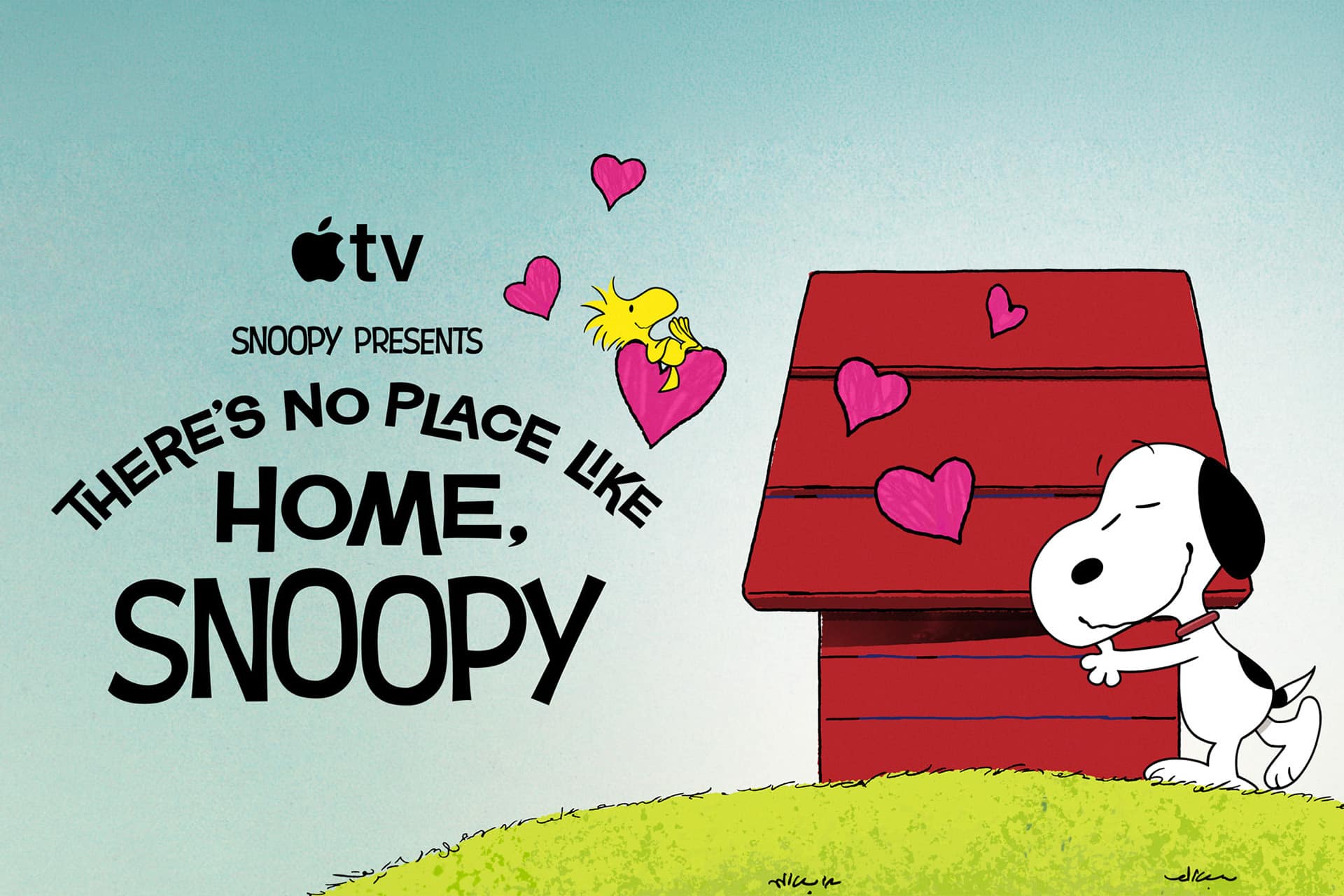
There’s No Place Like Home, Snoopy is now available globally on Apple TV, beginning a new Peanuts adventure with the accidental sale of one of the comic strip’s most recognizable objects.
The 31-minute animated special follows Snoopy after his doghouse disappears during a yard sale. Charlie Brown attempts to help his devastated friend by organizing a search, but recovering the missing home becomes more difficult once it has left the neighborhood.
The story uses Snoopy’s doghouse as more than a familiar red prop. It is the place where he sleeps, stores his possessions and begins the imaginary adventures that transform him into a World War I flying ace, author and explorer.
Losing it removes the physical center of that private world. Charlie Brown and Snoopy must determine whether home depends on recovering the exact building or remaining close to the people and memories connected to it.
The Apple Original is rated TV-G and includes Dolby Atmos audio in supported languages and configurations. An Apple TV subscription is required, with availability extending across the Apple TV app and the service’s supported devices.
There’s No Place Like Home, Snoopy Begins at a Yard Sale
The central problem begins with an ordinary neighborhood event rather than one of Snoopy’s elaborate fantasies.
His doghouse is mistakenly treated as an item that can be sold. By the time Charlie Brown and the others understand what happened, Snoopy has lost the one place he regards as entirely his own.
The premise creates a recognizable childhood fear. A treasured object can appear unimportant to another person while carrying memories and emotional meaning for its owner.
Snoopy cannot explain that attachment through conventional dialogue. His reactions, imagination and physical comedy must communicate why the loss feels larger than a missing piece of outdoor furniture.
Charlie Brown responds by doing something he rarely manages for himself: taking charge with enough confidence to help someone else. His search gives the special momentum while preserving the uneven friendship at the center of many Peanuts stories.
Snoopy frequently ignores Charlie Brown, takes his meals for granted and escapes into fantasies. Charlie Brown continues caring for him even when the beagle’s behavior makes that affection difficult to return.
The missing doghouse reverses their normal relationship. Snoopy needs practical help, while Charlie Brown becomes the person capable of guiding him through the disappointment.
Why Snoopy’s Doghouse Matters
Charles M. Schulz turned Snoopy’s doghouse into one of the most flexible locations in the Peanuts comic strip.
From the outside, it is a simple red structure with a black entrance. Snoopy rarely sleeps inside it, preferring to rest on the pointed roof despite the physical impossibility of remaining balanced there.
The interior follows no ordinary rules. Comic storylines have suggested that it contains a pool table, television, library, guest rooms, paintings and other possessions that could not fit within its exterior dimensions.
Schulz generally avoided showing the complete interior. That decision allowed the doghouse to expand according to Snoopy’s imagination without requiring one definitive layout.
The roof also becomes the Sopwith Camel flown by the World War I flying ace. A few changes in posture and sound can transform a suburban backyard into an aerial battle with the Red Baron.
For Snoopy, the building is simultaneously a bedroom, stage, aircraft, writing desk and portal into imaginary lives. Selling it removes the starting point for nearly every identity he creates.
There’s No Place Like Home, Snoopy can therefore explore loss without introducing a permanent tragedy into the Peanuts world. The doghouse is physically replaceable, but Snoopy’s attachment to the original makes the search emotionally credible.

Charlie Brown Voices Lead the New Special
Riley Vargas voices Charlie Brown, while Terry McGurrin returns as Snoopy. McGurrin has become closely associated with the modern animated version of the character through Apple’s Peanuts programming.
Rob Tinkler voices Woodstock, the small yellow bird who frequently joins Snoopy’s adventures. Although Woodstock’s speech appears as rapid bird sounds, Snoopy understands him, allowing the pair to communicate without conventional dialogue.
Grace Nicolaou-Wood voices Sally, and Jo-Hannah Atchison performs Lucy. Kitai O’Garro plays Franklin, Josephine Nisbett voices Marcie and Lexi Perri voices Peppermint Patty.
Athan Giazitzidis appears as Linus, while Diego Whalen voices Rerun. Noah Paisley plays Milo.
The larger ensemble gives Charlie Brown access to the neighborhood network needed for a search without shifting the story away from Snoopy. Each character can respond differently to the problem according to an established personality.
Lucy may approach the situation with certainty, Linus with reflection and Sally with her own interpretation of what occurred. Woodstock has the closest connection to Snoopy’s private world and understands what the doghouse represents without requiring an explanation.
There’s No Place Like Home, Snoopy Behind the Scenes
Ridd Sorensen directed There’s No Place Like Home, Snoopy, with Rob Boutilier serving as series director. Rob Hoegee wrote the special.
Executive producers include Josh Scherba, Stephanie Betts, Logan McPherson, Paige Braddock, Chris Bracco and Mark Evestaff.
The production continues Apple’s collaboration with WildBrain, Peanuts Worldwide and Lee Mendelson Film Productions. Those organizations combine modern animation production with the characters and creative legacy established by Schulz.
The special was produced in Canada and is available with extensive dubbing and subtitle support.
Apple lists audio options spanning languages including:
- Arabic
- Cantonese
- Danish
- Dutch
- French
- German
- Hindi
- Italian
- Japanese
- Korean
- Mandarin
- Portuguese
- Spanish
- Thai
- Turkish
- Vietnamese
Audio descriptions are included across many of those language options. English playback supports Dolby Atmos and Dolby 5.1 on compatible equipment.
The wide localization reflects the international reach Peanuts developed long before streaming. Schulz’s comic strip appeared in more than 2,600 newspapers and reached readers across 75 countries.
Apple can now release one new animated story simultaneously across more than 100 countries and regions without waiting for separate broadcast schedules.
An Original Song Gives the Story Its Emotional Center
There’s No Place Like Home, Snoopy includes the original song “Home, Where Your Heart Found Me” by singer-songwriter Allen Stone.
Music has always occupied an important place in animated Peanuts productions. Vince Guaraldi’s jazz compositions became inseparable from the classic television specials, creating a musical identity that later productions must acknowledge without simply reproducing the same material.
An original song allows the new story to develop its own emotional language around home and attachment. It can express ideas that Snoopy cannot communicate verbally while avoiding the need for Charlie Brown to explain the complete meaning of the adventure.
The title connects home with an emotional discovery rather than an address or possession. That idea supports the special’s central distinction between the missing doghouse and the relationships Snoopy still has around him.
Apple previously expanded the musical side of its Peanuts catalog through Snoopy Presents: A Summer Musical, the first Peanuts musical special in decades. The addition of Allen Stone continues that willingness to use original songs rather than treating music only as background.
How to Watch There’s No Place Like Home, Snoopy
The special is available through the Apple TV app on iPhone, iPad, Mac, Apple TV 4K and Apple Vision Pro.
It can also be watched on supported smart televisions from manufacturers including Samsung, LG, Sony, Vizio and TCL. Roku, Amazon Fire TV, Google TV, PlayStation and Xbox devices provide additional access.
Web playback is available through tv.apple.com after signing in with an Apple Account carrying an active subscription.
Apple TV currently costs $12.99 per month in the United States and includes a seven-day trial for eligible new subscribers. Customers activating a qualifying new iPhone, iPad, Mac or Apple TV 4K may receive three free months, subject to Apple’s promotional conditions.
There’s No Place Like Home, Snoopy is presented as one complete special rather than an episodic series. Its 31-minute running time makes it closer to the length of traditional Peanuts television programs than a feature film.
Parents can locate it within the Kids & Family area of Apple TV. Its TV-G classification indicates that it is designed for a general audience, although rating systems and descriptions can vary by country.
Apple Builds a Permanent Peanuts Library
Apple has served as the principal streaming home for Peanuts since 2020, combining classic holiday programs with new specials, series and documentaries.
The agreement has sometimes received attention because programs such as A Charlie Brown Christmas, A Charlie Brown Thanksgiving and It’s the Great Pumpkin, Charlie Brown spent decades appearing on broadcast television.
Apple has provided limited free streaming windows for major holiday titles, allowing people without a subscription to continue watching selected specials during their associated seasons.
The wider library includes The Snoopy Show, Snoopy in Space and Camp Snoopy. Original Snoopy Presents specials have focused on characters and subjects that received less attention in the earliest television productions.
One-of-a-Kind Marcie centered on Marcie’s quiet approach to leadership. Welcome Home, Franklin expanded Franklin’s introduction to the neighborhood, while Lucy’s School explored the group’s anxiety about change.
Apple also carries the documentaries Who Are You, Charlie Brown? and Peanuts in Space: Secrets of Apollo 10.
The service added This Is America, Charlie Brown and The Charlie Brown and Snoopy Show during July 2026, bringing more material from the 1980s into the same streaming catalog as the latest production.
Snoopy’s Next Search Heads to the Big City
Apple’s Peanuts partnership extends through 2030, giving WildBrain and Peanuts Worldwide several more years to create original series and specials for the service.
The most ambitious announced project is Snoopy Unleashed, an animated feature film currently in production.
That story will reverse the situation presented in There’s No Place Like Home, Snoopy. Instead of Charlie Brown searching for the doghouse, the Peanuts gang will search for Snoopy after he runs away to the Big City.
The larger setting will move Snoopy beyond the familiar neighborhood and require Charlie Brown, Lucy, Linus and the others to navigate an environment rarely explored in the comic strip.
Apple plans to release Snoopy Unleashed in 2027. Until then, Snoopy’s missing doghouse provides a smaller journey built around the same question the film will approach from another direction: what remains of home when the person or place associated with it disappears?
The post There’s No Place Like Home, Snoopy Arrives on Apple TV appeared first on AppleMagazine.


