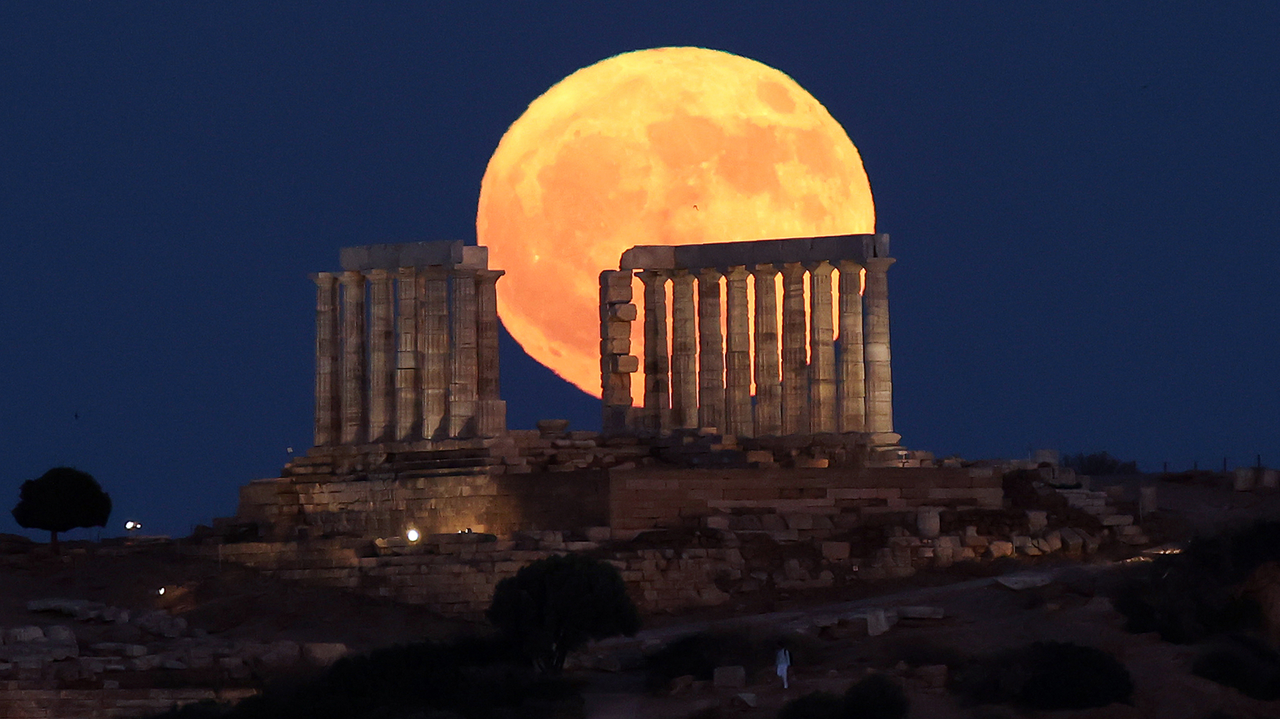
July’s full Buck Moon, the second full moon of summer in the Northern Hemisphere, will turn full on Wednesday (July 29). It will be the final full moon before a flurry of solar and lunar activity — notably, a total solar eclipse caused by the new moon on August 12, and a partial lunar eclipse during the following full moon on August 28.
Named for the new antlers that emerge from male deer during summer, July’s full moon is also known as the Thunder Moon and Hay Moon, according to Time and Date. The Anishinaabeg people call it Miin Giizis, or Berry Moon, according to the Center for Native American Studies.
The Buck Moon will be at its fullest at 10:37 a.m. EDT on Wednesday — however, it will also look bright and full on Tuesday and Thursday night. From North America, the best time to see it will be at moonrise in the southeast during dusk on Wednesday evening. The exact time of moonrise will depend on your location. A full moon looks most dramatic as it first appears above the eastern horizon shortly after sunset, with Rayleigh scattering making it loom orange — the same light-scattering phenomenon that makes the sky blue and sunsets red.
July's full moon is one of the lowest full moons of the year as seen from the Northern Hemisphere because it occurs relatively soon after the June solstice. A full moon always sits opposite the sun, so the path of July's full moon mirrors the sun's path in February.
Two weeks after theBuck Moon, the new moon will slide directly between Earth and the sun, causing a total solar eclipse. Observers along a narrow path of totality in eastern Greenland, western Iceland and northern Spain will see the moon block the sun for a few minutes, revealing the solar corona.
A deep partial solar eclipse will be visible across Europe, with a small partial solar eclipse observed over Canada and the northeastern U.S.. The largest eclipse in Canada will be 93% in northeastern Nunavut, while northeastern Maine in the U.S. will see 29% of the sun covered by the moon. Solar eclipse glasses must be worn at all times to safely view the partial phases.
The next full moon, the Sturgeon Moon, will rise on August 27 and be partially eclipsed by Earth overnight. More than 96% of the moon will pass into Earth's shadow as seen from Europe, Africa, North America and South America.
How much do you know about the moon? Test your lunar smarts with our moon quiz!
In a string of a dozen small galaxies hung in the sky like a row of cosmic fairy lights, astronomers have discovered a small, ghostly galaxy without any dark matter. The rare discovery offers additional evidence that violent galactic collisions can knock this invisible substance loose from visible matter.
Dark matter acts like cosmic glue, accumulating in "halos" in which galaxies form. It makes up about 85% of all the matter in the cosmos, meaning all the stars and other celestial objects we see account for a small fraction of the universe's mass. And as astronomer Vera Rubin observed, despite its invisible nature, dark matter seems essential to explain the apparent movement of stars around their galactic centers.
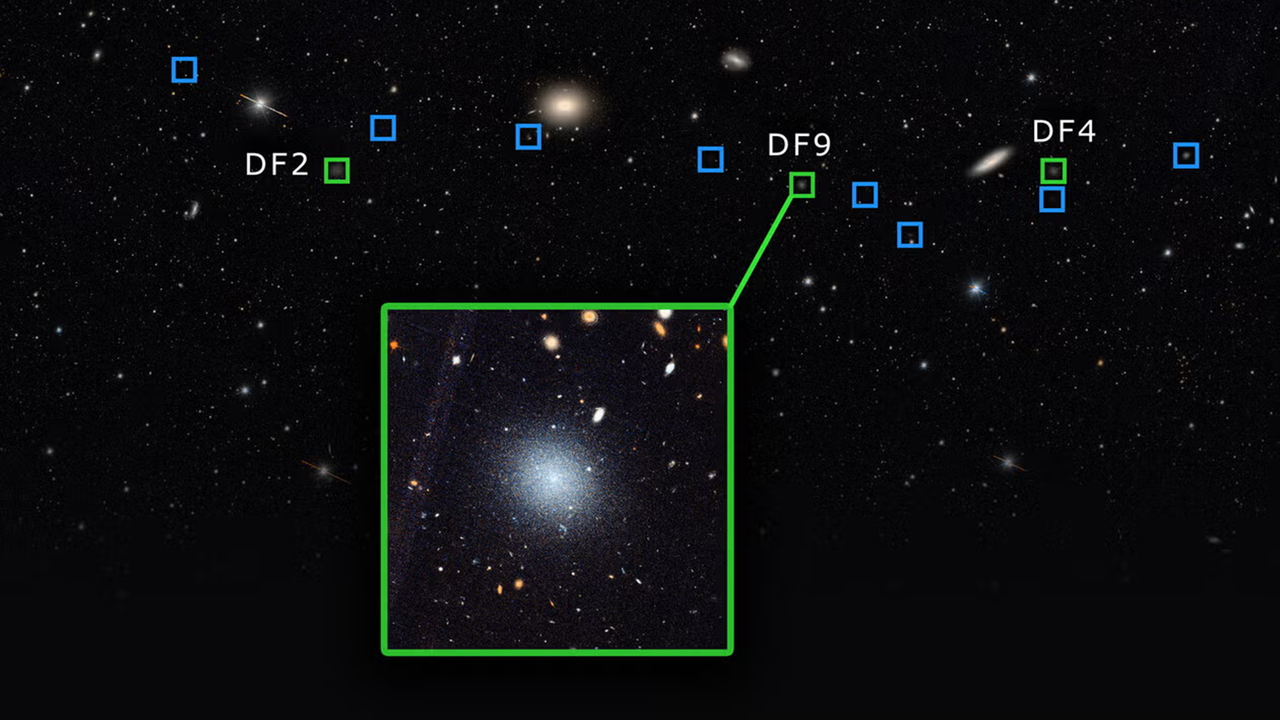
Yet in a study published June 16 in The Astrophysical Journal, astronomers report that a dwarf galaxy called DF9 may be devoid of dark matter, joining a couple of other apparently dark-matter-devoid dwarfs (DF2 and DF4) previously discovered in the same string of tiny, faint galaxies.
"The most surprising aspect is that this finding indicates that an entire trail of galaxies including DF2, DF4, and DF9 formed together in an extreme event producing galaxies not alike any we've ever seen before — the first of its kind," Michael Keim, an astrophysicist at Yale's Graduate School of Arts and Sciences and the study's first author, told Live Science via email. "As a result, they have a ghostly appearance, bright clusters of stars, and a lack of dark matter."
Following a trail of galactic crumbs
To study DF9, the researchers used the Keck Cosmic Web Imager at the W. M. Keck Observatory atop the dormant Mauna Kea volcano in Hawaii. The dwarf galaxy is situated within a long trail of a dozen similarly small, diffuse galaxies in the NGC 1052 field, nearly 70 light-years from Earth.
To calculate the mass of DF9, the researchers measured the motion of its stars by analyzing changes in their wavelengths. The analysis revealed that DF9 has a measly mass of approximately 100 million suns, which is consistent with its visible mass in stars. If it contained the expected amount of dark matter, it would be exponentially heavier, harboring a mass of more than 10 billion suns, the researchers said in a statement.
As revealed over the past decade, at least two of DF9’s nearby galactic siblings also appear to lack dark matter.
A video showing the galactic collision that resulted in this string of dwarf galaxies. (Image credit: Video courtesy of W. M Keck Observatory / Adam Makarenko)
"If DF2, DF4, and DF9 were the only galaxies known, one would not conclude there is any need for dark matter," the researchers wrote in the paper. These three galaxies do not display a mass-based discrepancy based on their visible and invisible matter; their mass, determined by the gravitational motion of their stars, matches their mass as measured by the light emitted from these same stars.
But this is hardly typical among most observed galaxies, especially the tiniest ones. Counterintuitively, low-mass dwarf galaxies such as these often have the highest fraction of dark matter. Because they are not as massive, they have lower escape velocities, allowing supernovas and other "feedback mechanisms," like intense black hole winds, to eject their gas more easily. This mass expulsion typically results in dark matter halos around galaxies that are 100 times more massive than all of a dwarf galaxy's stars, the researchers said.
Dark matter deficiency is linked to a violent past
The team likened this lineup of dwarf galaxies to a miniature version of the Bullet Cluster, located nearly 4 billion light-years from Earth. The collision of two galaxy clusters that created the Bullet Cluster is considered the most energetic event known since the Big Bang, astronomers say, and the massive mashup is responsible for separating the system's gas from its dark matter.
The Bullet Cluster seen by the Chandra Telescope (Image credit: (X-ray: NASA/CXC/CfA/M.Markevitch et al.; Optical: NASA/STScI; Magellan/U.Arizona/D.Clowe et al.; Lensing Map: NASA/STScI; ESO WFI; Magellan/U.Arizona/D.Clowe et al.))
Violent galaxy mergers are widespread in space, suggesting such galaxies without dark matter also may be more common throughout the cosmos than once thought.
"The Bullet Dwarf event in which DF9 is thought to have formed is named after the famous Bullet Cluster wherein the gas of two entire clusters of galaxies was separated out in a similar manner as this 'Bullet Dwarf' collision, so indeed this can occur at much larger scales," Keim explained via email. "But collisions between giant clusters are far less frequent than collisions of individual galaxies."
Yet being able to glimpse DF9 and its linearly laid-out counterparts still required an element of fortune. "High-speed collisions are, nevertheless, somewhat rare," Keim added. "DF9 is 67 million light years away from Earth; based on cosmological simulations, we would expect just 7 or so similar collisions to have occurred within that distance."
Additionally, celestial bodies are always in flux, so finding galaxies devoid of dark matter is difficult for other reasons. For example, they may exist in dense regions, where they are harder to view through the obscuring dust, gas and starlight surrounding them. Or, they may merge with other galaxies that do have dark matter.
The strange separation between dark matter and visible matter in the galaxies of the NGC 1052 field warrants further study, the researchers said. Finding any leftover gas from the collision would provide the "smoking gun" evidence for the collisional origin of this faint string of galaxies.
The astronomers are conducting follow-ups with other observatories, including the new MOTHRA facility, the "world's largest all-lens telescope," which is under construction in Chile. With an array of 1,140 telephoto lenses, "its line mapping sensitivity on large scales — like that of the trail — will be at least an order of magnitude deeper than any other facility," Keim added.
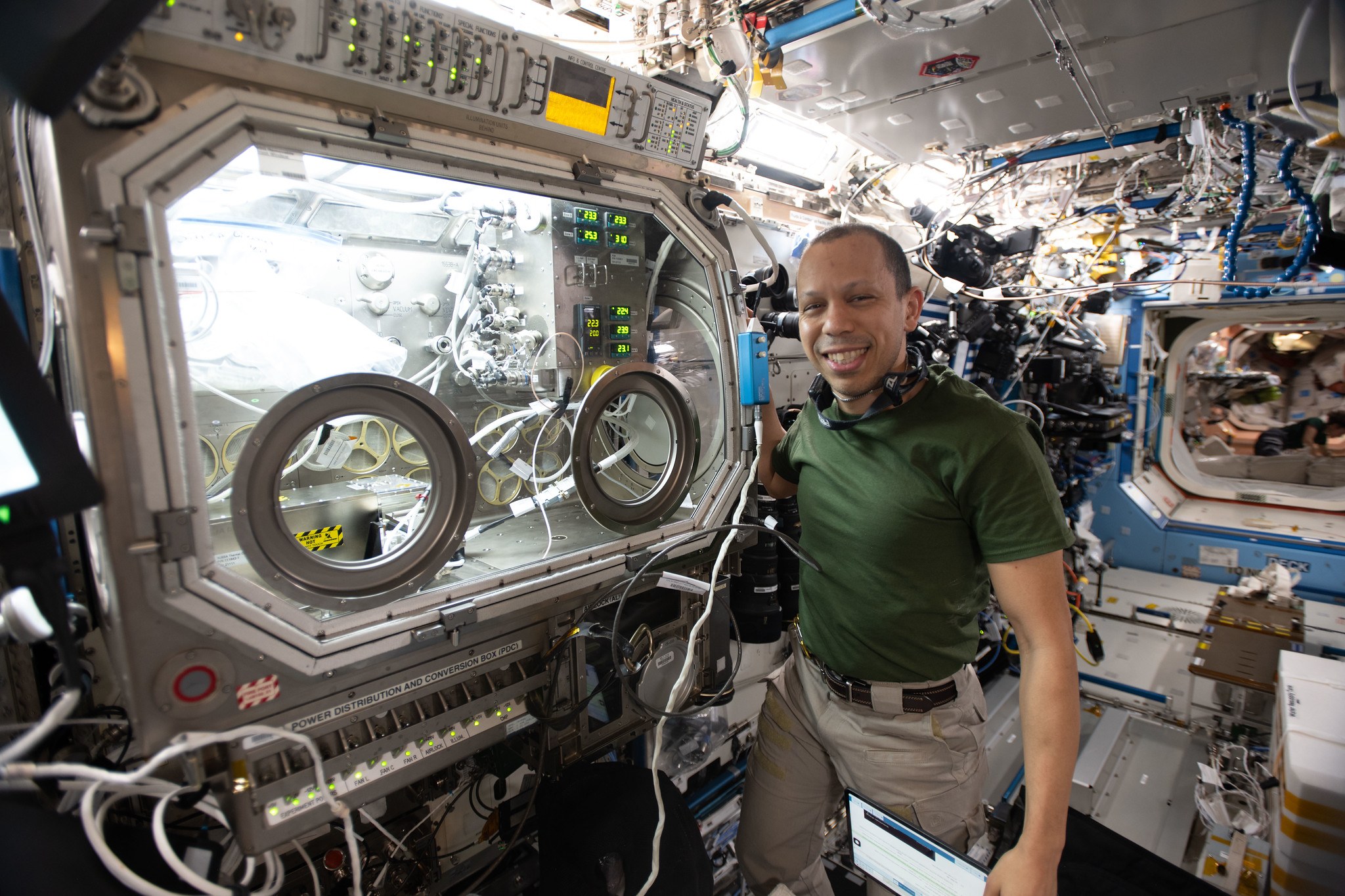
NASA astronaut and Expedition 74 flight engineer Chris Williams shows off the Destiny laboratory module’s Microgravity Science Glovebox aboard the International Space Station. Williams was supporting semiconductor crystal research to help advance the commercial space economy and promote Earth-based industries.
NASA/Chris Williams
NASA astronaut Chris Williams will recap his recent eight-month mission aboard the International Space Station during a news conference at 2:45 p.m. EDT Tuesday, Aug. 4, from the agency’s Johnson Space Center in Houston.
NASA will stream this event live through a variety of platforms. Learn where to watch online:
United States-based media interested in attending in person must contact the NASA Johnson newsroom no later than 5 p.m., Friday, July 31, at jsccommu@mail.nasa.gov.
Media wishing to participate by phone must contact the Johnson newsroom no later than two hours before the start of the event. To ask a question by phone, media must dial into the news conference no later than 15 minutes prior to the start of the call. NASA’s media accreditation policy is available online.
Williams returned to Earth on July 26, after logging 241 days as an Expedition 73/74 flight engineer during his first spaceflight. He returned along with Roscosmos cosmonauts Sergey Kud-Sverchkov and Sergei Mikaev, completing 3,856 orbits of the Earth over the course of their more than 102-million-mile journey. They also saw the arrival of six visiting spacecraft and the departure of eight.
During his mission, Williams supported a wide range of scientific investigations and technology demonstrations. He helped advance research for new cancer treatments and improved in-space manufacturing of materials used in high-performance computers and electronics. Williams also completed two spacewalks to prep for space station power system upgrades and to replace a faulty joint on the Canadarm2 robotic arm. The crew’s work aboard the space station helps improve life on Earth and prepare for future human missions to the Moon and Mars.
To learn more about International Space Station research, operations, and its crews, visit:
NASA astronaut Jessica Meir works inside the International Space Station’s Quest airlock in March, her reflection visible in a spacesuit helmet visor as she installs leg and arm components and swaps parts between suits.
Credit: NASA/Jack Hathaway
Editor’s note: This media advisory was updated July 27, 2026 to reflect an updated start time for the spacewalk on Thursday, Aug. 6.
NASA will provide coverage as astronauts venture outside the International Space Station during three spacewalks in August to continue upgrading solar arrays, replace a communications antenna, and connect power and data cables in support of space station operations.
Experts will preview the upcoming spacewalks during a news conference at 2 p.m. EDT, Thursday, July 30, from NASA’s Johnson Space Center in Houston.
NASA will stream these events through a variety of platforms. Learn where to watch online:
Bill Spetch, deputy manager of Commercial, Low Earth Orbit Program
Chris Dobbins, spacewalk flight director
Chloe Mehring, spacewalk flight director
United States-based media interested in attending in person must contact the Johnson newsroom no later than 3 p.m., Wednesday, July 29, at jsccommu@mail.nasa.gov. Media joining by phone should request dial-in details by the same deadline. To ask a question, media must dial in no later than 15 minutes before the start of the news conference.
Thursday, Aug. 6
NASA astronauts Jessica Meir and Anil Menon will exit the Quest airlock to install hardware that will modify the station’s 3B power channel and prepare it for the future installation of an International Space Station Roll-Out Solar Array (IROSA). The solar array, scheduled for delivery later this year, will be the seventh IROSA and will provide additional power to support critical station operations, including its safe and controlled deorbit.
Watch NASA’s live coverage of U.S. spacewalk 96 beginning at 7 a.m. The spacewalk is expected to start at 8:35 a.m. and last about six and a half hours.
This spacewalk will be the sixth for Meir and the first for Menon. Meir will serve as spacewalk crew member 1 and will wear a suit with red stripes. Menon will serve as crew member 2 and will wear an unmarked suit.
Thursday, Aug. 13
During U.S. spacewalk 97, two astronauts will replace a Space-to-Ground antenna on the orbital complex. The antenna is a critical communication system NASA uses to transmit data and high‑speed communication between the Mission Control Center in Houston and the space station.
Tuesday, Aug. 25
The U.S. spacewalk 98 crew members will connect power channel cables and data relay systems as part of ongoing maintenance, including preparations for the space station’s future deorbit. The astronauts also will replace a navigational aid used for spacecraft docking on the Harmony module’s forward port.
NASA will share additional details about U.S. spacewalks 97 and 98, including timing, assigned crew members, and coverage information, closer to each operation.
The spacewalks will be the 281st, 282nd, and 283rd conducted in support of space station assembly, maintenance, and upgrades.
To learn more about International Space Station research, operations, and its crews, visit:
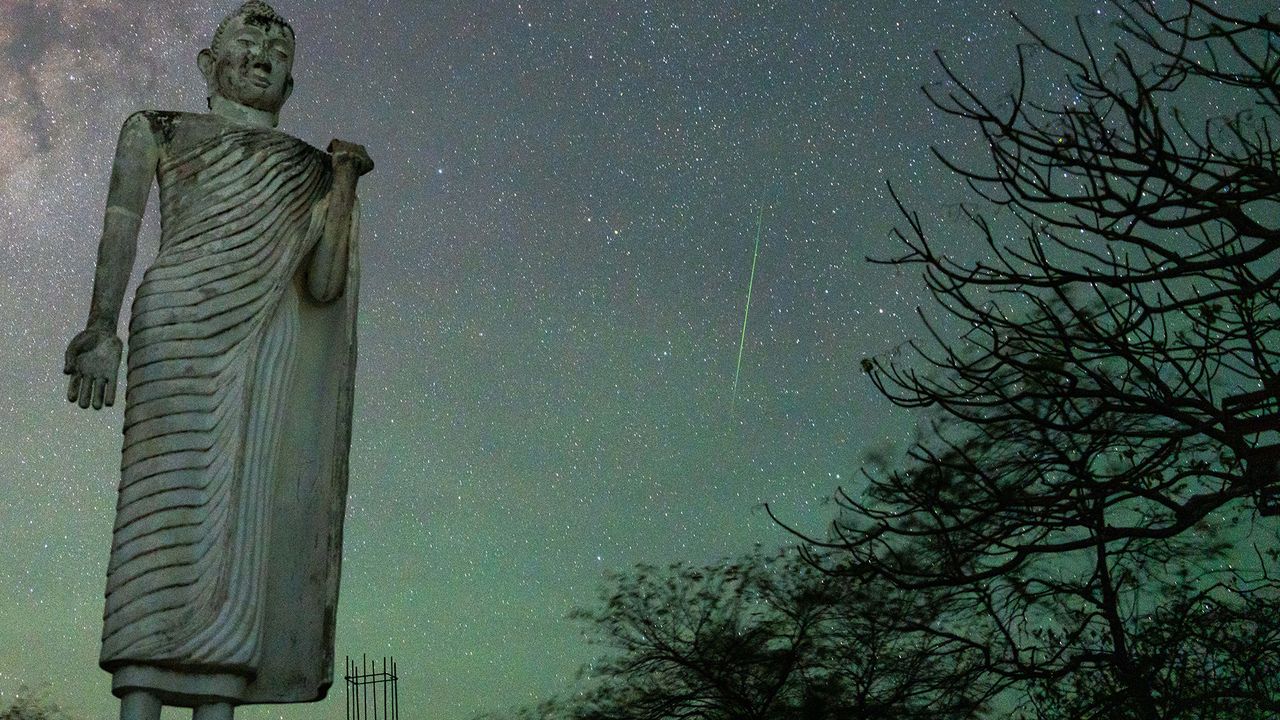
Two meteor showers will peak together overnight on Thursday, July 30, into Friday, July 31 — but skywatchers should expect a moonlit challenge rather than a dazzling display.
Both the Southern Delta Aquariids and the Alpha Capricornids reach maximum activity just one night after July's full Buck Moon, which turns full on Wednesday, July 29. According to the American Meteor Society, the moon will still be 98% full during the peaks of those meteor showers, meaning bright moonlight will wash out many of the fainter "shooting stars."
This year, the Southern Delta Aquariids are active from July 12 to Aug. 23 and peak on the night of July 30-31. The meteor shower can result in about 25 shooting stars under ideal dark skies, but the full moon makes this year's timing far from perfect. The Alpha Capricornids, which are active from July 3 to Aug. 15 this year, offer around five meteors per hour on the same peak night. That's not many, but the Alpha Capricornid meteor shower is known for bright fireballs — space rocks that shine brightly, and sometimes colorfully, as they catch fire during the plunge through Earth’s atmosphere.
From North America, the moon will appear bright for much of the night around the meteor showers' peak. A nearly full moon does not stop meteors from occurring, but it brightens the sky enough to hide the faintest streaks. That's particularly important for the Southern Delta Aquariids, which can be faint and typically lack fireballs, according to the American Meteor Society. Even still, the overlapping showers make a great night for practicing your meteor shower photography or for taking pictures of the moon.
The best time to try watching will be between midnight and dawn, when the radiant — the point from which the meteors seem to emanate — of the Southern Delta Aquariids, the constellation Aquarius, is highest in the southern sky. Observers in the southern U.S., Mexico and the Caribbean will be better placed than those farther north because Aquarius climbs higher at lower latitudes.
For the best chance of seeing some shooting stars, keep the moon behind you or blocked by a building, tree or hill, and look toward the darkest part of the sky. Meteor showers are always best viewed with the naked eye.
If you're clouded out — or mooned out — during the July meteor peaks, don't worry, as you'll get a better opportunity in August. The Perseid meteor shower will peak overnight on Aug. 12-13, just after the Aug. 12 new moon, when skies will be moonless for the meteor shower's peak rate of 100 meteors per hour.
That same new moon will also cause a total solar eclipse to be visible along a narrow path through eastern Greenland, western Iceland and northern Spain. A partial solar eclipse will be seen from parts of Canada and the northeastern U.S. (Remember to protect your eyes with proper solar eclipse glasses at all times during the partial phases.)
The combination of a solar eclipse and the peak of a major meteor shower will make Aug. 12-13 potentially one of the most exciting days of the year for skywatchers.
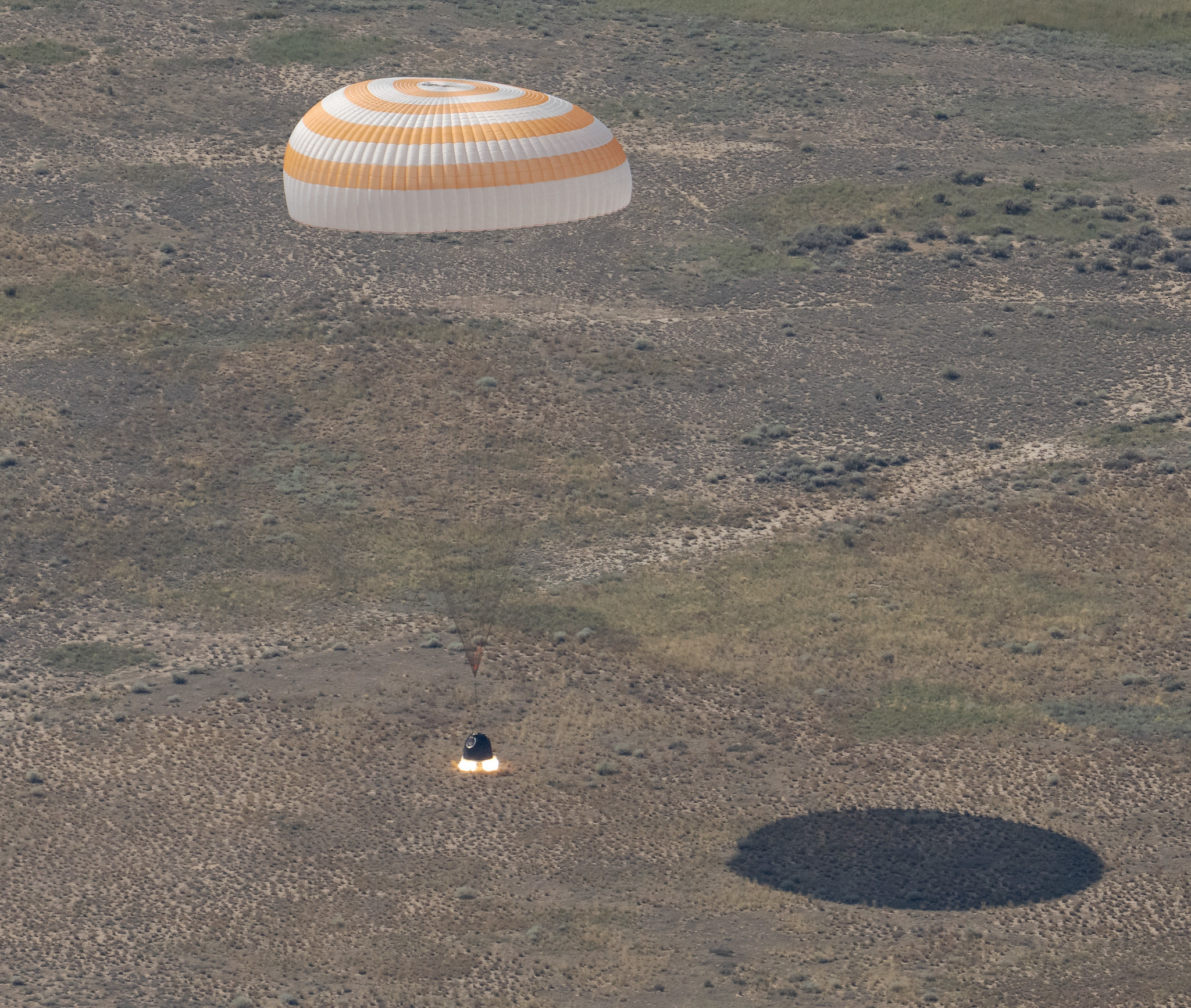
The Soyuz MS-28 spacecraft is seen as it lands in a remote area near the town of Zhezkazgan, Kazakhstan with Expedition 74 NASA astronaut Chris Williams, and Roscosmos cosmonauts Sergey Kud-Sverchkov, and Sergei Mikaev aboard, Sunday, July 26, 2026.
NASA/Bill Ingalls
Concluding an eight-month science mission aboard the International Space Station, NASA astronaut Chris Williams returned to Earth on Sunday alongside Roscosmos cosmonauts Sergey Kud-Sverchkov and Sergei Mikaev.
The crew made its safe, parachute-assisted landing at 5:27 a.m. CDT (3:27 p.m., Kazakhstan time), southeast of Dzhezkazgan, after departing the space station at 2:03 a.m., aboard the Soyuz MS-28 spacecraft.
The crew was in space for 241 days, orbiting the Earth 3,856 times and traveling more than 102 million miles. They launched to the International Space Station on Nov. 27, 2025. The mission was the first for Williams and Mikaev and the second for Kud-Sverchkov.
While aboard the orbiting laboratory, Williams supported a wide range of scientific investigations and technology demonstrations. He helped advance research for new cancer treatments and improved in-space manufacturing of materials used in high-performance computers and electronics. Williams also completed two spacewalks to prep for space station power system upgrades and to replace a faulty joint on the Canadarm2 robotic arm. The crew’s work aboard the space station helps improve life on Earth and prepare for future human missions to the Moon and Mars.
Following post-landing medical checks, the crew members will fly by helicopter to Karaganda, Kazakhstan, where recovery teams are based. Williams then will board a NASA aircraft bound for the agency’s Johnson Space Center in Houston.
For more than 25 years, people have lived and worked continuously aboard the International Space Station, advancing scientific knowledge and making research breakthroughs not possible on Earth. The space station helps NASA understand and overcome the challenges of human spaceflight, expand commercial opportunities in low Earth orbit, and build on the foundation for long-duration missions to the Moon, as part of the Artemis program, and to Mars.
To learn more about International Space Station research, operations, and its crews, visit:
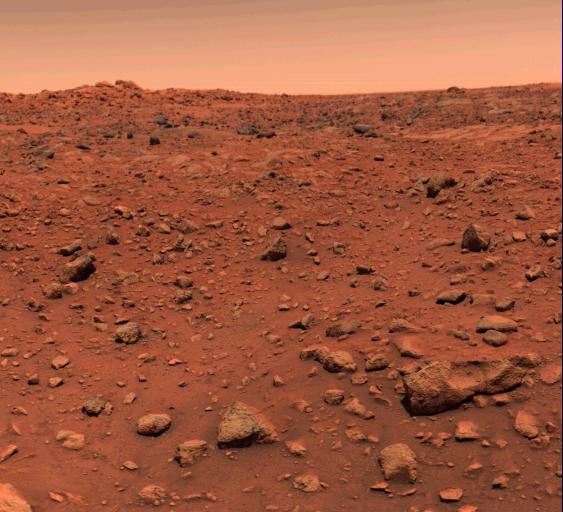
About 40 minutes after it landed on Mars on July 20, 1976, NASA's Viking 1 lander sent this first photo from the surface of the Red Planet. (Image credit: NASA/JPL)
Quick facts
What it is: The surface of Mars
Where it is: 189 million miles (305 million kilometers) from Earth
When it was shared: July 20, 2026.
For thousands of years, humans looked at Mars and wondered what lay on its surface. Fifty years ago this week, we finally found out when NASA's Viking 1 became the first spacecraft ever to land on the Red Planet and transmit images from its surface. It was humanity's first view from the surface of another planet.
Viking 1 had been programmed to take its first image just 25 seconds after touchdown, according to NASA. It occurred at 7:53 a.m. EDT on July 20, 1976 — exactly seven years after Apollo 11 landed on the moon. It was supposed to coincide with the U.S. Bicentennial on July 4, 1976, but the landing was delayed by the search for a flat landing zone.
Although the spacecraft landed safely at Chryse Planitia, north of the equator, mission controllers still had to wait another 19 minutes for the radio signal confirming success to cross the 212 million miles (340 km) between Mars and Earth.
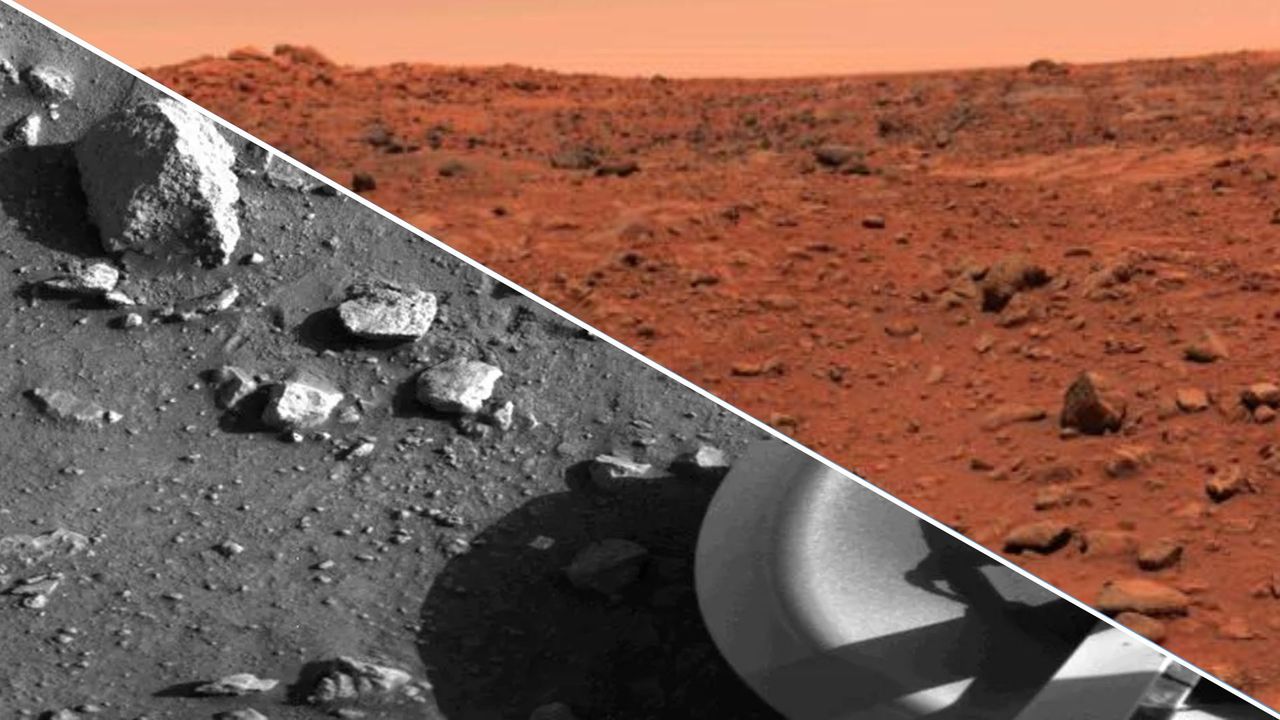
Forty minutes after touchdown, the confirming image began appearing on monitors at NASA's Jet Propulsion Laboratory, slowly building line by line from left to right. Dr. Thomas Mutch, leader of the Viking lander imaging team, never forgot the moment.
"I studied the black screen, waiting for that narrow strip that will signal the first few lines of the first picture," he said. "Rocks and sand are visible and — finally at the far right — one of the spacecraft foot pads, a symbolic artifact that stamps our accomplishment with the sign of reality … Time and time again I repeat, 'It's incredible.'"
The image revealed a solid, slightly rocky surface, with dust and pebbles thrown up by the landing already settling back onto the spacecraft. Viking’s first color image came the next day, with a panorama following a few days later.
The first color image taken by the Viking I Lander in 1976. (Image credit: NASA)
The Viking mission consisted of four spacecraft: two orbiters and two landers. Viking 1 was joined six weeks later on the surface by Viking 2, which landed in Utopia Planitia, also in the northern hemisphere. Meanwhile, the two orbiters mapped Mars and relayed data — including more than 52,000 orbital images and 4,500 photographs from the surface — back to Earth.
Viking transformed our understanding of Mars, but its most intriguing scientific result remains unresolved. The landers carried the first experiments designed to detect life directly in Martian soil. Although the mission's official conclusion was that no convincing evidence of life had been found, some scientists have continued to argue that one of the experiments produced a genuine biological signal; others argue that Viking’s experiments destroyed the very evidence of life that they sought to prove. Discoveries by later missions — including organic molecules detected by Curiosity and perchlorate salts found by Phoenix — have prompted some researchers to revisit the Viking data.
Viking 1 fell silent in 1982, two years after Viking 2, following a software error during an update. The intrepid spacecraft showed us the surface of another planet for the first time, but whether Viking 1 also found the first hints of life off-Earth remains one of planetary science's most enduring mysteries.
What do you know about the Red Planet? Test your knowledge with our Mars quiz!

 Login