❌

Reading view

A 1952 Pan Am plane crash transformed passenger safety procedures – a former airline pilot explains how

On Good Friday, April 11 1952, a Pan American Douglas DC-4 named Clipper Endeavor took off from San Juan in Puerto Rico, bound for New York. On board were 64 passengers including six infants, plus five crew.

The flight lasted less than nine minutes before two engines lost power. Unable to make it back to the airport, the captain ditched the plane in the Atlantic Ocean, roughly 11 miles northwest of San Juan’s Isla Grande Airport.

Remarkably, all 69 people on board survived the impact. What killed 52 of them was what happened afterwards.

The airframe broke apart and began to sink, and in the ensuing chaos, many passengers refused the captain’s order to get out, remaining buckled into their seats. Investigators recorded drowning as the cause for almost all of the deaths.

The pilot told air crash investigators that he had forced some of the passengers into the water. However, the language barrier between the crew and the mostly Puerto Rican passengers had made communication harder – as did their reported fear of sharks in the water.

For 74 years, the wreckage remained hidden under 2,000 feet of water off Puerto Rico’s coast – until an uncrewed underwater vehicle owned by marine survey company Deep Sea Vision located it in June 2026.

Video: WBD US Nets Press.

As a former commercial airline pilot, the story of this tragedy holds particular interest for me – in particular, the enormous impact it had on how airline safety procedures are still done today. According to Josh Gates, a Discovery Channel presenter who was part of the search team: “It is an accident that fundamentally reshaped aviation as we know it.”

The critical 90 seconds

The US Civil Aeronautics Board’s investigation found that Clipper Endeavor should probably never have taken off. One engine that later failed had shown abnormal fuel readings and metal fragments in its oil the day before.

But the report placed greater weight on what happened after the ditching. There had been no requirement for passengers to be briefed on the plane’s emergency exits, nor to be shown how to use a life vest before a flight over water.

In short, nothing had prepared 64 people for the critical 90 seconds they had to escape the plane before it sank.

As a result of these findings, regulators soon required airlines to keep life vests and rafts accessible to passengers rather than locked away, and to give passengers on extended overwater flights a verbal briefing on life vests, emergency exits and rafts – including demonstrating how to put on a life vest.

The aim was to make sure passengers had already walked through the actions in their minds before panic could override them. A 2018 review of aviation safety research highlighted that many historical air accidents would have resulted in significantly higher survival rates, had every passenger involved read the safety card or watched the crew’s demonstration beforehand.

One apparent example of the importance of passenger safety briefings occurred in January 2009, when Captain Chesley “Sully” Sullenberger ditched US Airways flight 1549 into New York’s Hudson River after a bird strike disabled both engines. All 155 people aboard survived.

However, the official investigation into the incident told a more complicated story than the “Miracle on the Hudson” headlines suggested. About 70% of passengers had not watched any part of the pre-flight briefing, and only around ten had retrieved a life vest themselves.

The evacuation was nonetheless orderly, which investigators credited to the flight crew’s professionalism, the flotation equipment the aircraft was carrying, and ferries reaching survivors within about seven minutes. Clipper Endeavor’s passengers faced almost the same situation decades earlier, with none of that preparation and no one reaching them in time.

Video: Smithsonian Channel.

Not every incident since the 1952 Pan Am tragedy has ended so fortuitously. Knowing the safety drill is one thing – following it under real pressure is another.

When a hijacked Ethiopian Airlines jet ditched in the Indian Ocean in 1996, killing 125 of the 175 people aboard, the official investigation found that passengers in the economy cabin had inflated their life vests before the aircraft went down.

Crew members had to quickly deflate them and re-brief passengers on the brace position under extraordinary stress. Their instructions were found to have only been given in English, so investigators concluded that some passengers probably hadn’t understood them.

Passenger compliance in an emergency

During my ten years flying Airbus A320s and A330s as a commercial pilot, giving the safety briefing was never my job. That role falls to cabin crew whose professionalism rarely gets the credit it deserves.

The seatbelt sign was mine, though. My voice was the one on the PA reminding passengers to stay buckled in whenever seated – another critical piece of safety advice for as long as the plane is in the air, which Clipper Endeavor’s passengers never received. (If you are not convinced of the seatbelt sign’s importance, read this interview with the passenger who was nearly sucked out of a Ryanair flight recently.)

After each flight, pilots and crew have a debrief that may include discussion of passenger behaviour, particularly if something went wrong during boarding or an emergency. The recurring complaint among cabin crew was about what passengers do the moment an emergency actually starts: reaching for hand luggage instead of leaving it behind.

When an Aeroflot Sukhoi Superjet caught fire after a hard landing in Moscow in 2019, investigators found that passengers retrieving bags from the overhead lockers had probably slowed the evacuation of the burning cabin, contributing to the deaths of 41 people.

A separate study of real emergency evacuations found that half of those involved admitted to attempting to grab a carry-on bag on their way out, making it the most commonly reported obstruction to a fast evacuation.

A 2014 study by aviation safety scientist Brett Molesworth showed that passengers’ recall of safety messages was better if they watched more entertaining demonstrations that used humour or celebrities.

As a result, some airlines now make safety videos both entertaining and informative – such as British Airways dressing more than 40 staff in period costumes for a Regency-style safety film, and Qatar Airways using the American comedian and actor Kevin Hart.

But recall and compliance during a terrifying emergency, when passengers are prone to panic, are two different problems. This is the gap the air travel industry is still striving to solve.

The Conversation

Marco Chan does not work for, consult, own shares in or receive funding from any company or organisation that would benefit from this article, and has disclosed no relevant affiliations beyond their academic appointment.

  •  

Nasa’s new space telescope will tackle some of the universe’s biggest mysteries

The Nancy Grace Roman telescope could help answer some of the biggest cosmic questions. Nasa

Nasa is about to launch a space observatory that could help settle some of the biggest mysteries in modern astronomy. The Nancy Grace Roman space telescope will study how the universe began, what it is made of and how it has evolved over time.

The observatory is named after Nasa’s first chief of astronomy and its first female executive. Nancy Grace Roman, who died in 2018 aged 93, made important contributions to our understanding of stars and played a crucial role in shaping Nasa’s space-based astronomy programme.

The telescope is undergoing final preparations ahead of a launch set to take place from Florida’s Kennedy Space Center in late August. It is eight months ahead of its original schedule, and under budget – a rare feat for a Nasa flagship mission.

Unlike the James Webb space telescope, which is designed to look at individual objects in extraordinary detail, Roman is built to survey the sky at scale. It will take in vast areas of the cosmos, allowing astronomers to build up a much broader picture of the universe and how it changes.

Roman has an unusual history. It began life as a “spare” spy satellite, donated to Nasa by the US government agency responsible for gathering intelligence from space.

Roman carries two main instruments, added by Nasa. These are the wide field instrument and the coronagraph. The wide field instrument will detect infrared light coming from the universe. Infrared light has wavelengths that are slightly longer than those of visible light. This allows the instrument to see through cosmic dust and look deeper into the cosmos.

Nancy Grace Roman, Nasa's first chief of astronomy, pictured at the agency's Goddard Space Flight Center in Greenbelt, Maryland, around 1972.
Nancy Grace Roman, Nasa’s first chief of astronomy, pictured at the agency’s Goddard Space Flight Center in Greenbelt, Maryland, around 1972. Nasa/Esa, CC BY

Its field of view – how much sky it sees when pointed in a given direction – is about 100 times that of the Hubble space telescope’s infrared camera, but with similar sharpness. The wide field instrument’s capabilities also mean it can survey the cosmos about 1,000 times faster than Hubble. Observations that would take Hubble centuries could be completed by Roman in a fraction of the time.

The coronagraph is designed to block the overwhelming glare of nearby stars. The idea is a bit like placing a hand in front of the Sun to make it easier to see something faint beside it.

By suppressing starlight, the coronagraph will allow astronomers to test methods for directly imaging faint planets and discs of dust and gas around other stars.

The Roman telescope is ready for launch (Nasa Goddard Space Flight Center)

Over the course of its mission, Roman is expected to detect billions of galaxies and tens of billions of stars. Roman’s combination of scale and precision gives the telescope its power. It will see enough of the sky to reveal broad cosmic patterns, while measuring galaxies and stars accurately enough to detect small but important effects.

Cosmic evolution

Modern cosmology – the study of how the universe originated and evolved – rests on a remarkably successful model. According to this model of the universe, ordinary matter – the stuff that makes up stars, planets and people — accounts for just a small fraction of everything out there. The rest of the cosmos is made up of two unseen, mysterious components.

The first is dark matter, which makes up about 25% of the universe. This form of matter neither reflects nor absorbs light, yet its gravitational pull helps hold galaxies together. The mission could help shed light on the nature of dark matter by tracking how it has shaped the formation of galaxies across different epochs of cosmic history.

Galaxies
The main model for how the universe evolved has been highly successful, but there are hints of problems. Nasa

The second unseen component is dark energy, which makes up around 70% of the universe. Its exact nature remains elusive, but dark energy is causing the expansion of the universe to accelerate. For decades, astronomers assumed that it is constant, or uniform. However, recent results hint that dark energy could be changing over time. Roman will put these competing ideas to the test.

If dark energy is constant, it points to a universe that keeps expanding forever. If dark energy changes, it could point to new physics beyond our current theories.

Roman may help address a longstanding puzzle: why we observe the universe at a moment when the densities of matter and dark energy are roughly comparable. In the early universe, matter dominated.

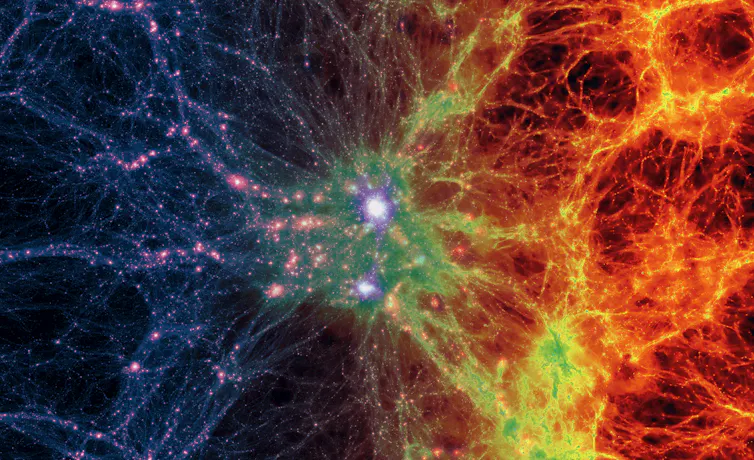
Dark matter forms part of the underlying structure of the universe, known as the cosmic web.
Dark matter forms part of the underlying structure of the universe, known as the cosmic web. Esa

In the far future, dark energy is expected to dominate completely. The present era appears to be a transition between the two – a cosmic intermission lasting billions of years, but brief in the lifespan of the universe.

This could be a simple coincidence or a clue to new insights about the cosmos. For example, it could be that dark energy is changing over time, that gravity behaves differently on cosmic scales or that some ingredient is missing from our model of the universe. Distinguishing between these scenarios would require observations across huge spans of cosmic time – exactly the kind of data that Roman will provide.


Read more: Dark energy: could the mysterious force seen as constant actually vary over cosmic time?


Beyond cosmology

Roman’s science extends well beyond dark energy. It will carry out the largest survey yet of planets beyond our solar system, detecting thousands of new worlds using a technique called gravitational microlensing.

Microlensing happens when the gravity of a foreground star briefly bends and magnifies the light from a more distant background star – acting like a natural magnifying lens passing between us and a distant object. If the foreground star has a planet, that planet can create a small extra brightening in the signal, revealing its presence.

Many of these exoplanets would be difficult to find with the two most widely used techniques to discover exoplanets – the transit and radial velocity methods. Using microlensing, Roman could find planets in wide orbits, low mass planets and even free floating worlds that are not bound to any star.

Roman is also part of a new era of survey astronomy. Its wide-field capabilities place it alongside other major missions. The European Space Agency’s Euclid space mission is mapping billions of galaxies to study dark matter and dark energy. The Vera C. Rubin Observatory, built on a mountaintop in Chile, will repeatedly scan the southern sky.

Together, these observatories will help astronomers map the universe across different wavelengths, distances and timescales.

Roman will also work together with the James Webb space telescope, identifying large-scale patterns and unusual objects across the sky, which Webb can then study in detail. This combination of breadth and depth is increasingly important in modern astronomy.

Roman’s greatest impact may come from the unexpected. With repeated observations of large areas of sky, it will detect rare events and previously unseen phenomena. For astronomers, this is one of the mission’s most exciting aspects.

By mapping the universe in unprecedented detail, the Roman telescope will provide a powerful test of our current understanding of cosmology – and potentially point the way to new physics.

The Conversation

Noelia Noël does not work for, consult, own shares in or receive funding from any company or organisation that would benefit from this article, and has disclosed no relevant affiliations beyond their academic appointment.
  •  
❌