Login

Court Orders SK Chairman Chey Tae-won to Pay 944 Billion Won in Property Division
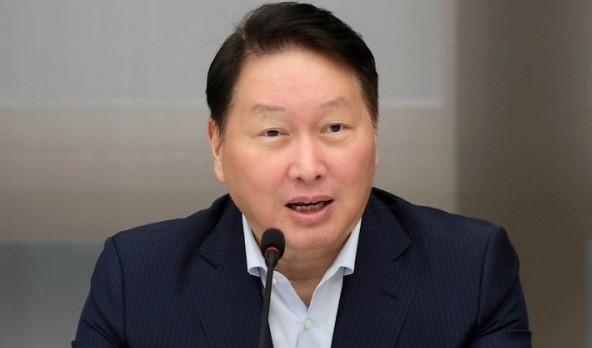
SK Group Chairman Chey Tae-won must pay 944 billion won in property division to Roh Soh-yeong, director of Art Center Nabi, a South Korean court ruled in a remanded divorce case. The ruling included Chey's holdings in SK Inc. as part of the assets subject to division. The amount was about 400 billion won less than the 1.3808 trillion won awarded by the appellate court, but far higher than the 66.5 billion won ordered by the first-instance court.
The Seoul High Court's Family Division 1, presided over by Judge Lee Sang-joo, ruled on July 24 that Chey must pay Roh 944 billion won in property division, along with annual default interest of 5% from the date the judgment becomes final until payment is completed. The court ordered each party to bear its own litigation costs.
The court recognized Chey's holdings in SK Inc. as assets subject to division, concluding that a substantial portion of the couple's joint assets had been formed or acquired during their marriage. It set April 16, 2024, the date when oral arguments concluded in the divorce proceedings, as the valuation date for the assets. SK Inc. shares were trading at around 160,000 won at that time.
The court did, however, take into account the subsequent sharp increase in the value of Chey's SK Inc. shares when determining the amount of the property division. SK Inc. shares that Chey had gifted to relatives to maintain control of the group were excluded from the assets subject to division.
The court recognized Roh's contribution to the formation of the assets at 33.3%, or one-third. It found that Roh contributed to Chey's business activities and to the appreciation of SK Inc. shares by handling household affairs and child-rearing and through her external activities during the marriage. The contribution ratio was slightly lower than the 35% recognized by the appellate court.
The court did not take into account the 30 billion won in slush funds linked to former President Roh Tae-woo in calculating the property division ratio.
For the method of division, the court chose compensatory division, under which Chey will continue to hold the shares and pay Roh the shortfall in her portion in cash. The decision took into account the defense of management control and the stability of the group's governance structure.
The divorce proceedings began in 2015, when Chey publicly disclosed his intention to divorce and the existence of a child born outside the marriage. The legal dispute escalated when he filed for divorce mediation in July 2017.
In December 2022, the first-instance court ruled that Chey's SK Inc. shares were his separate property and excluded them from the assets subject to division, awarding Roh 66.5 billion won in property division and 100 million won in alimony. In May 2024, the appellate court determined that the shares were the couple's joint assets, recognized Roh's contribution at 35%, and ordered Chey to pay 1.3808 trillion won in property division and 2 billion won in alimony.
In October 2025, the Supreme Court found that the 30 billion won from the side of former President Roh Tae-woo appeared to be illicit funds raised during his presidency, and that it could not be taken into account as Roh Soh-yeong's contribution to the formation of the assets even if the money had flowed into SK Group. The court overturned the property division portion and sent the case back to the Seoul High Court. The divorce itself and the 2 billion won alimony payment were confirmed.
The business community is watching the impact the ruling will have on SK Group's governance structure. With Chey required to raise close to 1 trillion won for the property division payment, attention is turning to how he will secure the funds. Some observers have raised the possibility that he could use his SK Inc. stake as collateral or sell some assets, with SK Siltron cited as a prime example.
Immediately after the ruling, Chey's legal counsel issued a statement saying, "The divorce was confirmed by last year's Supreme Court ruling in a process of dissolving a marriage spanning nearly 20 years, and today's remanded ruling on property division followed. We feel apologetic for causing concern to many people." The statement added, "We respect the court's judgment, but we will closely review the details of the ruling before deciding our future response, including whether to appeal to the Supreme Court."