❌

Reading view

New Gravity Theory Suggests How Cosmic Order Emerges Despite Rising Entropy

Galaxies, stars, and living cells are all examples of local order emerging in the universe. At first glance, that seems to contradict one of physics’ oldest principles.

However, a recent study in Physical Review D offers a mathematical explanation for how these structures form while still obeying the second law of thermodynamics.

The second law of thermodynamics states that entropy, or disorder, in an isolated system always increases over time. Einstein famously said that “the second law of thermodynamics occupies a unique position among the laws of Nature,” reflecting how fundamental he believed the principle to be.

In its early days, the universe was smooth and uniform, with low entropy. As it expanded, gravity pulled gas into stars, stars into galaxies, and eventually made life possible. Each step seems to create order in one place, even though the universe as a whole became more disordered. Cosmologists have usually explained this by pointing to the universe’s growing volume.

Gravity as a Ledger, Not a Force

Mathematician Ginestra Bianconi at Queen Mary University of London addressed this problem with a framework called Gravity from Entropy. Rather than treating gravity as a fundamental force, the Gravity from Entropy framework proposes that it emerges from an information-based difference between two descriptions of spacetime geometry. One metric describes the actual shape of spacetime, while the other describes the geometry that matter and curvature would create. When these two match, gravity disappears. When they differ, gravity arises from the difference.

In the low-energy, weak-curvature limit, the framework reduces to general relativity. In the new study, Bianconi adds a thermodynamic perspective. She applies Gravity from Entropy to the standard model of an expanding universe and shows that the local geometric degrees of freedom follow the first law of thermodynamics, with their own temperature and pressure emerging from the equations.

Falling Density, Rising Total

One of the study’s central findings is the distinction between total entropy and entropy per unit volume. As the universe grows, the total entropy increases, just as the second law demands. However, the study found that entropy per unit volume decreases over time even as the universe’s total entropy continues to increase. Within the Gravity from Entropy framework, Bianconi proposes that this declining local entropy density may help explain how galaxies and other cosmic structures emerge.

The study also shows that these geometric temperatures change depending on what dominates the universe. In a universe dominated by matter or radiation, the temperature decreases over time. In a universe dominated by dark energy, like our own, they remain nearly constant. The framework even assigns a temperature and pressure to empty spacetime.

A Theory Still Waiting to Be Tested

“This work reveals how the Gravity from Entropy theory can tackle the challenging question of reconciling the second law of thermodynamics with the emergence of complexity in our universe,” stated Bianconi. “These results may open new avenues for investigating the long-standing problem of reconciling the foundations of cosmological irreversibility, the emergence of complex structures, and ultimately life with fundamental gravitational dynamics.”

So far, Gravity from Entropy has not been confirmed by observations. The theory makes predictions that future observations of large-scale cosmic structures and other gravitational phenomena could test. While it remains unproven, Bianconi believes it could offer a new way to link gravity, thermodynamics, quantum mechanics, and the rise of complexity in the universe.

Austin Burgess is a writer and researcher with a background in sales, marketing, and data analytics. He holds an MBA, a Bachelor of Science in Business Administration, and a data analytics certification. His work focuses on breaking scientific developments, with an emphasis on emerging biology, cognitive neuroscience, and archaeological discoveries.

  •  

The Sun’s twin star may have tilted the planets’ orbits

Around 4.6 billion years ago, an immense cloud of gas and dust in space collapsed in on itself. As it collapsed, gravity pulled most of the material toward several small points, one of which would eventually become our Sun. The other points formed other stars in what scientists call an open cluster. 

During this early stage of the Sun’s life, it was surrounded by a swirling disk of leftover material aligned with its equator, known as a protoplanetary disk. Eventually, this disk condensed to form the planets that make up our solar system. This process normally results in a system with a star at its center, and the planets orbiting the plane of the star’s equator. 

However, scientists have found that this scenario doesn’t quite hold for our solar system. The planets in our solar system orbit the Sun in a single plane offset from the Sun’s equator by approximately 6°. The fact that the planets are in the same orbital plane suggests that the protoplanetary disk model of solar system formation is correct, since the odds of the Sun capturing 8 rogue planets in this arrangement are astronomically low. So, what threw the planets in our solar system off-kilter?

The plane in which the solar system’s planets orbit the Sun is offset from the Sun’s equator by approximately 6°. Li simulated how the solar system tilted based on its 4 largest planets, from left to right: Neptune, Saturn, Jupiter, and Uranus.

The plane in which the solar system’s planets orbit the Sun is offset from the Sun’s equator by approximately 6°. Li simulated how the solar system tilted based on its 4 largest planets, from left to right: Neptune, Saturn, Jupiter, and Uranus. Illustration by Andrew Bizal.

To determine what caused the solar system to tilt, Daohai Li at Queen Mary University of London recently used the computer program NBODY6++ to model different versions of the open cluster from which the Sun came. In these simulations, he varied the number of stars in the cluster, from 500 to 2,000 to 8,000. He also varied the radius of the cluster, from 0.25 to 1 to 4 parsecs (8 to 30 to 100 trillion kilometers or 5 to 20 to 70 trillion miles). Finally, he varied the percentage of stars with a binary companion from 10% to 50% to 90%. Li assigned each star a randomly generated initial mass, starting position, and velocity, and simulated their interactions for 400 million years.

First, Li examined the simulations to identify stars with masses approximately equal to the Sun’s. From this group of solar-massed stars, Li found ones that left the cluster after 400 million years as a single star, after either forming alone or having lost a former companion star. He proposed that these stars were the most similar to the Sun and could thus host a simulated solar system.

Li then simulated the planets and their orbits as they would have formed on these potential host stars. To simplify this process, Li only simulated the 4 giant planets, Jupiter, Saturn, Uranus, and Neptune, which dominate planetary behavior in our solar system. He modeled these solar systems independently for 200 million years to ensure they would remain intact and used those that did for statistical analysis of the solar system’s past.

Overall, Li discovered 2 scenarios that could explain the solar system’s tilt. In the first, the primordial solar system was jostled by many distant neighboring stars in its cluster. This jostling tilts the planets’ orbits, but it does so randomly. Therefore, this scenario would make it unlikely for the planets to remain in the same orbital plane. It would also cause them to orbit the Sun faster and more chaotically than in our solar system.

In the second scenario, the Sun had a temporary companion star that it either formed with or briefly encountered before separating. When this occurred, the simulated planets’ orbits all tilted together. Stars that formed with a binary companion had a 10% chance of tilting their planets’ orbits by 6° or more, while stars that formed alone had a less than 0.1% chance. 

Li concluded that the solar system could have tilted as a result of interactions between the Sun and a temporary companion star within its parent cluster. However, he acknowledged that the model strongly depends on how closely a star passes by the Sun, since the closer a star passes, the more it disturbs the solar system. Despite this uncertainty, it’s possible that somewhere in space is the Sun’s twin or former neighbor that we haven’t seen in eons, and that’s what made our solar system crooked!

The post The Sun’s twin star may have tilted the planets’ orbits appeared first on Sciworthy.

  •  

Scientists may have found the 1st twin star system where both stars exploded

For the first time, scientists may have discovered a binary system—like the twin suns of the fictional planet Tatooine in "Star Wars"—where both stars exploded as supernovas, a new study finds.

Although Earth may orbit around a single star, more than half of all stars are in systems where two or more suns orbit each other. "When it comes to massive stars, the percentage in multiple systems are even higher," study lead author Miltiadis Michailidis, a postdoctoral fellow at Stanford University in California, told Space.com.

When massive stars burn all their fuel, they can die in giant explosions known as supernovas. These outbursts can briefly outshine all of the other suns in these stars' galaxies. They often leave behind expanding super-hot clouds of debris known as supernova remnants. Astronomers have detected about 300 such remnants in our galaxy to date.

Given how often massive stars are found in binary systems, "one can expect many pairs of massive stars where both will explode as supernovas," Michailidis noted. "However, this has never been observed, until now."

One reason supernova pairs may have escaped attention is that "if the stars are too close together when they exploded, the resulting supernova remnants may look like that from a single explosion," Michailidis explained. Another is that one star going supernova may propel its partner far enough away to hide the fact they were ever a duo, he added.

In the new study, Michailidis and his colleagues investigated a supernova remnant known as IC 443, located about 6,000 light-years from Earth in the constellation Gemini. IC 443 is also known as the Jellyfish Nebula for how it resembles a jellyfish.

IC 443 is one of the most extensively studied supernova remnants in the galaxy because of how shock waves from the supernova have collided with surrounding clouds of gas and dust to create a set of concentric bubble shells, "much like how a drop of water falling on a lake creates circular waves," Michailidis said. "It is very isolated from its surroundings, without many other objects nearby to complicate its very bright emissions."

The scientists analyzed one of IC 443's much dimmer, long-hidden neighbors, dubbed G189.6+3.3. The German-led ROSAT (Roentgen Satellite) mission first discovered G189.6+3.3 in 1994 via its faint X-ray emissions, and the Russian-German Spektrum Roentgen Gamma (SRG) space observatory later clearly detected shell-like structures within G189.6+3.3, suggesting that it was a supernova remnant.

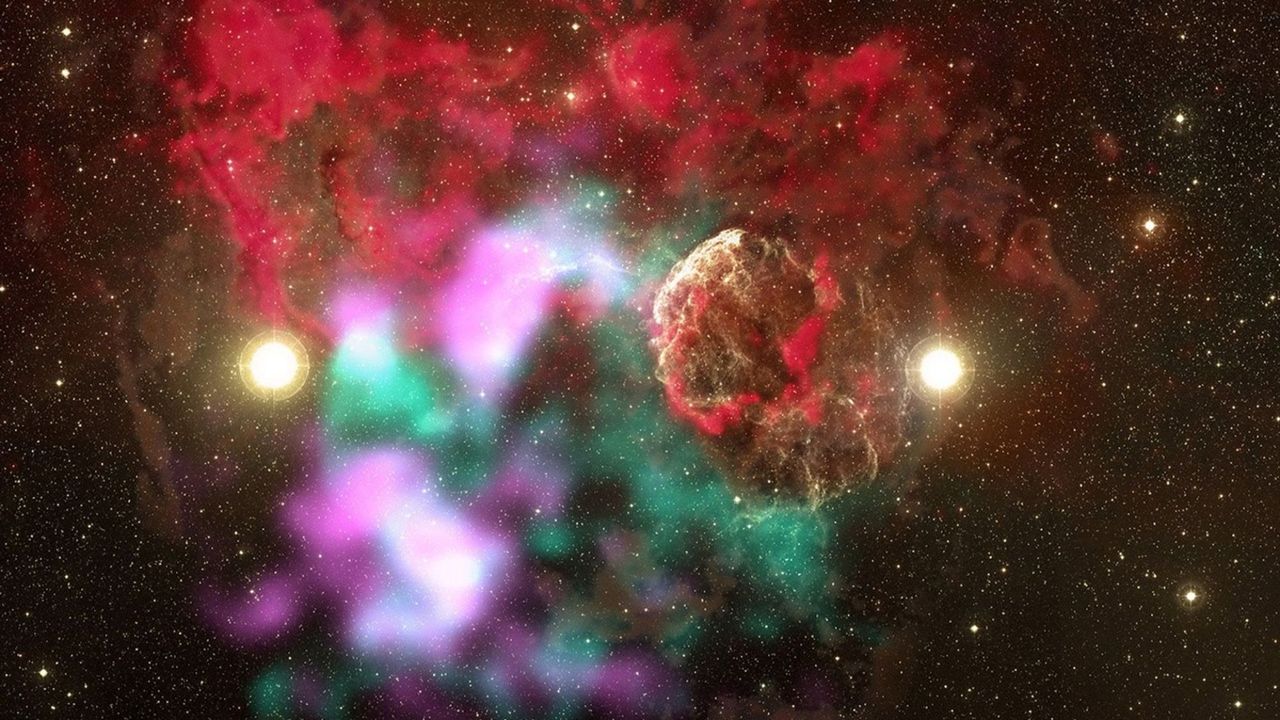
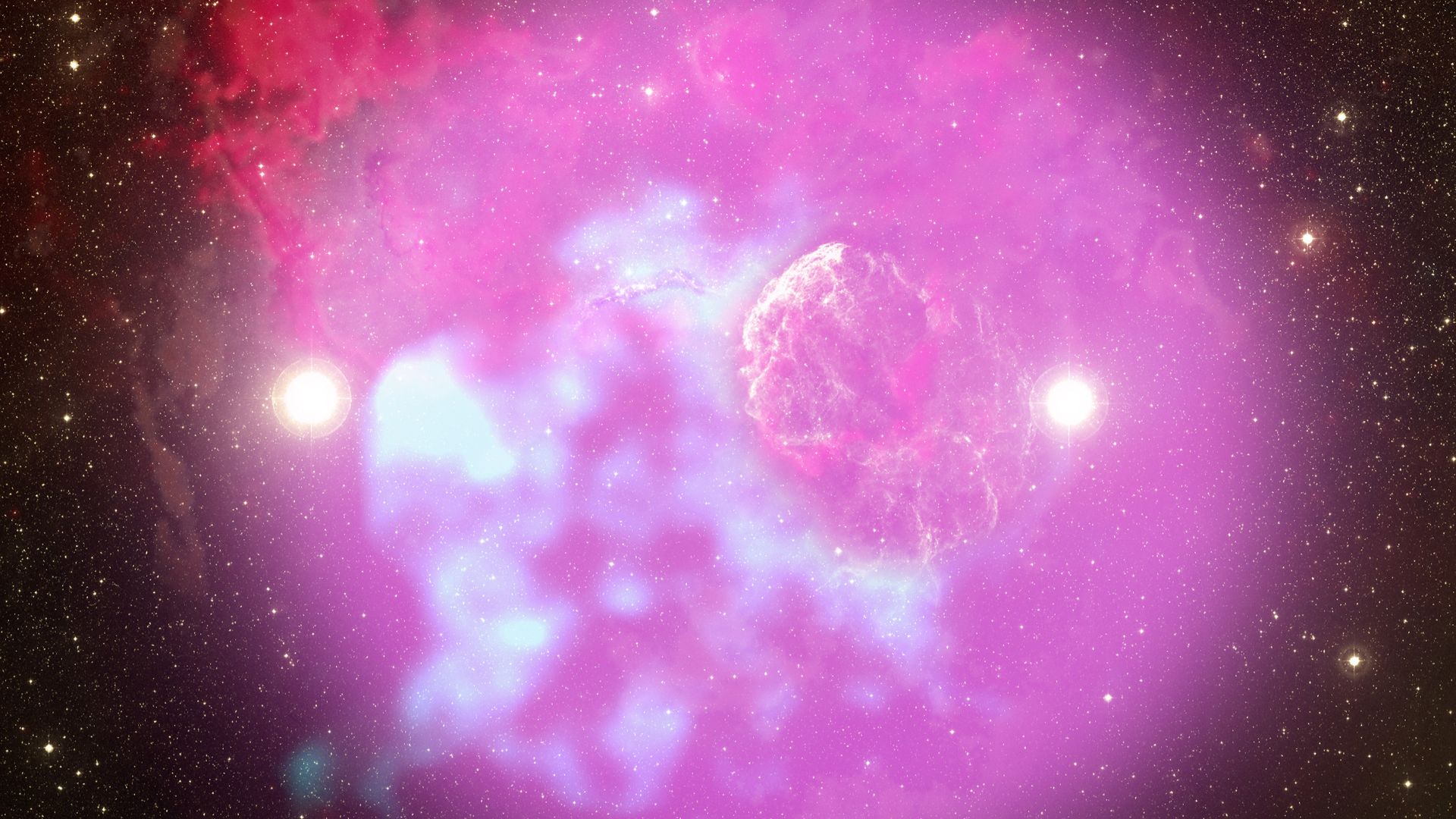
A pink haze over the jellyfish nebula.

A composite multiwavelength view of the IC 443 region (with the X-ray emission from IC 443 removed) overlaid with gamma-ray emission above 1 GeV detected by the Fermi Large Area Telescope.  (Image credit: NASA Goddard Space Flight Center and M. Michailidis et al. 2026; orange, brown: radio, ESA/Planck and MWISP; yellow: optical, DSS; red: infrared, NASA/WISE; violet: ultraviolet, NASA/Swift; teal: X-rays, SRG/eROSITA; magenta: gamma rays, NASA/DOE/Fermi LAT Collaboration)

In the new study, the researchers analyzed more than 16 years of data from NASA's Fermi Gamma-ray Space Telescope along with earlier X-ray, optical and radio measurements. They discovered signs that both IC 443 and G189.6+3.3 were both smashing into the same interstellar cloud of hydrogen, revealing they were close together in space, with the centers of their explosions about 30 to 50 light-years apart.

The researchers calculated that the chances of randomly encountering two unrelated supernova remnants at this distance from one another "was about one in 1,000," Michailidis said. "This suggests that our discovery is in fact the first known binary-system supernova pair."

The scientists estimated that G189.6+3.3 was older than IC 443, with the parent star of G189.6+3.3 exploding between 20,000 to 110,000 years ago, while IC 443 was created about 8,000 to 9,000 years ago. The original stars may have been 20 or more times the sun's mass.

These new findings can help shed light on how massive binary stars evolve, interact and die. For instance, further analysis of G189.6+3.3 and IC 443 can reveal how much of a kick the former gave the latter when it died, Michailidis said.

The scientists detailed their findings July 21 in the journal Nature Communications.

  •  
❌