
❌

Reading view

Metasurface grating gives solar telescopes a boost

A compact optical technology that has already proved its worth in Earth-bound applications could be on its way to space after researchers at the University of California San Diego, US showed that it can map the Sun’s magnetic field just as well as traditional instruments. By making polarization gratings from specially engineered metasurfaces rather than a complex assembly of optics, the researchers say that future solar-observing missions could benefit from reduced complexity and cost as well as size.

“Our work makes use of recent advancements in nanoscale optical technologies to help improve the hardware for making astronomical observations of the Sun,” says study leader Noah Rubin of UC San Diego’s Jacobs School of Engineering. “We believe this is one of the first times that metasurface optics – which have been a subject of intense interest in both academic research and industry for about a decade – have been used to improve scientific instrumentation of any kind outside of a lab/academic proof-of-concept.”

Polarized light and solar magnetic fields

Although light emitted by the Sun is generally unpolarized – that is, the light waves do not vibrate along a particular axis – strong magnetic fields that develop near sunspots can polarize this light via the quantum mechanical Zeeman effect. These magnetic fields are closely associated with space weather events such as solar storms that can damage electronic infrastructure both on Earth and in orbit. Studying the Sun’s magnetic activity by monitoring areas of polarized light is thus an important step towards detecting or predicting such storms in time to take protective action.

Usually, measuring the polarization state of light means analysing different polarization directions using a device such as a waveplate that mechanically rotates between exposures. Rubin compares this process to taking several photographs through polarized sunglasses held at different angles, then combining them to obtain a fuller picture of what’s going on.
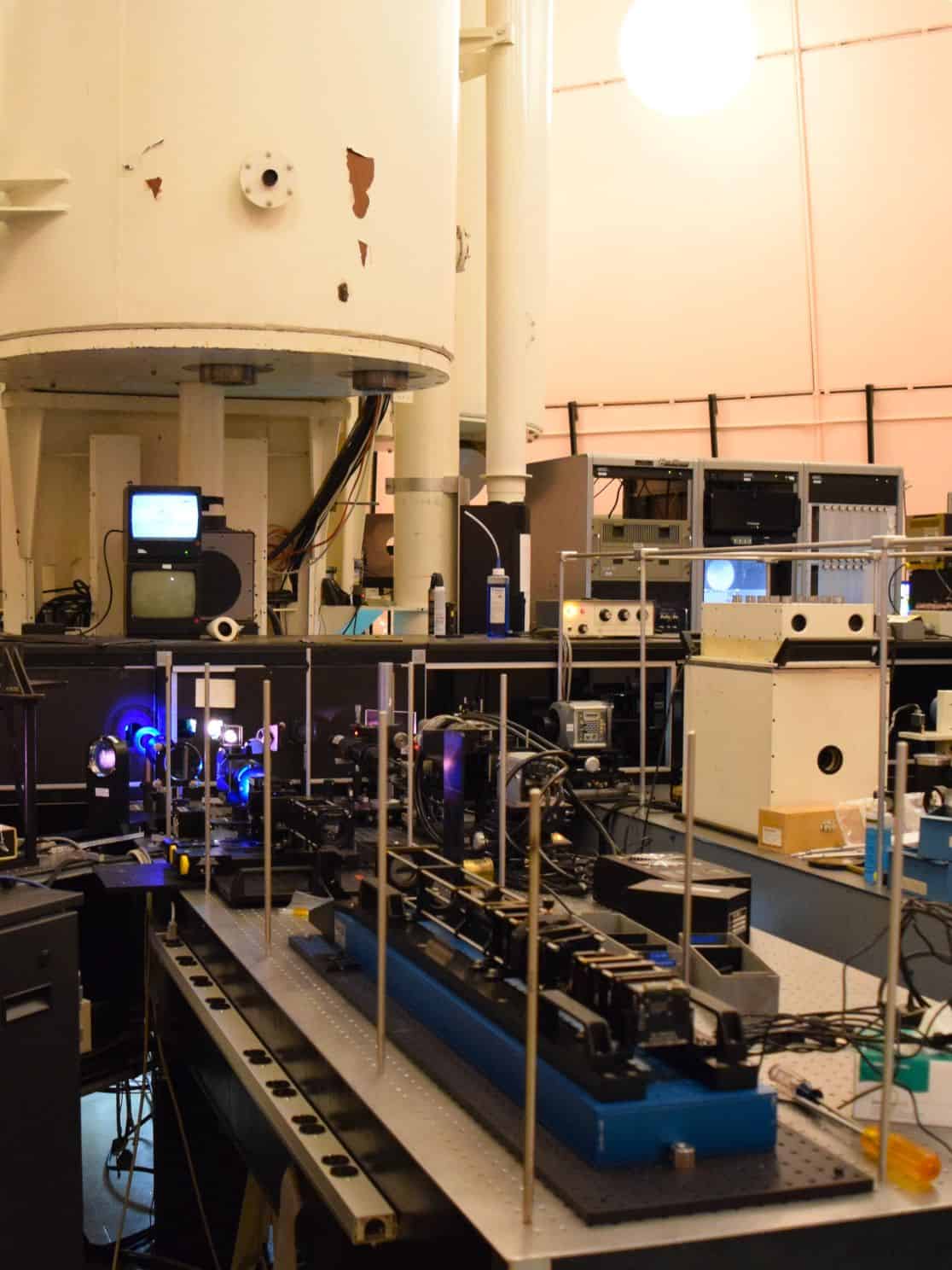
Photo of the custom-built telescope being tested at the Dunn Solar Telescope
Test rig: Sunlight from the top of the Dunn Solar Telescope’s 136-foot-tall tower travels 228 feet underground and is reflected back up to this room at ground level, where it passes through an optical system (blue lights, background) before reaching the team’s custom-built telescope (foreground). (Courtesy: Noah Rubin)

While this technique works, and instruments that use it have already been sent into space, the image analysis process is very time-consuming. It also requires an external power source, and the need to mechanically rotate the waveplate introduces extra complexity and cost, says Rubin.

“In space-based applications, a satellite itself can be moving while this component reorients, causing a highly undesirable blurring effect,” he explains. “As a result, designers of these systems often invest considerable resources into mechanical remediation and engineering to correct the motion of the telescope on the satellite, and this frequently ends up being substantially more expensive than the telescope optics themselves.”

A metasurface solution

In the new study, which is detailed in Science Advances, Rubin and colleagues solved this problem by creating a polarization-sensitive metasurface that splits light into its different polarization components. A camera-like system containing this metasurface polarization grating can then form multiple images of a scene in parallel. Rubin explains that each image in this scene is analysed with respect to a different polarization state, meaning that the system can measure the polarization of light simultaneously and passively in a single camera frame.

Rubin notes that this technique of condensing an instrument that would ordinarily involve a complex assembly of optics into a single, flat surface has previously made its way into applications as diverse as facial recognition in mobile phones and the preparation of complex photon states in quantum optics experiments. “In this work, we show that these advantages translate to polarization imaging in astronomy,” he tells Physics World.

Comparable results

Working with industrial partners at BAE Systems Space & Mission Systems in Colorado, US (formerly known as Ball Aerospace, which Rubin describes as “well-known for its involvement in the development of the James Webb Space Telescope, Hubble and countless other NASA missions”), the team designed a specialized telescope built around such a metasurface polarization grating. They also deployed their instrument on the Dunn Solar Telescope in New Mexico, US, and showed that they could quantitatively map the magnetic fields in sunspots by capturing simultaneous polarization images of these spots.

The researchers report that their results were comparable to those obtained by the state-of-the-art NASA Solar Dynamics Observatory mission in-orbit, highlighting what Rubin calls “the significant advantages that these metasurface components can offer when designed in conjunction with more traditional optical systems”. The UC San Diego team is now exploring ways of integrating its technology into future NASA solar-observing space missions.

The post Metasurface grating gives solar telescopes a boost appeared first on Physics World.

  •  

Molecular spin sensor takes the temperature of cancer cells

Researchers in Japan have succeeded in measuring the temperature inside living cells with high precision using a new class of biocompatible quantum nanosensor – something that has been difficult to do until now even. If improved, the nanosensor could be used to characterize a wide range of biological phenomena and so help in disease diagnosis, they say.

Recent years have seen the advent of a new generation of nanoscale quantum sensors that can detect the tiny magnetic fields of biological systems. Some of these sensors rely on photons and others on electrons or spin defects – typically diamond specially engineered with nitrogen–vacancy (NV) defects. This material is made by removing two carbon atoms from the diamond lattice and replacing one with a nitrogen atom. The other “hole” is left empty, thereby creating a vacancy or defect. The spin state of the defect is influenced by the local magnetic field that can be “read out” from the way it fluoresces.

While a powerful tool, and biocompatible, this type of quantum sensor does suffer from certain limits. For one, it can be structurally inhomogeneous, which affects how it detects temperature and other physical or chemical parameters inside biological cells.

A more homogenous structure

Even though the new molecular quantum nanosensor (MoQN) works in the same way as these conventional devices, it does not suffer from this problem, explain Nobuhiro Yanai of the University of Tokyo and Hitoshi Ishiwata of the National Institutes for Quantum Science and Technology (QST), who led this research effort. This is because it has a more homogenous structure and does not contain any defects. Instead, it is made by embedding molecular spin qubits, in this case fabricated from pentacene, in nanocrystals of para-terphenyl. This design makes the structure uniform on a molecular scale and preserves the quantum coherence of the spin qubits. It is then coated with Pluronic F127, which is a biocompatible surfactant.

By detecting the spin direction of the “excited triplet state” of the pentacene qubits using a technique known as optically detected magnetic resonance (OMDR), the researchers can precisely determine the temperature of the qubits’ surroundings from the OMDR peak position. When they tested their method inside the cytoplasm of cancer cells in vivo, they found that the intracellular temperature was consistently higher than the surrounding medium.

Yanai says he embarked on this study after reading about the work of Sam Bayliss’ group at the UK’s University of Glasgow, and Ashok Ajoy’s group at the University of California, Berkeley in the US on OMDR in pentacene-doped para-terphenyl crystals. He says he immediately got the idea that nanocrystals of this material could be used for quantum sensing inside cells. This was because his group had already developed such nanocrystals for a different purpose in previous research.

Ensuring biocompatibility

“I then spoke with Hitoshi Ishiwata, who is an expert in quantum sensing using NV centres,” he recalls. “While many molecular qubits have been developed to date, there had been no examples demonstrating their sensing ability within living cells.”

The project required materials science expertise, he tells Physics World, and in particular, finding out how to reduce the material to the nanoscale and ensuring it was biocompatible.

“We already knew that nanodiamonds are good quantum sensors for temperature measurements, but I had noticed a practical limitation: their ODMR spectra often vary significantly from particle to particle,” he says. “This spectral dispersion can introduce errors, especially when trying to perform precise measurements at the single-particle level.”

Replacing hydrogen with deuterium

The researchers thought they had overcome this problem during the first run of their experiments because they found that different particles showed identical OMDR spectra. However, their joy quickly waned when they observed that the spectra were still broadened by hyperfine interactions between the pentacene-doped para-terphenyl molecules’ electron spins and hydrogen nuclear spins.

To improve the spectral resolution, Ishiwata says he suggested chemically modifying the molecule by replacing the hydrogen in it with deuterium. And the technique worked: “the hyperfine broadening was strongly suppressed, allowing us to determine the OMDR spectra much more precisely.”

These findings, which are detailed in Science Advances, show that MoQNs are a chemically versatile platform for quantum sensing in living cells and that they can operate directly inside them while maintaining the precision needed for absolute thermometry, he says. Their appeal also lies in in the fact that their structures can be easily modified.

It will not all be plain sailing, however, adds Yanai. MoQNs cannot yet target specific organelles within cells, so endowing them with this targeting capability is an important future challenge. “What is more, their size has been limited to around 200 nm so far, so creating smaller MoQN particles will be crucial,” he says.

The post Molecular spin sensor takes the temperature of cancer cells appeared first on Physics World.

  •  

U.S. Space Development Agency Orders 36 Space Vehicles for Defense Against Missile Attacks

The United States Space Development Agency (SDA), in support of the U.S. Space Force, has awarded contracts to L3Harris Technologies and Sierra Space Corporation to build and deliver 36 Accelerated Missile Defense Tranche 3 (AMDT3) space vehicles (SVs) designed to operate in four distinct orbital planes.

Part of the Tracking Layer for Tranche 3 of the Proliferated Warfighter Space Architecture (PWSA), the space vehicles will support the White House’s space-based segment ‘Golden Dome for America’ antimissile defense system to expand the country’s missile tracking and defense network, with a projected delivery date of 2028.

36 Space Vehicles Orbiting in Four Separate Planes Will Aid Missile Defense

According to a statement announcing the awards, the 36 space vehicles will operate across four separate orbital planes. Half of the vehicles covering two of the four orbital planes will be made by Sierra Space Corporation. The statement from the SDA describes the vehicles as “missile warning/missile tracking” SVs loaded with specialized sensor packages. An official at the SDA speaking on background told The Debrief that the details of the sensor technologies and capabilities are not available at this time.

The second half of the vehicle order covering the other two orbital planes will be made by defense technology company L3Harris Technologies. Their award calls for 18 Hypersonic and Ballistic Tracking Space Sensor (HBTSS)-like missile defense variant SVs.

When The Debrief asked the SDA for clarification on the term “variant” space vehicles, the official explained that this designation represents the different types of sensor packages that each company will provide. For the L3Harris award, the SDA explained that their sensor is an advancement on earlier work performed with the Missile Defense Agency under the Hypersonic and Ballistic Tracking Space Sensor (HBTSS) program.

Infrared Sensors Will Integrate with a Low-Latency Communication Network

When discussing the significance of the twin awards, the SDA said their deployment will expand the company’s missile defense sensing established in previous phases “in support of homeland defense and theater defense.”

“Each AMDT3 SV will be interoperable with all SDA Tranche 1, Tranche 2, and Tranche 3 SVs and will operate in an integrated fashion through a common ground system,” the statement explained.

They also note that the tracking layer is equipped with infrared sensors “that will integrate with a low-latency communication network.”

“With these awards, SDA is accelerating the deployment of the Tracking Layer to provide the homeland, our deployed forces, and allies with global, persistent indications, detection, identification, warning, tracking, and defense against advanced and evolving missile threats,” explained G.P. Sandhoo, Space Force Portfolio acquisition executive for Missile Warning and Tracking and SDA director. “AMDT3 expands upon SDA’s previous and current Tracking Layer generations — Tranches 1, 2 and 3 — marking another milestone in delivering a resilient, global missile warning, missile tracking, and missile defense capability.”

Future Satellites Will Offer Even Greater Capability to the Warfighter

Although a specific delivery date for each of the company’s separate awards was not made public, the announcement did say they are expected to be available for launch “by the end of 2028.” Once aloft and in their respective orbital planes, the missile tracking and defense space vehicles will be operated and maintained by the U.S. Space Force.

When asked by The Debrief if there are any plans to add capabilities beyond detection and tracking to the multi-layer system in the future, the SDA said future improvements are one of the main pillars of the organization’s business model.

“We use spiral development to deliver new generations of satellites (we call them “tranches”) every few years,” the SDA explained. “Each new tranche represents an enhancement over the previous and offers greater capability to the warfighter, either through additional sensing coverage, or through technology advances (or potentially both).” 

Christopher Plain is a Science Fiction and Fantasy novelist and has spent the last six years as Associate News Editor and Head Science Writer at The Debrief. Follow and connect with him on X, learn about his books at plainfiction.com, or email him at christopher@thedebrief.org

  •  
❌