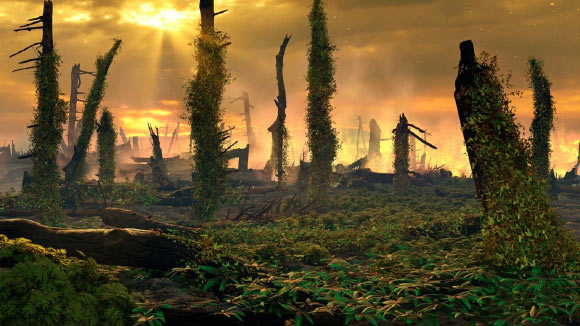
Researchers from the University of British Columbia studying material from the mysterious dinosaur-killer meteorite that wiped out 75% of Earth’s species, including non-avian dinosaurs, have determined the doomsday space rock was likely a rare type of carbonaceous chondrite.
Although the international team behind the discovery, which includes researchers from Paris, Brussels, and Vienna, said the evidence for this category of “oddball” meteorite offers a viable solution to its mysterious composition, they note that the rarity of chondrite meteorites makes its origin a new mystery that needs to be solved by future research.
They also note that a chondrite meteorite impact would have much less effect on atmospheric sulfur, which is critical to most extinction models, potentially casting doubt on its central role in dinosaur extinction.
Many Details About the Dinosaur Killer Meteorite Remain a Mystery
According to a statement, the Cretaceous-Paleogene impactor resulted in one of the largest extinction events in the planet’s history. While most scientists agree that the event played a significant role in ending the dinosaurs’ reign, the study’s authors note that “the exact mechanism and the extent of the impact-extinction link are debated.” They also note that the origin and composition of the dinosaur killer have remained a mystery.
An analysis of the Chicxulub impact structure reveals that the doomsday dinosaur-killer meteorite was between 10 and 15 kilometers (approximately 6 to 9 miles) wide. Estimates also suggest it impacted Earth at 64,000 km/m (40,000 mph) beneath the modern-day Yucatán Peninsula in Mexico.
Although previous studies identified the meteorite as similar to carbonaceous chondrites, the researchers said that carbonaceous chondrites are a diverse class of space rock, “leaving the exact nature of the impactor unclear.”
“Carbonaceous chondrites of the Ornans class (CO) are definitely not like the typical meteors you find in museum collections,” explained study co-author and visiting professor Dr. Philippe Claeys.
For example, the professor explained, a CO contains fewer volatile elements, such as zinc, carbon, Sulphur, and H20 “than other classes of meteorites we’ve discovered so far on Earth.”
One Mystery Solved
To try to unravel the mystery of the dinosaur-killer meteorite, the researchers teamed up with scientists from the Institut de Physique du Globe and the Université de Paris to conduct high-precision nickel isotope measurements of meteor samples from the event that have been collected over the years from the thin, worldwide layer of clay created by the explosive impact.
Dr. Claeys, a professor at Vrije Universiteit Brussel, currently visiting the Pacific Center for Isotopic and Geochemical Research in Earth, Ocean and Atmospheric Sciences at UBC, noted the challenging nature of the isotopic analysis, primarily due to the limited number of samples.
“Only a minute fraction of the projectile is preserved in the planet’s KT clay layer because the entire meteorite vaporized upon impact,” the researcher explained.
Still, the study authors explain, evaluating Nickel isotopes offers several advantages over other testing methods. For example, Nickel has five isotopes that the researchers note “allow for up to three separate internally normalized signatures.” They also highlight the availability of Nickel in “virtually all types of available early Solar System solids,” including iron meteorites, which allows for comparison with a wide variety of potential impactors.
Finally, they write, CI chondrites have a distinct Ni isotope signature from the rest of the class, therefore “making it possible to distinguish a CI-like impactor clearly” from other meteorite types.
After completing an isotopic analysis of samples of marine clays containing microscopic pieces of the ejecta, the team said their results “constrain the impactor to one group of carbonaceous chondrites, CO chondrites, “ as well as some evidence for “ungrouped chondrites.”
“By combining our new Ni isotope data with the existing evidence, we demonstrate that the composition of the Chicxulub impactor was most likely CO chondrite-like,” the researchers write, adding that this identification is possible “given nickel’s high abundance in primitive meteorites compared to the Earth’s crust and the distinct isotope compositions they record.”
A New Mystery is Created
While the isotopic analysis offers a compelling solution to the composition of the famed dinosaur-killer that slammed into Earth millions of years ago, the team said the identification casts doubt on the extent of its role in the dinosaurs’ extinction. Specifically, they note that CO chondrites are “dry” compared to others in their class, meaning they contain much less of the volatiles that most extinction theories cite as a significant mechanism.
“As highly volatile elements, such as C, N, and S, in CO chondrites are less abundant than in the typical CCs, questions arise whether the impactor was an essential contributor to the volatiles released during the impact,” they explained.
The most important volatile in most extinction theories is Sulfur (S). However, the authors note, CO chondrites would deliver “approximately half as much S” as more common types.
If the new analysis is correct, it also puts the dinosaur-killer’s origin in question. The authors note that possible sources include distant, debris-rich regions of the outer Solar System or even the outer area of the asteroid belt near Jupiter.
Combined with the compositional analysis lacking volatiles, the team notes that their findings allow “further studies of the mechanism behind the extinction.”
Finding “Doesn’t Alter Our Theory” of What Caused Land Dinosaur Extinction
When discussing the potential implications of their findings, the researchers said their study “highlights the extraterrestrial origin of the K-Pg mass extinction and the isotopes of Ni as a well-suited tool to characterize the nature of extraterrestrial material on Earth.” They also note that the composition of the dinosaur-killer “opens the door for further research into the connection between the impact and the mass extinction.”
From a scientific perspective, the research said their work “highlights the use of Ni isotopes in fingerprinting extraterrestrial materials on Earth,” and helps evaluate the risks associated with “potential future impact events and their consequences.” The study also shows how even an uncommon type of space rock can permanently alter the planet’s history.
“Being impacted by such a rare, distant projectile really underscores how unlucky the dinosaurs were,” Dr. Claeys said.
The researcher also noted that the lack of volatiles in this category of meteorite “doesn’t alter our theory of what caused the extinction event.” However, he notes, if correct, the result “makes it less likely that Sulphur contained in the impactor was the smoking gun.” Instead, the fine debris “thrown into the atmosphere” by the forceful impact would have been the primary factor in the end of the dinosaurs.
The study “The origin of Cretaceous-Palaeogene impactor revealed by nickel isotopes” was published in Science Advances.
Christopher Plain is a Science Fiction and Fantasy novelist and has spent the last six years as Associate News Editor and Head Science Writer at The Debrief. Follow and connect with him on X, learn about his books at plainfiction.com, or email him at christopher@thedebrief.org

 Login