❌

Reading view

Are quasiparticles real?

Beyond familiar particles such as electrons and protons, scientists have discovered a zoo of "quasiparticles" with exotic names, such as magnons, angulons, dropletons and polaritons. But what are quasiparticles, exactly? And given the "quasi" in their name, are they considered real particles?

One way to understand quasiparticles is to explore what a particle is. The standard mental picture of a particle "is of a discrete object, like a ball," Douglas Natelson, a condensed matter physicist at Rice University in Houston, told Live Science. However, this classic image of particles changed with the advent of quantum physics, which revealed that the universe becomes fuzzy at its smallest levels. For example, in 1924, French physicist Louis de Broglie showed that particles such as electrons could also behave as waves β€ͺ—‬ a discovery that earned him a Nobel Prize.

Modern physics suggests that particles are excitations in fields that permeate the entire universe, a bit like a ripple in a pond, Ross McKenzie, a theoretical condensed matter physicist and professor emeritus at the University of Queensland in Australia, told Live Science. Each type of particle has its own corresponding field. For instance, photons of light are ripples of the electromagnetic field, McKenzie noted.

The quantum nature of particles means they can not only fly through an empty vacuum but also ripple through matter. For instance, photons can zip through transparent and translucent materials, and electrons can flow inside wires.

Sign up for our newsletter

Life's Little Mysteries logo with a question mark in a magnifying glass

(Image credit: Marilyn Perkins / Future)

Sign up for our weekly Life's Little Mysteries newsletter to get the latest mysteries before they appear online.

If you can picture a standard particle, such as an electron, as a ripple traveling within a material, you can also envision other kinds of excitations within matter. These other types of ripples are quasiparticles.

For example, think of "the wave" done at a sporting event. "You can watch it propagate around a football stadium; it has a location and a speed," Natelson said. "It only exists within the stadium, though, and it's made up of the collective response of all the interacting fans."

In much the same way, "quasiparticles can only exist within some medium or material, because they are built up from the response of that material's constituents or building blocks," Natelson said; in contrast, particles such as electrons and protons "can exist in free space."
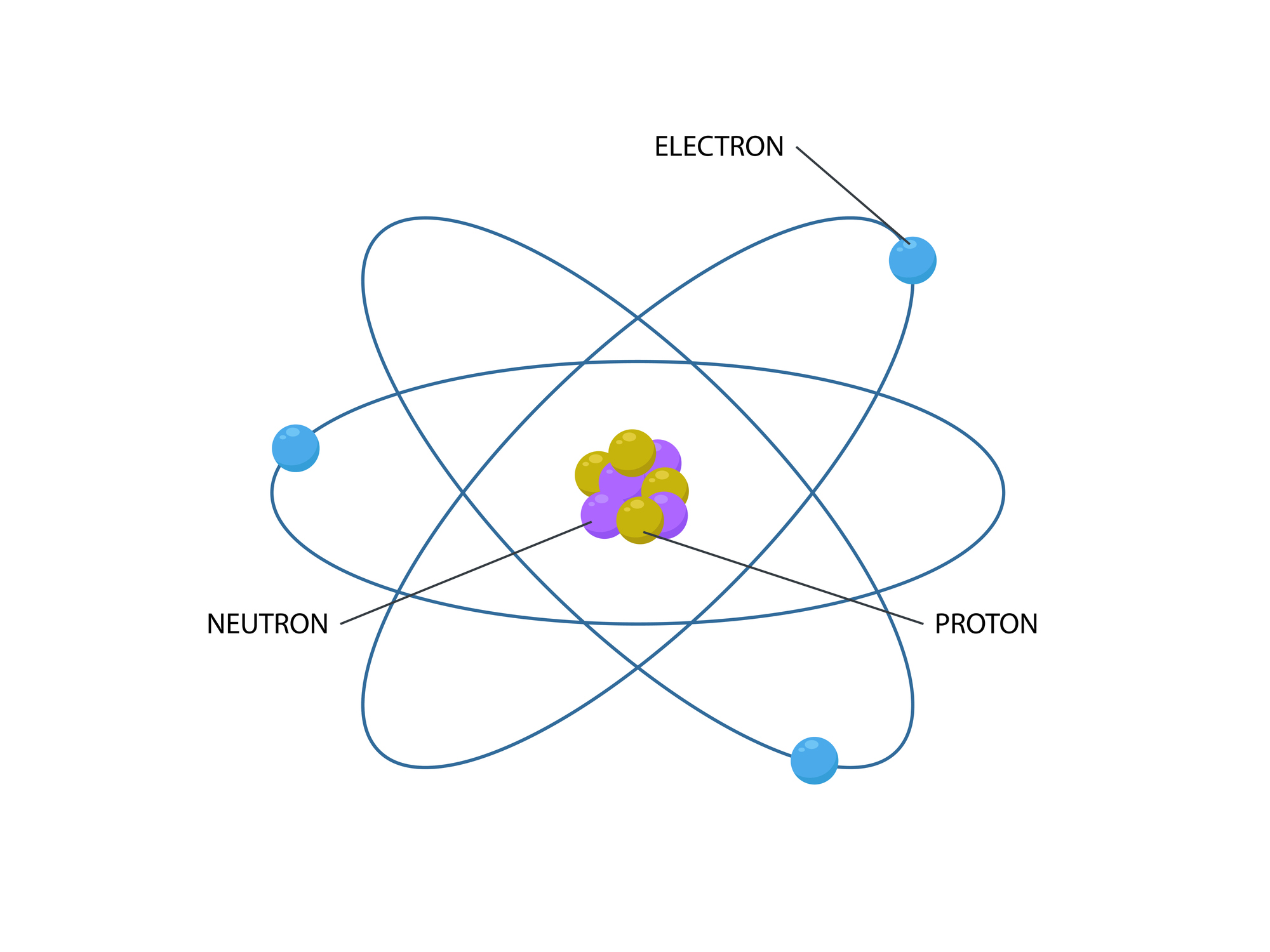
An illustration of an atom with a nucleus of protons and neutrons in the center and electrons orbiting around it

Electrons have a negative charge and orbit around the nucleus of an atom. (Image credit: agung fatria viaGetty Images)

In other words, quasiparticles can't exist in a vacuum and they can't exist on their own. They're reliant on particles acting together and being in a material where they can emerge, just as a wave carried out in a stadium can only exist when there is a group of people there who can perform it.

A philosophical question concerning quasiparticles is whether they are real, McKenzie noted. After all, "quasi" in Latin means "almost."

"Fundamental particles can exist in isolation in a vacuum, and quasiparticles need many interacting particles to exist," McKenzie said. "Still, I would say quasiparticles are, for all intents and purposes, just as real as particles, in how you can detect them and manipulate them."

A zoo of quasiparticles

The concept of quasiparticles originated with theoretical physicist Lev Landau in the 1950s, McKenzie said, and the idea ultimately helped Landau win the Nobel Prize in physics in 1962. Scientists have now proposed the existence of dozens of quasiparticle types, including the following:

  • The phonon, which is a quasiparticle of sound β€” it is the smallest packet of vibrational energy that makes up sound in matter, McKenzie said.
  • The electron hole, often simply called a hole, is the positively charged vacancy left behind once an electron has left its original place, McKenzie noted.
  • The electron quasiparticle, which essentially consists of an electron and its interactions with its surrounding environment. This combined package means the electron quasiparticle requires more force to move, so it effectively has more mass than a regular electron, McKenzie explained.
  • The exciton, a quasiparticle made of an electron and a hole orbiting each other.
  • The anyon, a kind of quasiparticle so far only seen in two-dimensional systems, which may carry only a fraction of an electric charge.

"How many kinds of quasiparticles are there?" McKenzie said. "Just like there are an infinite number of possible states of matter, I would say that, in principle, there are an infinite number of types of quasiparticles."

Scientists describe activity in material as quasiparticles "because it simplifies everything dramatically," McKenzie said. In the same vein, Natelson said that "very often the math behind physical phenomena in solids is described well by quasiparticles."

Quasiparticles are not simply useful for bookkeeping. For instance, researchers typically describe the behavior of electricity in electronic devices in forms of quasiparticles such as holes and excitons, Natelson said.

All in all, the answer to the question of whether quasiparticles are real is a matter of interpretation. If the question is whether or not a quasiparticle is an elementary particle such as an electron, the answer is no β€” they cannot exist on their own, and they depend on the materials in which they manifest.

However, if the question is whether or not quasiparticles are real phenomena, the answer is yes β€” they are things that scientists can measure that can behave like particles and effectively have many of the same properties that other particles do.
  •  

Life of Alan Turing Emerges in Richer Detail From Short Story

A Cambridge professor has transcribed a handwritten story that the famous mathematician wrote in the year before his death, presenting a different side of him.
  •  

Jacob Tsimerman Lives in Number Theory

Dr. Tsimerman won one of four Fields Medals, an award for top mathematicians under 40, for his work on the AndrΓ©-Oort conjecture, but is now changing his focus to artificial intelligence.
  •  

Fields Medal 2026 winners include mathematician Hong Wang β€” the third woman to ever win in the award's 90-year history

The 2026 Fields Medal, one of the world’s most prestigious mathematics prizes, has just been awarded to four pioneering young researchers β€” including mathematician Hong Wang, the third woman ever to win the prize in the 90 years since the award was established.

The Fields Medal is an award presented every four years to mathematicians under the age of 40 for their outstanding discoveries. The International Mathematical Union announced Thursday (July 23) that Wang, a professor at New York University, is among the four recipients of the 2026 medal for her work on a decades-old conjecture about how needles move in 3D spaces. .

The 2026 Fields Medal winners also include Yu Deng of the University of Chicago, who was recognized for connecting microscopic and macroscopic descriptions of gases; John Pardon of Stony Brook University, whose work solved major problems in topology and geometry; and Jacob Tsimerman of the University of Toronto, who developed powerful new techniques in algebraic geometry that have advanced progress on longstanding mathematical puzzles.

Wang joins an exceptionally small group of women to receive the Fields Medal. Iranian mathematician Maryam Mirzakhani was the first, in 2014, followed by Ukrainian mathematician Maryna Viazovska in 2022. No woman received the award at all in the nearly 80 years before Mirzakhani's win.

Four people stand on stage

The four 2026 Fields Medal honorees. From left to right: Yu Deng, John Pardon, Jacob Tsimerman, and Hong Wang. (Image credit: ERIN BLEWETT via Getty Images)

Wang was recognized for her work on the Kakeya conjecture, a problem that asks how little space is needed to rotate a needle so that it points in every possible direction in three dimensions. Mathematicians had chased a solution for roughly 50 years.

Working with collaborator Joshua Zahl, Wang showed that if you track every direction the needle could point as a bundle of thin tubes, there's a precise trade-off between how thin those tubes are and how much total space they must occupy. Solving the puzzle required tools from harmonic analysis, a field that studies how complex shapes and signals can be broken down into simpler pieces.

The proof wasn't a triumphant moment for Wang, at least not right away. She and Zahl spent months checking their 127-page proof before making it public β€” and even then, Wang worried that their argument might be unclear. The paper nonetheless earned comparisons to a "once-in-a-century" result and set off a string of honors culminating in the Fields Medal, according to Quanta Magazine.

The 2026 Fields Medals were presented during the International Congress of Mathematicians in Philadelphia. The first Fields Medal was awarded in 1936. So far, 65 men have received the award.

  •  

Fields and Abacus Medals 2026

Every four years, the math world’s preeminent awards are given to the finest minds of a generation. The young winners β€” all under 40 on the first day of the year β€” have reshaped mathematics and theoretical computer science. Here are their stories.

The post Fields and Abacus Medals 2026 first appeared on Quanta Magazine

  •  

Living Fully in the Math World Means Threading the Needle

One might imagine that, for a mathematician, proving a monumental theorem is a blissful experience. It wasn’t so for Hong Wang. In February 2025, Wang and her collaborator Joshua Zahl presented a 127-page proof of a long-standing conjecture at the intersection of multiple branches of math. The duo had been checking their work for months and had sent it to select colleagues for review before…

Source

  •  

Sometimes Being First Means Seeing the End Before Anyone Else

Jacob Tsimerman knows that many people see mathematics as a search for beauty. Over the course of his career, he has encountered beauty many times. But beauty is not what drives him. What he loves most is to solve hard problems, and to be the first to do so. β€œIn my experience, and I think many people’s experience, math is very much a goal-oriented endeavor,” he said. β€œThe truth-and-beauty stuff…

Source

  •  

Science word of the day: Cryptology

Science word of the day: Cryptology

Pronunciation: Krip-TAH'-leh-jee

What it means: Cryptology is the study of secret codes β€ͺ—‬ both making them (cryptography) and breaking them (cryptanalysis). Once associated with spy networks' secret codes and ciphers, cryptology now often refers to the computer algorithms used to encrypt data to protect passwords and personal information from prying eyes.

How to use it in a sentence: Native American soldiers known as "code talkers" harnessed cryptology in World War II by developing codes and ciphers based on their Indigenous languages.

Can you crack our science word of the day puzzle, Chain Word?

  •  
❌