A court has dismissed Google’s case against SerpApi over that company’s scraping of search results to train AI models.
The US District Court for the Northern District of California found that there was no indication that any copyright had been breached.
Google announced in December that it was suing SerpApI for its alleged web scraping, claiming that it was protecting copyright holders. In February, SerpApI fought back and asked the court to dismiss Google’s case. And this week, Judge Yvonne Gonzalez Rogers agreed with SerpApi that Google’s case has no merit.
Google’s argument was that SerpApi’s actions breached the US Digital Millennium Copyright Act (DCMA). It made two claims: first, that no person shall circumvent a technological measure that effectively controls access to a work protected under this title, and second that no person shall manufacture, import, offer to the public, provide, or otherwise traffic in any technology, product, service, device, or component protected by the Act.
SerpApi claimed that the URLs and other links that were being served by Google did not in themselves entail copyright and the judge agreed. In her judgment, she said that there was no indication that the copyright holders had authorized Google to take action against SerpApi.
The case is not completely over as the judge has given Google 21 days to amend its complaint to demonstrate that it was acting on behalf of the copyright owners. It remains to be seen whether its war against the web scrapers is finally over.
The European Commission has fined Google a total of €890 million ($1 billion) for its breaches of the Digital Market Act (DMA).
Just over half the fine — €460 million — was because Google illegally gave preference to its own services in Google Search results.
The remainder was because in the Google Play store for Android apps, the company prevented app developers from leading consumers to alternative, often cheaper, purchase channels. Under the DMA, app developers who distribute their apps via Google Play or Apple’s App Store should be able to inform customers of alternative offers.
Now Google must give third-party services featuring in its results the same treatment as its own services, and allow developers of apps in the Play Store to communicate about offers both in and outside the Play Store, or face further fines.
AMD executives took to the stage at its Advancing AI 2026 event in San Francisco today to detail the company’s next generation of AI infrastructure solutions, from Instinct MI455X AI accelerator GPUs and 6th Gen EPYC “Venice” CPUs, to Pensando networking, ROCm.AI software and its Helios rack-scale platform that ties it all together.
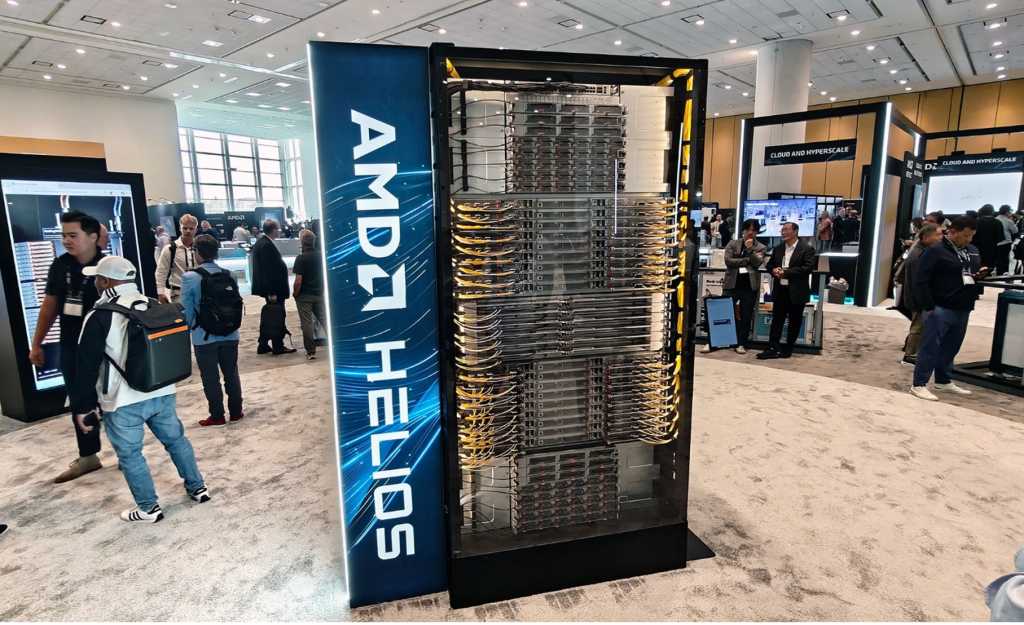
AMD has been working towards rack-scale AI system solutions for years. Its ZT Systems acquisition last year added valuable engineering talent and intellectual property that is now finally bearing the real fruits. Its Helios AI platform is a major platform evolution for AMD, with shipments scheduled to begin in the second half of this year (which is here and now).
The announcements at Advancing AI show how the company has engineered its AI platform solutions for large reasoning models, sustained inference and agentic workflows. These workloads pressure memory capacity, data movement, networking and CPU orchestration. AMD’s approach is to keep as much data close to the compute engines as possible and move it more efficiently throughout the system, but there’s deeper nuance here that’s obvious versus AMD’s chief rival, NVIDIA.
AMD’s MI455X targets the AI memory wall
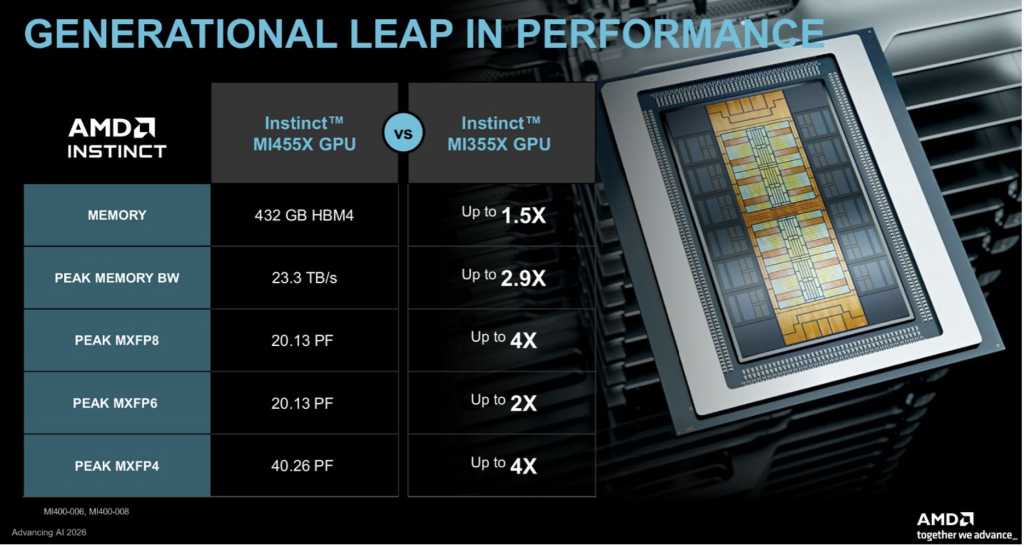
The Instinct MI455X GPU is the compute engine that fuels the Helios rack, and the first GPU based on AMD’s new CDNA 5 architecture. Built with a modular mix of 2nm and 3nm chiplets, it carries 432GB of HBM4 and 23.3TB/s of peak memory bandwidth.
Compared to AMD’s current MI355X, the MI455X offers 1.5 times the memory capacity, up to 2.9 times the peak memory bandwidth and up to four times the peak matrix performance with MXFP4 and MXFP8 data types, which are lower-precision numerical formats designed to accelerate AI processing while reducing memory demands. With MXFP6 (6-bit floating point), performance is rated at up to twice that of MI355X.
AMD also shared some actual, measured internal results using production silicon. The company claims MI455X delivers 3.8 times higher FP8 decode performance, 3.5 times more measured FP4 compute performance and between 2.5 and 3.5 times more networking bandwidth than MI355X, depending on the transfer path tested. Those figures provide more context than just numerical specifications, though they remain AMD-provided comparisons that will need independent validation.
AMD
The architectural choices behind the numbers are important. Reasoning models and long context windows require sizeable KV caches for maintaining AI attention states, while mixture-of-experts models frequently move large amounts of data across accelerators. MI455X should let more model data, activation states and cache remain local. New dedicated IP in hardware can transfer data while the GPU continues processing, and expanded cache and multicast capabilities are designed to reduce redundant data movement to further improve efficiency.
The aforementioned lower-precision formats can also raise throughput and reduce memory use, but model developers still have to determine where they can be applied without unacceptable accuracy loss.
AMD’s Helios rack takes aim at Vera Rubin
Dave Altavilla
Helios is AMD’s primary rack-scale competitor to NVIDIA’s Vera Rubin platform. Each liquid-cooled rack combines 72 MI455X GPUs, 18 single-socket Venice host CPUs and Pensando networking technologies.
In its most complete, premium configuration, AMD rates Helios for 2.9 exaflops of low-precision AI compute, with 31TB of aggregate HBM4 capacity, 1.7PB/s of memory bandwidth, 260TB/s of bidirectional scale-up bandwidth and 43TB/s of scale-out bandwidth.
These are formidable figures, but they are technical specifications rather than actual application benchmarks. The more consequential development is AMD’s move from collections of eight-GPU servers to a 72-GPU shared-memory domain. Models too large for one node can operate across the rack without treating every exchange as a scale-out networking transaction, which benefits large-model inference as well as training.
AMD uses UALink over Ethernet, or UALoE, for an open standard scale-up fabric. Each MI455X provides 3.6TB/s of bidirectional scale-up bandwidth, while the complete rack delivers all-to-all connectivity through a single switch layer. AMD also claims six times more scale-out bandwidth per GPU than MI355X when MI455X is configured with three Pensando Vulcano 800 AI NICs.
While open standards give cloud providers more control over suppliers and system design, AMD and its partners now have to prove those components can deliver the predictable performance, reliability and deployment experience customers expect from a tightly controlled, more vertically integrated platform.
Finally, AMD designed Helios with automatic rerouting around failed links, virtual rack partitions, tray-level serviceability and rack-wide power, cooling and health monitoring. Major hyperscalers and potentially large-scale enterprise customers will likely key in on these capabilities, which can affect the availability, total cost and consistency of the AI services they consume.
Kind of like cowbell, AMD Venice gives agentic AI more CPU
AMD
AMD’s agentic CPU messaging regarding its upcoming Venice-based EPYC processors is mostly marketing speak, but the underlying requirement is very real. An AI agent can invoke retrieval, databases, security checks, code execution and other tools before a GPU generates a response. Running many agents concurrently increases the amount of conventional compute requirements surrounding the accelerators.
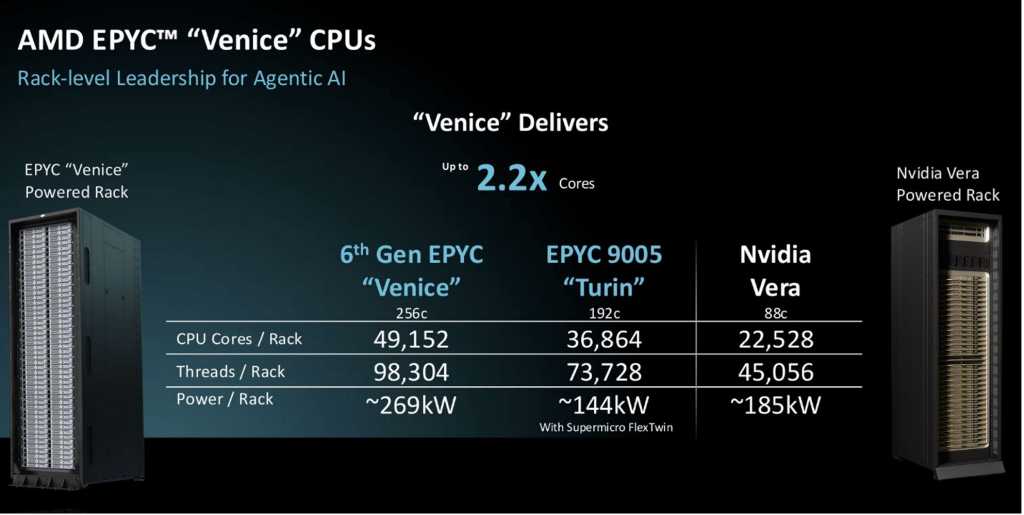
Venice scales to 256 Zen 6 cores with support for 512 threads, 16 memory channels, up to 1GB of L3 cache per socket, along with PCIe 6.0 and CXL 3.1 connectivity. AMD is also offering several Venice configurations for other applications, including general-purpose servers, high-frequency workloads, GPU hosts and high-density CPU sandbox systems used to execute agent tools.
Treating the CPU solely as a GPU host understates its role. Gateways, tokenization, vector search, databases and short-lived code execution stress different mixes of per-core performance, thread count, memory bandwidth and I/O. Specifically, AMD’s internal testing shows Venice significantly outperforming its current EPYC 9965 Turin CPU across five parts of the agentic AI pipeline, including gateway processing, context assembly, vector search, enterprise applications and short-lived tool execution. Individual gains vary by workload, but AMD details the overall generational improvement at up to a 1.7 times lift. As with the MI455X figures though, these comparisons come from AMD and will require independent validation.
Pensando networking and ROCm software advance
Keeping GPUs fed with data and coordinating traffic across racks directly affects utilization and operating costs. In fact, GPU utilization is a pretty sad state of affairs currently for some of the major frontier model providers.
As such, Pensando networking has become central to AMD’s roadmap. Helios can connect each MI455X to as many as three 800Gbps Vulcano AI NICs, while Salina DPUs handle front-end networking and infrastructure services.
On the software side, which is an equally critical component, AMD also introduced ROCm.AI, an AI-assisted development layer due to arrive in August. It includes reusable skills for coding agents, simplified management and Hyperloom, which can profile workloads, tune serving configurations, modify kernels and validate results.
These tools address two persistent AMD challenges: developer efficiency and ease of use, and software tuning. Automated optimization still has to produce repeatable gains without creating hard-to-maintain code, however. And while ROCm has progressed significantly over the last few years, NVIDIA’s CUDA retains an advantage in maturity, tooling and developer familiarity.
AMD now has commitments that give its MI450 generation and Helios considerably more weight. Meta and OpenAI have announced multi-generation agreements composed of up to 6GW of AMD compute capacity, with initial 1GW deployments planned for the second half of 2026.
Oracle plans a 50,000-GPU public cloud cluster beginning in the third quarter, while Microsoft will deploy Helios for Azure AI inference. Finally, just before the AMD event, Anthropic announced a strategic partnership for up to 2 Gigawatts of AMD-fueled AI compute, with its first gigawatt expected online in the first half of 2027.
Commitments of this scale reflect confidence in more than just MI455X performance. These customers are evaluating the complete architecture, including Venice CPUs, Pensando networking, ROCm software, rack integration, serviceability and AMD’s ability to deliver and execute across multiple product generations.
There is some financial alignment behind the agreements as well. AMD issued OpenAI performance-based warrants and committed to investing up to $5 billion in Anthropic. That context matters when evaluating these deals as market validation, but these planned deployments are substantial nonetheless and put Helios on a much stronger foundation as it begins shipping.
AMD expands its robotics and embedded foundation
AMD also expanded its physical AI portfolio, building on credible traction from its Xilinx-derived Kria adaptive system-on-modules and embedded technologies that are already powering robotics, machine vision and industrial automation applications.
The new Ryzen AI Embedded X100 combines up to 16 Zen 5 CPU cores, integrated Radeon graphics, a second-generation NPU and as much as 128GB of unified LPDDR5X memory shared across its compute engines. To me this looks a lot like a repackaging and optimization of the company’s Strix Halo platform, but with specific optimizations for the embedded space. Regardless, AMD is pairing X100 with the Kria AI Robotics Developer Platform, which includes a System Module or SOM, and a new Robotics Partner Network spanning hardware, software and platform providers.
Samples began shipping in June, with full production expected in the fourth quarter. This broader objective is to give developers a path across AMD x86 CPUs, GPUs, NPUs and FPGAs for real-time autonomous systems, rather than requiring them to assemble those hardware engines and software components independently.
Execution for AMD is now the test
AMD has assembled a credible platform for the burgeoning agentic AI market that’s blowing up currently with no signs of stopping. MI455X addresses memory and data movement, Venice handles dense agentic CPU workloads, Pensando networking connects global system resources, and ROCm.AI addresses software complexity. Finally, Helios assembles these components into a true competitive threat for NVIDIA’s latest Vera Rubin platform.
AMD’s open architecture may appeal to customers seeking supplier choice, but openness must also translate into reliable deployments, competitive total cost and software that does not require a significant rip-up. NVIDIA enters this cycle with a stronger ecosystem and far more rack-scale deployment experience. The true test will be how easily and reliably customers can integrate, operate and maintain these AMD solutions at scale.
As it stands, AMD now has major customers and a clearly defined architecture with systems engineering expertise behind it. Delivering Helios on schedule and showing that its performance claims translate into a real production workload throughput advantage and total cost of ownership gains will determine how much the competitive gap narrows. And of course, this is in a market that is clamoring for ever-more compute resources with a seemingly insatiable demand for AI services and capacity. That’s an environment for big iron success. Now AMD just has to deliver optimized, turnkey AI platforms. This is far easier said than done, but time will soon tell as deployments take shape this year.
This article is published as part of the Foundry Expert Contributor Network. Want to join?
Google CEO Sundar Pichai has sought to allay concerns over the delayed release of the Gemini 3.5 Pro large language model. He dodged questions about it in Google’s quarterly earnings call on Wednesday by focusing on the company’s next frontier AI model, Gemini 4, and plans to release subsequent LLMs at an almost monthly cadence.
His comments came a day after Google unveiled Gemini 3.6 Flash and 3.5 Flash Cyber but offered no update on the release of Gemini 3.5 Pro, the company’s delayed flagship reasoning model that many developers had expected to arrive weeks earlier.
Google introduced the Gemini 3.5 family at its annual I/O conference, promising to release the Pro model in June. That timeline has since slipped, with Bloomberg suggesting Gemini 3.5 Pro is months late because the model’s coding performance is falling short of internal expectations, especially when compared to better performance by similar models from OpenAI and Anthropic.
Instead of revisiting the Gemini 3.5 Pro timeline, Pichai used the earnings call to shift the discussion toward Gemini 4, when asked about how his company planned to navigate an increasingly competitive race to release frontier AI models by to Barclays Investment Bank analyst Ross Sandler.
“We are creating a baseline on top of which you will see us rapidly iterate on subsequent model releases. And so picking up pace and releasing models almost at a monthly cadence is part of our road map as we are building Gemini 4 as well,” Pichai said during the call.
Sandler’s question followed one from JPMorgan Chase & Co analyst Douglas Anmuth, who asked Pichai if Google was releasing frontier AI models frequently enough to keep pace with rivals OpenAI and Anthropic.
Pichai had responded to Anmuth’s question that Google remained confident of competing at the frontier and was investing heavily in a larger Gemini 4 base model.
Analysts, though, aren’t as confident as Pichai.
While delays to Google’s frontier model roadmap have not triggered an exodus of existing customers, either because of high switching costs or because many enterprises already running multi-model architectures, they have made CIOs evaluating AI platforms more cautious about making new commitments, said Bhupendra Chopra, chief revenue officer at IT consulting firm Kanerika.
A monthly model release cadence could prove to be a double-edged sword for enterprises and their CIOs.
While a monthly release cadence could help enterprises gain faster access to improvements in model performance, cost and capabilities, it will also require CIOs to invest more heavily in testing, governance and version management to safely adopt those updates, said Sanchit Vir Gogia, chief analyst at Greyhound Research.
Similarly, Pareekh Jain, principal analyst at Pareekh Consulting, said enterprises will embrace a faster release cadence only if each successive model delivers measurable improvements in performance, cost or safety, rather than simply changing version number.
The challenge for CIOs, Jain said, is not just keeping up with model releases; it’s deciding whether each new version is worth the cost of validating it.
It’s difficult to ignore the fact that Apple seems to have turned its MacBook Neo into a weapon to promote platform growth, with enough performance under the hood to make competitors seem inferior.
And even as the PC industry moves to try to compete with Apple’s last huge Mac success, the company is already planning a powerful follow-up.
That points to the discipline Apple has applied to the Mac since the introduction of Apple Silicon. The company has built a clear product roadmap, strong entry-level pricing, and steady performance gains. This focus is now paying dividends, giving people the impetus to keep placing their trust in Apple and its Macs — even as the industry raises prices in the face of RAMageddon and price increases.
The numbers don’t lie
“Apple’s recent price increase seems to be an inevitable response to these cost increases. In the second half of the year, other PC OEMs are expected to continue to raise prices, and the overall ASP increase is expected to continue,” Counterpoint said in a post Wednesday. The researcher tells us global PC shipments shrank 4% in the second quarter of 2026 as rising costs hit demand. The Mac maker, by contrast, moved in the opposite direction, generating 13% growth in the quarter — mainly on the back of the MacBook Neo introduction.
Recent IDC data gives Apple 10.1% year-over-year growth and just under 10% (9.9% to be exact) of the worldwide PC market, even as the overall market declined 4.9%.
“With emerging supply chain and tariff challenges inflating memory prices…, Apple’s incredibly aggressive price-point for the MacBook Neo makes its release feel all the more like a gut punch to one of the PC market’s most valuable price tiers,” Futurum Research Director Olivier Blanchard said when the Neo was released.
Neo 2.0 is already coming
In the immediate future, as competitors raise prices on the PCs that compete with Apple’s lower-cost device, Cupertino is already plotting the path toward MacBook Neo 2. Reports claim this will debut in March in new colors and use the A19 Pro chip from the iPhone 17 Pro, with performance boosted by slightly more unified memory (12GB, rather than 8GB). That’ll make it a much better Mac, likely with 10-15% performance gains and the ability to run Apple Intelligence, making it the best and most affordable AI PC in its class.
Just four months after the Neo’s rollout, Apple is already in position to leak rumors of an even more computationally capable follow-up, while competitors struggle to compete with the original on performance, build quality, and price. Still, the Neo might get more expensive, reporting warns, with the lowest-price 256GB model now gone, making the $599 Mac a mirage we can only wistfully hope to see again.
That might matter less in context, as PC makers everywhere boost prices while RAM, chips, and storage prices head north, along with transport, logistics, and energy costs. “While [Apple] did raise prices in line with the broader market, it still remains well positioned against rivals facing the same cost pressures,” said Jean Philippe Bouchard, vice president for consumer devices at IDC.
“As market conditions continue to worsen, the importance of supply chain management and capabilities are increasingly important,” Bouchard said. “The largest vendors, with their buying power and long-standing supplier ties, are best positioned to take share from smaller rivals.”
This was never about luck
This isn’t solely a market take about competition, it’s about planning.
Few in the industry seemed prepared for the massive memory price increases that hit this year. Apple clearly planned its low-cost Mac well before that happened, hoping to seize the PC market at the low-mid-range. This is precisely what it seems to have done, what it continues to do, and what it will continue to do.
The recent reports that it has a successor planned shows the breadth of the Mac company’s strategic vision, as Apple has quite clearly sought to fully exploit the failings of Windows and the internal contradictions of a value-conscious industry in stiff competition with itself.
With the first M-series Macs about to enter the replacement cycle, Apple has built a market it can capitalize on for at least a decade, meaning it already has a vision for PC sales that extends at least as far. That’s the kind of road map corporate purchasers want when they make platform deployment decisions, which is why Apple’s 10% share gains are the beginning of even more significant market change.
You can follow me on social media! Join me on BlueSky, LinkedIn, Mastodon and subscribe to my daily Apple-related news summaries at The Core.
Just in time for the iPhone’s 20th anniversary, Apple is moving closer to becoming a service company. It is set to launch its new deal with Klarna next week and when it does, Apple enthusiasts in the US will effectively be able to subscribe to their favorite Apple hardware, with the cost spread across up to three years.
This matters because when combined with Apple One and Apple’s Creator Studio subscriptions, the Klarna arrangement brings Apple closer to offering a full subscription model for hardware, software, and services. The only thing you don’t get under the new arrangement is AppleCare, for which you’ll allegedly need to pay extra.
Moving closer to hardware-as-a-service
Apple has slowly been transitioning toward hardware-as-a-service for almost a decade. Back then, Forrester analyst Frank Gillet predicted the company would eventually offer bundles of services and products for a monthly, all-in, fee.
This isn’t quite where we are yet; you still need at least three subscriptions to get close. But, after the better part of a decade, Apple has moved much nearer to the hardware-as-a-service idea.
There are some products reportedly excluded from the arrangement, including MacBook Neo, Apple Watch SE, the entry-level iPad, and iPhone 16. Clearly, Apple sees those products as sufficiently affordable.
Easy payments for RAM-ageddon
The new Klarna arrangement comes as Apple is forced to increase product prices as AI-driven memory price inflation becomes widely felt across every economy. In theory, I assume, Apple hopes to make its products available to cash-strapped consumers who need new hardware, while also navigating a time of deep economic tumult and uncertainty. It’s thought the company has previously rejected these plans to protect normal hardware sales, but normality is a kingdom we no longer seem to possess. Interesting times. Probable inflation incoming.
“Apple Upgrade lands at precisely the moment Apple needs it,” IDC analyst Francisco Jeronimo wrote in a note seen by Computerworld. “Having just pushed Mac and iPad prices up on the back of the memory shortage, with iPhone increases widely expected in September — as well as the new iPhone foldable expected at $2,500 — Apple’s real risk is that rising prices even further can impact the upgrade cycle.”
New age, new shopping habits
The introduction of the scheme gives consumers a way to purchase the company’s popular high-end devices when they are introduced — no doubt,at higher cost — this fall. Plus, of course, if it’s good enough for GM, it’s good enough for Apple.
Reluctance to embrace “Access Not Ownership’”purchasing models has dropped dramatically since Apple — and CEO Tim Cook — first began banging the drum for services income. Apple’s services stream has now become its second-biggest revenue driver after the iPhone. It has over 1 billion paid subscriptions, and an active hardware installed base of more than 2.5 billion devices globally.
A combination of changed customer habits and external threat means the stars are now aligned for hardware-as-a-service models. “Reframing a device as a low monthly payment protects that [upgrade] cadence and allows Apple to start marketing their products as device-as-a-service to consumers, which no other vendor was ever able to do,” Jeronimo wrote to me.
There is a one-more-thing aspect to this: the products are effectively being leased, a new approach that will give Apple a stronger grip on EOL devices, helping it grab more of them for refurbishment, resale, and recycling. Over time, this will give the company a much stronger grip on the lucrative second-user market that exists around Apple equipment, even while for almost every consumer product we find the life we want is something we can rent, but probably can’t afford to own.
Managing future risk
The other solid reason to take a partnership approach is risk management. Apple had intended to develop its own buy-now, pay-later scheme via Apple Pay Later, but abandoned that plan as it became riskier with rising bank rates. “Also, by backing the program with Klarna rather than reviving the in-house subscription plan it shelved in 2024, Apple captures the demand upside without taking the credit risk onto its own balance sheet,” Jeronimo said.
As Apple gears up to anoint John Ternus the new company CEO in September (while current leader Tim Cook takes a seat on the board) the company appears to be firing on all cylinders ahead of the leadership transition.
What’s going well
Just look at the evidence:
Apple is building market share across its entire product range; even memory-driven price inflation doesn’t seem to have dampened demand for its hardware yet.
While Apple had to raise prices, the company’s MacBook Neo remains seriously popular. It’s sitting atop Amazon’s US best-selling chart, which currently includes six Macs in the top 10. The Neo has topped this chart since its introduction.
Apple’s iPhone 17 series continues to sell well, with recent market data showing sustained growth. Both Counterpoint and IDC tell us that iPhone shipments continue to increase, even as other vendor shipments slide.
IDC analyst Francisco Jeronimo recently estimated that Apple’s upcoming foldable iPhone Ultra could grab 29.4% of global folding smartphone sales this year, rising to 34.9% in 2027.
The company’s new 27 series of operating systems is attracting a great response as beta testers report that it is already solid, stable, and performing well.
The AI narrative has really changed, with analysts no longer quite so starry-eyed at the prospects for the big frontier AI firms. Apple’s edge-AI-enabling approach is winning converts.
What’s coming up
The company’s newly-filed lawsuit against OpenAI may or may not succeed, but it will certainly help consolidate recognition of the importance of Apple’s designs and intellectual property in whatever hardware emerges from the AI firm. It also means both Apple and OpenAI are already competing in hardware, even though neither company yet offers anything that directly challenges the other.
Apple has just set out its stall to brand-loyal fans in a big way and did so before OpenAI gets to woo the same set of customers with a wriggle of its Jony Ive-tinged talisman.
The stage is set for intense competition between the two. Though some say Apple’s needs to improve employee retention, if it does find proof of efforts to use recruitment to engage in industrial espionage, it’ll be easier to represent its own products as being the OG for new hardware.
If nothing else, it means consumers will forever be asking, “If OpenAI’s designers are so good, why did it need to poach them from Apple?” Doubt is a weapon.
Managing perception
It doesn’t matter how the case goes, because there fight is already affecting consumer psychology. It also means that as Ternus prepares to take his seat atop the rainbow-colored Apple throne, we can already size him up. “A man is measured by his enemies,” Joe Abercrombie wrote in “The Trouble With Peace.”
Given the proximity of the leadership transition, it’s highly probable that Ternus signed-off on the litigation; in doing so he — and Apple — tell us to expect more of the same.
Apple has, rightly or wrongly, decided that OpenAI will become its new existential bugbear, following in the footsteps of Microsoft Windows, Real Networks, Adobe Flash, Android, and Samsung, all of whom have been useful foils against which Apple has been able to build and maintain its identity.
Looking at that list, you’d be tempted to believe that nothing much is new. Apple has often defined itself by the enemies it sometimes keeps. What has been will be again, which in this case means even as OpenAI attempts to carve out an identity as a hardware manufacturer delivering solutions to compete with Apple and Google, Ternus’ team’s looks to drive a consensus-shaped wedge into the pro-LLM propaganda.
That blow comes as Apple finally gets its act together around AI, and as the company prepares for a future in which the world’s most-used wearable device also becomes the wearable way to woo Siri AI.
My kingdom come
Rising market share, powerful solutions, an increasingly recognized and respected approach to AI, and an ideological crusade — these details constitute Apple’s place today and are Tim Cook’s coronation gift to Ternus. He’s passing along a strong and hyper-profitable baton that screams of timeliness and relevance even as the company gets set, ready, to go with a year or two of new product designs, new product families, and a 20thanniversary iPhone.
This is Apple’s party. OpenAI’s name didn’t make the list.
Looking ahead just a short time, Apple could hold a powerful position in AI where it most makes sense: deployment.
Not only will the company offer up its own AI models for the kind of tasks millions use ChatGPT to do today, but it will provide more sophisticated on-device agentic models to help users get things done through Siri AI.
Apple also offers limited capacity for more complex tasks through Private Cloud Compute, and, in partnership with the likes of Google in the US and Alibaba in China, the company is giving users a trusted conduit through which to access even more sophisticated AI services.
Apple is also coming up the inside lane around frontier AI, with iterative OS and hardware enhancements that mean its devices become increasingly effective for Edge AI use cases, on device — no cloud service required.
The company appears to be digging down into those use cases. Mark Gurman at Bloomberg recently predicted that future M7 Ultra Macs will support as much as 1.5TB RAM, making these systems more than capable of running full weight frontier models in people’s offices, colleges, and homes.
While that does assume the AI-flationary memory market can supply that much RAM at prices humans can afford, it is also true that people are already running AI clusters using off-the-shelf Mac minis networked over Thunderbolt cables. It’s no stretch to believe this will continue to be the case, and that it will even broaden as the power/performance offered at the high end grows.
What’s wrong with good enough?
When combined with open AI stacks, particularly newly emerging varieties, Apple’s platforms should become leading contenders for private AI services and edge AI. Many business users will leap at the chance to offer their workers powerful, self-hosted, private AI services using one or more daisy-chained Mac Studios or Mac minis. The recent craze in deployment of both Macs to support OpenClaw instances shows they already are.
Ultimately, these different slices of momentum mean I agree with investor Jason Calacanis that Apple is in position to apply a great deal of pressure on OpenAI and Claude just by putting models on their devices.
It’s also worth thinking about how people use AI today. How many of the queries made in the world right now constitute relatively simple tasks that could be transacted by on-device AI, such as the emerging new version of Apple Intelligence or even smaller LLM models running on device? You can even run PrismML’s 1-bit, 27-billion parameter Bonsai on an iPad using the Locally app, and that’s in the here and now.
What happens? Pretty soon you’ll find people recognize that they can already run the vast majority of their AI-augmented workflows using services they have on their existing device or can access on their on-prem Mac set-ups. And, of course, as people get used to running small tasks locally and larger tasks on premises, the actual space in which they need to turn to cloud-based frontier models will erode. That’s even as companies like PrismML work towards slimming down full-weight models so they don’t need to run on a server at all.
“It’s going to be wild when people have unlimited tokens on their desks,” said Calacanis in a podcast round table discussion.
Who has the most to lose?
The current incarnations of AI felt like they came from nowhere. Most people weren’t aware of the technology until returning to work after the 2022 holiday season. Since then, the industry has proliferated with dozens of competing models, most recently including powerful but affordable frontier models such as Qwen and Kimi.ai.
These models aren’t necessarily all as good as one another, but in many cases for much of what we do, we’ll find them to be good enough. That’s an existential crisis for some, as industry observers now think the inevitable pricing pressure means some services might have over-invested in capacity before finding any way to turn a profit.
Those profit-seeking services are the ones with the most to lose as Apple extends its hardware advantage, democratizing AI access for all while providing platforms suitable for edge AI, on-premises AI, private AI, and even AI access using third-party services. (The need for the latter will shrink as the capabilities of the former get better.)
Cupertino rising
What does this all mean? While the industry remains young, it is already fragmenting. And striding through the dust of that process comes Apple, equipped with the hardware, software, and approach to build its business even as the enterprise of first mover AI services erodes.
You can follow me on social media! Join me on BlueSky, LinkedIn, Mastodon and subscribe to my daily Apple-related news summaries at The Core.

 Login