❌

Reading view

Discovery of giant ‘exosatellite’ challenges our notion of what makes a moon

A possible “exosatellite” has been discovered 73 light years away. Bizarrely, it is roughly the size of Jupiter and orbiting a failed star called a brown dwarf, which in turn is orbiting the red dwarf star CD-35 2722.

This huge alien “moon” was found by the Very Large Telescope’s CRIRES+ spectroscopic instrument, which measured the Doppler shift in the brown dwarf’s light as the exosatellite gravitationally tugged on it. This is the same method used to discover the first known exoplanet around a Sun-like star, namely 51 Pegasi b, in 1995.

Only a handful of exosatellite candidates have been discovered thus far, with none being particularly convincing. This newly detected satellite, reported in Nature, is possibly the best of the bunch. The brown dwarf, known as CD-35 2722b, has a mass about 37 times greater than Jupiter and its exosatellite has a minimum mass of 90% that of Jupiter.

Moon, satellite or planet?

Planetary mass objects around brown dwarfs have been discovered before. Take the example of 2M1207b, which is an object up to six times more massive than Jupiter orbiting a brown dwarf, discovered in 2005 by the Very Large Telescope. Such objects have not been referred to previously as moons or satellites, so why now?

“This system is meaningfully different from 2M1207 because of the mass ratios and separations involved in CD-35 2722,” says Kevin Hoy, a PhD candidate at the European Southern Observatory and the Instituto de Estudios Astrofísicos in Chile, who led the discovery.

Whereas 2M1207b is approximately a quarter of the mass of its host brown dwarf and on a very wide orbit, possibly as long as 20,000 years, CD-35 2722b’s satellite has about 2.5% of the mass of its host brown dwarf and is on a much closer 170-day orbit.

There’s also the hierarchy of the system to consider. In the 2M1207 system, the brown dwarf doesn’t orbit anything, but in CD-35 2722 the brown dwarf is on a 5000-year-long orbit around its companion star. The candidate exosatellite therefore orbits something that orbits a star, just as a given moon in our Solar System orbits a planet that orbits a star. Since our Solar System has nothing like this brown dwarf–satellite combination, the language that we use to describe such objects is seemingly inadequate.

Mary Anne Limbach of the University of Michigan, who was not involved in this study, agrees that our nomenclature is increasingly ill-suited to the bizarre objects that we are discovering beyond our Solar System.

“Most people in the astronomical community would probably hesitate to call this an exomoon,” she tells Physics World. “But I think ‘exosatellite’ is appropriate. The field needs language for companions that do not neatly fit into the traditional categories of planets and moons, and ‘satellite’ seems to be the broader term that the field is gravitating towards.”

Forming exosatellites

Definitions are important, adds Limbach, because they allow us to distinguish between how otherwise similar objects formed.

The moons in our Solar System formed from debris discs encircling their parent planets. Material in the discs clumped together, forming cores that were then able to sweep up the remainder of the material. Astronomers refer to this as core accretion formation.

“If I had to put money on it, I would doubt that the CD-35 2722b satellite formed via core accretion for several reasons,” says Hoy. These reasons include the size of the disc required to build such a massive satellite, the speed with which it would have done so (it is only 150 million years old) and its eccentric orbit. Moons born in situ around their parent typically adopt a more circular orbit.

Instead, Hoy suspects that the brown dwarf and its satellite collapsed directly out of a gas cloud in much the same way that stars do. “That would be my best guess,” he says.

The formation mechanism makes all the difference to Limbach, who opines that, “an object can reasonably be called a moon if it formed through a process analogous to the formation of the moons around the Solar System’s planets.”

Limbach cautions that since we only know the satellite’s minimum mass, we cannot yet rule out this being a binary system of two brown dwarfs. Either way, Limbach sees the system as being close to that of a binary giant planet. Our understanding of how giant planetary bodies and low-mass brown dwarfs form tells us that binary giant planets should be rare, “but the first emerging examples hint that they may not be,” says Limbach. These include about 40 pairs of rogue binary giant planets, called Jupiter Mass Binary Objects (JuMBOs), found by the James Webb Space Telescope in the Orion Nebula’s Trapezium star cluster.

Tip of the iceberg

Another unanswered question is how far down does CD-35 2722’s hierarchy go? Could the exosatellite have moons of its own?

“I think it’s definitely possible,” says Hoy, so long as they are on tight orbits so that gravitational tides cannot destabilize them. “Unfortunately such an object is likely impossible to detect with our current methods.”

However, our current methods could soon learn that CD-35 2722 is just the tip of the iceberg.

“Looking at directly imaged planets and brown dwarfs is the most likely way to yield more exosatellites,” says Hoy, while also citing astrometry (looking for deviations in the motion of a star through space) and microlensing (where the gravity of an otherwise unseen exosatellite creates a temporary gravitational lens) as key techniques that could bring dividends.

Meanwhile, it is hoped that the European Space Agency’s PLATO mission, which will discover exoplanets via transits, will detect significantly large terrestrial moons once the mission launches at the beginning of 2027. All in all, we could be on the cusp of a new era of exomoon and exosatellite discovery.

The post Discovery of giant ‘exosatellite’ challenges our notion of what makes a moon appeared first on Physics World.

  •  

Scientists discover sugar in interstellar space

Sugars are a vital ingredient in the recipe for life, responsible for a range of biological processes and a key component of nucleic acids such as DNA and RNA. The question of how these essential biomolecules were produced on primitive Earth is a pressing concern for origin-of-life researchers, with laboratory experiments suggesting that primordial conditions would not yield sufficient quantities.

In a study led by Izaskun Jiménez-Serra at the Centro de Astrobiología (CAB, CSIC-INTA) in Spain, researchers have observed a four-carbon sugar, erythrulose, in the interstellar medium for the first time. Such sugar could have contributed to the resources available for early biological processes, providing insight into how life began on Earth.

Sugars in space

Based on studies of asteroid samples, researchers suggest that key building blocks for life may have had an extraterrestrial origin. Previous analysis of samples from the asteroid Bennu has demonstrated the presence of the sugar glucose, a primary energy source for biological processes, and ribose, a sugar that contributes to the development of nucleic acids.

The idea is that meteorites and comets containing these important chemical components impacted Earth and contributed to the resources available to develop life. This latest research looks backwards in this process to question whether these molecules may have formed in the clouds of dust and gas that parent these astronomical bodies.

Detailed in Nature Astronomy, this first observation of sugar in the interstellar medium suggests that the ingredients for life may indeed form in dust clouds as previously proposed.

Detecting erythrulose

To detect these molecules, Jiménez-Serra and colleagues used the Yebes 40 m and IRAM 30 m telescopes in Spain. Ultrasensitive, broadband spectral surveys allowed them to identify the signature of erythrulose inside G+0.693−0.027, a cloud of gas close to the centre of the Milky Way.

The team had to overcome various challenges, including the spectral signatures of different molecules overlapping and blending into one another. To ensure the validity of their observations, they identified over 180 molecular species to better understand any possible interference with the emission of erythrulose. This extensive characterization allowed the researchers to obtain very high levels of confidence in their observations, they say.

The team also analysed how the erythrulose may have been formed in the extreme low temperatures and vacuum conditions of interstellar space. The abundance of erythrulose is eight times that of three-carbon sugars which are currently undetected by these incredibly sensitive observations. This led the team to model the formation of erythrulose from simpler and more readily available two-carbon aldehydes and alcohols – a process that occurs on the surface of grains of dust in space, with the potential to then contribute to chemical systems on Earth.

Extraterrestrial building blocks

On Earth, erythrulose is found in fruits such as melons and raspberries. In aqueous environments, such as bodies of water on Earth, erythrulose easily changes its configuration into the sugar threose. Similar to ribose in RNA, threose appears in threose nucleic acid (TNA). One of the simplest nucleic acids, TNA may be one of the first involved in the early development of life.

According to Jiménez-Serra: “The discovery of erythrulose in the interstellar medium opens up the possibility for these key organic compounds to form in other molecular clouds in the Galaxy where stars and planets are forming”.

The team’s future plans include searching for larger sugars such as the five-carbon ribose found in RNA. “By combining astronomical observations with laboratory experiments and theoretical calculations, we will explore the chemistry of these sugars and of their related compounds, which could have played a key role in the origin of life,” shared Jiménez-Serra.

The work is being completed as part of the ERC consolidator grant OPENS. This highly interdisciplinary project draws from a range of research methods and scientific fields to approach the question of how life begun on earth. By continuing this research, the team hopes to learn more about the very earliest stage of our journey on this planet.

The post Scientists discover sugar in interstellar space appeared first on Physics World.

  •  

Asymmetric weather pattern reveals exoplanet’s true atmosphere

Thanks to new “transit” observations of the hot Jupiter exoplanet WASP-94A b using the James Webb Space Telescope (JWST), researchers at Johns Hopkins University in the US have discovered a striking weather pattern on this distant world. Their work could help provide a clearer picture of the atmospheres on exoplanets, which has been very limited until now.

When an exoplanet passes in front of (or transits) its host star, some of the light from that star passes through the planet’s atmosphere. By detecting this light using telescopes, either ground-based or in space, astronomers are able to obtain the exoplanet’s atmospheric light spectrum.

A team led by Sagnick Mukherjee and David Sing has now analysed data on WASP-94A b from the space-based JWST and have found that the mornings on this exoplanet are extremely cloudy – with water absorption features in the spectrum – while its evenings are very clear. Clouds likely form on the planet’s colder, permanent nightside where temperatures are low enough for minerals to condense. Winds then carry those clouds towards the morning limb (the leading edge of the atmosphere), explains Mukherjee.

“As these cloud particles are dragged farther toward the hotter dayside, the clouds evaporate or sink deeper, leaving the evening side much clearer,” he says. “This is a clear discovery of a planet-wide cloud cycle in action on a distant exoplanet.”

Part of a broader survey

The researchers, who detail their findings in Science, decided to study WASP-94A b as part of a broader survey of exoplanet atmospheres with the JWST called the “Grand Tour Program”. The goal of this project, says Mukherjee, is to better understand the composition of these exoplanets and the physical processes at play in their atmospheres.

One of the main difficulties encountered during such observations is how small the signals that we are trying to look at are, he explains. However, in this case, the asymmetry between the morning and evening side of the planet was rather dramatic, which made it possible to separately probe the two.

Until now, researchers only had access to a single averaged spectrum of WASP-94A b – and indeed most other exoplanets studied over the last decade –from observations made by the Hubble telescope, for example. The chemical composition of the exoplanet’s atmosphere was therefore highly biased, says Mukherjee, and it was thought that the levels of oxygen and carbon there were hundreds of times higher than on the Sun. “This finding baffled us because this result could not be explained by planet formation theories. The new data show that WASP-94A b only contains only about five times as much oxygen and carbon.”

“Being able to resolve the cloudy morning and clear evening separately therefore gives us a much cleaner view of what the atmosphere is actually made of,” Mukherjee tells Physics World. “And this is not just relevant to hot-Jupiters like WASP-94A b, but might be extended to all exoplanet atmospheres that we are trying to understand using the transit method.”

“One of the most exciting aspects”

For Mukherjee, this is one of the most exciting aspects of the JWST era. “We are taking a step beyond simply detecting the atmospheres of distant planets and are now beginning to map their weather, chemistry, and three-dimensional structure in extraordinary detail.”

Indeed, using WASP-94A b as a benchmark, the Johns Hopkins team has already studied eight other hot gas giants and discovered the same distinctive cloud cycle on two other worlds: WASP-39 b and WASP-17 b. “Inspired by these observations, our collaboration, co-led by David Sing, myself and our colleague Guangwei Fu, is about to receive more than 180 hours of new JWST data to understand weather on diverse exoplanets and measure how their weather and cloud-coverage vary with planet temperature and gravity,” reveals Mukherjee.

The post Asymmetric weather pattern reveals exoplanet’s true atmosphere appeared first on Physics World.
  •  

Astronomers Detect an Atmosphere on a Potentially Earth-Like World

Artist’s Illustration of Exoplanet LHS 1140 BThis discovery marks a major milestone in the search for life on worlds beyond our solar system. A faint stream of helium escaping from a distant rocky world has revealed something astronomers had never clearly detected before: an atmosphere around an Earth-like planet in another star’s habitable zone. The result is the strongest evidence so [...]
  •  

MCMC Science

MCMC Science

In addition to model development, the Mars Climate Modeling Center (MCMC) conducts cutting-edge scientific research on the past and present atmosphere and climate of Mars.

NASA Ames MCMC Logo Left Justified

The Mars Climate Modeling Center (MCMC) conducts atmospheric and climate science research using the NASA Ames Mars Global Climate Models (MGCMs), advancing our understanding of Mars’ climate today, in its ancient past, and as a target for future exploration.

Mars’ climate is governed by three interacting cycles — dust, water, and carbon dioxide (CO₂) — that vary across seasons and from year to year. MCMC scientists use the MGCMs to study these cycles and the processes that drive them, including:

  • Dust storms and dust transport – Investigating the mechanisms that lift, transport, and remove dust in the Martian atmosphere, including the onset and evolution of regional and global-scale dust storms.
  • Water and CO₂ cycles – Studying the seasonal exchange of water and CO₂ between the atmosphere, polar caps, and surface, and the clouds that form as a result.
  • Atmospheric dynamics – Examining circulation patterns, wave-mean flow interactions, and the extension of the MGCM into the middle atmosphere to better connect the lower and upper atmosphere.
  • Ancient Mars and habitability – Reconstructing past climate states, including the role of asteroid and comet impacts, to assess when and where conditions may have supported liquid water and habitability.
  • Mission support – Applying model results to landing site selection and characterization, atmospheric entry planning, and interpretation of data from current and past Mars missions.

This research is carried out by a team of civil servant and contractor scientists, postdoctoral researchers, and students, often in collaboration with universities and other NASA centers. You can read more about individual MCMC team members and their science on the Group Members page. A full list of MCMC research papers, conference presentations, and technical reports is available on the Publications page.

The post MCMC Science appeared first on NASA Science.

  •  

MCMC Webserver

Model Webserver

The Mars Climate Modeling Center (MCMC) presents the webserver, a website for interactive plotting and downloading Mars Global Climate Model (MGCM) output.

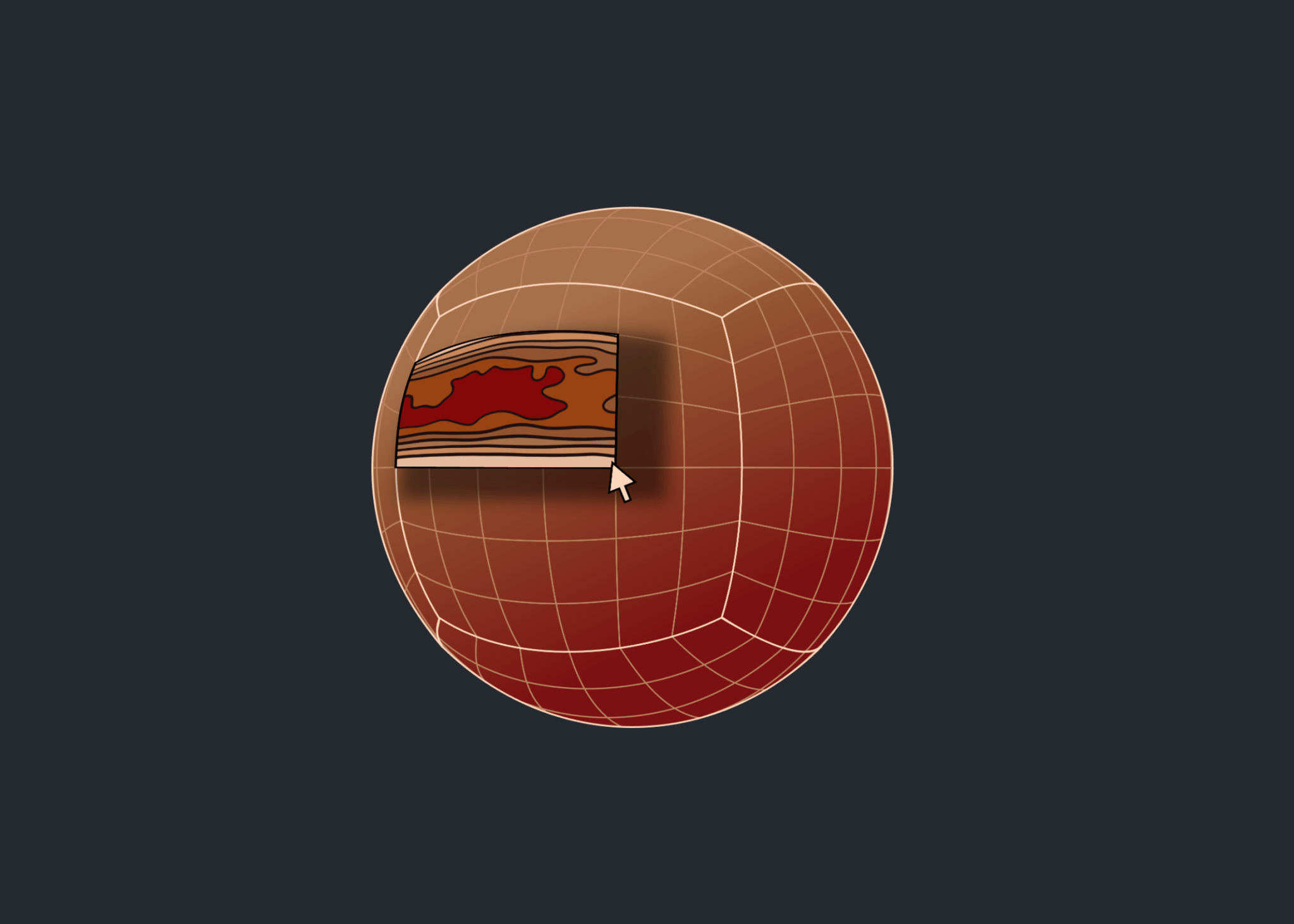
Artist rendering of MCMC's MGCM cubed-sphere grid with an overlay of a surface temperature plot

The model visualization tool offers the most accessible introduction to Mars Global Climate Model (MGCM) data. It is an online dashboard that allows users to interactively plot, explore, and download model output stored on the NAS Data Portal (see the MGCM Output tab for more information).

GCM analysis tools

MGCM Webserver

You can explore, plot, and download the MGCM output through our user-friendly web interface.

Link to the Webserver
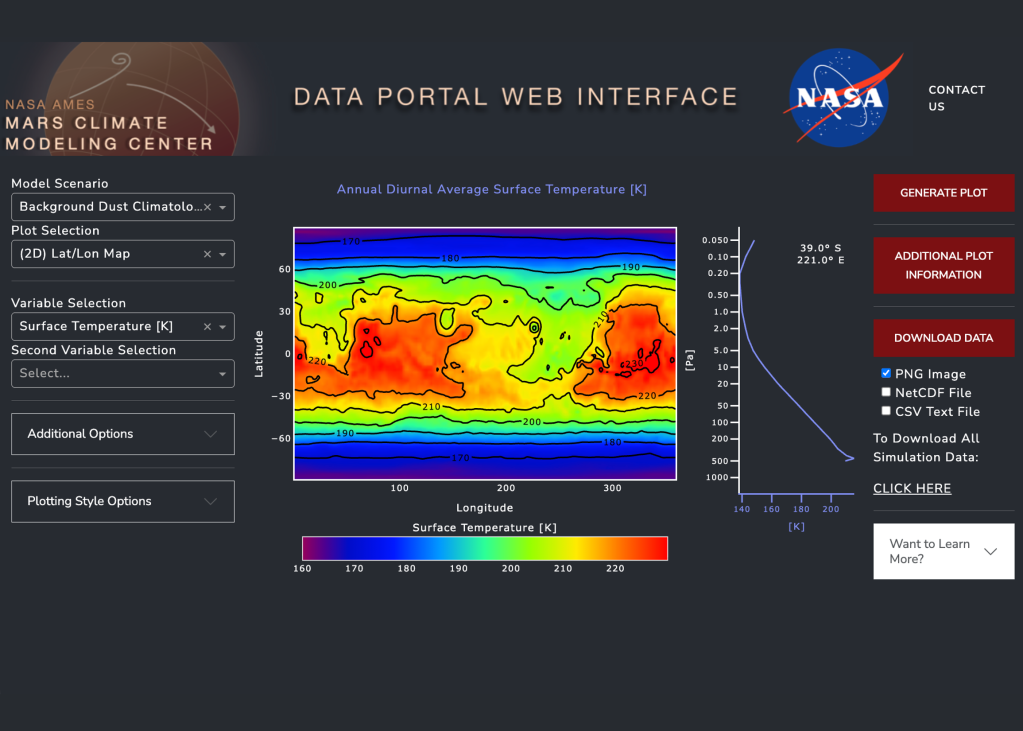
Screenshot showing the MCMC data portal web interface
The Data Portal Web Interface plotting surface temperature from MGCM output stored on the NAS Data Portal
NASA/Courtney Batterson

If you use the web interface in your research, please cite it as follows:

Web Interface (APA):

NASA Ames Mars Climate Modeling Center. (2024, August 14). Data Portal Web Interface [Web tool]. NASA Ames Research Center, NASA. https://data.nas.nasa.gov/mcmc/portals/web-interface/

Return to the MCMC homepage

Mars Climate Modeling Center (MCMC) Logo in the banner style
Mars Climate Modeling Center (MCMC) banner
NASA/Courtney Batterson

The post MCMC Webserver appeared first on NASA Science.

  •  

Giant Rift Valleys Hint Venus is Still Tectonically Active

This hemispheric view of Venus was created using radar observations, including images from NASA’s Magellan spacecraft. Magellan imaged more than 98% of Venus. Gaps in the Magellan coverage were filled with images from the Earth-based Arecibo radar. The composite image was processed to improve contrast and to emphasize small features, and was color-coded to represent elevation. Magellan launched on May 4, 1989, and was deployed from the cargo bay of Space Shuttle Atlantis on May 5, 1989. The spacecraft orbited Venus from August 10, 1990, until October 13, 1994 when the spacecraft was commanded to plunge into the atmosphere of Venus. Image credit: NASA / JPL-Caltech / USGS.

New 3D computer simulations from ETH Zurich show that young rift flanks on Venus stay tall and steep, while older ones flatten out over time.

The post Giant Rift Valleys Hint Venus is Still Tectonically Active appeared first on Sci.News: Breaking Science News.

  •  

Noble Gases Along for the Ride

A rendering of an orange and grey planet against a dark background.

What can some neon trapped in a chunk of rock tell us about Earth’s formation and the protosolar nebula? Quite a lot, as detailed in a recent study in The Planetary Science Journal.

Noble Mysteries

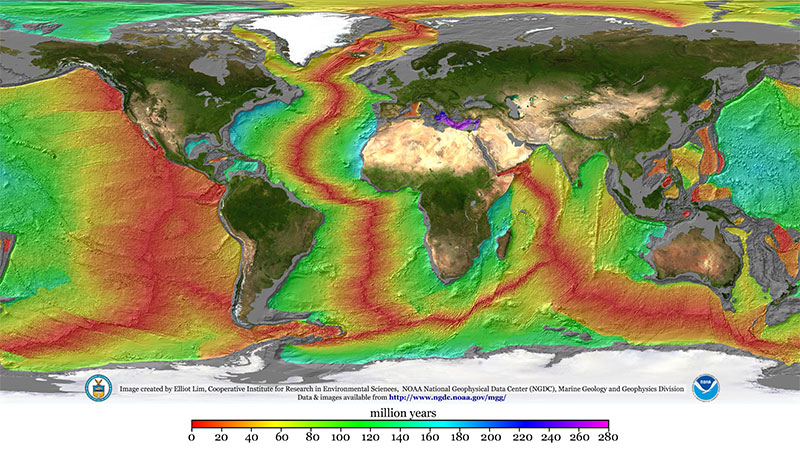
By analyzing rocks pulled from mid-ocean ridges, geologists have concluded that there are tiny amounts of noble gases in the deep interior of Earth. That’s a strange statement upon reflection: how did these gases, which are famously apathetic to essentially all other elements, end up embedded within rocks thousands of kilometers underground? Since their passivity rules out the potential of a chemical reaction that formed them in place, they must have been in the mantle since the very beginning of Earth’s history.

A map of Earth with the continents shown normally but the sea colored according to age.

A map illustrating the age of the seafloor. Mid-ocean ridges stand out clearly in red. By sampling material from these ridges, planetary scientists can infer the composition of Earth’s deep interior. Click to enlarge. [Mr. Elliot Lim, CIRES and NOAA/NCEI]

There are a few scenarios for how this could have happened. Though it’s possible that these inert species were delivered to the early Earth encapsulated within primitive meteorites or in solids contaminated by ions from the solar wind, at least some fraction of these elements likely came directly from the gaseous nebula that surrounded the earliest protoplanets.

That last option is especially exciting to present-day planetary scientists interested in constraining Earth’s formation history because it requires some very specific conditions. Since light noble gases like neon don’t dissolve well in seawater, they must have dissolved into a magma ocean — meaning the nebula was still around when Earth was large enough to have a molten surface. That already restricts us to a very specific time in the solar system’s history, but it doesn’t say much about the specific size of the proto-Earth other than “big,” and it doesn’t say much about the state of the nebula other than “it existed.” Recently, Vincent Savignac and Eve Lee (University of California, San Diego; McGill University) successfully refined these constraints to pin down information about both the early Earth and the nebula that surrounded it.

Infant Earths

Savignac and Lee began by growing a grid of infant Earths on their computers via models of gas accretion and atmosphere–magma interactions. Each simulation started with a different proto-Earth mass and nebular density, and each one yielded a different amount of neon in Earth’s deep interior. Excitingly, only a small handful of the scenarios tested ended up with values similar to those observed.

A cartoon of small cores surrounded by gaseous envelopes eventually merging into the Earth.

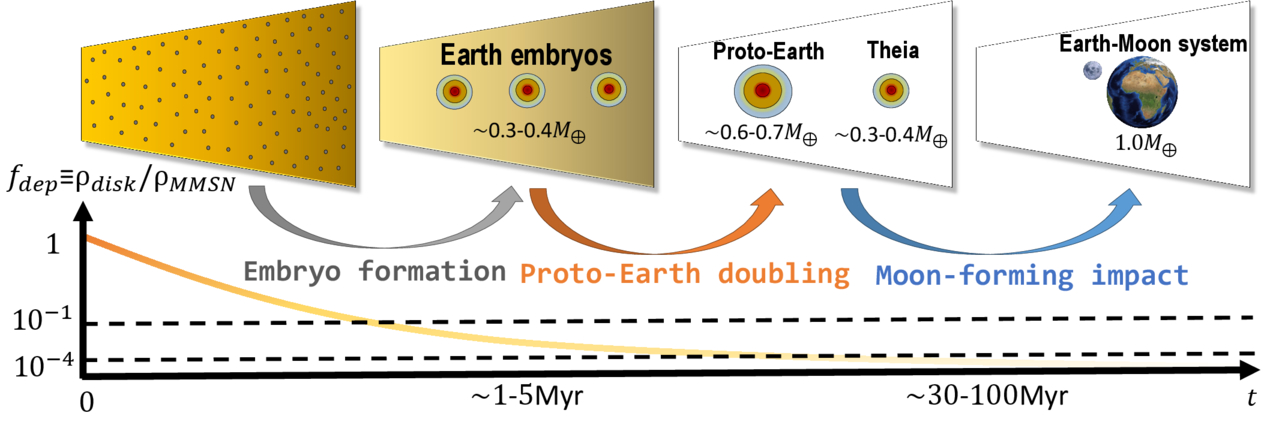
A schematic of Earth’s formation via embryo formation (when the noble gases enter the mantle) followed by mergers. Click to enlarge. [Savignac & Lee 2026]

On the mass axis, the team found a narrow range of acceptable conditions. If a proto-Earth was less than about 20% of Earth’s present-day mass, it couldn’t accrete much gas. This let it cool rapidly, freezing the magma ocean and shutting down neon dissolution before too much could be trapped inside. On the other hand, if a proto-Earth was more than about 40% of Earth’s present-day mass, it would accrete too much gas, stay molten for too long, and be left with too much neon. On the density axis, the researchers found that when the nebula accreted on to the proto-Earth, it must have been fairly depleted compared to its initial density. This implies that the whole process happened at the end of the nebula’s life, just before it was completely blown away by the proto-Sun.

Savignac and Lee demonstrated that these constraints are robust against the later stages of Earth’s evolution. In its later years, Earth either suffered or benefited from a giant impact, depending on your feelings about the Moon, but the researchers showed that this event doesn’t pose a problem for their models. Overall, this study builds a delightful link between rocks from our deep oceans and the particulars of Earth’s formation, demonstrating the unique power of planetary science to tie together different scientific fields.

Citation

“Constructing the Earth’s Formation History Using Deep Mantle Noble Gas Reservoirs,” Vincent Savignac and Eve J. Lee 2026 Planet Sci. J. 7 135. doi:10.3847/PSJ/ae64f7

The post Noble Gases Along for the Ride appeared first on AAS Nova.

  •  

Juno’s Microwave Vision Peers beneath Surface of Jupiter’s Volcanic Moon Io

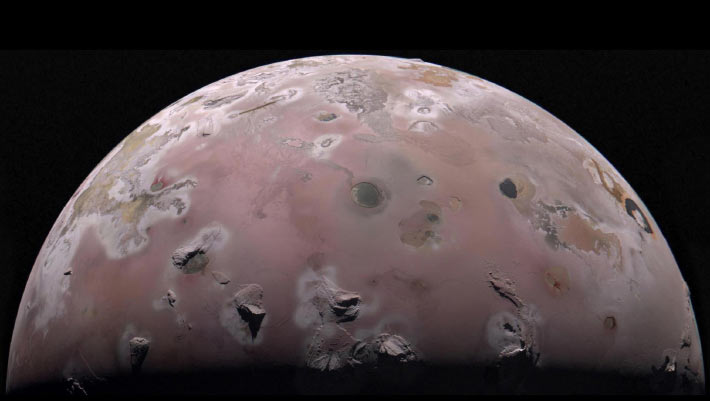
The north polar region of Io was captured by NASA’s Juno spacecraft on December 30, 2023. Image credit: NASA / JPL-Caltech / SwRI / MSSS / Gerald Eichstädt.

New data from NASA’s Juno spacecraft show temperatures spike more than 20 degrees Celsius just a few meters under Io’s surface, providing the first look at what’s happening below the crust of the Solar System’s most volcanic world.

The post Juno’s Microwave Vision Peers beneath Surface of Jupiter’s Volcanic Moon Io appeared first on Sci.News: Breaking Science News.

  •  

Space Weather May Warp Martian Weather during Dust Storms, Planetary Scientists Suggest

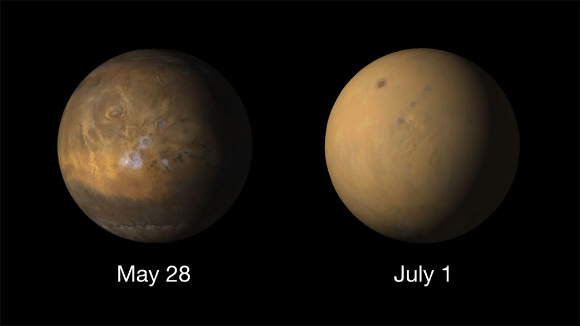
These images from Mars Color Imager (MARCI) aboard NASA’s Mars Reconnaissance Orbiter (MRO) show Mars before (left) and during (right) the June 2018 dust storm. Image credit: NASA / JPL-Caltech / University of Arizona.

Planetary researchers have found the first evidence that bursts of energetic particles from the Sun could warm the lower atmosphere of Mars during massive dust storms, hinting at an unexpected link between space weather and Martian climate.

The post Space Weather May Warp Martian Weather during Dust Storms, Planetary Scientists Suggest appeared first on Sci.News: Breaking Science News.

  •  
❌