❌

Reading view

US accelerates development of next-gen chemical protection suits for fighters with new program

A Chicago-based company has been awarded an initial $23.67 million acquisition contract under the U.S. Department of War’s Accelerate the Procurement and Fielding of Innovative Technologies (APFIT).

With this Numat Technologies will accelerate the deployment of next-generation chemical and biological protection suits for U.S. Special Operations Forces.

The award is being executed in partnership with the Defense Threat Reduction Agency (DTRA) and is intended to speed the transition of the company’s technology from development into operational use.

Numat will deliver field-ready protective suits at scale

The APFIT program was established to bridge the gap between promising defense technologies and field deployment by providing procurement funding for mature innovations that are ready for operational use. Since its launch, the program has supported the rapid acquisition of advanced capabilities for the U.S. military, with total awards now exceeding $2 billion, according to a press release.

“Over the past 10 years, Numat built the MOF industrial base for this moment, where we can activate an entire supply chain, from material design through high-volume system manufacturing, to protect the Warfighter,” said Ben Hernandez, CEO of Numat Technologies.

“This contract award reflects our long-term investment in American innovation. Numat will deliver finished, field-ready protective suits at scale, made completely in the United States.”

Numat’s protection suits incorporate metal-organic frameworks

Numat’s protection suits incorporate metal-organic frameworks (MOFs)—highly porous engineered materials designed to capture and neutralize hazardous chemical and biological agents. Unlike conventional protective garments that primarily act as barriers, the company’s MOF-enabled suits are engineered to self-detoxify by neutralizing harmful substances upon contact, while also improving breathability and wearer mobility.

Under the APFIT contract, Numat will supply the MOF-enabled chemical and biological (CB) suits directly to U.S. Special Operations Forces, whose personnel often operate in environments where exposure to chemical and biological threats is a significant concern. According to the company, the suits are designed to offer enhanced protection without compromising comfort or operational effectiveness.

The contract also represents a milestone for the domestic manufacturing of metal-organic frameworks, a technology that has gained increasing attention for applications ranging from defense and industrial filtration to energy storage and environmental protection. Numat said it has spent more than a decade building a U.S.-based supply chain capable of designing, producing and integrating MOFs into mission-critical systems.

Company Chief Executive Officer Ben Hernandez said the award reflects years of investment in establishing a domestic industrial base for MOF technology and positions the company to deliver field-ready protective equipment manufactured entirely in the United States.

The latest award builds on Numat’s long-standing collaboration with several U.S. defense organizations, including the Defense Threat Reduction Agency, the Office of the Assistant Secretary of War for Industrial Base Policy, the Capability Program Executive Office for Chemical, Biological, Radiological and Nuclear Defense, U.S. Special Operations Command, the U.S. Army and the U.S. Navy. These partnerships have helped advance MOF technology from laboratory research to scalable manufacturing, according to the company.

Beyond military applications, Numat said its MOF platform has potential uses across industrial, semiconductor and energy sectors, where advanced materials are increasingly being deployed for gas storage, chemical separation and hazardous material filtration.

The APFIT award underscores the U.S. government’s broader efforts to accelerate the procurement of innovative defense technologies while strengthening the domestic industrial base and reducing the time required to transition emerging capabilities into operational service.

  •  

Pentagon awards $7.1 million to expand U.S. production of cover glass for satellites

Defense Production Act funding was awarded to Martin Materials Solutions, a small business that makes radiation-resistant cover glass used on spacecraft solar arrays and thermal-control systems

The post Pentagon awards $7.1 million to expand U.S. production of cover glass for satellites appeared first on SpaceNews.

  •  

US firm unveils sensors to track military personnel and supplies at tactical edge

Rune Technologies has unveiled TyrSense, a new line of ruggedized sensors designed to help military units track personnel, casualties, and supplies in contested environments where conventional communications may be unavailable.

The hardware marks the company’s first expansion beyond software, extending its TyrOS logistics platform directly to personnel operating at the tactical edge.

The initial TyrSense products use small, durable NFC tags that can be attached to personnel or cargo. When scanned during a handoff, the system records the location and status of the individual or pallet in TyrOS.

Unlike conventional tracking systems, the location is determined by the node where the scan takes place rather than through GPS.

The tags can also operate without an active cloud connection or satellite signal, allowing units to continue recording movements in denied, degraded, intermittent, or low-bandwidth environments.

Once connectivity returns, the collected information can synchronize with TyrOS.

Aim to replace manual military tracking

Military units continue to rely heavily on manual processes to account for personnel and supplies, according to Rune.

Information about available resources is often maintained through whiteboards, paper manifests, and manually compiled reports. These systems can become difficult to maintain when units relocate or lose network connectivity.

TyrSense is initially designed around three military workflows that commonly depend on manual reporting: personnel accountability, medical operations, and cargo tracking.

For personnel, scanning a tag allows units to update an individual’s duty status, reducing the need for the daily manual process of compiling accountability information.

In medical operations, the system can record each transfer of a casualty as the individual moves from the point of injury through successive levels of care.

For logistics, tags attached to pallets can register shipments as they move through different nodes across a military supply network.

Built to operate when battlefield networks fail

Rune has designed the sensors around conditions where military personnel may have limited or no communications access.

Because individual scans can be registered locally at the tactical edge, units can continue collecting information even during network disruptions.

“A tag has to work in a vehicle and with no signal, because that’s where these counts happen,” said Peter Goldsborough, Co-Founder and Chief Technology Officer of Rune Technologies.

“We built TyrSense so the scan registers at the edge and reaches TyrOS the moment a connection is there. The hardware is deliberately simple. The value is what TyrOS does with the data,” he added.

The approach allows TyrOS to receive updated information once connectivity becomes available rather than requiring personnel to maintain continuous access to remote infrastructure.

Rune plans sensors for fuel and water

TyrSense builds on the company’s deployment of TyrOS with operational military units over the past year.

During Balikatan 26 in the Philippines, the software provided tactical commanders with information on food, water, fuel, and personnel supporting thousands of troops across a Joint Task Force, according to the company.

Rune is also the sole logistics provider for the US Marine Corps’ Project Dynamis and is the only application selected by both prime contractor teams participating in the US Army’s Next Generation Command and Control program.

The company now plans to expand the TyrSense hardware portfolio beyond NFC-based tracking.

  •  

US Air Force crews drop 36 practice bombs to validate F-15EX strike capability

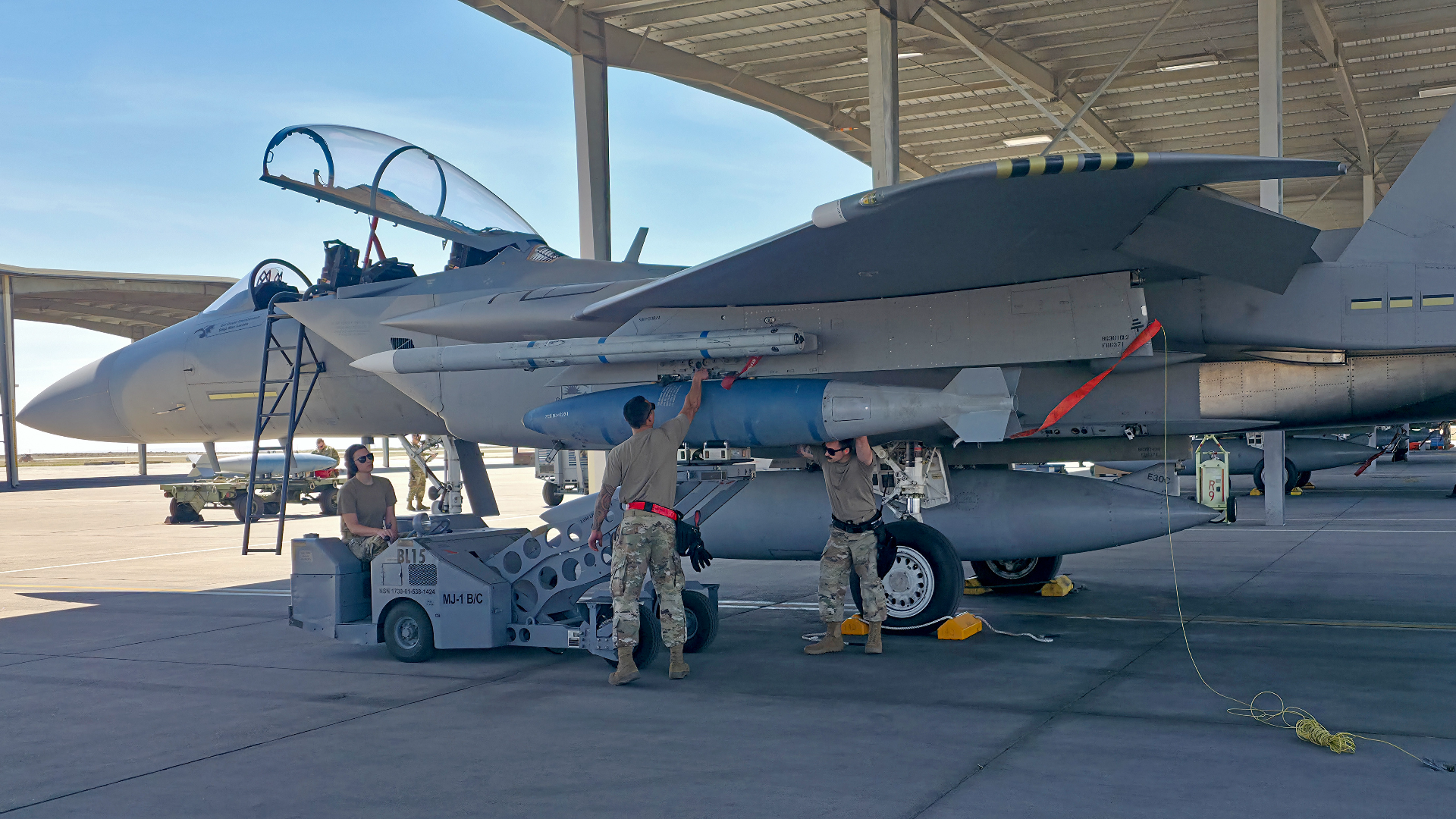
The US Air Force’s 142nd Wing has completed its first live bomb-dropping exercise with the F-15EX Eagle II, marking a key milestone in expanding the aircraft’s operational capabilities. In early May, pilots, maintainers, and munitions specialists traveled to Mountain Home Air Force Base in Idaho to carry out the training mission.

During the exercise, crews loaded 500-pound BDU-50 and 2,000-pound BDU-56 practice bombs onto the aircraft before releasing them over the Mountain Home bombing range. Although these training munitions closely resemble live bombs, they are filled with concrete instead of explosives, allowing crews to safely practice real-world weapons employment.

While the F-15EX has previously undergone weapons testing with the 85th Test and Evaluation Squadron at Eglin Air Force Base in Florida, this marks the first time an operational F-15EX unit has successfully loaded and dropped bombs as part of its mission readiness training.

F-15EX’s new combat role required months of pilot training

The F-15EX Eagle II is designed to do far more than its predecessor. Although it closely resembles the aging F-15C, the newer aircraft is built as a multirole fighter, capable of carrying out both air-to-air and air-to-ground missions. Unlocking that expanded capability, however, required months of preparation and specialized training across the 142nd Wing.

A key part of that effort was led by Maj. Jesse Loya, one of only three pilots in the wing with prior experience in air-to-ground operations. Together, the three completed a nine-month training program focused on the tactics and technical aspects of delivering precision-guided munitions. They then developed a training curriculum to teach the rest of the wing’s pilots the fundamentals of air-to-ground operations, laying the foundation for the unit’s first operational bomb-dropping mission.

According to Loya, the training at Mountain Home Air Force Base served as a stepping stone toward preparing pilots to safely employ air-to-ground weapons. The program focused on building the skills needed to handle ordnance while following a much shorter timeline than the traditional nine-month qualification course. 

He said the ability to complete the training so quickly reflected the experience and capabilities the pilots had developed throughout their careers, allowing the wing to accelerate the F-15EX’s transition into a multirole combat aircraft.

Weapons loaders play key role in prepping F-15EX

Preparing the F-15EX Eagle II for its first bomb-dropping mission required extensive training from weapons crews as well as pilots. Tech. Sgt. Tyler Phelps, one of the 142nd Wing’s experienced weapons loaders, traveled to Nellis Air Force Base in Nevada earlier this year to train with F-15E aircraft and earn certification to load bombs.

After returning to Oregon, Phelps and other certified Airmen trained the rest of the weapons team ahead of the Mountain Home mission. Seeing the bombs loaded onto the F-15EX marked the culmination of months of preparation and a major milestone for the 142nd Wing.

The training mission involved 10 sorties, during which crews dropped a total of 24 BDU-50 and 12 BDU-56 practice bombs. The operation was completed without any safety incidents, and all missions received satisfactory evaluations, marking a major step forward in the wing’s transition to the multirole capabilities of the F-15EX.

The next phase in the F-15EX’s air-to-ground certification process will involve loading and dropping live munitions. The crew is scheduled to conduct that mission at Nellis Air Force Base at the end of August, bringing the wing one step closer to full air-to-ground operational capability.

💾

The Oregon Air National Guard's 142nd Wing has completed its first live bomb drop with the F-15EX Eagle II.
  •  

Nature study identifies a new way to spot nuclear weapons in orbit

Russia's Kosmos-2553 spacecraft, alleged to be part of a nuclear weapons program, prior to launch. Credit: Ministry of Defense of the Russian Federation

NEW YORK — A study published last week in Nature Astronomy has proposed a new satellite design and technique to detect thermonuclear warheads in space. Funded in part by the […]

The post Nature study identifies a new way to spot nuclear weapons in orbit appeared first on SpaceNews.

  •  

Trump’s pick to lead Space Force defends plan to more than double budget

Lt. Gen. Douglas Schiess, to be the next chief of space operations of the U.S. Space Force, testified July 16 before the Senate Armed Services Committee in a confirmation hearing

The post Trump’s pick to lead Space Force defends plan to more than double budget appeared first on SpaceNews.

  •  
❌