Japan has succeeded in the first-ever flight test of its RV-X experimental reusable rocket prototype.
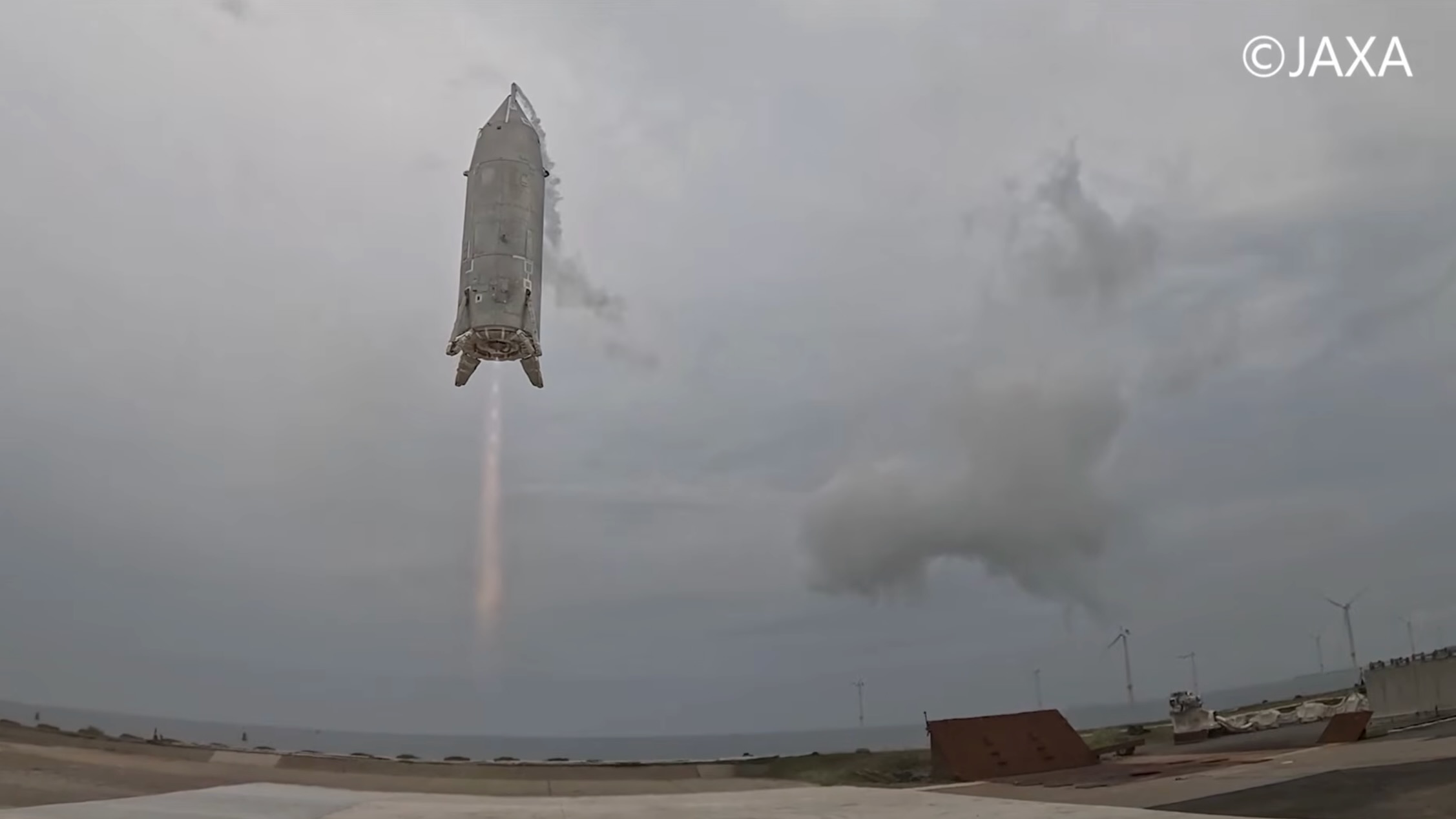
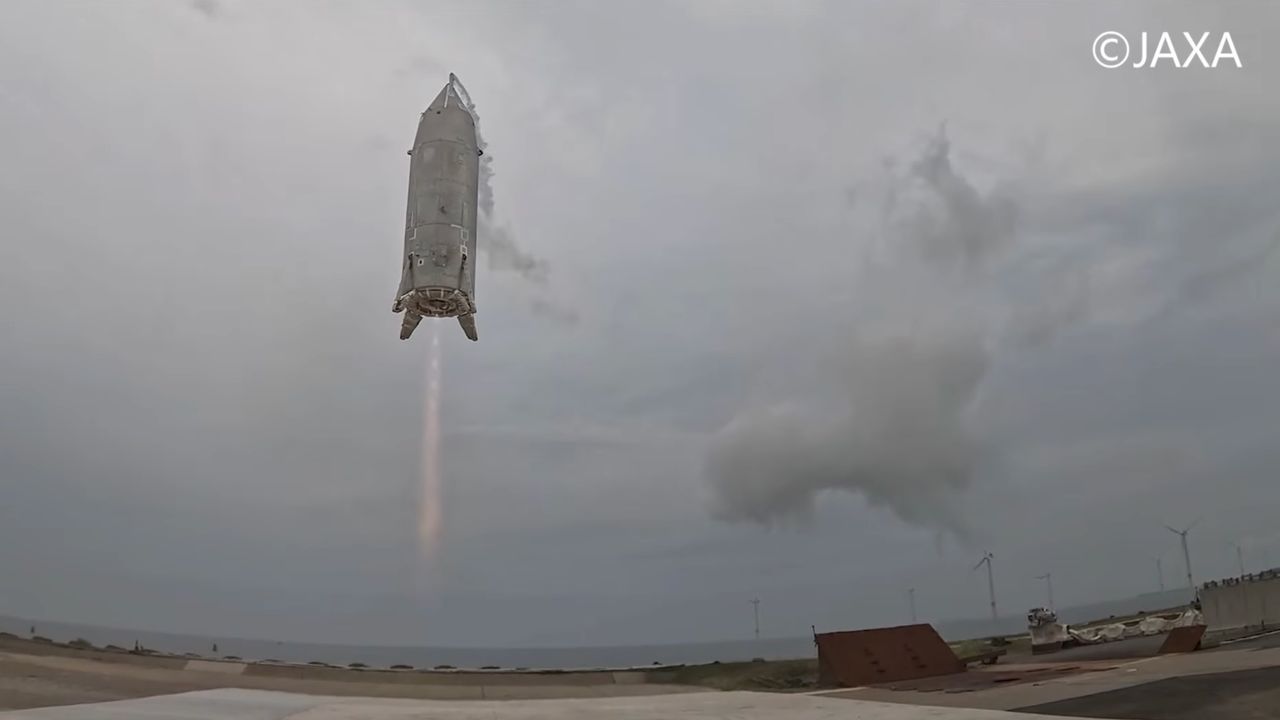
The launch — or hop, considering its duration and distance — took place at the Japan Aerospace Exploration Agency's (JAXA) Noshiro test facility on July 11 and lasted about 40 seconds. The 24-foot-tall (7.3 meters) test vehicle, powered by a single engine, rose just over 33 feet (10 m) in the air and traveled a horizontal distance of approximately 50 feet (15 m) across the site's concrete pad before touching down softly on the side opposite its liftoff point.
The short test flight went exactly as planned and puts JAXA and its partners one step closer to the development of a technological spaceflight achievement only ever accomplished by a small handful of orbital rockets — SpaceX's Falcon 9, Falcon Heavy and Starship, Blue Origin's New Glenn and, most recently, China's Long March 10B.
Japan's RV-X reusable rocket prototype takes its first hop, on July 11, 2026. (Image credit: JAXA)
JAXA's RV-X is being developed and operated in conjunction with Japan's Mitsubishi Heavy Industries and is a precursor vehicle to a single-stage reusable flight experiment project called CALLISTO. CALLISTO is a joint venture involving JAXA, France's space agency CNES and the German Aerospace Center (DLR) to design and build a single-stage rocket capable of vertical launch, landing, refurbishment and reuse. That vehicle will itself be a pathfinder rocket as JAXA seeks its own entry into the cost-saving playing field of reusable launch services.
Japan's most advanced rocket in operation, the H3, was introduced in 2023 but wasn't designed for reusability. The H3 is more efficient and cost-effective than its H-2A predecessor, which was retired last year. But two of the new rocket's eight launches have not been fully successful, and it falls short in its cost-effectiveness compared to more advanced reusable rocket stages. So JAXA is hard at work on the H3's future replacement.
"Reusable rockets require consideration of operational feasibility," JAXA's website says. "By repeatedly verifying maintenance, operation, vehicle movement and launch pad setup using an actual experimental vehicle in preparation for flight tests, we were able to establish operational procedures that will contribute to the repeated operation of future rockets."
The test, and the RV-X vehicle itself, slightly resemble a similar flight article from SpaceX's early Starship development days. The "Starhopper" Starship prototype was compared to a water tower during its first "hopper" test in 2019. The first time the stumpy, three-legged, steel Starhopper jumped off the ground at SpaceX's Starbase facility in South Texas, it flew about 65 feet (20 m) straight up and back down.
Starhopper's success paved the way for higher jumps for longer durations as SpaceX honed Starship's early design, and the same is planned for RV-X. Now that JAXA's test rocket has completed its first 33-foot (10 m) hop, Japan's space agency is looking higher, too. RV-X's next launch is expected to fly as high as 330 feet (100 m), with another lateral crossover and hover included in its flight before landing.
Es probable que para la mayoría de los lectores, la región ártica de Beringia les refiera un puente que durante las glaciaciones conectaba dos continentes, lo que permitió el paso de humanos y animales de un lado a otro. Sin embargo, este no siempre fue un simple lugar de paso.
Durante cientos de miles de años fue el hogar de innumerables criaturas que la poblaban durante los períodos glaciales, y albergó un nicho ecológico propio que permaneció intacto durante eones, un registro que conserva en su capa de permafrost. Un equipo de científicos equipado con las tecnologías actuales ha analizado restos de heces congelados por el tiempo, y se han llevado una intrigante sorpresa: los nidos de ardillas prehistóricas demuestran presencia de grandes herbívoros, entre ellos mamuts y bisontes de las estepas, e incluso carnívoros, desde antiguos lobos hasta pumas prehistóricos. ¿Qué significa este hallazgo?
Durante la última glaciación, ocurrida hace unos 110.0000 años, el descenso del nivel del mar dejó al descubierto una enorme extensión de terreno donde hoy se encuentra el estrecho de Bering. Sin embargo, mientras gran parte del hemisferio Norte quedaba sepultada bajo capas de hielo de kilómetros de espesor, la región de Bering permaneció libre de glaciares, lo que la convirtió en un refugio para numerosas especies de animales de aquella época.
Aquel lugar no era tan inhóspito como hoy, sino que en él se tapizaba una frondosa estepa dominada por pastos que sostenía una variada y rica fauna de herbívoros, como el mamut lanudo o el bisonte estepario, que convivían con otros carnívoros, además de otros mamíferos de menor tamaño, como las ardillas prehistóricas, parientes lejanos de las especies actuales.
Un nicho ecológico con una identidad propia
Lo interesante es que Beringia no solo sirvió de puente para especies que ya existían en otros lugares. Sino que también fue un espacio donde poblaciones enteras de fauna se aislaron hasta formar un nicho ecológico particular, cuya singularidad demuestra su diferenciación ecológica, que dio pie a linajes propios que no pueden encontrarse en ningún lugar.
Un ejemplo revelador de esta singularidad lo encontramos en un lugar inesperado, según una investigación recién publicada en Nature. Los ecólogos extrajeron y analizaron el ADN ambiental conservado en coprolitos (heces fosilizadas) congeladas en el permafrost de la región de Yukón, en Canadá, con muestras de hasta 700.000 años de antigüedad. Descubrieron un linaje genético de ardillas del que nunca se había tenido constancia hasta la actualidad. Y eso no es todo, esos propios restos desvelaban por primera vez ADN de especies de herbívoros, como el mamut estepario, del que nunca se habían obtenido evidencias en esa región.
¿eran las ardillas realmente carnívoras?
Que nadie se lleve a engaño, es probable que algún lector imaginativo haya pensado en temibles ardillas voladoras que se lanzan a yugular a grandes herbívoros y otros depredadores de aquella era antediluviana. Nada más lejos de la realidad. Las ardillas prehistóricas no eran depredadoras, aunque es posible que sí que fueran carnívoras ocasionales, a la vista de las conclusiones de esta investigación.
Según explica a National Geographic España el coautor del estudio Duane G. Froese, de la Universidad de Alberta, los investigadores se esperaban este hallazgo. Un descubrimiento revelador, aunque lógico, desde el punto de vista evolutivo, explica. “Sabemos que las ardillas terrestres árticas actuales son carroñeras oportunistas, por lo que creemos que probablemente se alimentaban de los restos de mamuts que encontraban en el paisaje”. Una mera hipótesis que, de momento, aclara, no han podido comprobar.
¿Y qué ocurre con otros carnívoros, desde parientes de los lobos y los pumas, también hallados en los coprolitos? “Lo más probable es que intentaran entrar en el hibernáculo de las ardillas”, aunque, de la misma manera, se trata de una mera hipótesis que no han podido comprobar hasta la fecha.
"Los datos que observamos aquí son de un período corto de tiempo, y de baja cobertura, pero lo que lo hace especialmente interesante es la antigüedad de las muestras —apunta el científico—. Algunas son de hace unos 31.000 años, cuando sabemos que había nuevos clados de bisontes y mamuts que entraban a América del Norte por el puente de Bering. No sería descartable ver algún carnívoro que se dispersara junto con estos megahervívoros.
Lo más importante del descubrimiento, asegura el experto, es que demuestra que el permafrost no solo conserva huesos, sino también el registro genético de ecosistemas enteros de Beringia a lo largo de cientos de miles de años. Eso, apunta, nos permite reconstruir cómo respondió la vida en el norte a los cambios climáticos del pasado con una precisión sin precedentes.
Una demostración de que aquella fauna antediluviana pudo adaptarse a un mundo cambiante con una extraordinaria resiliencia. Ojalá nuestra especie pueda decir lo mismo en el futuro. Si no, puede que guardemos en nuestros intestinos aquello que un día fuimos.
It's been busy, and some exciting things are happening! A couple of companies are moving into the space solar power arena — something we've long advocated — and that's welcome progress. Starship is set to fly Starship test number 13, and a lot is riding on this — the system is overdue for some proof of concept to keep up with NASA's HLS contract.
An exoplanet spotted a decade ago has shown signs of a potentially habitable atmosphere; there are landslides — big ones — on Pluto, and evidence of "space candy" sugars in an interstellar cloud are in the news. Finally, SpaceX is doubling down on their big defense contracts with a well-funded US Space Force. Join us for all the latest!
This Week in Space covers the new space age. Every Friday we take a deep dive into a fascinating topic. What's happening with the new race to the moon and other planets? When will SpaceX really send people to Mars?
Join Rod Pyle and Tariq Malik from Space.com as they tackle those questions and more each week on Friday afternoons. You can subscribe today on your favorite podcatcher.
It's almost inconceivable that 40 years have passed since what's been called the greatest sci-fi action filmof all time (and not just by us) assaulted theaters with the juiced-up sequel to Ridley Scott's 1979 classic, "Alien."
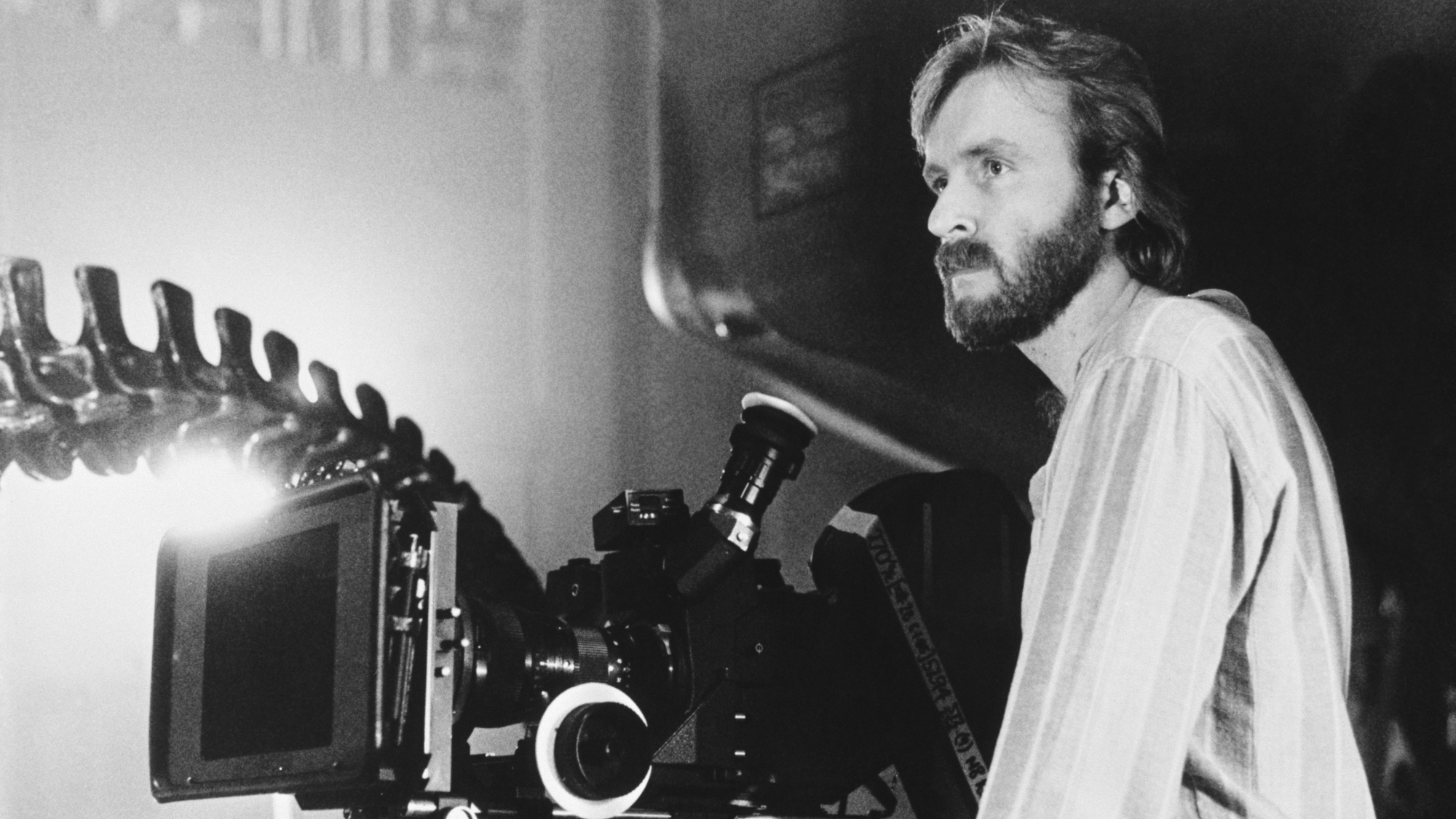
Director James Cameron's propulsive vision for a gung-ho military-style movie would call upon Stan Winston Studio's elite creature effects crew from 1984's "The Terminator" — a team that would later work on "Predator," "Terminator 2: Judgment Day," "Jurassic Park," and "Predator 2."
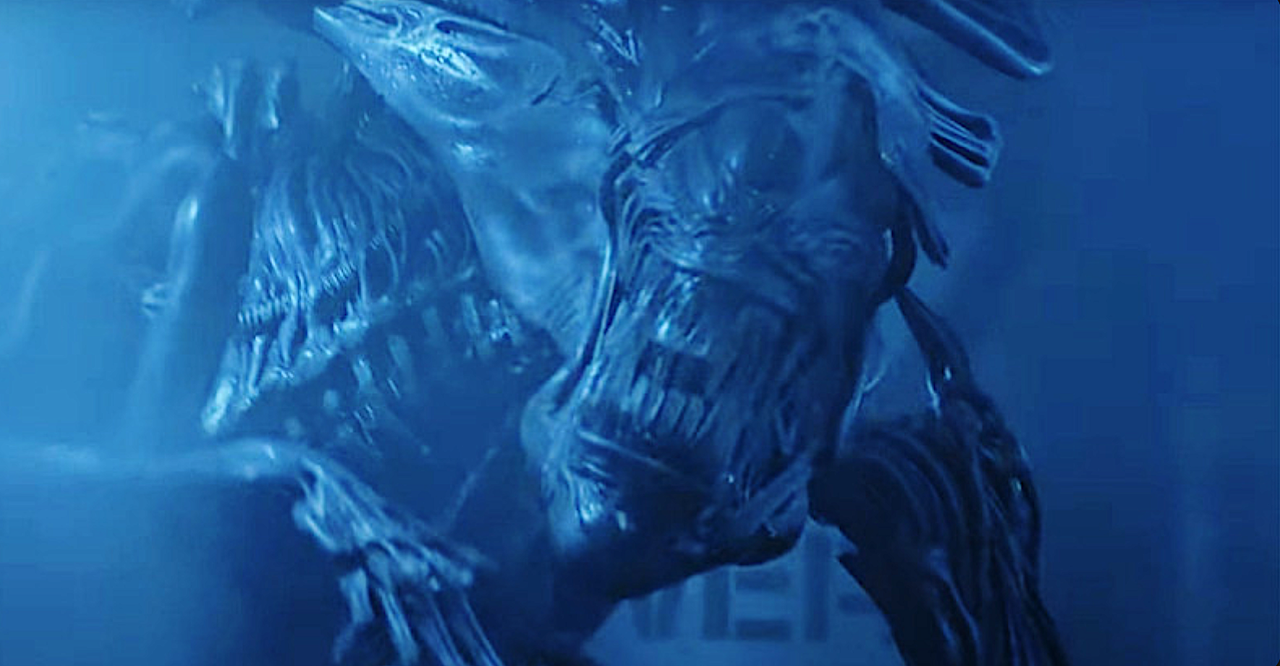
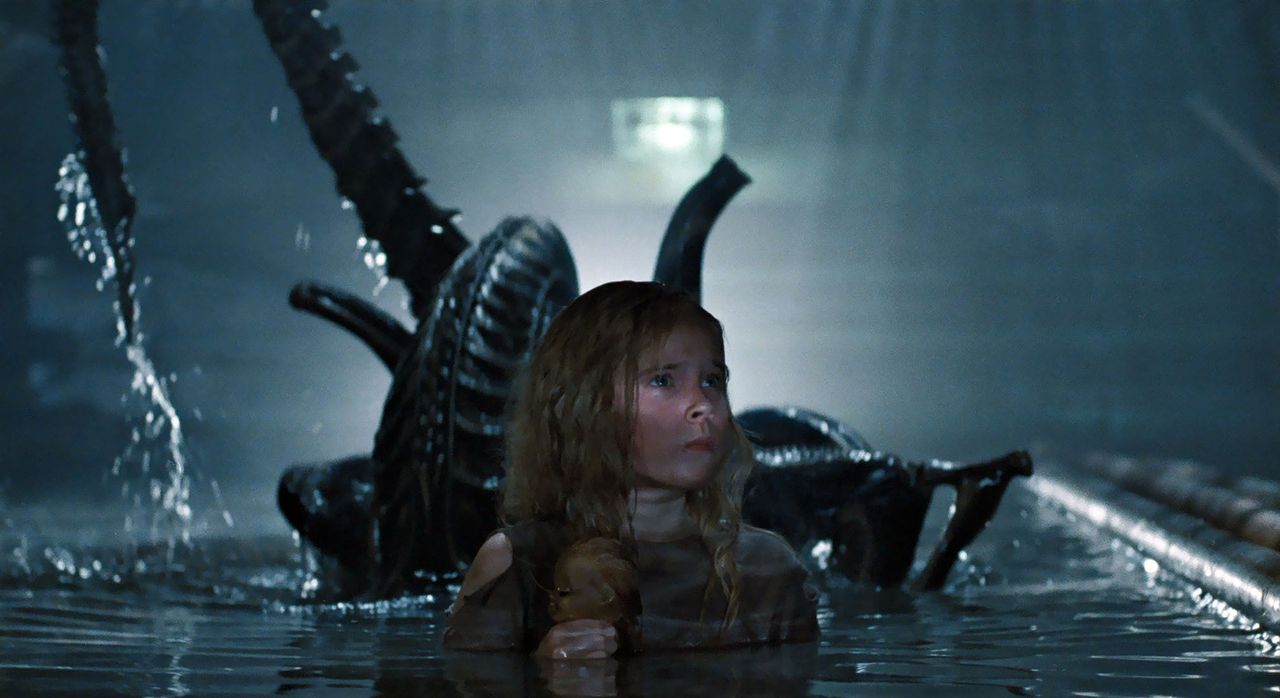
Cameron's "Aliens" greatly expands upon the xenomorph life cycle with the inclusion of a matriarchal beast that his screenplay described as "a massive silhouette in the mist, the ALIEN QUEEN glowers over her eggs like a great, glistening black insect-Buddha. Her fanged head is an unimaginable horror. Her six limbs, the four arms and two powerful legs, are folded grotesquely over her distended abdomen."
The brilliant filmmaker and Winston's energetic gang would craft and operate this 14-foot-tall articulated hydraulic puppet fabricated from fiberglass, foam rubber, and plastic. It contained two stunt performers in the torso and puppeteers on the ground manipulating legs and limbs.
Production was led by Stan Winston, Shane Mahan, Alec Gillis, John Rosengrant, Tom Woodruff Jr., and Lindsay MacGowan, the core wizards who’d later found the acclaimed Legacy Effects firm with J. Alan Scott following Stan Winston’s unfortunate death in 2008. Gillis and Woodruff would eventually split off to form Amalgamated Dynamics in 1988.
We caught up with Mahan and MacGowan to have them offer memories of working on "Aliens" at Pinewood Studios and specifically constructing this magnificent drooling, hissing monster that's spawned countless nightmares since the blockbuster landed on July 18, 1986.
"It was 1983 when I started at Stan's on the first 'Terminator,'” Mahan tells Space. "I’d worked with Jim on a Roger Corman movie that Makeup Effects Lab was doing, 'Battle Beyond the Stars.' [...] During 'Terminator,' Jim had drawings of Sigourney and the Power Loader he'd brought into the shop. I'd see them out of the corner of my eye and knew exactly what it was supposed to be. It was clearly an alien of that world with Sigourney Weaver.
"I was intrigued by it all because four years before, when 'Alien' had come out, it was so amazing cinematically. The lifecycle of the creature, and the organic nature of it. I had no idea that seven years later we'd be in England doing a sequel."
Mahan and posse began working on the Queen's preliminary designs in Southern California at Stan Winston's shop, where they conducted the infamous 'garbage bag test' out in the back parking lot, so named due to the flailing puppet being wrapped in black plastic trash bags.
"It was a proof of concept of how that was going to work," he explains. "Moving to Windsor, England, and setting up shop at Pinewood Studios was extraordinarily exciting. We then started making the full-size process of making the Queen and all the other effects, and we met the English crew, and Lindsay was one of them."
MacGowan fondly remembers his experience on the ambitious project and being recruited to join Stan Winston and the rest of the guys.
"They were legends at that point for us. We were also young and goofy, and it's amazing they actually let us do what we did when we were that young," MacGowan notes. "I was at college at the time, and I’d skip off college and make my way to Pinewood. It was like here’s the rock ‘n' roll Americans, and then we have our more reserved English team that got influenced by the American team. It was a lot of fun and some of my favorite memories of starting in the business.
"I remember it being incredibly cold at Pinewood at the time. There was no insulation in the warehouse, and we had these giant propane jet heaters, and they kept going out. We’d be nice and warm, then suddenly the flame would be out. It was a great time to get to know Shane, John, Alec, and Tom. I look at them as my American brothers."
Having everything under one roof, being created pre-shooting, was a great asset as it allowed Cameron to constantly oversee the process and monitor the progress being made.
"We were life-casting all the actors, various teams were doing the xenomorph warriors and the eggs and the facehuggers," Mahan adds. "It was a pretty big build list, and we had four or five months to get everything done. John Richardson was a great special effects man from the Bond films, and we all thought that was cool to work with guys that had done James Bond movies.
"That was my first time in England, so the setting was very new and exciting. Of course, we blew off a lot of steam occasionally, but we were very serious about just getting it all done. We knew we had a lot to live up to because of the first film. Very few people, if any, had come back from working on that first film. You don’t know how it's going to turn out. We all thought the 'Aliens' script was great. Jim had a lot of turmoil there and didn’t have a good time on his own for various reasons, but we weren't really privy to that."
Legacy Effects' Lindsay MacGowan between two armored supersuits created for 2008's "Ironman" (Image credit: Legacy Effects)
Before hopping across the pond to the UK, Mahan and his ace crew did molds and castings using a quarter-scale maquette of the Alien Queen sculpted at Stan Winston's shop for their design master.
"Back then, everything had to be done by measurements, by plotting out, and by eye. Today, it's so simple to have a computer generate and mill out a perfectly formed section. You had to use a really focused artistic eye to get exactly where we were supposed to be.
"We also had to make action suits, and there were a lot of them. I think there were 13 or 14, and then there were like eight eight-foot-tall puppets that were more spindly and long that were going to be used on wires and get hit and blow up and get shot. Then there was one articulated half-animatronic that would play in various scenes. You have to imagine an era that was pre-CGI. There was no reliance on rod removal or performer puppeteer removal. You had to hide everything and everybody in the frame. So in the dropship fight, it’s an enormous amount of people making the Queen operate, and you don’t see them.
"That all comes down to Jim Cameron and his magnificent eye for framing this action scene without seeing the crane or any of the support devices. Directors today, most of them don't even have any idea how to do that. And that was the magic of Jim Cameron and still is. He had the designing thought of shot composition and action that played off the best attributes of that hydraulic/actor-driven Queen. Because there were two guys inside and nine of us on her tail, her head, the cable, her hands, the feet. We were everywhere."
MacGowan took his role very seriously to get the fit and finishing perfect for this elegant egg-laying beast that would end up being the seething, android-ripping superstar of the popular 1986 sequel. -
"It was really just to honor what Giger had done in the past, but also to give Jim what he was looking for in his vision for the Queen," he recalls. "The Queen is really Jim's design and entire look. Our focus was making sure that we got what Jim wanted, but still make sure that fans of the original movie, which was all of us, could really appreciate."
As a mentor to his dedicated young crew of VFX creators, Winston schooled them in the subtle art of injecting personality and emotion into their creature performances.
"It's something they always reinforced, but if you’re a student of horror and science fiction films, you know all the great creatures and monsters have got some sympathetic or some interesting personality," adds Mahan. "Even the xenomorph in the first film, the personality is that it does not care. It's just going to kill you. But that’s still a personality trait.
"We were always taught by Stan that these are not effects; these are characters that we’re making; these are actors in the film. It just happens to be a creature from space, or a robot from the future, or a dinosaur. Whatever it is, it has to be believed, and we’ve always carried that philosophy through."
As to the mystery of exactly where the original Alien Queen screen-used puppet ended up, Mahan has a few clues, but sadly admits that most of it has unfortunately been lost to time.
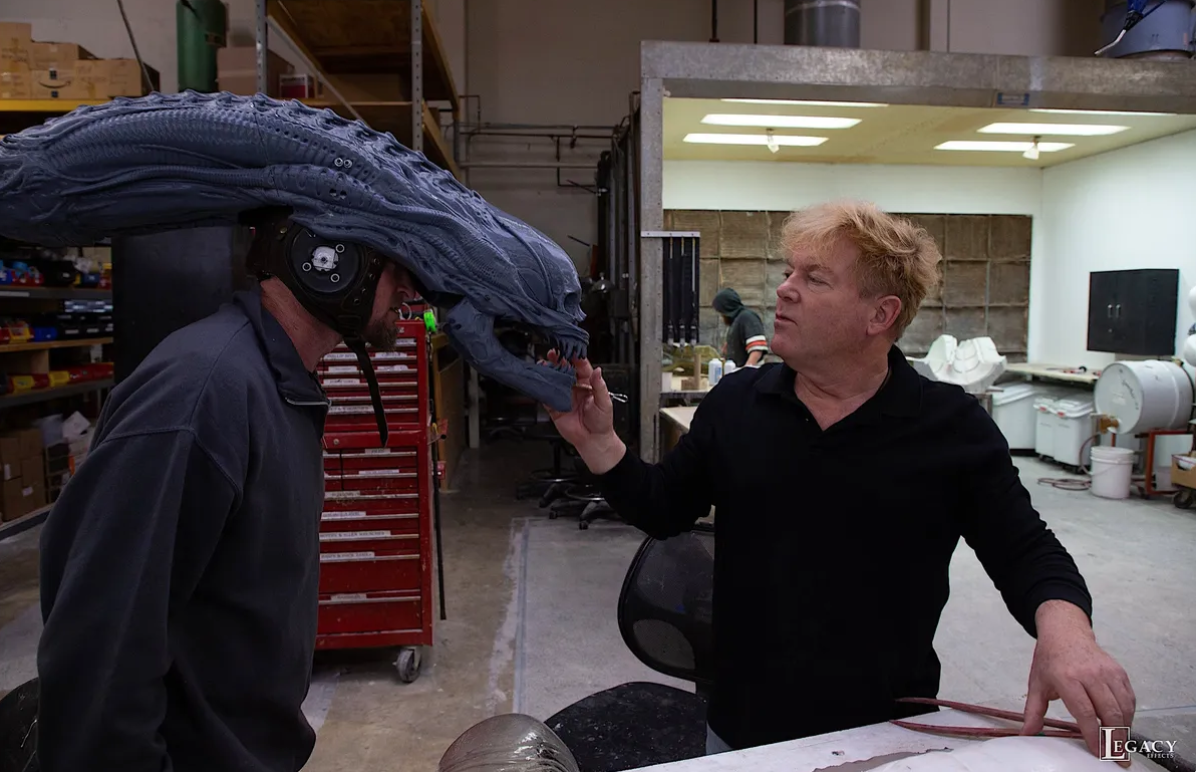
Legacy Effects' Shane Mahan working on a xenomorph design for "Alien: Romulus" (Image credit: Legacy Effects)
"Jim has one in his museum, and I think collector Bob Burns did have a head," Mahan shares. "The rest of it might be that it's fallen into disrepair. I know when we left, a lot of it was put into containers at Pinewood, and it sat and rotted for years. We always wanted to get that back, but I’ve not seen a real Queen in a while.
While the classic design hasn't changed much over the years, Mahan notes that the materials used to make creatures like the Alien Queen have.
"The head was fiberglass and had other foam rubber parts. The materials back then were not very sophisticated," explains Mahan. "The materials we have today, like what we did on 'Alien: Romulus', are like from outer space. They're translucent silicones, and they stretch well, and there’s lightweight plastic 3D-grown parts."
"Back then, the only thing we had was clear urethane that I got the cowl of her head to kind of move around. The original idea was that the skin on her face was supposed to be translucent. It ended up being foam rubber painted to look translucent. A lot of those materials have just fallen apart. On screen, it's pretty impressive.
"When we did 'Alien: Romulus,' Lindsay and I had not done an 'Alien' film since 'Aliens.' When that opportunity came up to revisit that world, the sensory memories came flooding back. It's one of those movies where I think I remember every day that I was on set for that film.”
"Aliens" is available to stream on Disney+ in the UK, and to rent and buy on various platforms in the US.
El pasado 10 de julio de 2026, a las 4:15 horas (UTC) desde el Complejo de Lanzamiento 2 del Sitio Comercial de Lanzamiento Espacial de Wenchang, tuvo lugar el lanzamiento del cohete Changzheng 10B (Larga Marcha 10B, en español); un vehículo de lanzamiento de 2 etapas y carga media parcialmente reutilizable. De 63,6 metros de altura e impulsado por siete motores de queroseno, China anunció el mismo día que lo recuperó con éxito, siendo esta la primera vez en recuperar un propulsor orbital reutilizable en el Mar de China Meridional.
A los diez minutos del lanzamiento, el Larga Macha 10B descendió del espacio y aterrizó en una estructura de cuatro patas fijada a un buque en alta mar. Una serie de cables tensados lo sujetaron mientras apagaba sus motores, dejando el propulsor humeante suspendido en el aire. Mientras tanto, la etapa superior del cohete continuó su trayectoria hacia la órbita y desplegó una carga útil conocida como CX-26. El lanzamiento, según las autoridades, fue un “éxito rotundo”.
El Larga Marcha 10B ha hecho historia, ya que se ha convertido en el cuarto cohete del mundo en ser recuperado con éxito, después del Falcon 9, Starship y New Glenn, de las empresas aeroespaciales privadas SpaceX (Elon Musk) y Blue Origin (Jeff Bezos). De hecho, es el primer cohete no estadounidense en lograr recuperarse, lo que reafirma que China es un fuerte rival en la nueva carrera espacial que se está disputando en el mundo.
China está un paso más cerca de pisar la Luna en 2030
El Larga Marcha 10B ha sido desarrollado por la Academia China de Tecnología de Vehículos de Lanzamiento (CALT) y lo opera su brazo comercial, Chinarocket (China Long March Rocket Co.). Su primera etapa, que es común a toda la serie Long March 10, va provista de siete motores YF-100K de queroseno y oxígeno líquido, mientras que la segunda tiene propulsión metalox con un único motor YF-219 alimentado por metano y oxígeno líquidos, entregando unas 140 toneladas de empuje.
El objetivo del Larga Marcha 10B es aportar capacidad de carga pesada a bajo coste para desplegar megaconstelaciones, pudiendo colocar hasta 16 toneladas en órbita baja y al menos 11 toneladas en una órbita de 900 kilómetros e inclinación de 50º; justo las necesidades de la constelación de Internet satelital Guowang, la cual tiene como objetivo crear un sistema de cobertura mundial de Internet. El proyecto, iniciado en 2022, es la alternativa a Starlink impulsada por SpaceX, y se prevé que esté formado por 13 mil satélites cuando finalice.
La portavoz del Ministerio de Asuntos Exteriores de China, Directora General del Departamento de Prensa, Comunicación y Diplomacia Pública, Mao Ning, compartió a través de su perfil oficial en la red social X (anteriormente conocida como Twitter, y cuyo acceso está restringido en China, al igual que muchas otras redes sociales occidentales) su alegría por el éxito de la recuperación del Larga Marcha 10B:
A historic day in China’s space program!
China’s Long March-10B has successfully completed its maiden flight—and recovered its first stage via a sea-based net. This marks the country’s first-ever controlled rocket recovery. A major leap toward reusable launch capabilities.… pic.twitter.com/FWuQXLltaD
“¡Un día histórico para el programa espacial de China! El Long Mach 10-B de China ha completado con éxito su primer vuelo y ha recuperado su primera etapa mediante una red colocada en el mar. Esto marca la primera recuperación controlada de un cohete en la historia del país. Un gran avance hacia capacidades de lanzamiento reutilizables”.
El Larga Marcha 10B emplea un método de recuperación distinto al de SpaceX y Blue Origin, combinando una embarcación en alta mar que se desplaza a cierta distancia con la técnica de captura, similar a la que utiliza SpaceX para Starship. Capturar el cohete de esta manera reduce el impacto de la reutilización en la capacidad de carga útil.
En un comunicado, el CASC afirmó que el vuelo de prueba del Larga Marcha 10B “validó tecnologías centrales clave” para una arquitectura de lanzamiento reutilizable, como el reinicio múltiple de motores con encendido a gran altitud, la navegación y el control de alta precisión, y la primera captura y recuperación mediante un sistema de red en una plataforma marítima. Gracias a pruebas como esta, China se está preparando para aterrizar en la Luna con configuraciones más pesadas que lleven a los astronautas chinos y sus módulos al satélite de la Tierra. El plan es que llegan a la Luna para 2030.
A 12-week intermittent fasting program produced weight-loss benefits that were still visible a year later. Participants who ate within an eight-hour window maintained more weight loss than those who followed their usual longer eating schedule. Both early and late eating windows worked, while early fasting appeared especially helpful for preserving fat loss.
The Perseids may be the summer meteor shower everyone marks on the calendar, but they are not the only reason to look up this season.
From mid-July through late August, Earth plows through several other streams of comet and asteroid debris, triggering a series of lesser-known meteor showers across Northern Hemisphere skies.
Most will not deliver the dazzling hourly rates of the Perseids, and moonlight will spoil some peak nights in 2026. But for patient skywatchers under dark skies, these lesser-known showers can still serve up bright fireballs, faint streaks and a preview of the main event to come.
The duration in days of a shower we provide here is somewhat arbitrary, since the beginning and ending are gradual and indefinite. While the hourly rates from these other meteor streams provide but a fraction of the numbers produced by the Perseids, combined, overall, they provide a wide variety of meteors of differing colors, speeds and trajectories.
Capricornids
First to appear are the Capricornids, starting around July 10, with their maximum on July 25 and end on Aug. 15. Under the best conditions only a few bright meteors per hour come from this stream, so you'll hardly know it is in progress unless you plot meteor trails on a star map and trace them back to their common intersection point; most of the meteors you'll see will be sporadics or members of another shower.
The radiant reaches its highest point at about 30 degrees high in the south, about 2:00 a.m. local daylight time. The waxing gibbous moon will have set at around 1:40 a.m. on the night of the peak, leaving the rest of the night dark for prospective meteor watchers.
Delta Aquarids
Next come the Delta Aquarids, July's most prolific shower, with maximum on July 29, and as many as two or three dozen meteors per hour under ideal conditions. The shower lasts from July 12 to Aug. 23. It has a double radiant, indicating that we are seeing two distinct streams of celestial debris burning up in the Earth's atmosphere.
The meteors are mostly faint; a few bright, 5-10% leave persistent trains; they move at medium-slow speeds because they are coming in sideways across Earth's orbit. On peak night this year, the double radiant will be highest — roughly 40 degrees above the southern horizon — at 3:30 a.m. Unfortunately, in 2026, peak activity will coincide with full moon, so most of these streaks will likely be squelched by bright moonlight.
Piscis Australids
Another weak shower is the Piscis Australids, on July 30, with normal limits July 10 to Aug. 10. This is a lesser stream; only about eight members per hour are seen under best conditions to observers in the Southern Hemisphere, where the radiant — near the bright star Fomalhaut — climbs high in the sky.
As is the case with the Delta Aquarids, the moon, only one day past full, unfortunately, wrecks any chances of getting any decent views this year.
Alpha Capricornids
The final shower peaking in July is the Alpha Capricornids, which begin about July 7, peak on July 31, and end on Aug. 15. The radiant reaches its highest point, about 30 degrees high in the south at about 1:00 a.m. local daylight time. Though sparse (5 per hour) in number, the Alpha Capricornids are photogenic, frequently producing bright yellow fireballs that can be quite spectacular. Sadly, the bright moon, 93% illuminated, is in eastern Capricornus and will seriously impact the peak of this year's display.
Iota Aquarids
The last minor shower before the Perseids is the Iota Aquarids, a two-radiant shower having detectable members from July 15 to Aug. 25. At peak activity on Aug. 6, only about six members per hour are seen under good conditions; the radiants are at their highest point, about 40 degrees in the south at 2:30 a.m. A last quarter moon will be about one-third up in the eastern sky at that hour, which will interfere to an extent with viewing these meteors.
Perseids
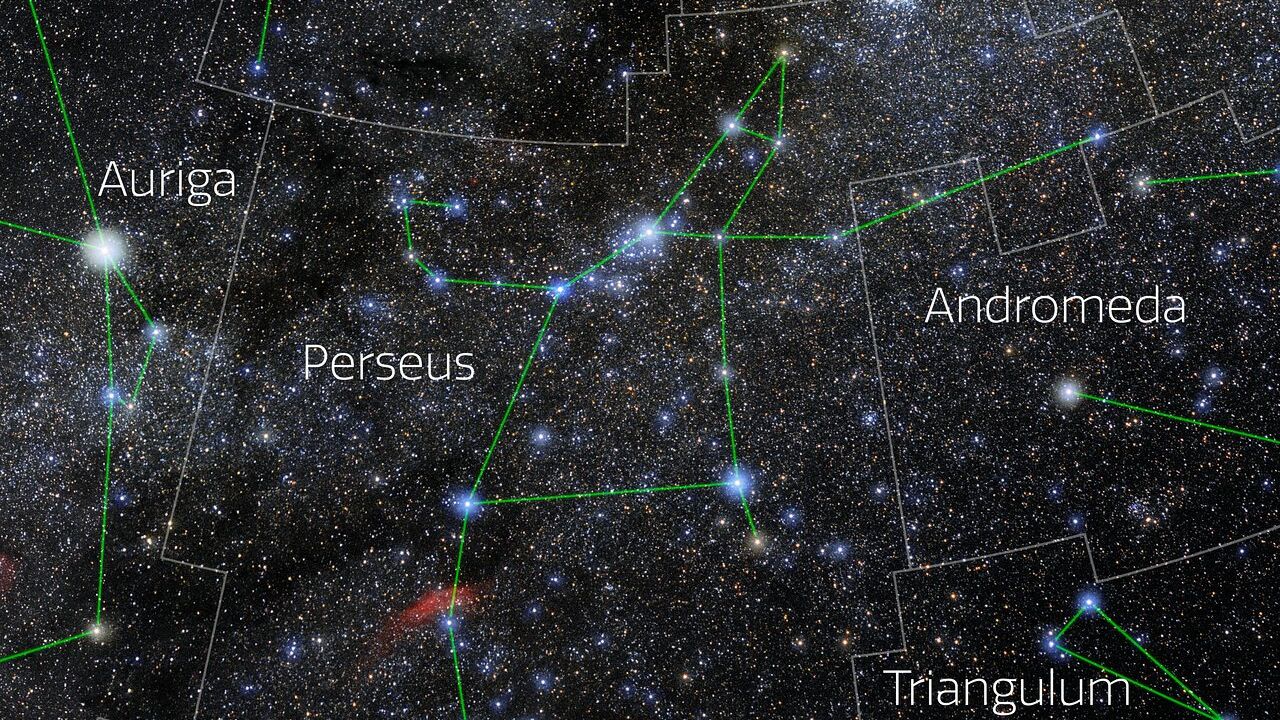
The Perseids are predicted to reach their peak in 2026 on the morning of Aug. 13. Meteors whose paths extended backward intersect at a spot near the Perseid-Cassiopeia border not far from the famous Double Cluster in Perseus.
It rises at dusk and is highest in the sky — nearly overhead — at 5:40 a.m. When maximum occurs in a dark sky, as will be the case this year, this rich stream offers a crescendo in hourly rates averaging more than 50 members per hour, though double this rate has been seen on occasion. Many flaring meteors with trains are seen. This shower normally extends from July 17 through Aug. 24.
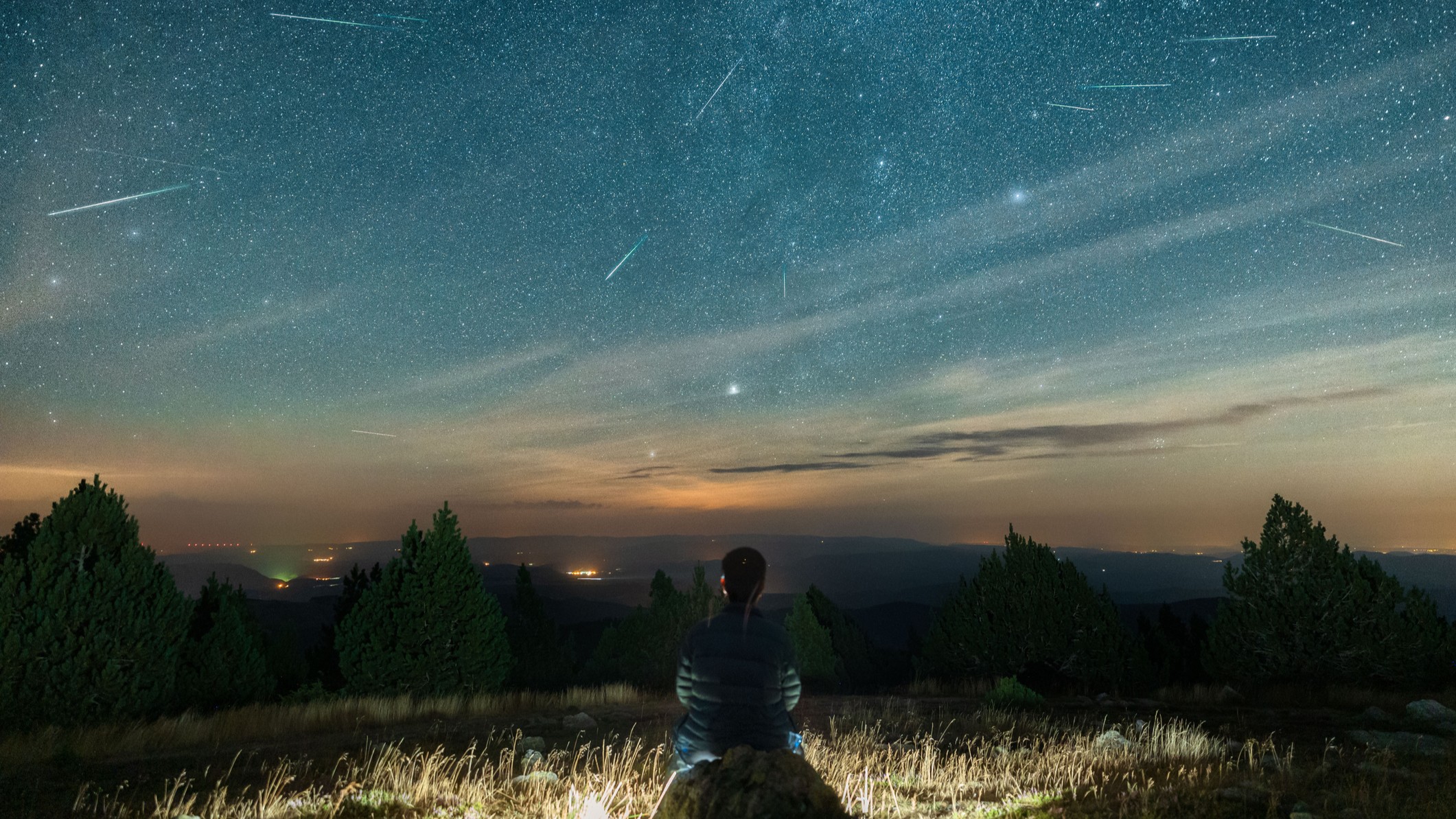
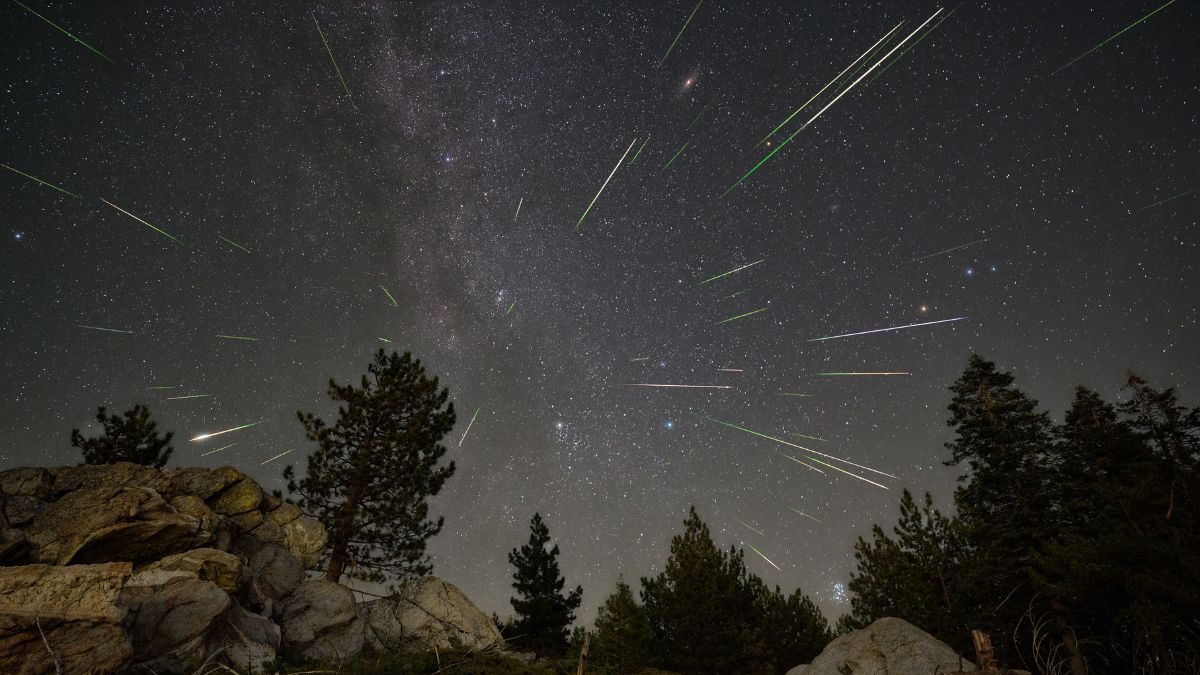
The Perseid meteor shower will be one of the top skywatching events this year as it will enjoy minimal interference from the moon. (Image credit: SEN LI via Getty Images)
Kappa Cygnids
The last summer shower is the Kappa Cygnids. The limits of this shower run from Aug. 3 to Aug. 25, with the peak on Aug. 17. Though the maximum rate is only about four per hour, the stream does provide slow-moving flaring fireballs, and a careful observer may be nicely rewarded for the time spent.
The radiant is just north of the star Kappa Cygni and is nearly overhead — some 80 degrees high — at around 10:00 p.m. local time. At about that same time, a waxing crescent moon is low in the southwest and is about to set and will offer little viewing interference.
Where to look
The radiant is the place in the sky where the paths of shower members, if extended backward, would intersect when plotted on a star chart. Many people are misled into thinking that this is the best place to look for these meteors, but only stationary meteors — ones coming nearly straight at you — can be seen here.
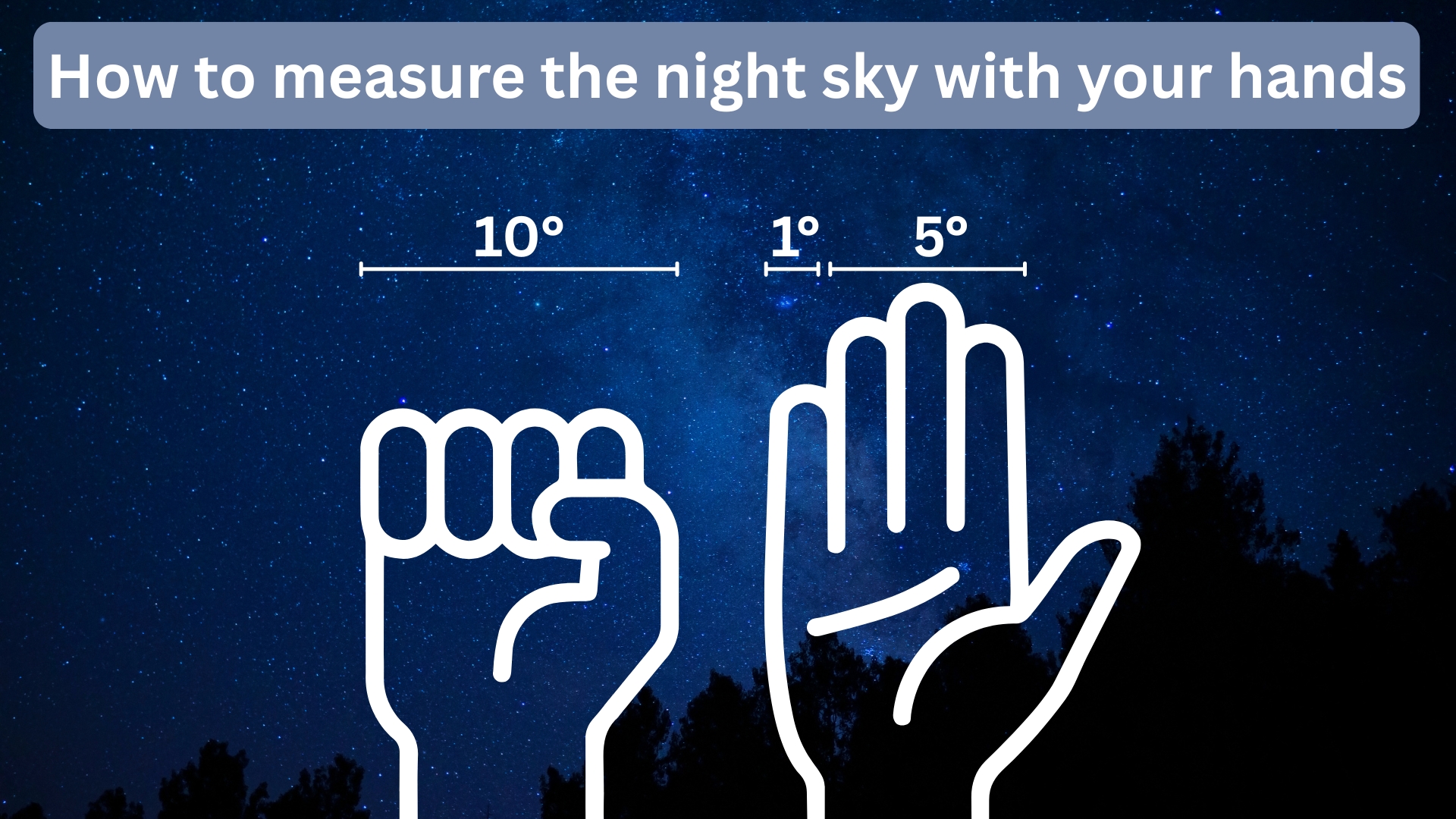
You hand held out at arm's length can be a useful tool for measuring the night sky. (Image credit: Created in Canva Pro)
The greatest numbers will be seen perhaps 30 degrees away from the radiant, in the general direction of the zenith. Remember that your clenched fist held at arm's length is roughly equal to 10 degrees.
In addition to shower meteors, there are always sporadic ones, apparently unrelated to one another, that occur at an average rate of about 7 per hour. The duration in days of a particular shower is somewhat arbitrary, since the beginning and ending are gradual and indefinite.
Skywatching tips
The only equipment you'll need is your eyes and a modest amount of patience.
The number of meteors an observer can see in an hour depends strongly on sky conditions. The rates quoted here are based on a limiting star magnitude of +6.5 (an exceptionally good, dark sky), an experienced observer, and the assumption that the radiant is directly overhead.
The lower the radiant in the sky, the fewer the numbers that will be seen. At an altitude of about 30 degrees, the hourly rate is halved, at 15 degrees it is one-third. No two observers prepare for a meteor vigil the same way.
Expect the overnight low temperature to be well below what the weather forecast suggests. When you sit quite still, close to the rapidly cooling ground, and if the air is even just slightly damp, you can become very chilled. It helps to take a late afternoon nap, followed by a shower, and to wear fresh clothing. Heavy blankets, sleeping bags, a ground cloth, an auto cushion, and a pillow are all necessary equipment. Some food and non-alcoholic beverages will help keep you comfortable.
Don't forget the moon
Another factor is the phase of the moon, which this year will be full on July 29 and new on Aug. 12. This makes it a very favorable year for viewing the Perseids, but not so favorable for those displays peaking at the end of July into early August. However, most are also active for a good number of days before and after maximum activity, so you can also watch for them when moonlight is not a hindrance.
Are these meteor showers worth watching?
In short, minor summer meteor showers are worth watching if you enjoy patient, low-key skywatching, but they are not ideal if you expect a dramatic display.
They offer a long observing season, require no equipment, and can produce a variety of meteors with different colors, speeds, paths, and occasionally bright fireballs. They also give observers more chances to watch when skies are clear and moonlight is less intrusive.
However,most are weak when compared to the Perseids, with low hourly rates and many faint meteors. Moonlight, low radiant positions, overlapping showers, and sporadic meteors can make them harder to see and identify, so observers need dark skies and patience.
Un equipo científico ha logrado documentar cómo el conflicto armado entre Rusia y Ucrania altera la vida de la fauna salvaje drásticamente. El hallazgo se detalla en un reciente estudio publicado por la revista Science, donde se analizan las consecuencias del breve periodo de ocupación militar en la zona. Las cámaras automáticas instaladas en el área restringida capturaron imágenes reveladoras sobre las alteraciones conductuales de múltiples especies.
Los investigadores, bajo el liderazgo de Svitlana Kudrenko de la Universidad de Friburgo, analizaron cientos de miles de imágenes registradas por dispositivos de fototrampeo antes, durante y después de la invasión. Este exhaustivo análisis visual se complementó con encuestas diarias a los trabajadores locales sobre los niveles de ruido y perturbación ambiental. Los resultados demuestran que la hostilidad humana genera un impacto ecológico inmediato en el comportamiento animal.
La movilización de tropas y armamento pesado afectó a las especies de formas muy diversas debido a sus diferentes hábitos de vida. El registro de avistamientos del ciervo común se elevó de manera notable durante las semanas de mayor hostilidad en la zona. Por el contrario, los encuentros con corzos descendieron de forma drástica, lo que sugiere que estos últimos huyeron hacia zonas boscosas más profundas.
Adaptación de las especies al conflicto
Este comportamiento tan dispar se debe a que el ciervo común suele agruparse en espacios abiertos, mientras que el corzo es un animal solitario y esquivo. La presencia de soldados alteró también los ritmos de actividad de especies como el zorro rojo, que modificaron sus patrones horarios tradicionales. Estas criaturas incrementaron su actividad diurna con el fin de esquivar el peligro, adaptándose de forma flexible a los ruidos del conflicto.
El comportamiento de carnívoros como el lince siberiano también experimentó variaciones notables al aproximarse a las infraestructuras humanas durante los picos de tensión. Los científicos sospechan que estos depredadores y los zorros se acercaron a las instalaciones militares atraídos por la posible presencia de residuos de comida. Mientras tanto, el jabalí y el perro mapache evitaron de forma sistemática cualquier estructura construida por el ser humano.
Impacto evolutivo a largo plazo
Estas variaciones conductuales demuestran que las hostilidades dejan una huella profunda en la biodiversidad, la cual va mucho más allá de los límites físicos del territorio. Las variaciones en la fauna se suman a las observaciones realizadas en otra investigación previa sobre los perros de Chernóbil que habitan las regiones afectadas. Aquellos cánidos sometidos al estrés de las zonas de combate presentaban rasgos físicos muy distintos a los de las áreas seguras.
La selección natural parece beneficiar a los ejemplares con orejas más puntiagudas, hocicos alargados y menor tamaño corporal en condiciones de extrema inestabilidad bélica. Estos rasgos físicos de tipo salvaje asemejan a los canes a sus ancestros directos, los lobos, facilitando su supervivencia en entornos hostiles. Los expertos todavía desconocen si la breve ocupación militar en la zona restringida provocará cambios genéticos permanentes a largo plazo.
La investigación evidencia que el ecosistema del área ha sufrido una fuerte desestabilización que altera el equilibrio alcanzado durante décadas de ausencia humana. Este territorio, que se había transformado en un refugio de biodiversidad tras el accidente nuclear de 1986, afronta ahora nuevos desafíos de conservación. Los dispositivos de seguimiento científico continuarán registrando la evolución de estas especies para medir el verdadero alcance de la perturbación humana.
¿Puede existir un color que nunca nadie haya visto? Esta es la verdad sobre el «olo», contada por Cochi Lillo. Un color que existe sí, pero que podemos llamar imaginario.
Conchi Lillo Delgado es profesora titular en el Departamento de Biología Celular y Patología de la Universidad de Salamanca e investigadora del Instituto de Nuerociencias de Castilla y León. Es asimismo investigadora principal del grupo ‘Trastornos degenerativos del sistema visual’. Dilvulgadora científica, es autora del libro ¡Abre los ojos!
Parece bastante lógico fijarse en la fecha que figura en la etiqueta de un alimento antes de decidir si comprarlo o consumirlo. Sin embargo, una encuesta de 2025 realizada a más de 2.000 adultos en EE. UU. reveló que casi la mitad de ellos malinterpreta el significado real de los términos asociados a esas fechas.
Términos como "best by", "use by", "sell by", "best before" y "expires on" pueden parecer sinónimos, pero no lo son. Y esta confusión puede llevar a la gente a desechar alimentos innecesariamente, lo que supone un derroche de dinero —por valor de 150.000 millones de dólares entre los hogares estadounidenses, según la encuesta— y contribuye al problema mundial del desperdicio alimentario.
"Las fechas de los productos alimenticios rara vez indican cuándo es seguro consumir el alimento", afirma Nicole Arnold, profesora adjunta y especialista en seguridad alimentaria de la Universidad Estatal de Ohio. En cambio, añade, "casi todas las fechas de los productos alimenticios en Estados Unidos indican durante cuánto tiempo un producto mantendrá su máxima calidad", lo que puede referirse al tiempo que conservará características como el sabor, el color, la textura y el valor nutricional.
Para complicar aún más las cosas, algunos de estos términos son meras sugerencias sobre la calidad del alimento, mientras que otros tienen más peso. Y a veces hay una fecha estampada en el envase de un alimento sin ninguna de estas frases, lo que puede resultar realmente desconcertante.
Algunos miembros del Congreso han presentado la Ley de Etiquetado de Fechas en los Alimentos de 2025, de carácter bipartidista, para reducir la confusión de los consumidores y el desperdicio de alimentos limitando la jerga a solo dos términos: "consumir preferentemente antes del" para la calidad óptima y "consumir antes del" para la seguridad. El proyecto de ley sigue pendiente. Mientras tanto, los expertos afirman que hay algunas reglas generales que puedes seguir dependiendo del tipo de alimento que quieras consumir.
Alimentos en los que debes respetar la fecha
Los embutidos envasados y las salchichas deben desecharse según la fecha de la etiqueta por motivos de seguridad alimentaria; lo mismo ocurre con las carnes, las aves, el pescado y el marisco envasados. En todos estos casos, la preocupación es que las bacterias (como la listeria, la E. coli y la salmonela) presentes en el producto puedan multiplicarse con el paso del tiempo, lo que significa que podrías contraer una intoxicación alimentaria al consumirlo.
Con estos productos perecederos, "no se puede recurrir al aspecto, el olor ni el sabor para evaluar su seguridad, ya que las bacterias patógenas son invisibles", afirma Donald W. Schaffner, profesor de ciencia alimentaria en la Universidad de Rutgers. Además de la leche de fórmula para lactantes, los alimentos envasados para bebés deben desecharse una vez pasada la fecha de consumo preferente, afirma Sara Morris, investigadora sénior en seguridad alimentaria y trazabilidad del Instituto de Tecnólogos Alimentarios. "El sistema inmunitario de los niños pequeños aún se está desarrollando y no es tan fuerte como el de los adultos, así que hay que prestar atención a la fecha".
Productos en los que hay cierto margen de flexibilidad
Existe cierto margen de flexibilidad en lo que respecta a las fechas impresas en los envases de los productos lácteos, como la leche, la nata agria y el yogur. Siempre que se conserven refrigerados a 40 grados Fahrenheit o menos, es posible que aún se puedan consumir una vez pasada la fecha de caducidad. (Hazte con un termómetro para el frigorífico si el tuyo no tiene uno).
Por lo general, la leche se puede consumir entre cinco y siete días después de la fecha de consumo preferente; el queso duro, entre tres y cuatro semanas después de la fecha indicada (los quesos blandos tienen una vida útil considerablemente más corta); el yogur, entre una y dos semanas después de la fecha de la etiqueta; y la mantequilla, entre uno y tres meses después de la fecha indicada, según Julia Zumpano, dietista titulada del Centro de Nutrición Humana de la Clínica Cleveland.
Por su parte, los huevos se pueden consumir si se cocinan una o dos semanas después de la fecha indicada en la etiqueta. Sin embargo, recuerda que, una vez abiertos los envases de leche, queso o yogur, el contenido se vuelve más perecedero al quedar expuesto al aire, la luz y la humedad. Para ir sobre seguro con todos estos alimentos, los expertos aconsejan olerlos, probarlos y examinarlos visualmente en busca de signos de moho antes de utilizarlos o consumirlos.
Alimentos en los que puedes usar tu buen juicio
En el caso de los aperitivos, cereales, galletas saladas, galletas dulces, condimentos, salsas, zumos, pasta, arroz y aderezos, puedes utilizar tus sentidos —olfateando, observando y probando el producto— para evaluar si te apetece comerlo después de la fecha indicada en el envase.
"No creo que comer cereales rancios sea perjudicial para la salud", afirma Zumpano. "Simplemente puede que no sepa bien". En cuanto a otros productos que pueden llevar o no una fecha impresa en la etiqueta, también es aconsejable utilizar los sentidos para evaluar su frescura. "En caso de duda, tíralo", aconseja Arnold. "Si notas olores extraños o cambios notables en la textura, como verduras crudas blandas, deshazte de los productos".
Del mismo modo, desecha los frutos secos o los aceites si huelen a rancio; aunque no te provoquen molestias digestivas, pueden estropear el sabor de lo que estés preparando. Estas estrategias prácticas te ayudarán a minimizar el desperdicio de alimentos y a maximizar la calidad de tus comidas, tanto desde el punto de vista nutricional como en cuanto al disfrute. Otra buena estrategia: "Sé consciente de lo que hay en tu nevera y en tus armarios y ve rotando tus provisiones de atrás hacia delante" de forma regular, según sus fechas de caducidad, aconseja Zumpano. De esa forma, utilizarás primero los productos más antiguos.
Además, asegúrate de mantener limpio el interior de tu nevera, añade, "porque si hay bacterias en la nevera, es más probable que contaminen los alimentos que hay dentro". Y eso es lo último que quieres que ocurra. En cuanto a las fechas que aparecen en las etiquetas de los alimentos, ¿a cuáles debes prestar atención? "Los consumidores deben prestar atención a todas ellas para gestionar los alimentos que llevan a sus hogares", afirma Schaffner. "Nadie quiere comer alimentos de mala calidad".
Cada semana se producen noticias realmente positivas que merecen ser contadas. Desde avances científicos a sorpresas que nos regala el medio ambiente. National Geographic te ofrece un recopilatorio de las noticias más reconfortantes que nos dejan estos últimos días.
Descubren que una rana australiana amenazada esconde un destello iridiscente idéntico al de un ópalo
La rana de campana verde y dorada (Ranoidea aurea), una emblemática especie australiana tristemente en peligro de extinción, acaba de revelar un secreto espectacular a los biólogos de la Universidad de Newcastle. Han descubierto que, al saltar, la parte interna de los muslos de este anfibio destella con una asombrosa iridiscencia estructural, cambiando de azul a turquesa y verde según el ángulo de visión (igual que una piedra preciosa).
Este rarísimo efecto óptico en anfibios no se debe a pigmentos químicos, sino a la presencia de unos cristales microscópicos perfectamente ordenados en su piel (iridóforos) que interactúan físicamente con la luz. Los científicos creen que estas deslumbrantes "patas de discoteca" son un sofisticado mecanismo de defensa evolutivo diseñado para confundir y llamar la atención de los depredadores en el momento exacto de la huida.
Descubren una nueva y asombrosa especie de mono de labios naranjas en el corazón del Congo
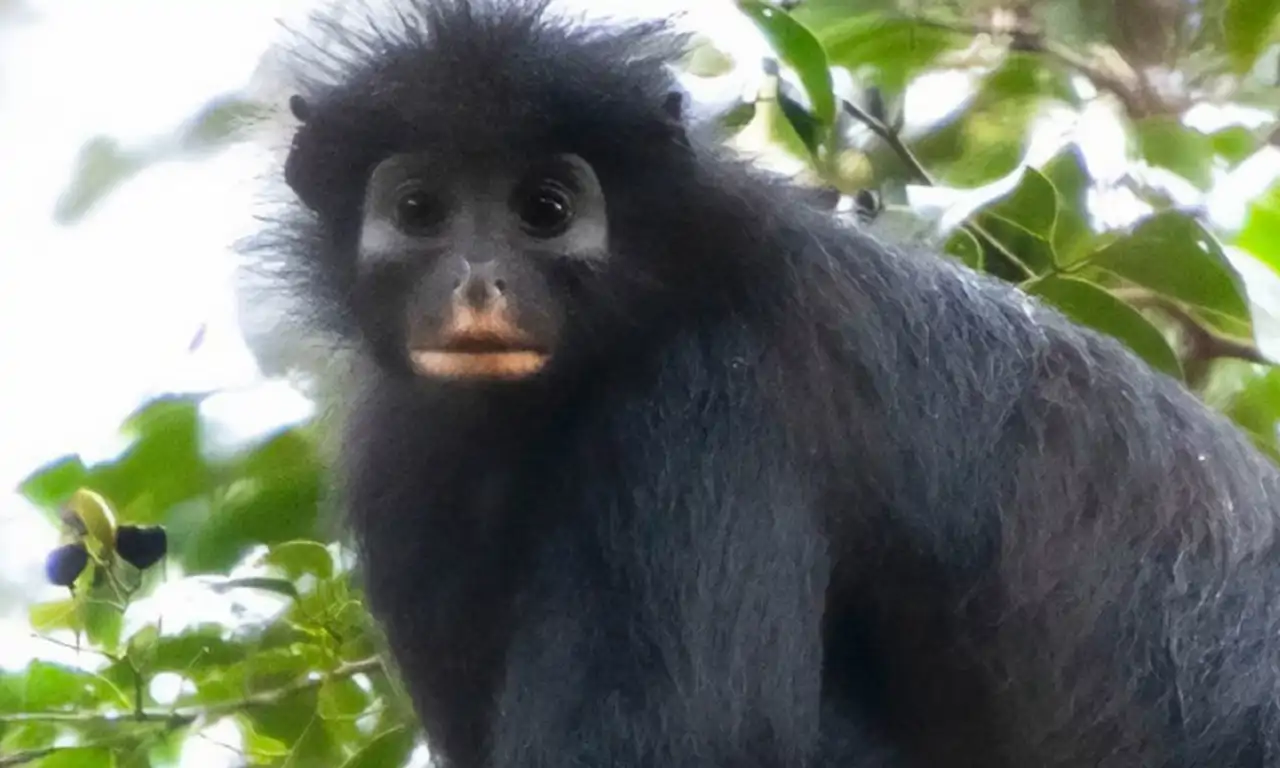
La inmensa y exuberante cuenca del Congo nos ha regalado una sorpresa biológica mayúscula: la confirmación de una especie de primate completamente nueva para la ciencia,Colobus congoensis. Bautizado por las comunidades locales como "Likweli" o "el sacudidor de ramas" por sus ágiles saltos en la canopea, este esquivo mono destaca por su pelaje negro brillante, una curiosa "máscara" facial gris y, sobre todo, un llamativo parche de color crema anaranjado alrededor de sus labios y nariz.
Tras casi dos décadas de investigaciones desde que se obtuvo su primera fotografía borrosa en 2008, los análisis de ADN han revelado que su linaje es antiquísimo, separándose de sus parientes más cercanos hace más de 4 millones de años. Además de su inconfundible aspecto, se comunica mediante unos profundos rugidos y bufidos únicos en su género.
Llega una nueva hembra del rumiante más pequeño del mundo a Bioparc Fuengirola
La conservación de especies amenazadas está de enhorabuena gracias a la llegada de una nueva hembra de ciervo ratón, un paso crucial dentro del programa europeo de preservación coordinado por la EAZA. Este desconocido mamífero asiático, considerado el rumiante más pequeño y primitivo del planeta, es una verdadera rareza evolutiva: apenas mide 20 centímetros de altura y pesa poco más de un kilo. De hábitos crepusculares y metabolismo acelerado, su mejor estrategia de supervivencia en la naturaleza es permanecer completamente inmóvil durante largos periodos para pasar desapercibido ante los depredadores.
Actualmente, los biólogos y veterinarios del parque están llevando a cabo un delicado y riguroso proceso de adaptación, permitiendo que el macho y la nueva hembra se vean y huelan a través de una barrera antes de compartir espacio físico. Gracias a esta meticulosa labor científica, se espera repetir el éxito reproductivo de años anteriores.
La ciencia revela que la península ibérica alberga dos especies de conejos en lugar de una
Durante más de un siglo pensamos que nuestros campos estaban habitados por una única especie de lagomorfo, pero un reciente estudio internacional liderado por el IESA-CSIC ha demostrado que en realidad tenemos dos.
La ciencia ha reconocido oficialmente al conejo ibérico (Oryctolagus algirus), endémico del oeste peninsular y Portugal, separándolo del ya conocido conejo europeo (Oryctolagus cuniculus). Ambas especies divergieron hace unos dos millones de años al quedar aisladas en distintos refugios durante las glaciaciones. El recién reconocido conejo ibérico es más pequeño, tiene menos crías por camada y posee una genética, parásitos y microbioma únicos.
Descubren en el Himalaya una nueva y gigante especie de mosca 'león'
En 1978, unos científicos encontraron en el sur del Tíbet unas extrañas larvas que construían trampas de arena en forma de embudo para cazar hormigas, pero el insecto adulto fue imposible de localizar. Hasta ahora- Una reciente expedición ha logrado por fin cerrar el círculo e identificar a la especie: Vermitigris tsangyanggyatso, bautizada así en honor al sexto dalái lama y poeta tibetano.
Se trata de un díptero maravilloso cuyas larvas han desarrollado la misma técnica de caza subterránea que las famosas hormigas león, un precioso ejemplo de evolución convergente. Además, esta nueva mosca ha batido récords al ser la más grande conocida de su género (casi 2 centímetros) y presenta una peculiaridad evolutiva asombrosa: los adultos carecen de piezas bucales funcionales, por lo que no comen absolutamente nada y sobreviven únicamente gracias a las reservas de energía acumuladas durante su voraz etapa larvaria.
Descubren una inédita convivencia entre diminutos peces y los asustadizos gusanos árbol de Navidad
Por primera vez en la historia de la ciencia, investigadores han documentado una asombrosa relación simbiótica entre pequeños peces de arrecife (como los gobios neón y los blénidos) y los vistosos gusanos árbol de Navidad (Spirobranchus giganteus). Lo verdaderamente extraordinario de este descubrimiento, realizado en el Caribe y otras regiones tropicales, es que estos gusanos marinos son criaturas extremadamente tímidas que, ante la menor perturbación, se retraen a la velocidad del rayo dentro de sus tubos de carbonato de calcio. Sin embargo, toleran pacíficamente que estos pececillos descansen sobre sus delicados tentáculos en forma de pluma.
Los biólogos sugieren que esta convivencia podría ser mutuamente beneficiosa: los peces obtienen un camuflaje perfecto y un mirador privilegiado para cazar, mientras que los gusanos podrían beneficiarse de la limpieza de algas, protección frente a depredadores o incluso de los nutrientes que dejan sus pequeños inquilinos.
La ciencia crea una "copia de seguridad" genética para salvar a los koalas de la extinción
Los icónicos koalas (Phascolarctos cinereus) se enfrentan a un momento crítico en el este de Australia debido a la p��rdida de hábitat, los incendios y, sobre todo, una devastadora epidemia de clamidia que merma drásticamente su fertilidad. Sin embargo, científicos de la Universidad de Queensland han ideado un plan brillante: están recolectando óvulos y espermatozoides de ejemplares rescatados en hospitales de fauna para congelarlos en nitrógeno líquido a -196 ºC.
Este asombroso "banco genético" permitirá conservar intacta la valiosa diversidad de la especie durante décadas. El objetivo es utilizar este material en el futuro mediante técnicas de fecundación in vitro e inseminación artificial, limpiando previamente las células de cualquier patógeno. La idea es que sea una verdadera póliza de seguro biológica.
Su línea de investigación se enfoca en el desarrollo tecnológico de compuestos químicos sustentables y bioinsumos para disminuir la exposición y efectos adversos a la salud humana y ecológica por la exposición a contaminantes emergentes, así como ofrecer alternativas sostenibles y seguras para el uso de productos químicos domésticos e industriales.
Ha recibido varias distinciones por su trabajo; la más reciente, en 2024, es la beca L’Oréal-UNESCO para las Mujeres en la Ciencia en colaboración con la Asociación Mexicana de Ciencias. Este reconocimiento subraya su destacada contribución y compromiso con la investigación científica en el ámbito de la química y las ciencias ambientales.
Karla Ximena Vargas Berrones. Fotografía proporcionada por la investigadora.
1. ¿Cuál es tu área de investigación?
Mi trabajo se enfoca en la protección del medio ambiente a través de la ciencia y la tecnología. Investigo cómo restaurar ecosistemas dañados y cómo prevenir la contaminación antes de que ocurra. Actualmente, mi labor se divide en tres áreas clave: primero, identifico contaminantes peligrosos para evitar que afecten nuestra salud; segundo, desarrollo métodos para limpiar ríos, manglares y mares —especialmente tras derrames de petróleo— usando limpiadores orgánicos creados en mi laboratorio; y finalmente, diseño productos industriales seguros, como detergentes sustentables, que impulsan una economía más limpia y circular.
2. ¿Por qué te dedicas a ella?
Me apasiona innovar y crear soluciones reales que cuiden nuestro planeta. Para mí, la innovación no se trata solo de construir robots o viajar al espacio. Soy fiel creyente de que la innovación puede salvar al planeta desde lo cotidiano, no solo con grandes máquinas. Me motiva el reto de sacar los inventos del laboratorio y llevarlos a la industria, porque es ahí donde realmente transforman el mundo. Mi trabajo consiste en tender un puente entre el laboratorio y la industria para que los cambios lleguen a todos. Un ejemplo de esto son los detergentes que desarrollo: una respuesta directa a problemas globales como la contaminación del agua, protegiendo así nuestra salud y la naturaleza.
Al final del día, mi meta es crear soluciones que sanen nuestros ecosistemas y aseguren el bienestar de quienes habitamos en ellos.
3. ¿Has tenido alguna figura de referencia en tu trayectoria?
Mi familia es el pilar de mi trayectoria. De mis padres aprendí que construir una familia es el máximo trabajo en equipo: es sostener al otro cuando no puede y entender que, a veces, para lograr el 100 %, uno pone el 90 % y el otro el 10 % sin reclamos.
Ellos me enseñaron que, mientras la ciencia y los experimentos permiten segundas oportunidades, el tiempo en casa es irreversible. Mis hijos crecen solo una vez. He comprobado que cuando la vida personal está en equilibrio, la profesional despega; tener una red de apoyo sólida hace que cualquier desafío sea más fácil de superar.
4. ¿Qué te gustaría descubrir o solucionar en tu campo?
Creo firmemente que la contaminación del agua es uno de los desafíos más críticos de nuestra era. Aunque resolverlo por completo es una tarea compleja, atenderlo de forma integral puede generar cambios extraordinarios. Mi meta es que mis investigaciones ayuden a sanar nuestros ríos y mares desde dos frentes: primero, evitando la raíz del problema mediante la creación de detergentes sostenibles que no generen residuos tóxicos; y segundo, desarrollando técnicas naturales (biorremediación) para limpiar el agua que ya está dañada.
Pero la ciencia no basta por sí sola; también quiero transformar la conciencia de las personas. Hoy en día, muchos desconocemos que productos tan cotidianos como los detergentes pueden afectar gravemente nuestra salud y el entorno. Compartir este conocimiento me llena de satisfacción, pues estoy convencida de que, si todos aportamos nuestro grano de arena, lograremos un impacto positivo real en la salud de nuestro planeta.
5. ¿Qué consejo darías a quien quiera adentrarse en el mundo de la investigación?
Como corredora, encuentro en el maratón la analogía perfecta para la ciencia. Correr un maratón y hacer ciencia tienen algo en común: el muro del kilómetro 30. Ese momento donde el entusiasmo del inicio desaparece, la meta se siente lejana y piensas seriamente en rendirte. Pero en la pista, como en el laboratorio, la meta no se mueve; ella te espera. Si sigues avanzando —aunque sea paso a paso— vas a llegar. Muchos creen que la ciencia es éxito tras éxito, pero en realidad es la suma de muchos fallos superados. Al final, lo que separa a un científico que transforma el mundo de los demás no es su brillantez absoluta, sino su capacidad de mantenerse en movimiento cuando otros deciden parar.
Nadie duda de qué animal es conocido como el rey de la selva, pero ¿qué ocurre en el bosque? El oso pardo es un animal territorial capaz de dejar señales químicas en ramas o árboles para que otros puedan interpretar, ya que tiene un olfato 2.000 veces superior al de los humanos. Esta fotografía la captó Janne Tikkanen, en la frontera entre Finlandia y Rusia en julio de 2026. Al erguirse sobre sus patas traseras, el oso comprueba su altura, muestra su fuerza y se prepara para seguir avanzando en el bosque, donde indudablemente se siente el único rey.
Las temperaturas extremas en los océanos están alterando de forma drástica la dinámica de los ecosistemas marinos globales. Así lo asegura un equipo internacional de científicos, que ha descubierto que las olas de calor oceánicas provocan graves distorsiones en las redes alimentarias de las especies microscópicas. Este preocupante fenómeno reduce drásticamente la capacidad natural que posee el mar para absorber y almacenar el carbono atmosférico sobrante, según detalla un nuevo estudio publicado en la revista Nature Communications. La investigación analiza de forma pormenorizada cómo el calentamiento excesivo del agua afecta de manera directa a los procesos químicos globales.
Los investigadores examinaron más de 10 años de registros biológicos en el golfo de Alaska para llegar a estas conclusiones. Esta zona geográfica concreta sufrió de forma consecutiva dos fenómenos de calentamiento extremo durante la última década: el primero se prolongó desde 2013 hasta 2015, bautizado popularmente como The Blob, mientras que el segundo evento sucedió entre los años 2019 y 2020. Ambos episodios de calor extremo sirvieron como escenario real para monitorizar las alteraciones estructurales e inmediatas en la transferencia de los componentes orgánicos esenciales.
Impacto en el bombeo orgánico
"El océano tiene una bomba biológica que normalmente actúa como una cinta transportadora que lleva el carbono desde la superficie hasta el océano profundo. Este proceso está impulsado por los organismos microscópicos que forman la base de la red alimentaria oceánica, incluidos las bacterias y el plancton", explica Mariana Bif, autora principal del texto científico. La experta añade detalladamente que el objetivo primordial consistía en rastrear dichos organismos microscópicos para comprobar si sus alteraciones afectaban directamente a la exportación final de material hacia los fondos marinos.
Para lograr estos resultados, los expertos utilizaron los datos físicos del proyecto científico Global Ocean Biogeochemistry Array, una iniciativa de alta tecnología liderada por el Monterey Bay Aquarium Research Institute. Esta red utiliza modernos dispositivos robóticos autónomos flotantes encargados de medir la salinidad, la temperatura, el oxígeno, el nitrato y el carbono orgánico particulado cada cinco o diez días en toda la columna de agua. Estos datos tecnológicos se complementaron eficazmente con muestreos estacionales en barcos mediante técnicas de química de pigmentos y secuenciación de ADN ambiental.
Alteraciones en el ciclo marino
Los análisis finales demostraron de forma contundente que las anomalías térmicas rompieron la base misma de la estructura alimentaria subacuática, modificando de raíz el tránsito habitual de los componentes químicos. En condiciones climáticas normales, el fitoplancton fotosintético transforma el dióxido de carbono en materia orgánica útil que posteriormente es consumida por organismos de mayor tamaño. Los desechos resultantes de este proceso biológico caen de forma natural hacia la zona mesopelágica, situada entre los 200 y los 1.000 metros de profundidad, quedando confinados de forma segura durante miles de años.
Durante el primer gran evento térmico registrado entre 2013 y 2015, la productividad del fitoplancton aumentó de forma notable durante el segundo año de mediciones. Sin embargo, las partículas orgánicas resultantes repletas de carbono se acumularon estancadas a unos 200 metros bajo la superficie en lugar de descender hacia las profundidades como ocurre habitualmente. Este estancamiento intermedio impidió que el ciclo natural de almacenamiento a largo plazo se completara de forma eficiente, alterando el equilibrio biológico del entorno protegido.
Consecuencias en la red biológica
En el segundo evento térmico de 2019 y 2020, los residuos orgánicos se concentraron en las capas superficiales de forma prematura debido al reciclaje de detritos por parte de pequeños organismos. Este material degradado descendió lentamente, pero se detuvo por completo entre los 200 y los 400 metros de profundidad, sin lograr alcanzar jamás las zonas abisales del océano. Los científicos asocian estas diferencias estructurales a los cambios radicales en las poblaciones de fitoplancton, los cuales benefician a especies de pastoreadores más pequeños cuyos desechos orgánicos caen con extrema lentitud.
"Nuestra investigación encontró que estas dos importantes olas de calor marinas alteraron las comunidades de plancton y afectaron la bomba biológica de carbono del océano. La cinta transportadora que lleva el carbono desde la superficie hasta el mar profundo se atascó, aumentando el riesgo de que el carbono pueda regresar a la atmósfera en lugar de quedar confinado profundamente en el océano", sentencia Mariana Bif sobre el peligro de acelerar el cambio climático debido a la saturación de los mecanismos naturales del planeta.
El 18 de julio de 1860 hubo un eclipsetotal de Sol visible en el norte de España. Santiago Ramón y Cajal tenía solo ocho años y vivía cerca de Zaragoza. Su padre le había explicado de antemano la teoría de los eclipses, pero él desconfiaba: le costaba creer que la ciencia pudiera predecir con exactitud un fenómeno tan extraño. Cuando llegó la hora anunciada y el eclipse se cumplió tal cual habían calculado los científicos, Ramón y Cajal quedó tan impresionado que describió el momento como "toda una revelación", en la que comprendió que "el hombre tiene en la ciencia un instrumento poderoso de previsión y dominio".
Esta anécdota, a un mes del evento astronómico del siglo, cobra sentido de nuevo. Serán muchos niños (y no tan niños) los que sientan la necesidad de informarse mucho sobre el tema, de satisfacer su curiosidad con conocimiento, de empaparse sobre por qué se va a oscurecer el cielo de repente o cómo afecta este curioso suceso al mundo que vemos cada día.
El Eclipse total de agosto no va a ser solo un acontecimiento folclórico para nuestro país sino la puerta de entrada al mundo de la ciencia y la astronomía para mucha gente. En una época donde el click, el contenido de baja calidad, el bulo y el discurso de odio marcan nuestras agendas informativas, el Eclipse oscurecerá por un momento toda esa realidad. Será el momento de hacernos muchas preguntas.
A nivel editorial, para National Geographic España es un reto de dimensiones colosales. Desde hace semanas estamos preparándonos para el acontecimiento y les invito a que sigan a través de todas nuestras plataformas las sorpresas que tenemos preparadas para todos los que nos leéis. Podríamos decir que nuestra final del Mundial no es mañana, sino dentro de tres semanas. Aunque llevamos preparándonos toda una vida para ello.
Por el momento les recuerdo las recomendaciones básicas. Planeen bien sus desplazamientos, elijan un buen sitio para visualizarlo, háganlo con las gafas homologadas y disfruten del espectáculo. Si por lo que sea no están en la península ese día, recuerden que igualmente habrá dos nuevas oportunidades de ver el eclipse durante los siguientes dos años.
La ciencia vuelve a ser noticia
La ciencia pues, vuelve a formar parte de la actualidad en un contexto en el que todo el sector reclama mejores condiciones, la fuga de cerebros continúa en los últimos años y el país no acaba de dar con la tecla para retener todo el talento científico que acaba en otros lugares de América y el norte de Europa. Nunca está de más reivindicar, ahora que el mundo científico volverá a ser importante a nivel mediático, que queda mucho camino por recorrer en este sentido.
Porque sí, hay que exigir que las instituciones fomenten en la educación el conocimiento científico y lo cuiden hasta el punto de que nuestros graduados no deban desarrollar sus carreras fuera de España a causa de la precariedad. Quizás el 12 de Agosto, como Ramón y Cajal, el futuro Nobel de Medicina español empiece a interesarse por la ciencia gracias al eclipse. Hay que cuidarlo hasta que lo consiga.
-----
Este contenido se publicó originalmente en nuestra newsletter semanal. ¿Te ha gustado? Apúntate a las newsletter que más te interesen y recibe gratis los mejores reportajes, fotografías, y noticias cada semana en tu email.
It's not known whether "Ulysses 31" was on Christopher Nolan's radar in his teenage years, but it's intriguing to think it could have influenced the director's decision to take on Homer's "The Odyssey".
This animated space opera, a French/Japanese co-production, delivered a crash course in Greek mythology to a generation of kids who grew up in the '80s. And, although it looks more like "Star Wars" than Homer's original tale, it had a decent stab at transferring the Classics to the 31st century (the clue really was in the title), years before the Coen brothers took "The Odyssey" to the Deep South in "O Brother, Where Art Thou?"
The cartoon's core premise would be familiar to any Greek scholar, even though purists would surely bristle at the hero going under his Roman pseudonym, Ulysses, rather than the original Greek Odysseus.
(Image credit: DIC Audiovisuel & Tokyo Movie Shinsha)
At heart, it's that old story of a ship's captain racing to get home from Troy (in this case, a starbase) before his wife, Penelope, marries another man. That voyage is soon waylaid, however, when Ulysses' son, Telemachus, is abducted to become a sacrifice to a giant robot Cyclops.
Ulysses quickly lives up to the promise of his famous theme song — "Always fighting all the evil forces, bringing peace and justice to all" — by vanquishing the one-eyed menace and rescuing Telemachus along with Yumi and Numinor (a pair of blue alien Zotrians who, as far as we can tell, do not feature in the original Homer).
Unfortunately for Ulysses and his crew, he messed with the wrong giant robot Cyclops, because this one happened to belong to the Greek sea god Poseidon, who's now taken up residence in outer space. The deity is so annoyed at the puny mortal's impudence that he gets his brother, Zeus (aka the head honcho in Olympus), to inflict divine retribution.
(Image credit: DIC Audiovisuel & Tokyo Movie Shinsha)
Ulysses is subsequently sentenced to "travel among unknown stars" (his ship, the Odyssey, has its navigational databanks purged) while his crewmates — referred to, in what now sounds like contemporary corporate jargon, as "companions" — are put into a perpetual slumber. If he's going to make it home to Penelope, he'll need to find the Kingdom of Hades before his 26-episode run comes to an end.
It's less an update of Homer than a riff on his greatest hits, with several other notable classics of the Classical period thrown in for good measure. In addition to slaying the Cyclops, Ulysses follows in OG Odysseus's footsteps when he meets the Sirens and Lotus Eaters.
But he also ventures beyond the confines of Homer's narrative when he encounters Sisyphus (fated to devote his entire life to a repetitive, pointless task), Orpheus (en route to Hades to rescue Eurydice, the love of his life), and three-headed dog Cerberus, reinvented as an interceptor satellite with, yes, three heads.
(Image credit: DIC Audiovisuel & Tokyo Movie Shinsha)
Many of the character names are also familiar. Priam, the commander of the Troy starbase, shares his name with Troy's last king in antiquity, while Nestor, Ulysses' second in command, is an advisor in the original story. Shirka, the computer on Ulysses' ship, takes her name from Circe, a sorceress.
But the show also adopts a pretty liberal approach to the source material. Homer's version of Telemachus spends much of the story separated from his dad, whereas "Ulysses 31"'s is a constant presence. While Odysseus's shipmates mostly wound up dead, here they're plunged into a state of literal suspended animation, lifelessly floating in the ship's hold.
And Ulysses is already aware of the Greek gods before he makes first contact — in one episode, he even travels back thousands of years in time to meet his famous namesake.
(Image credit: DIC Audiovisuel & Tokyo Movie Shinsha)
If this sounds like writers sanitising the story for younger audiences, well, it didn't feel that way if you watched the show as a kid. At times, "Ulysses 31" is genuinely freaky, from those levitating lifeless bodies to some truly grotesque monsters. The gods themselves are also an unnerving presence, omnipresent beings of colossal power who see humans as their playthings and view Ulysses' toils as some twisted spectator sport.
Besides, unlike "Masters of the Universe" and many of the other biggest sci-fi cartoons of the '80s, the good guys weren't always guaranteed to win. Being Ulysses — a single dad guiding his son and adopted daughter Yumi through the cosmos — wasn't easy.
Now 45 years old (though it didn't find its way onto British and American TV screens until the mid-'80s), "Ulysses 31" is showing its age. The animation is often rudimentary, particularly in outer-space scenes that are effectively a cut-out of a starship being dragged across a stellar background. The dialogue, meanwhile, is played hilariously straight — good luck finding a laugh among these uncharted stars — and often consists of someone shouting another character's name. "Telemachus!" "Father!" "My son!" "Yumi!" etc. Telemachus's small red robot pal, Nono, is up there with the most irritating "cute" sidekicks of the era — quite the achievement in an extremely competitive field.
(Image credit: DIC Audiovisuel & Tokyo Movie Shinsha)
But there's also plenty to like. As static as they sometimes look, the spaceship designs have the feel of a classic space opera book cover, particularly Ulysses' eye-shaped craft, the aptly named Odyssey. The series also borrows heavily from a more modern piece of mythology, namely the "Star Wars" saga. Ulysses may not be a Jedi (as far as we know), but his gun/laser sword weapon looks a lot like a lightsaber. Some of the incidental music even apes John Williams' score from a galaxy far, far away.
Which brings us on to the soundtrack, the main reason this show lives on in the collective consciousness of a generation.
The work of Denny Crockett, Ike Egan, and, on selected tracks, Shuki Levy and Haim Saban (the latter duo also composed for "Masters of the Universe", "Jayce and the Wheeled Warriors," and many more cartoon classics), the music is a cut above. "The Curse of the Gods" refrain is loaded with menace, totally living up to its portentous title, and then there's that theme song.
Seriously, to people of a certain age — even those who remember nothing else about the show — hearing the name "Ulysses" is enough to get them singing "Ulysee-ee-ee-ee-ees" ad infinitum, an earworm truly worthy of the gods of Olympus.
Homer's tales may still be remembered thousands of years after he wrote them, but you can guarantee he didn't have a tune quite like that.
"Ulysses 31" isn't on any major streaming service, but there are fan uploads on YouTube if you want to experience the show for yourself.
If you still picture Mars as a monotonous red desert, it may be time for an update.
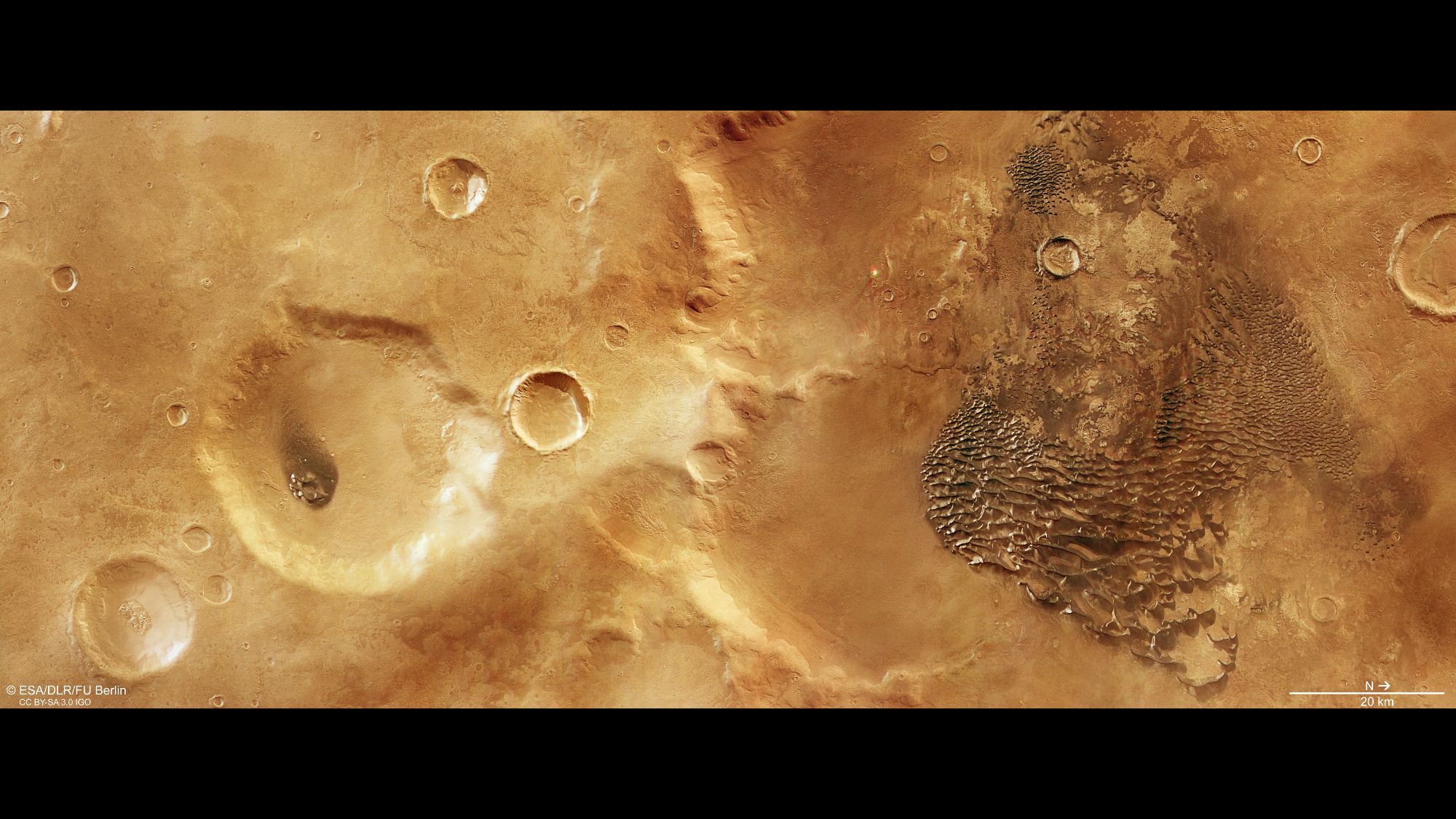
The European Space Agency's Mars Express orbiter has been capturing some of the Red Planet's most surreal landscapes, and its latest images reveal a sprawling field that looks like molten metal frozen across the floor of an ancient Mars crater.
The shimmering "waves" aren't metal at all, however. They are dark sand dunes dusted with seasonal frost, much of it carbon dioxide, or "dry ice," that settles on the surface during Martian winters, giving the dunes their uncanny chrome-like sheen, according to ESA.
The rest is a trick of light and contrast. Because the dark sand absorbs light and the white frost reflects it, the interplay transforms the landscape into something that looks more like a scene from a sci-fi movie than a windswept Martian plain.
A bird's-eye view of wind-blown dunes in Kaiser Crater. (Image credit: ESA/DLR/FU Berlin)
Over thousands of years, Martian winds have sculpted this volcanic sand into dunes that now ripple through the floor of Kaiser Crater, a 129-mile-wide (207-kilometer-wide) impact basin in the planet's southern highlands. The bowl-shaped crater acts as a giant sand trap that prevents the sand from escaping, according to NASA.
The dunes themselves are darker than much of Mars' surface because they are made of fine, basaltic sand rich in volcanic minerals such as pyroxene and olivine, rather than the iron-oxide dust that gives the planet its familiar rusty-red appearance and its famous moniker, the Red Planet.
Because the crater floor remains visible between the ridges, scientists think there is a relatively limited sand supply shaping the field. Still, these ripples of sand are massive, extending for several kilometers and towering more than 100 meters (320 feet) above the surrounding terrain.
The landscape isn't just visually dramatic, it also preserves clues to a time when Mars was a very different world.
Today, Mars is wrapped in an atmosphere little more than a thin veil that is 100 times thinner than Earth's and slowly leaking into space. That makes it harder for winds to lift and transport sand than it is on our own planet. Yet the soaring dunes inside Kaiser Crater show that Martian winds have nonetheless been powerful enough to sculpt vast landscapes over time, perhaps during a period when the Martian atmosphere was thicker a few billion years ago.
The new image adds to a growing collection of striking Martian scenes captured by Mars Express, which has been orbiting the Red Planet since 2003. Just last month, the probe tracked a frenetic cluster of 30 dust devils swirling through the canyons of Mamers Valles, also in the northern hemisphere.
Over the spring and summer, the orbiter similarly spotlighted the planet's vast and complex geological history, from Shalbatana Vallis — carved by groundwater floods about 3.5 billion years ago into winding valleys that span the length of Italy — to a massive blanket of dark volcanic ash elsewhere on the world that has spread across a large chunk of the terrain over just the last 50 years, having either been redistributed by Martian winds or exposed as the overlying dust was blown away.
However desolate Mars may appear from afar, there is certainly no shortage of activity on its surface — or discoveries still waiting to be made.
People keep asking me about the total solar eclipse on August 12. That's understandable. For anyone in the Northern Hemisphere, it is shaping up to be a joyous day of astronomy. Totality will cross eastern Greenland, western Iceland and northern Spain, but much of Europe will see a very deep partial eclipse, and even parts of North America will see a small bite taken from the sun. Then, just hours later, the Perseid meteor shower will peak beneath perfectly moonless skies. What a double-act!
The problem with promoting days and nights like that is that they make us think skywatching is only worth doing at very specific times. Everything becomes about moments, peaks and countdowns. That rings true for an eclipse, of course, but for the Perseids, it's less so.
The Perseid meteor shower actually begins right now. It's active from July 17 through August 24. Yes, it reaches a strong maximum overnight on August 12-13, where observers under ideal dark skies could see 50 or more "shooting stars" per hour. That's absolutely the night to aim for if you only go stargazing once a month. But for stargazers with a little more time, the hunt can begin right now.
The best Perseid is the first one you see. In these weeks before the peak, there's less expectation, less focus on the weather. An unexpected streak while you are outside feels accidental.
For me, it often happens when I've stopped observing properly for the night. Last summer, I was moving my telescope indoors late at night after a fairly unremarkable session looking at a few globular clusters. As I went back inside, I did my usual pause and look at the stars one last time. As I did, my peripheral vision caught a bright meteor whizzing across rooftops in the northeast. Summer's meteor season had begun with a bang when I least expected it to.
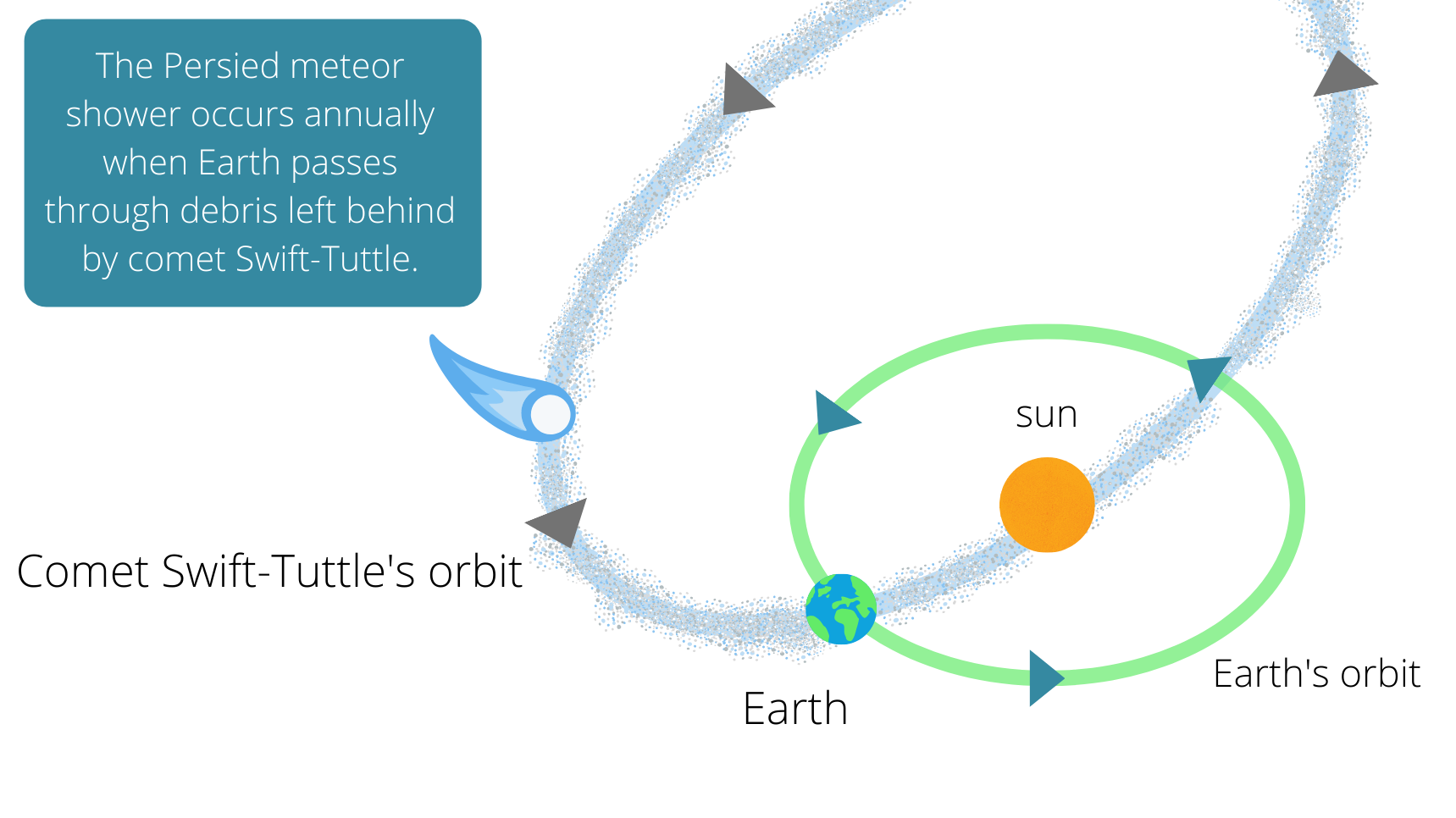
The Perseids officially build gradually over several weeks as Earth slowly enters the broad debris stream left behind by Comet Swift-Tuttle. It was last in the inner solar system in 1992 and will return in 2126. The peak around August 12—13 marks the densest part of the stream, but in mid-July, only a handful of meteors will appear each hour. That's exactly why early Perseids feel so special — you stumble across a meteor when you least expect it. Its gradual beginning also explains why some of the earliest Perseids can be surprisingly dramatic. The shower is famous for bright fireballs — large, vivid meteors that sometimes leave glowing trails lingering for several seconds. Even when overall meteor rates remain low in July, a single bright Perseid can add some magic to a night's observing.
What's happening and when to look
Meteors can technically appear anywhere in the night sky, but will appear to have come from the constellation Perseus. This photo shows a Perseid meteor over the Eboliang Yardang landform on August 12, 2022 in Haixi Mongolian and Tibetan Autonomous Prefecture, Qinghai Province of China. (Image credit: Photo by Wu Zhengjie/VCG via Getty Images)
If you want to begin watching for Perseids this week, the best time is after midnight through the small hours before dawn, when the radiant constellation, Perseus, climbs higher in the northeastern sky. "Shooting stars" can appear anywhere in the night sky, but if their paths backward point roughly toward Perseus, it's a Perseid. That's what gives the shower its name.
There's more to look at than Perseids because July is quietly crowded with other meteor showers. The Southern Delta Aquariids begin strengthening through the second half of the month. From southern latitudes, they can produce roughly 25 meteors per hour under dark skies, though observers farther north tend to see fewer because the radiant stays low in the southern sky. These meteors are usually softer and subtler than Perseids — medium-speed streaks without many dramatic fireballs or glowing trails.
Running alongside them are the Alpha Capricornids, active from early July into mid-August. Technically, this is a weak shower, often producing only a handful of meteors per hour, but it compensates with unusually bright, slow-moving fireballs.
Unfortunately, both showers peak this year beneath an almost full Buck Moon on July 30-31, which will wash out many fainter meteors. But bright meteors and fireballs should still occasionally punch through the moonlight.
Every year, Earth passes through the path of Comet Swift-Tuttle. With the Perseid meteor shower's peak occurring when Earth passes through the densest, dustiest area. (Image credit: Future)
How and when I'm watching it
I will probably begin meteor season the same way I always do: accidentally. I'll increase the odds by lingering outdoors slightly longer than necessary on warm nights, staying up later than I should and using my smart telescope to collect data on deep-sky objects while I search the skies for the first Perseid. It's best done now, before the moon waxes to full, and certainly before early August, when it wanes — the worst moon phase for observing meteors because it's in the sky just as meteor activity peaks.
Stargazer's corner: July 17-24, 2026
See a crescent moon and Venus on July 17. (Image credit: Starry Night)
With a new moon on July 14, this weekend is perfect for watching the return of a waxing crescent moon to the night sky. Look low in the west during dusk on Friday, July 17, to see a 16%-illuminated waxing crescent moon to the left of Venus. Watch it climb higher into the evening sky night after night, leaving genuinely dark late-night skies once it sets. It's good timing for the first serious Perseid-watching session of the season, particularly after midnight when meteor activity naturally increases as Earth rotates into the direction of travel around the sun.
Meanwhile, the Summer Triangle — formed by Vega, Deneb and Altair — hangs almost overhead during the darkest hours, making this one of the easiest seasonal star patterns for beginners to learn. Saturn now rises comfortably before midnight and dominates the southeastern sky by dawn, when it's joined by Mars and the stunning Pleiades open cluster.
Constellation of the week: Perseus
The constellation Perseus. (Image credit: E. Slawik/NOIRLab/NSF/AURA/M. Zamani)
Perseus, "The Hero," never quite looks how beginners expect. Rising into the northeastern night sky around midnight this week between bright star Capella and Saturn in the east, its name suggests something dramatic, but the constellation itself appears more like a loose chain of stars stretching below Cassiopeia in the northeastern sky. At this time of year, Perseus rises late, which is why the best Perseid activity happens after midnight once the radiant climbs higher. Beginners often assume meteors appear only near the radiant itself, but the longest and most impressive Perseids usually streak much farther away across the sky. Perseus matters less as a viewing target than as a reminder that meteor showers are fundamentally about perspective. The meteors are not actually emerging from the constellation at all — Earth is simply driving through comet debris head-on.
Making a sequel to Ridley Scott's 1979 classic "Alien" should have been a disaster. This was a movie that defined a whole new sub-genre of outer-space horror, a perfectly structured scarefest that also introduced one of cinema's greatest-ever monsters to the world.
Luckily, James Cameron — then one of Hollywood's hottest properties off the back of "The Terminator" — has never been a shrinking violet, and was brave enough to face the Xenomorph challenge head-on. Reinventing the franchise as a muscular sci-fi action movie, he created a whole new sub-genre of his own with a film every bit as memorable as its predecessor.
So, as the peerless "Aliens" turns 40, here — in honour of LV-426, the moon where the movie takes place — are 26 reasons it's still the greatest sci-fi action movie of all time.
1. James Cameron’$ original pitch
(Image credit: 20th Century Fox)
With only "The Terminator" (and the long-forgotten "Piranha II") on his resumé, James Cameron was yet to ascend to "king of the world" status when he pitched for the "Alien" sequel. His subsequent meeting with studio execs has since become the stuff of Hollywood legend.
The story goes that he turned over a copy of the script, wrote "ALIEN", added an S to the end, and then scrawled a couple of lines through the final letter. "ALIEN$" was a language the bigwigs understood, and you know what? Cameron was kinda right.
2. A new genre
(Image credit: 20th Century Fox)
Same continuity, same creature, same lead character… "Aliens" is undeniably a sequel to "Alien".
But while Ridley Scott's original film was already the definitive outer-space horror, Cameron boldly shifted genres to make the definitive outer-space action movie. Forty years on, fans are still debating which one is best.
3. Nothing is wasted
(Image credit: 20th Century Fox)
Anyone teaching action movie screenwriting should use "Aliens" as a core text. It's lean, it's efficient, and every line and moment is integral to the all-time classic whole.
It's no accident that Ripley shows off her Power Loader skills in the opening act — it's Cameron's version of Chekhov's gun.
4. The time jump
(Image credit: 20th Century Fox)
Some sequels pick up immediately after their predecessor left off. But by leaving Ellen Ripley in hypersleep for 57 years, the universe has a chance to evolve around her. Indeed, that's enough time for Weyland-Yutani to colonize LV-426 and — just maybe — pay a visit to that mysterious spaceship with all those eggs in its cargo hold.
What could possibly go wrong?
5. Ellen Ripley
(Image credit: 20th Century Studios)
Ellen Ripley may have been the accidental hero of "Alien", but she's 100% proactive in "Aliens". At the beginning of the movie, she's still traumatized by her experience on the Nostromo, and her employers at Weyland-Yutani are doing little to help. But her cool head in a high-pressure situation puts highly trained Colonial Marines to shame, and by the final act, she's grown into one of cinema's greatest heroes.
Sigourney Weaver rightly earned herself an Academy Award nomination for her tour de force performance.
6. The Colonial Marines
(Image credit: 20th Century Fox)
Cameron waited until late on in production to shoot the scene where the Colonial Marines wake up from hypersleep. It's a genius move, their real-life familiarity helping to establish a convincing camaraderie between these elite soldiers.
Even though most are lucky if they speak more than a line or two, Cameron's writing is so tight that we already know plenty — and care — about them when they inevitably become Xenomorph fodder. (Top fact: with the exception of Lt Gorman and Corporal Hicks, the Marines all share a first initial with the actor who plays them.)
7. The Dropship
(Image credit: 20th Century Fox)
Physics purists can bemoan the science all they like, but there's something undeniably cool about the craft that plunges the Marines to the surface of LV-426. A wonderfully utilitarian example of pre-CG model work.
8. The slow-build
(Image credit: 20th Century Studios)
In the original version of the movie, an entire hour has passed before you see an alien. Cameron doesn't waste a second of that time, however, establishing characters (see above), introducing Newt, showing off the geography of the Hadley's Hope terraforming base, and building a creeping sense of dread.
Those acid burns on the floor can't be good news, right?
9. The shouldercams
(Image credit: 20th Century Fox)
In an era when cameras can be shrunk down into phones or even a pair of glasses, anybody can film anything. But when Cameron gave his soldiers shoulder-mounted video units, it felt genuinely groundbreaking. It provides a suitably chaotic Marine's-eye-view as the carnage unfolds, but you always know whose perspective you're following because, well, their names are written on screen.
10. The ambush
(Image credit: 20th Century Fox)
"Aliens" may take its time getting to the actual aliens, but when it does, it doesn't hold back.
The walls start moving, flame-throwers start flaming, and suddenly the Marines are on the back foot against a vastly superior enemy. Throw in an exploding bag of ammunition, and it's all so brilliantly disconcerting that you need several rewatches to work out what you've just witnessed.
Within a matter of minutes, Hicks, Hudson, Vasquez, and Gorman are the only Marines left standing — and Gorman's technically comatose.
11. The Xenomorph drones
(Image credit: Twentieth Century Fox)
HR Giger's original Xenomorph is a design classic, but Cameron was more concerned about practicality than looks.
The new alien suits (usually occupied by gymnasts and acrobats) prioritized movement, as the director went big on research and development to make sure their motion was as inhuman — and as fast — as possible.
Remarkably, only six suits were built for "Aliens", but ingenious editing makes it look like Hadley's Hope is swarming with them.
12. The Alien Queen
(Image credit: 20th Century Fox)
We'd seen the eggs, the Facehuggers, and the drones. But, as Ripley pointedly asks, "Who's laying the eggs?"
The answer is a truly terrifying new stage in the Xenomorph life cycle, and arguably the last essential addition to the franchise's mythology.
Designed by Stan Winston (who'd worked with Cameron on "The Terminator" and won an Oscar for his work on "Aliens"), the Alien Queen is a towering apex predator who'll do anything to protect her kids.
13. Newt
(Image credit: 20th Century Fox)
Introducing a kid to a hard-boiled action franchise can be a risky move, but Rebecca Jordan (known to everyone as Newt, played by Carrie Henn) is totally integral to "Aliens".
As the last known survivor of Hadley's Hope, she's resourceful as hell and has plenty to teach the heavily armed Marines about survival in a Xenomorph-infested world. She also brings out the maternal instinct in Ripley, a key theme of the movie that comes to a head in her famous face-off against the Queen: "Get away from her, you bitch!"
Speaking of which…
14. The quotable dialogue
(Image credit: 20th Century Fox)
"We're on an express elevator to hell." "They mostly come at night… mostly." "Game over, man. Game over." "I say we take off, nuke the site from orbit. It's the only way to be sure."
Few action movies — with the possible exception of "Predator" and "Die Hard" — are quite as chock-full of zingers as "Aliens".
15. The APC
(Image credit: 20th Century Fox)
The Armored Personnel Carrier is every bit as iconic as the dropship it calls home.
Part mobile base-of-operations, part all-terrain action vehicle, it's the reason the few remaining Marines escape their close encounter in one piece — even if its transaxles have issues dealing with concentrated acid blood.
It's telling that the Resources Development Administration hardware in the "Avatar" series is so heavily influenced by this timeless "Aliens" tech.
16. Facehuggers on the move
(Image credit: 20th Century Fox)
The Facehugger that jumped — and subsequently impregnated — Kane in the original “Alien was already the stuff of nightmares. But the parasites in the sequel are much more than some acid-blooded jack-in-a-box.
In “Aliens”, those spider-like legs allow them to scurry around to hunt down their prey, ensuring they're a clear and present danger — even if you're not foolhardy enough to put your face over an open egg.
17. Carter Burke
(Image credit: 20th Century Fox)
If there’s one thing the "Alien" saga has taught us, it's that you should never, ever trust Weyland-Yutani, chillingly referred to simply as "the Company".
If "Alien"'s Ash was the ultimate company android, Burke (Paul Reiser) is the epitome of the company man, a total scumbag whose friendly, "I'm-your-best-friend demeanor" can’t disguise the fact that he’d screw you over for a percentage, kiddo. The only character in the movie whose death by Xenomorph elicits a cheer.
18. The motion trackers
(Image credit: 20th Century Fox)
You don't need to see the Xenomorphs to know they're there.
The ominous beep of the Marines' motion trackers is a highly effective way of teasing the approaching menace — even when they're hiding in the ceiling.
19. A countdown to detonation
(Image credit: 20th Century Fox)
It's bad enough that you're trapped on a barren moon surrounded by a vicious hive of extraterrestrials who want to use you as hosts for their offspring. And that your primary choice of rescue has crashed on the surface, leaving you even more stranded.
Then, fate (or, to be more accurate, James Cameron) throws you a curveball in the form of an atmospheric processor about to go nuclear. The clock is well and truly ticking…
20. Bill Paxton
(Image credit: 20th Century Fox)
The late Bill Paxton was Cameron's lucky charm, also turning up in "The Terminator", "True Lies", and "Titanic". But "Aliens" is his signature role, as the famously pessimistic Private Hudson makes the most of his limited dialogue.
As an interesting sidenote, Paxton had the honor of being killed on screen by a Terminator, a Predator, and a Xenomorph.
21. The Power Loader
(Image credit: 20th Century Fox)
Part Japanese mecha, part Transformer, Ripley's Power Loader is an instantly iconic piece of kit, so painstakingly designed that it looks like it could actually work IRL.
If you're going to go woman-to-woman with an angry Alien Queen, never leave the house without one.
22. Bishop
(Image credit: 20th Century Fox)
Ash, the Nostromo's resident synthetic in "Alien", was a bona fide bad 'un, prepared to sacrifice the crew in the name of getting a valuable Xenomorph back to "the Company"’s weapons division.
It's hardly a surprise, then, that Ripley is suspicious of Bishop (Lance Henriksen) from the off. Luckily for everyone, he gradually proves his worth via his skills with the knife game, elite dropship-piloting abilities, and generally being an all-round good egg.
Not bad for an android… (Bishop is manufactured by Hyperdyne Systems, a nod to Cyberdyne in Cameron’s “Terminator” movies.)
23. The music
(Image credit: 20th Century Fox)
"Aliens" was James Horner's first collaboration with Cameron (he went on to write the scores for "Titanic" and "Avatar"), and the then-32-year-old provided the perfect musical backdrop for the action unfolding on screen.
Sure, some of the themes are derivative of the composer's own "The Wrath of Khan" soundtrack, but it's impossible to imagine "Aliens" without Horner's contribution.
24. The sound effects
(Image credit: 20th Century Fox)
The best sci-fi franchises are as recognisable for their sound as their visuals. So, just as, say, "Star Wars"’ lightsabers and "Star Trek"s transporters are aurally unmistakable, "Aliens" has its own distinctive soundscape.
Hear a pulse rifle firing or the squeal of a Xenomorph, and you know exactly where you are. Best Sound Effects Editing was one of the film's two Academy Award wins, and it's easy to see why.
25. The Special Edition
(Image credit: 20th Century Fox)
If you've never seen "Aliens", the tighter theatrical cut is definitely the place to start. But once you know what's waiting for the Colonial Marines on LV-426, the Special Edition is the definitive version of the movie.
From Newt's family making first contact with a Facehugger to a wonderfully tense sentry gun sequence, Cameron's extra footage enhances a classic. It also adds to the film's mother/child subtext when we learn that Ripley had a daughter, Amanda, who died just before Ellen was discovered by the Weyland-Yutani recovery crew.
Amanda would later be retconned to become the lead character in the survival horror video game "Alien: Isolation".
26. Cameron himself
(Image credit: Getty Images (Bob Penn))
Cameron's intense working methods famously didn't go down well with his unionized British crew, who famously made t-shirts bearing the slogan "You can't scare me, I work for James Cameron".
But whatever the on-set experience, it's impossible to deny that he marshalled proceedings to perfection. Even the director's lesser works — the "Avatar" sequels, for example — feature action beats of unassailable genius. "Aliens", however, demonstrates a filmmaker at the pinnacle of his powers.
Every sci-fi action movie ever made will be judged against "Aliens". Even the brilliant "Predator" lives in the shadow of a movie that remains untouchable — and endlessly rewatchable — four decades after its original release.
"Aliens" is available to stream on Disney+ in the UK, and to rent and buy on various platforms in the US.
En este 2026, Steven Spielberg ha vuelto a los cines con el estreno de su última película: ‘El día de la revelación’. No es la primera vez que el director, guionista y productor de cine estadounidense hace una película sobre extraterrestres; en 1977, con ‘Encuentros en la tercera fase’, contó la historia de un reparador de líneas eléctrica que ve un objeto volador no identificado. Poco después, en 1982, encandiló al mundo con ‘E.T., el extraterrestre’, hasta el punto de ser uno de los largometrajes más taquilleros de su dilatada carrera.
La trama de ‘El día de la revelación’ gira en torno a dos protagonistas que intentan destapar un secreto gubernamental oculto durante décadas: los extraterrestres llevan mucho tiempo viviendo en la Tierra. Una revelación (valga la redundancia) que podría cambiar para siempre el mundo tal y como lo conocemos. La película no ha podido llegar en un mejor momento: hace unos meses, el Departamento de Defensa de Estados Unidos empezó a desclasificar documentos con información sobre Fenómenos Aéreos No Identificados.
Algunas personas creen que es una técnica de distracción para desviar la atención de la población de problemas como el caso Epstein. Otras opinan que ya es hora de que se sepa la verdad, y que las autoridades confirmen que el incidente OVNI de Roswell (Nuevo México) del 2 de julio de 1947 ocurrió realmente. Sea como sea, lo que está claro es que con lo avanzados que estamos tecnológicamente, resulta extraño que ninguna raza extraterrestre se haya puesto en contacto con nosotros. Los científicos creen saber el motivo.
Las civilizaciones extraterrestres podrían no ser tan avanzadas como la nuestra
Las películas clásicas de Hollywood han hecho que creamos que los astronautas son hombrecillos verdes escuálidos con ojos negros muy grandes y vestidos con trajes espaciales plateados. Pero lo cierto es que de existir vida extraterrestre (lo que es casi innegable, ya que el universo es extensísimo y tiene casi 14 mil años, por lo que alguna forma de vida inteligente aparte de la humana debe haber), no tendría por qué parecerse físicamente a nosotros.
Películas más actuales como ‘La llegada’ (2016) o ‘Proyecto Salvación’ (2026) nos han presentado seres extraterrestres muy distintos a los ya muy manidos hombrecillos verdes, destacando especialmente a Rocky de ‘Proyecto Salvación’, que es una especie de araña rocosa a la que se le da muy bien construir cosas. Justamente en estas dos películas, una de las cosas más importantes no es precisamente el contacto, sino la comunicación entre humanos y estos seres extraños.
Nuestros telescopios de observación espacial emiten señales de radio que podrían ser interceptadas por otra civilización y saber que existimos, pero si saben que estamos aquí, prefieren no establecer contacto. Lo que creen algunos expertos es que dichas ondas de radio pasarían “desapercibidas” para otras civilizaciones galácticas, que podrían ser miles de millones de años más antiguas que la nuestra y, por tanto, más avanzadas tecnológicamente.
Un estudio publicado en The Open Journal of Astrophysics en 2024 explora la posibilidad de que los extraterrestres se comuniquen entre sí mediante ondas gravitacionales. Estas ondas son perturbaciones en el espacio-tiempo que los físicos aún no han logrado comprender del todo. Los avances científicos que hemos logrado no son capaces de distinguir entre las ondas gravitacionales naturales y las que podrían ser artificiales.
Y aunque llegáramos a discernirlas, es posible que nunca pudiéramos descifrarlas. Hace unos años, en 2021, un grupo de investigadores utilizó un modelo de simulación galáctica para estimar la posibilidad de inteligencia extraterrestre a lo largo del tiempo en la Vía Láctea, con el objetivo de determinar la antigüedad de cualquier civilización alienígena, ayudando a saber si alguna podría viajar por el espacio o establecer contactos intergalácticos.
Y aquí aparece la posibilidad de que la civilización más cercana sea tan joven como para no disponer de los recursos necesarios para comunicarse, con una tecnología más “rudimentaria” que la nuestra. Este caso llama bastante la atención porque, justamente por culpa de Hollywood, creemos que los extraterrestres disponen de naves espaciales avanzadísimas, teletransportarse y comunicarse telepáticamente, pero podría no ser así.

 Login