
❌

Reading view

Hummingbirds and pineapples: why this ancient relationship hits the evolutionary sweetspot

kirkchai benjarusameeros/Shutterstock

High above the rainforest floor, tiny ponds form in the leaves of plants perched on tree branches. Frogs breed in these ponds, alongside insects, microbes and even tiny crustaceans, creating miniature ecosystems suspended high in the canopy. These are the bromeliads – the remarkable plant family that also gave us air plants, the towering 12-metre β€œQueen of the Andes”, and the pineapple on your terrible pizza.


Many people think of plants as nice-looking greens. Essential for clean air, yes, but simple organisms. A step change in research is shaking up the way scientists think about plants: they are far more complex and more like us than you might imagine. This blossoming field of science is too delightful to do it justice in one or two stories. This article is part of a series, Plant Curious, exploring scientific studies that challenge the way you view plantlife.


Bromeliads are one of the great evolutionary success stories of the neotropics, the tropical ecosystems of the Americas. The ancestor of all living bromeliads existed just 20 million years ago, and since then, they have branched into about 3,800 species. To put this into perspective, hydrozoans – a lineage of predatory jellyfish-like animals – took more than 500 million years to evolve about 3,800 species.

Explaining how the remarkable plant biodiversity of the neotropics evolved remains one of the greatest challenges in evolutionary biology. Bromeliads, which are almost entirely unique to this region, provide one of the best natural experiments for investigation. My colleague Elizabeth Forward and I have published a new study that confirms hummingbirds played a crucial role in this plant family’s evolution.

Over the past 20 million years, bromeliads repeatedly evolved new adaptations to the point that some of them are hard to recognise as close cousins.

Many abandoned the forest floor to grow on tree branches as epiphytes (meaning they use their host as a perch and don’t harm it). Others evolved leaf formations that trap rainwater. Some evolved Cam photosynthesis, the same water-saving strategy used by cacti living in the harshest deserts.

Plants that use Cam photosynthesis only absorb carbon dioxide at night, when it is cooler. These adaptations allowed bromeliads to maximise new ecological opportunities at high speed.

However, one idea that dates back to Charles Darwin is perhaps the strongest, and that is the influence of different pollinators.
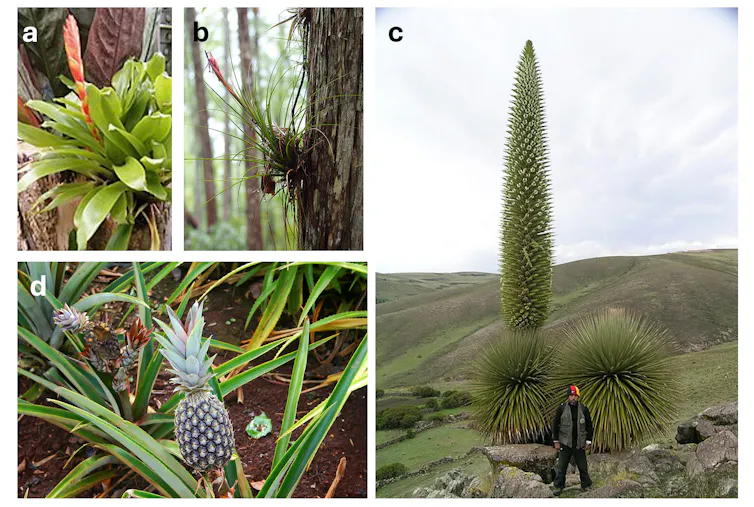
A panel showing the diversity found within the bromeliad family. (a) A tank-forming species. (b) An air plant. (c) The Queen of the Andes. (d) The familiar pineapple.
The diversity of bromeliads. (a) A tank-forming species. (b) An air plant. (c) The Queen of the Andes. (d) The familiar pineapple. Wikimedia, CC BY

The hummingbird hypothesis

Most flowering plants, including the earliest bromeliad ancestors, are pollinated by insects such as bees. However, at least half of all bromeliad species today are pollinated by hummingbirds, and some others rely on bats, butterflies or moths.

Scientists have long suspected that the repeated evolutionary shifts between pollinators helped accelerate the formation of new bromeliad species. But exactly when these shifts occurred, and what effect they had on diversity, has remained uncertain.

My colleague and I tested this idea. We compiled pollinator records for more than 400 bromeliad species, and reconstructed the history of how bromeliads switched between pollinators through 20 million years of evolution.
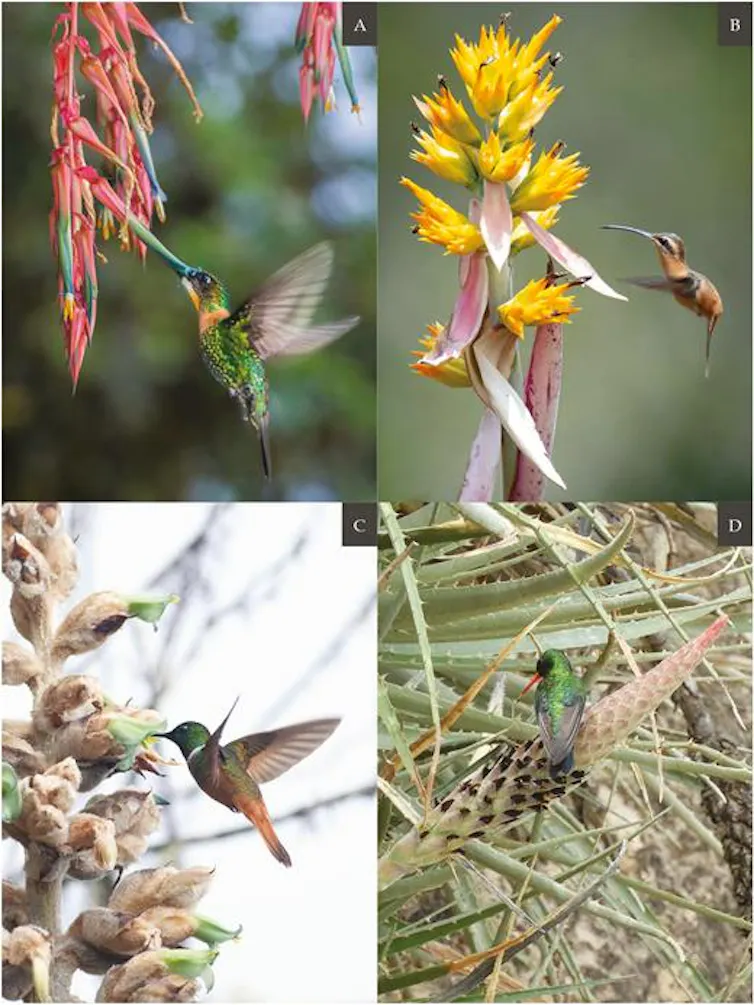
Photographs of hummingbird species visiting different bromeliads. Botanical Journal of the Linnean Society, CC BY

Our analyses support the idea that the earliest bromeliads were pollinated by bees. Following this, there were repeated shifts, primarily to hummingbirds, but also bats and butterflies. Bromeliads experimented with different pollinators as they spread into new habitats across the neotropics. Our results reveal a more dynamic evolutionary history than scientists previously suspected.

One pattern stood out. The bromeliads pollinated by hummingbirds split into new species at almost double the normal rate.

New species usually arise when populations become separated and gradually stop exchanging genetic material. Given enough time and isolation, enough genetic differences accumulate that they become unable to reproduce with each other. Pollinators can influence this process because they help shape which populations of plants are genetically connected and can reproduce together.

One possibility is that hummingbirds move pollen around differently to insects as many species move larger distances, which changes how genetic material flows across landscapes. Different pollinators also favour different flower colours, shapes and flowering times. Hummingbirds often prefer long, bright red and tubular flowers with copious nectar rewards, which match their long, slender beaks and hovering feeding behaviour. Over thousands of generations, these small differences build up. In mountainous regions, where many hummingbirds live, and in which valleys and peaks naturally separate populations, these effects may become even stronger.

Like most evolutionary stories, there is unlikely to be a single explanation that explains everything. Other innovations, such as epiphytism, also accelerate diversification rates. However, our study suggests that hummingbirds were of particular importance for bromeliads, helping to accelerate one of the fastest known plant radiations.
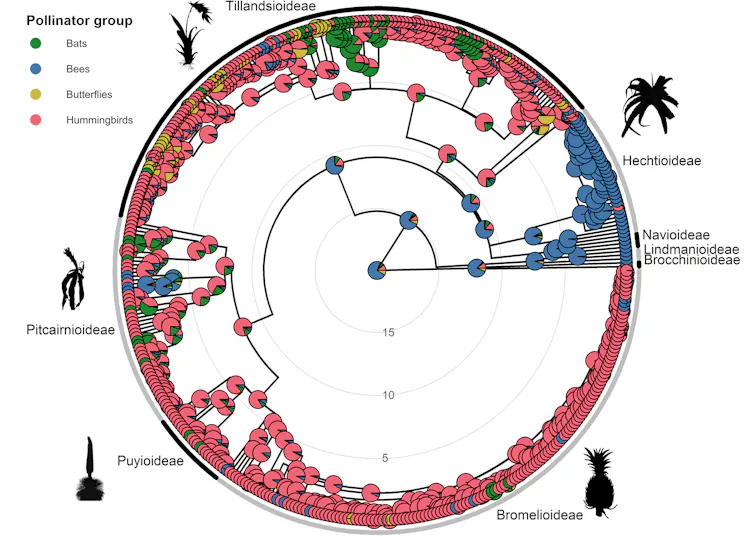
The bromeliad family tree with pollinators mapped to ancestors. Different subfamilies are highlighted with silhouettes of plants.
The bromeliad family tree with pollinators mapped to ancestors. Botanical Journal of the Linnean Society, CC BY

An ongoing evolutionary story

This high-speed evolutionary story of bromeliads has not finished. Our reconstruction shows that many shifts between pollinators occurred surprisingly recently. For example, the hummingbird-pollinated Hechtia iltisii, which looks a bit like a cross between a spider plant and an aloe vera. Its closest cousins are bee-pollinated.

In fact, about a quarter of bromeliad species changed their pollinator from that of their most recent ancestor in the last few million years, suggesting that bromeliads are still experimenting today. But they, and hummingbirds, face unprecedented pressures from habitat loss and climate change, threatening not only individual species but the evolutionary interactions that generate biodiversity across the neotropics.

Up to 81% of bromeliads are predicted to be possibly threatened with extinction. And dozens of hummingbird species are considered endangered.

Every pineapple in the supermarket, every air plant on a bathroom windowsill, and every pond-forming bromeliad clinging to a rainforest tree is the result of 20 million years of high-speed evolutionary experimentation. Tiny hummingbirds in particular have helped transform a single ancestral plant population into one of the richest bouquets of neotropical plant biodiversity.

The Conversation

Jamie Thompson receives funding from The Leverhulme Trust.

  •  

Heatwaves: why British trees are shedding branches and dying

British trees are struggling to survive in heatwaves. Forests like these are likely to be affected. Billy Stock/Shutterstock

If you visit the Royal Botanic Gardens at Kew, on the edge of London, you will see a brightly painted skeleton of a dead oak tree. The tree, known as the climate changed oak, succumbed in the heatwave of 2022. Instead of removing it, Kew left it in place as a reminder that climate change is already taking its toll on Britain’s trees.

The 2022 heatwave killed 400 of Kew’s trees and predictions show that up to 50% of Kew’s existing 11,000 trees could be vulnerable to climate change by 2090.

A similar story is playing out across the UK. Mature trees shedding limbs and branches during intense periods of hot weather, their canopies thinning, and some dying back altogether. Although these changes can appear sudden, they are often the final visible signs of a much longer process of decline that has been unfolding inside the tree.

The problem is not simply these high temperatures, but that the combination of both extreme heat and drought, increasingly referred to as a β€œhot drought”, pushes trees beyond the limits of what they can cope with.

Trees struggle to keep cool

To understand why heatwaves are so damaging to trees, one needs to appreciate how trees keep themselves cool. When water is absorbed by the roots, this travels through the xylem (the network of microscopic tubes that carries water from the roots to the leaves), where it evaporates through stomata (tiny pores on the leaf surface). This cools the leaves in much the same way that sweating cools humans.

This cooling system works well when water is freely available. A clear example can be seen in Fremont cottonwood (Populus fremontii), which is often found close to rivers. This tree used this process to keep its leaves between 2Β°C and 5Β°C cooler than the surrounding air during Arizona’s record-breaking heatwave in 2023, even when air temperatures exceeded 48Β°C.

As air temperatures rise, the atmosphere draws water from leaves more rapidly, in a process plant scientists call the vapour pressure deficit. Concurrently, dry soil makes it harder for roots to replace those losses, placing trees under increasing water stress and limiting their ability to maintain normal physiological functions.

By closing their stomata, trees conserve water. But this in turn restricts carbon dioxide uptake, slowing photosynthesis and reducing sugar production required for growth, repair and for defence against pests and diseases. When stomata are open, this allows for continued cooling, but comes at the cost of unsustainable water loss.


Read more: Heatwaves: expert tips on redesigning UK homes to cope with hotter temperatures


Every leaf has a thermal limit beyond which its ability to photosynthetise suffers irreversible damage. Surviving a heatwave therefore depends on maintaining enough evaporative cooling to stay below that threshold, although this safety margin is known to disappear surprisingly quickly. A recent study on poplar trees found that only 72 hours of reduced soil moisture and access to water was enough to disrupt leaf cooling. The leaves that had previously remained cooler than the surrounding air temperature became hotter than the air itself, reaching temperatures damaging to photosynthetic tissue.

Why branches fall

As heatwaves persist, problems can often spread beyond just the leaves. With xylem water under constant tension, when water supplies become limited, tiny air bubbles known as embolisms begin to form within the xylem in a process called cavitation. This results in a blockage impeding the transport of water. Ultimately, if enough xylem vessels become blocked in this manner, the tree experiences hydraulic failure, with water no longer able to reach the canopy tree effectively. This causes branches or entire sections of the crown to die back.

Some trees effectively sacrifice parts of their own canopy, reducing the need for water to keep the main stem alive. This strategy is known as hydraulic segmentation and helps explain why seemingly healthy trees may lose substantial numbers of limbs during prolonged hot weather.

Trees can continue to pay a price long after a heatwave is over, as this extreme weather depletes overall carbohydrate reserves and reduce growth potential. These effects can persist for years, leaving trees less resilient when the next drought arrives. A tree may therefore survive one exceptionally hot summer, only to succumb after another as the stresses accumulate over time. Water-stressed trees also become more vulnerable to insect pests and fungal and bacterial diseases because they have fewer resources available to defend themselves from attack.

Britain’s trees evolved under relatively cool, wet summers, and temperatures above 40Β°C were unheard of until recently. Many are now being exposed to climatic conditions well outside those under which they evolved. Research following the 2003 European heatwave suggests that vulnerability depends not only on how hot it becomes, but also on how well species can adapt to local conditions. As heatwaves become more frequent, many traditional species may increasingly find themselves outside their climatic comfort zone.

Record temperatures were seen across Europe in June 2026.

What can help?

Fortunately, there are several practical steps that can help, particularly for younger and more susceptible trees. Occasional deep watering is much more effective than frequent light watering because it encourages roots to grow deeper into the soil, where moisture remains available for longer.

Mulching, creating a thick layer of hardwood chip or compost, reduces soil surface evaporation rates, moderates soil temperatures and, as it breaks down, improves soil structure and water holding capacity. Soils with high concentrations of organic matter can absorb water/rain more effectively, which supports more resilient root networks.

Managing mature woodlands to increase their resilience to future heatwaves will require new strategies. Increasing woodland species diversity, reducing the concentration of trees in drought-prone areas and planting species better suited to future climates should be considered. A greater diversity of species helps resilience to hot weather.

Many of Britain’s mature trees have stood for centuries – these may be the most effective ways of protecting them for the future.

The Conversation

Glyn Barrett does not work for, consult, own shares in or receive funding from any company or organisation that would benefit from this article, and has disclosed no relevant affiliations beyond their academic appointment.

  •  
❌