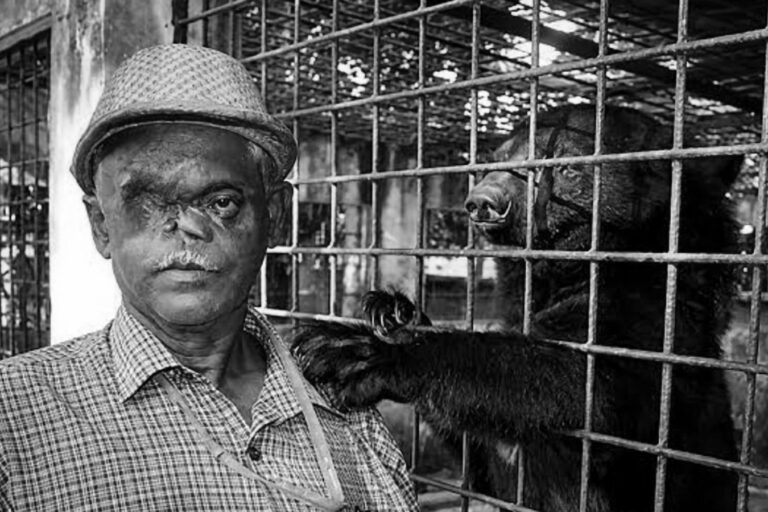
The bear came out of the forest with enough force to kill him. It mauled the hunter badly and cost him an eye. He spent three months in a hospital recovering. There, he began asking himself questions that had not troubled him much before. Why was he hunting? Why was he killing? Hunting had come to him through his family. His father and grandfather were known around Sreemangal, in northeastern Bangladesh, for killing leopards, wild boars, and other animals that threatened people or crops. As a boy, he accompanied his father into the forest. After his father died, he continued hunting. He became a gunsmith and a guide, familiar with animal tracks, forest paths, and the habits of creatures that most people encountered only by accident. Sitesh Ranjon Deb holds a pair of jungle cats in his house in Sreemangol, Bangladesh. Image via Agence France-Presse (AFP) After the bear attack, Sitesh Ranjan Deb, who died on July 14th, gave up hunting. He began capturing injured animals, removing snakes from houses, treating wildlife recovered from traffickers, and returning animals to the forest. The grounds of his home became a treatment center. It eventually developed into the Bangladesh Wildlife Service Foundation, one of the country’s best-known privately established wildlife-rescue institutions. The center remained closely tied to his household. Its patients occupied bedrooms, courtyards, cages, and improvised treatment spaces. Jungle-cat cubs, pythons, slow lorises, monkeys, birds, and other animals passed through. Those requiring constant attention stayed close to the family. Deb kept photographs…This article was originally published on Mongabay
His nephew recalled that the children were taught to chant, “Hyenas are beautiful!” as often as possible. On visits to Kruger National Park, he got them out of bed at midnight to look for bushbabies and again at five in the morning to search for big cats. Wildlife was often most active at inconvenient hours, and he expected anyone accompanying him to adjust. Michael “Gus” Mills, who died on July 13th, spent more than 40 years studying Africa’s large carnivores, especially hyenas, wild dogs, and cheetahs. He published more than 150 scientific papers, chapters, and reports, advised conservation bodies, and trained younger researchers. Much of his working life was spent in a vehicle on a sandy track, waiting beside an animal that might sleep for most of the day. Gus and Margie Mills. Sourced via the Endangered Wildlife Trust At school he had seemed an unlikely future scientist. He described himself as a “very bad student,” failed South Africa’s high-school leaving examination, and was told that science was beyond him. After passing the examination on a second attempt, he joked that he had earned an MA: “Matric Again.” Three years of psychology persuaded him that he did not want to be a psychologist. Zoology held his attention. A visit to Kruger in 1954, when he was eight, had already pointed him toward field biology. “It did something to me,” he said. From then on he wanted to work in the bush. After studying at the University of Cape Town and…This article was originally published on Mongabay
By some accounts, in the Philippine reefs of the 1970s, large groupers appeared every 50 feet or so. Some seemed as large as Volkswagen Beetles. Around them were snappers, fusiliers, wrasses, turtles, and corals, along with fish whose identities were still uncertain. A young biologist could spend his days diving and still feel he had only begun to understand what was there. Kent E. Carpenter arrived in the Philippines at 22, soon after graduating from the Florida Institute of Technology. The Peace Corps assigned him to the Philippine Bureau of Fisheries and Aquatic Resources and put him in charge of coral-reef research. He later called it “the best job there ever was or ever will be in the Peace Corps.” It gave him access to reefs across the archipelago and set the direction of his career. Carpenter was shot dead at his home in Sibulan, Negros Oriental, on July 12th. He was 73. According to police, three men entered the house late at night. A special task group was formed to investigate, and no motive had been established when his death was announced. Kent Carpenter. Image via Old Dominion University Pollution and destructive fishing were already damaging Philippine reefs during his early years there. The large predators he had seen so often became harder to find. He spent much of the next half-century recording marine life in increasing detail: which species lived where, how they were related, how populations changed, and what made them vulnerable. After completing a doctorate in…This article was originally published on Mongabay

 Login