❌

Reading view

On connaît enfin le nom d’un astronome maya : sa signature se cachait sous une formule mathématique

Ils ont prédit les cycles des planètes, construit des calendriers d’une grande complexité et observé le ciel avec une précision remarquable. Mais leurs noms avaient disparu. Jusqu’à ce qu’une inscription vieille de 1 200 ans révèle enfin l’identité d’un savant maya.

  •  

A 1,200-Year-Old Discovery Has Revealed the Identity of an Ancient Mayan Astronomer, in a New Archaeological First

A Maya astronomer’s identity has been revealed for the first time, discovered in an inscription at the Xultun site in Guatemala, finally revealing a name behind their storied knowledge.

Despite the Maya’s renowned knowledge of math and astronomy, no individual had ever been directly associated with those accomplishments, unlike figures such as the Greek scholars Ptolemy or Archimedes.

Now, in a recent paper published in Antiquity, an international team of archaeologists has identified a name linked to the Maya’s sophisticated mathematical knowledge: Sak Tahn Waax.

Advanced Maya Knowledge

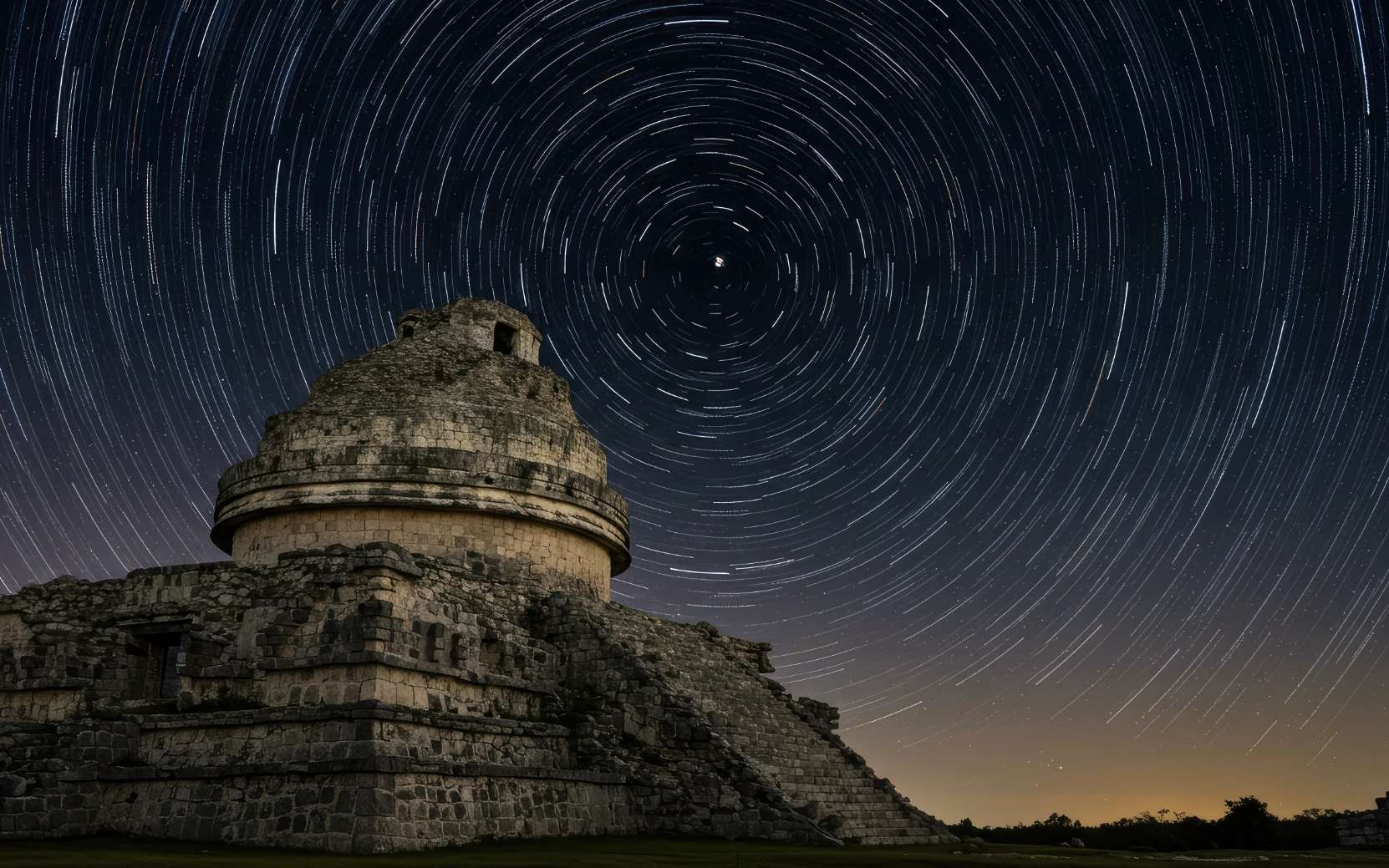
From around 2000 BCE until the Spanish conquest in the 16th century, the Maya flourished across the Yucatán Peninsula, building a civilization renowned not only for its political and economic power, but also for its remarkable scientific and mathematical achievements. Although relatively few Maya texts survived the Spanish conquest, those that remain—along with archaeological evidence—show that the Maya precisely calculated the length of the solar year and carefully tracked the movements of the Moon and Venus across the sky.

The art, architecture, and glyphic texts of the Classic Maya likewise reflect a sophisticated understanding of the natural world, interwoven with Indigenous cosmological traditions.

That expertise shaped nearly every aspect of Maya society. Their intricate calendars guided agriculture, informed religious observances, and influenced political life. Yet despite the importance of this knowledge, the individuals responsible for developing it have largely remained anonymous.

A Name Revealed

Meaning “white-chested fox,” the name Sak Tahn Waax appears on a wall engraved with mathematical formulas, which archaeologists dated to the eighth century CE using inscribed dates and radiocarbon analysis. Researchers believe the room likely served as either a classroom or a workshop for producing books.

The inscription was first documented shortly after excavations began at Xultun in 2011. Although the team initially focused on other priorities at the site, deciphering the text remained an enduring objective.

Reading the inscription required years of laboratory work using color scans and multispectral imaging. After reconstructing the wall’s faded engravings, the researchers determined that the text contained instructions for synchronizing the planetary cycles of Mars and Venus with the Maya calendar, concluding with the signature, “so says Sak Tahn Waax.”

“It’s really elegant, complex math,” said co-author Heather Hurst, an archaeologist at Skidmore College. “That’s why he’s signing it.”

Maya Signatures

The strangest thing about the discovery may be how common signatures are in other elements of Maya life. Artists and scribes often signed ceramics, while important political and military figures’ names often adorn stelae and buildings. Despite this propensity to name individual Maya on things, those responsible for their legendary knowledge of math and science largely remain unknown.

The archaeologists behind this new study now suggest that those names may be available after all; it is only that researchers have not known where to look.

“There’s good evidence for codex book production,” said lead author Franco Rossi, an archaeologist at the Massachusetts Institute of Technology. “So if there’s going to be a name … this would be the most logical place.”

The researchers hope the discovery will inspire a deeper appreciation for Maya history and for the scholars whose work shaped the civilization.

“I would have loved to see Sak Tahn Waax and Ptolemy hanging out,” Hurst concluded. “They would have had a great discussion.”

The paper, “The Identification and Work of an Eighth-Century Maya Mathematician,” appeared in Antiquity on July 14, 2026.

Ryan Whalen covers science and technology for The Debrief. He holds an MA in History and a Master of Library and Information Science with a certificate in Data Science. He can be contacted at ryan@thedebrief.org, and follow him on Twitter @mdntwvlf.

  •  

When the Spacecraft Align: Rescuing Saturated Images of Solar Flares

close-up image of the Sun showing a solar flare

Many observations of solar flares suffer from saturation and blooming, causing crucial information to be lost. Researchers recently validated a technique for retrieving information from saturated flare images, unlocking a treasure trove of powerful solar flares for examination.

Solutions for Saturation

Since 2010, the Atmospheric Imaging Assembly (AIA) on the Solar Dynamics Observatory (SDO) has been capturing nearly continuous extreme-ultraviolet images of the Sun’s disk, revealing our star’s dramatic high-energy behavior. Though SDO/AIA’s observations have transformed our understanding of the Sun’s activity, they have limitations: powerful solar flares can saturate the detector, spilling charge into nearby pixels.

This saturation and overflow compromises our ability to study the most energetic solar flares — but the “lost” information may actually be recoverable. When light from an intense flare enters SDO’s instruments, not all of it pools in the saturated region of the detector: some of the light is diffracted by the optics, and by mathematically inverting this pattern of diffracted light, researchers can attempt to extract the encoded information about the saturated region. Researchers have used this technique for more than a decade, but options for validating the results were limited until now.

Solar Orbiter Lends a Hand

Launched almost 10 years to the day after SDO, the Solar Orbiter spacecraft provides an excellent opportunity to test inversion techniques for recovering information from saturated solar images. Solar Orbiter’s Extreme Ultraviolet Imager snaps brief photos of the Sun at a rapid cadence, and its images remain unsaturated even when faced with energetic solar flares.

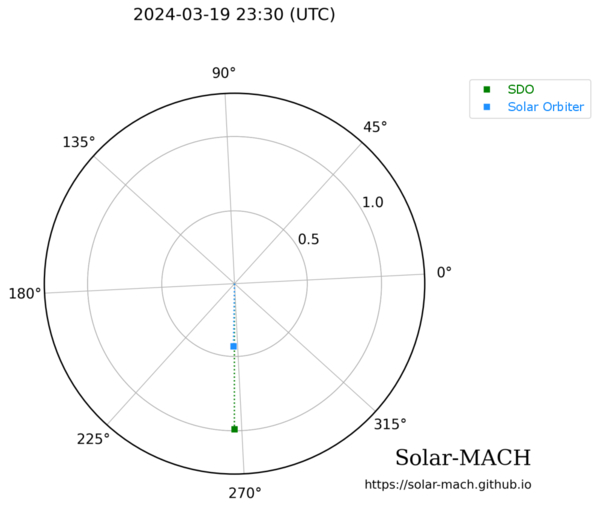
positions of Solar Dynamics Observatory and Solar Orbiter during a solar flare on 19 March 2024

Positions of SDO (green) and Solar Orbiter (blue) during a solar flare on 19 March 2024. Click to enlarge. [Guastavino et al. 2026]

As described in a recent research article by Sabrina Guastavino (University of Genoa; Italian National Institute for Astrophysics) and collaborators, the ideal setup for testing the inversion technique arose on 19 March 2024, when SDO and Solar Orbiter both viewed a solar flare while separated by just 1 degree in longitude.

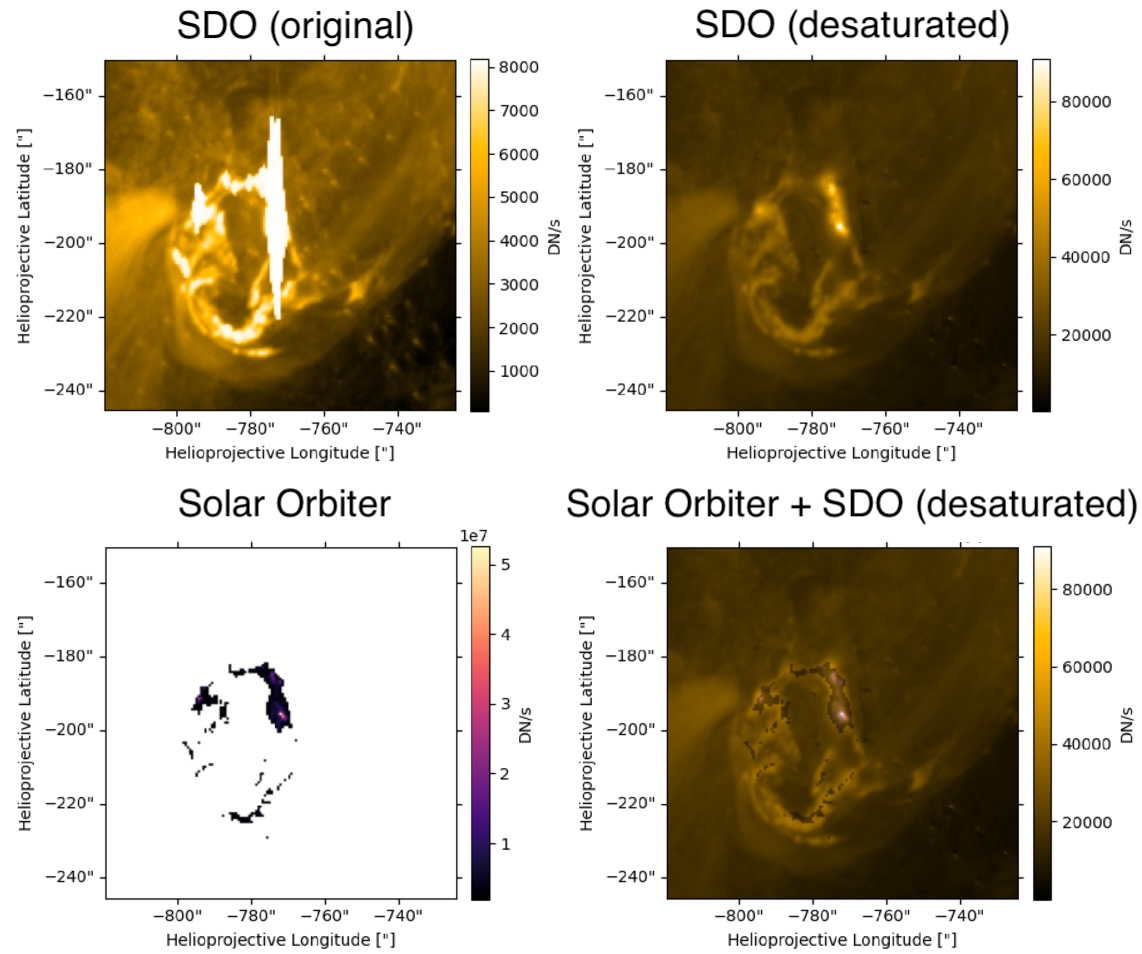
Guastavino’s team aligned and reprojected the data, accounting for the slightly different viewing angles of the two spacecraft, then applied an algorithm called Adaptive SE-DESAT to reconstruct the flux within the saturated portion of the SDO image. The team compared the desaturated SDO images to the unsaturated Solar Orbiter images over the course of the flare, finding the same flare morphology and similar time evolution between the two data sets.

sample results of the desaturation process

Example of unprocessed SDO data (top left), desaturated SDO data (top right), Solar Orbiter data (bottom left), and a combination of the two data sources (bottom right). Note that the Solar Orbiter observations have been clipped so that only the highest flare intensities were recorded. Click to enlarge. [Adapted from Guastavino et al. 2026]

A Treasure Trove of Desaturated Data

Overall, these results demonstrate the effectiveness of the inversion technique, though Guastavino and coauthors noted that improvements could be made during the impulsive phase of the flare, when the emission is increasing. The team identified several reasons why the results may not match during this phase, including rapid evolution of the flare during individual exposures.

Despite these areas that require further attention, the validation of this technique unlocks 16 years of solar flare observations from SDO. This especially enhances our sample of powerful solar flares, increasing the available records of the most energetic solar flares by orders of magnitude.

Citation

“Validation of an Extreme-Ultraviolet Desaturation Technique for the Atmospheric Imaging Assembly on Board the Solar Dynamics Observatory Using Observations from the Extreme Ultraviolet Imager on Board Solar Orbiter,” Sabrina Guastavino et al 2026 ApJL 1005 L50. doi:10.3847/2041-8213/ae7d2e

The post When the Spacecraft Align: Rescuing Saturated Images of Solar Flares appeared first on AAS Nova.

  •  
❌