Spin Signatures in Horizon-Resolved Images of LLAGN
Speaker
Dr. Daniel Palumbo, Harvard University
Abstract
With the advent of the Event Horizon Telescope (EHT), near-horizon black hole imaging with sub-mm very-long-baseline interferometry (VLBI) is now routine for the two sources for which terrestrial VLBI is sufficient to resolve the black hole shadow: Messier 87* and Sagittarius A*. Since the first images of M87*, the theoretical analysis of these images has advanced a broad class of black hole spin tracers in horizon-resolving observations, all of which have complex interplay with the astrophysical conditions near the horizon. Meanwhile, space VLBI mission concepts such as the Black Hole Explorer aim to drastically improve the angular resolution available via sub-mm VLBI, resolving out the primary accretion disk image to isolate the strongly lensed “photon ring,” which more robustly exposes black hole mass, spin, and viewing inclination to distant observers. In this talk, I will detail the spin signatures in both of these angular resolution regimes, and how they work together to build a “robustness ladder” for spin measurement with which the spins of many more low-luminosity AGN will soon become accessible as sub-mm VLBI sensitivity, frequency coverage, angular resolution improves. The resulting local “spin census” will help fill in missing pieces of the history of accretion and merging in the broader AGN population.
Coupling Driven H2 Excitation in Seyferts: GATOS JWST/MRS
Speaker
Daniel Delaney, University of Alaska
Abstract
We utilize James Webb Space Telescope/Mid Infrared Instrument (JWST/MIRI) Integral Field Unit observations from the Galaxy Activity, Torus and Outflow Survey to investigate the diverse range of ionized outflow rates of obscured active galactic nuclei (AGN) with similar bolometric luminosity and explore potential associations with AGN feedback. We explore spatial correlations between ionized emission potentially associated with fast shocks ([Fe II]5.34μm) and the excitation of H2. We further constrain our investigation to the inner 400 pc (the nuclear and circumnuclear regions r < 200 pc), and estimate the excitation temperature and column density of H2 assuming local thermodynamic equilibrium and using the S(1)–S(8) rotational H2 emission lines visible to JWST/MIRI spectroscopy. We report the molecular gas temperature of the deprojected 400 pc nuclear region to correlate with the ionized mass outflow rate. We also observe a stronger degree of spatial correlation between [Fe II]5.34μm emission and H2 gas temperature. We observe regions of enhanced [Fe II]5.34μm/[Ar II]6.99μm spatially coincident with the ionization cones of objects with higher ionized outflow rates and [Fe II]5.34μm/[Ar II]6.99μm in the deprojected 400 pc nuclear region to scale positively with both the ionized outflow rate and the estimated molecular gas temperature. We do not observe the estimated jet cavity power within the central 400 pc as strongly correlated with the ionized mass outflow rate or molecular gas temperature of the nuclear region. We take the preceding observations to suggest a higher degree of interaction between AGN outflows and the circumnuclear disk.
Seminar Connection
Zoom Registration (note this is a new registration link), you will receive connection details by email after registration:
From Micro to Macro: Connecting the Physics of Galaxy Formation Across Scales
Speaker
Drummond Fielding, New York University
Abstract
Galaxy formation is controlled by the cycling of diffuse gas through the ISM, CGM, and larger-scale environment, but predictive models remain limited by unresolved microphysics. I will discuss how sub-pc processes—including cosmic-ray transport, magnetic reconnection, and turbulent mixing—regulate multiphase structure, energy and momentum transport, and the launching of galactic winds. I will then describe how simulations, analytic models, and new multi-scale numerical methods can connect these processes to kpc-scale feedback and Mpc-scale galaxy evolution. The aim is to build physically grounded models of gas cycling that can sharpen our interpretation of observations and move galaxy formation theory beyond phenomenological feedback prescriptions.
How NASA’s Artemis III Lander Test Will Pave Way for Moon Landings
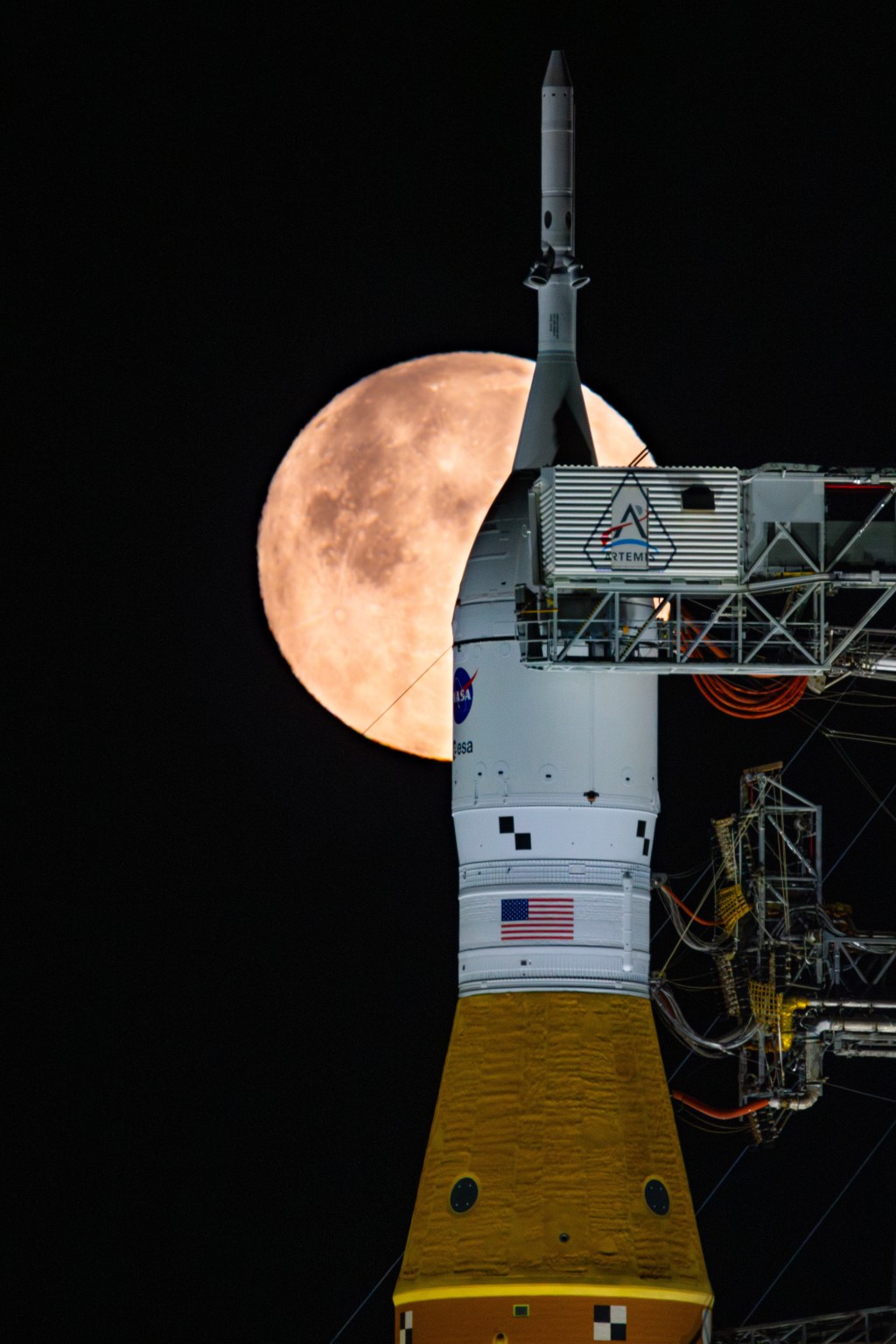
Before Artemis astronauts land on the Moon’s surface in 2028, NASA will conduct the Artemis III demonstration mission in 2027, allowing teams on Earth and in orbit to practice rendezvous and docking operations between commercial human landing systems and the Orion spacecraft. Data from that mission, along with future uncrewed demonstration missions at the Moon, will support astronaut safety and mission success for crewed lunar landings.
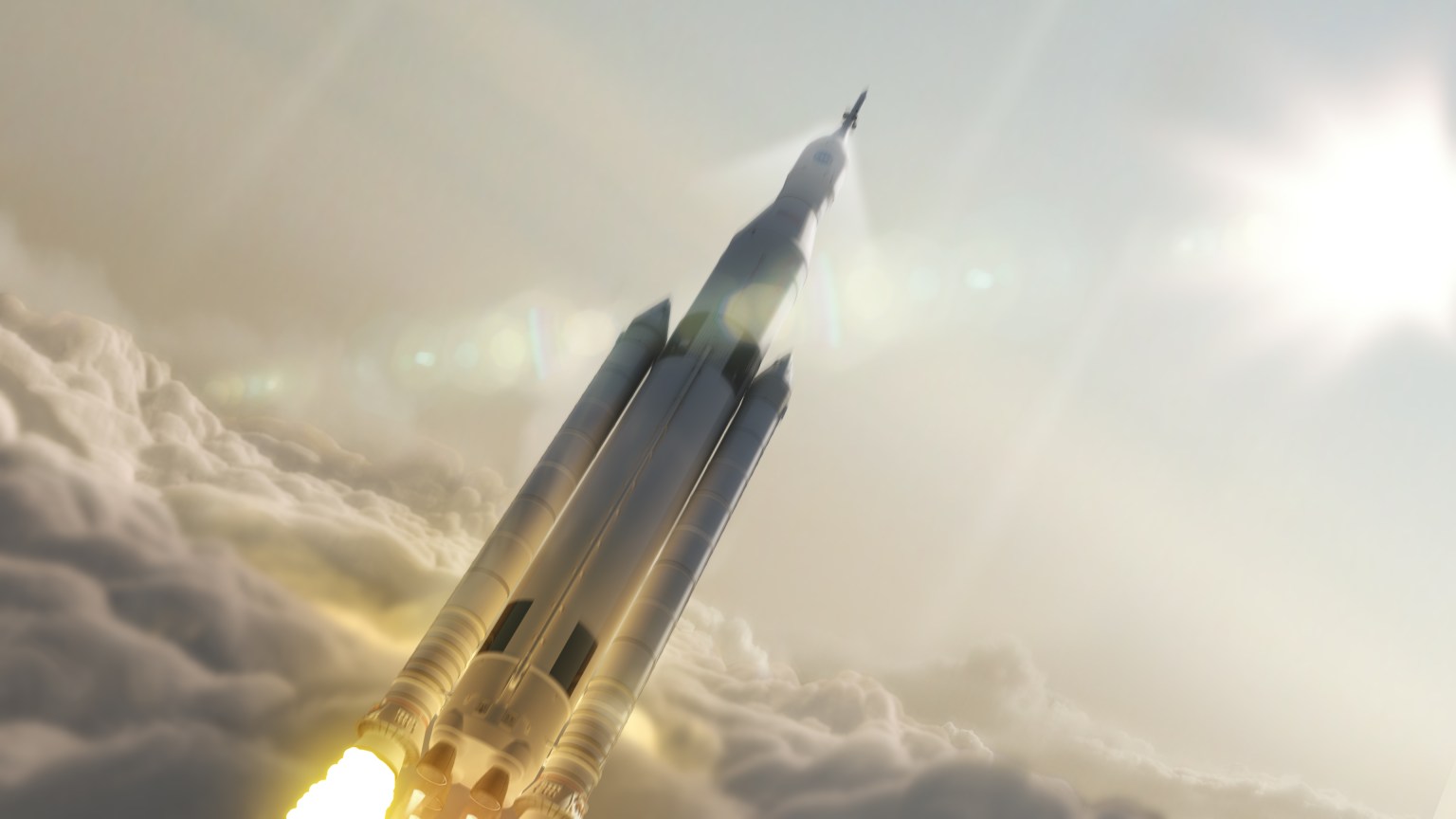
NASA is working with two American companies to develop the human landing systems that will safely transport astronauts from lunar orbit to the Moon’s surface and back for future Artemis missions. For Artemis III, both SpaceX and Blue Origin will fly test versions, or test articles, of the crewed landers that will be used for future Moon landings. The lander test articles will launch by commercial rockets, while the Artemis III crew will launch to low Earth orbit in Orion atop the agency’s SLS (Space Launch System) rocket.
Stage setting for crewed flights
NASA and the human landing system providers have been working closely together to plan and determine capabilities for the Artemis III mission. With missions fast approaching, both SpaceX and Blue Origin are optimizing hardware availability and capability. SpaceX plans to use the company’s latest version of Starship and basis of the future Starship HLS, called Version 3, while Blue Origin will test their planned HLS crew cabin, allowing each company to apply lessons learned prior to uncrewed and crewed missions on the Moon.
“Each human landing system provider has taken a different approach to the Artemis III mission,” said Steve Creech, program manager, Human Landing System Program, NASA’s Marshall Space Flight Center in Huntsville, Alabama. “Ultimately, SpaceX and Blue Origin have put forward a list of aggressive objectives and goals intended to complement upcoming uncrewed demonstration missions at the Moon so that we can gain both understanding and confidence in the spacecraft and launch vehicles prior to a crewed landing. The lander prototype designs will inform future development efforts and will continue to mature over the next year.”
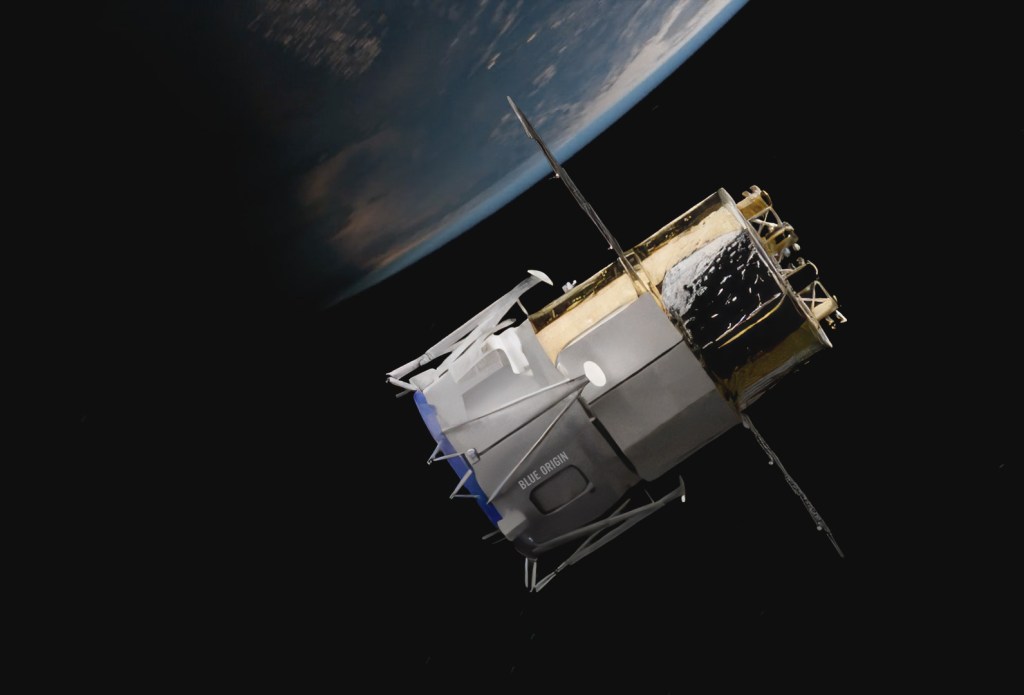
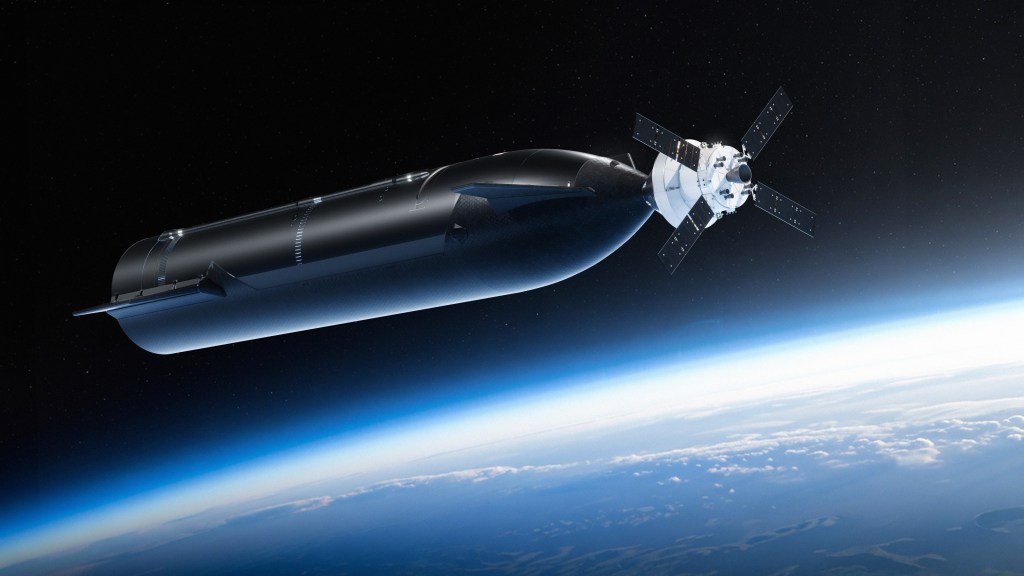
For the Artemis III mission, the Blue Moon test lander will be based on Blue Origin’s current architecture for its Mark 2 crew lander, incorporating all the major avionics and flight software and control systems to ensure flight operations from this demonstration mission can directly translate to crewed lunar flights. Up to two crew members, donning orange Orion crew survival system suits, will open the hatch to enter the Blue Origin test lander. The production hardware must incorporate many of the same systems and subsystems, including an Environmental Control and Life Support System (ECLSS), a crew cabin, and avionics.
These artist’s concepts depict Blue Origin’s Blue Moon Mark 2 human landing system test article in Earth orbit and docked with NASA’s Orion spacecraft as part of NASA’s upcoming Artemis III demonstration mission in low Earth orbit.
Blue Origin
These artist’s concepts depict Blue Origin’s Blue Moon Mark 2 human landing system test article in Earth orbit and docked with NASA’s Orion spacecraft as part of NASA’s upcoming Artemis III demonstration mission in low Earth orbit.
Blue Origin
The Blue Origin lander also will fly with an instrumented lunar surface spacesuit mass simulator. Like the suited “Moonikin” manikin that flew aboard Orion during the uncrewed Artemis I test flight, the low-fidelity spacesuit mass simulator will provide real-time feedback about the environment within the Blue Moon crew cabin.
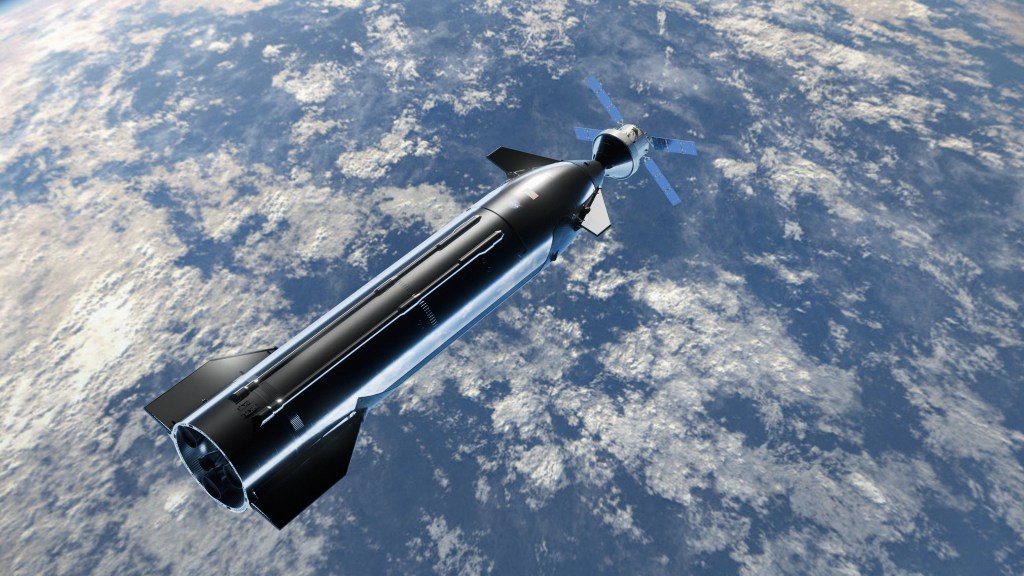
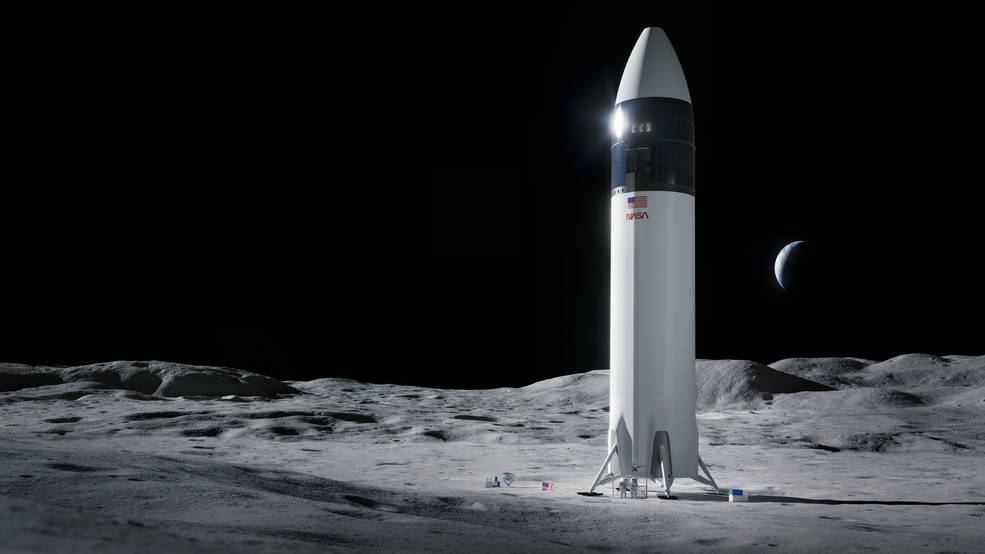
SpaceX’s Starship lander test article will use a Starship Version 3, currently in production and testing, with an added docking system installed on the nose of the 171-foot (52-m) spacecraft, enabling NASA and SpaceX to evaluate how the entire integrated stack of Orion and the Starship test lander interact. NASA and SpaceX are identifying controllability and communications tests for the Artemis III mission. Astronauts will not enter the Starship test lander during Artemis III.
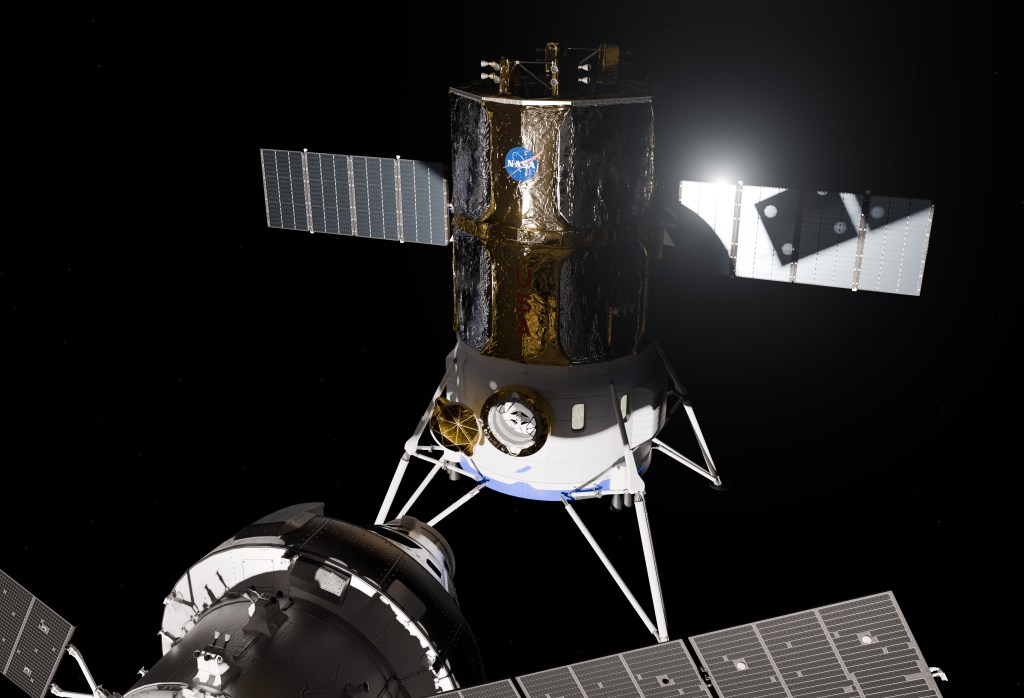
These artist’s concepts depict NASA’s Orion spacecraft and SpaceX’s Starship human landing system test article during docking operations as part of NASA’s upcoming Artemis III demonstration mission in low Earth orbit.
SpaceX
These artist’s concepts depict NASA’s Orion spacecraft and SpaceX’s Starship human landing system test article during docking operations as part of NASA’s upcoming Artemis III demonstration mission in low Earth orbit.
SpaceX
Launch cadence
NASA, SpaceX, and Blue Origin will launch three of the world’s most powerful rockets within a short timeframe of one another, exercising ground processing, launch crews, and facilities as well as control centers, networking, and data exchange at key sites across the country during two separate, back-to-back rendezvous and docking maneuvers between Orion and the lander test articles, before a safe splashdown of the Artemis III crew in Orion.
“Artemis III will be a highly choreographed dance with a demanding launch sequence across multiple launch pads and equally demanding mission operations for our ground and flight crews, making it one of the most complex and ambitious missions NASA has ever undertaken,” said Jeremy Parsons, Artemis program manager. “The demonstration mission will set the stage before our next giant leap. NASA’s expertise in systems engineering and integration, as well as launch and mission operations in low Earth orbit, will bring the mission together.”
For future crewed missions to the Moon, NASA and one of the commercial lander partners will execute a “dual launch campaign,” prepositioning the lander in orbit to await a crewed Orion, launched on SLS. Launching the three rockets in succession of one another for Artemis III offers a unique opportunity to practice launch processing and operations.
Blue Origin’s lander test article is planned to launch first and will be able to loiter in space for up to 30 days, allowing for checkouts in orbit prior to the launch of SLS and Orion from Launch Complex 39B at NASA’s Kennedy Space Center in Florida. The Blue Origin test article will launch at a set trajectory to meet a designated “parking” orbit for these systems checks.
Artemis III will be a highly choreographed dance with a demanding launch sequence across multiple launch pads and equally demanding mission operations for our ground and flight crews, making it one of the most complex and ambitious missions NASA has ever undertaken.
Jeremy Parsons
Artemis program manager
Following the completion of Blue Origin’s rendezvous and docking operations testing and the Artemis III crewed launch on SLS, SpaceX will launch its Starship lander test article to rendezvous with Orion and its crew for its phase of on-orbit testing.
Throughout the Artemis III mission, Orion will fly in a circular orbit. All three rockets will have more launch opportunities than are available for a lunar mission and will be able to reach the designated mission altitude in a single launch.
Docking operations
During docking and undocking operations, Orion and the Artemis III crew will use the lander test articles as the targets, while Orion will operate as the chaser spacecraft. This is the same configuration planned for future crew landing mission to the Moon.
NASA will ensure both test landers are mission ready and crew safe prior to Artemis III. These verifications will be based on functional and performance requirements for the test lander designs and hazard controls for hardware and software, ensuring the Artemis III astronauts inside Orion are safe throughout both docking phases of the mission.
SpaceX and Blue Origin have already tested their docking capabilities for their respective landers on the ground. SpaceX’s docking capability was qualified in 2023; Blue Origin conducted development ground testing on its pressurized docking system earlier this year.
A key difference between the docking capabilities of both lander test articles will be the location of docking. Orion will dock along the side of the Blue Moon test lander, adjacent to the crew cabin. Later, Orion will dock nose-to-nose with the giant SpaceX test lander.
Software testing between spacecrafts will help demonstrate that the commercial human landing system prototypes and Orion can meet at a precise time and location in space. When Orion docks with the Blue Moon test lander, the Orion spacecraft’s software will control the docked spacecraft. Meanwhile, the SpaceX test article will control the docked spacecraft for the second portion of the mission. During the docking phases, teams with NASA and the commercial partners will be able to test hardware and software interoperability, as well as dynamics of how the integrated lander-Orion spacecraft moves in space.
Through the Artemis program, NASA will send astronauts to explore the Moon for scientific discovery, economic benefits, and to build the foundation for the first crewed missions to Mars – for the benefit of all.
All the young people the Guardian spoke to disagreed with aspects of the government’s proposed block
Sixteen- and 17-year-olds in Britain are to be encouraged to observe a midnight to 6am social media curfew but will be able to opt out by changing their account settings.
From next spring, they will be urged to refrain from using certain apps, with the block being switched on by default. But the curfew will not be mandatory and can be overridden.
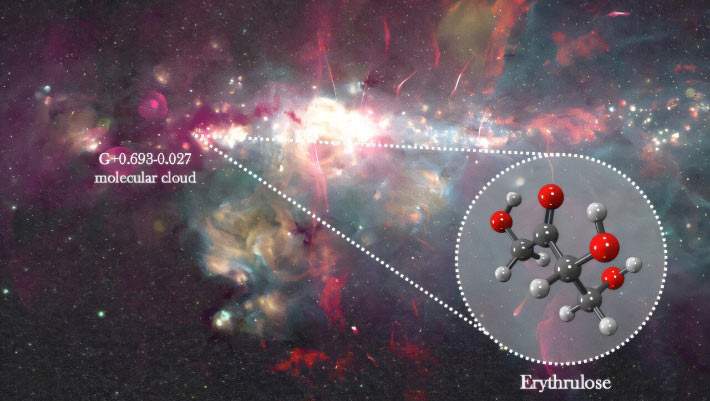
Using the Yebes 40-m and IRAM 30-m radio telescopes, astronomers have discovered erythrulose, a four-carbon sugar commonly found in raspberries and sunless tanning cosmetics, in the molecular cloud G+0.693-0.027.
The feature was part of the new AI image generator, Muse Image, and allowed AI-generated images to be created using content from public Instagram accounts. By specifying a public account with an @mention, users could let the AI model use the person’s images as a reference without informing the account holder.
The launch quickly prompted concerns about privacy and the risk of abuse, with critics saying the feature could be used to create manipulated or offensive images based on other people’s public content.
Meta said its the goal was to give users a creative tool where they could decide for themselves whether their public content could be used. But it removed the feature after feedback that the feature did not meet expectations.
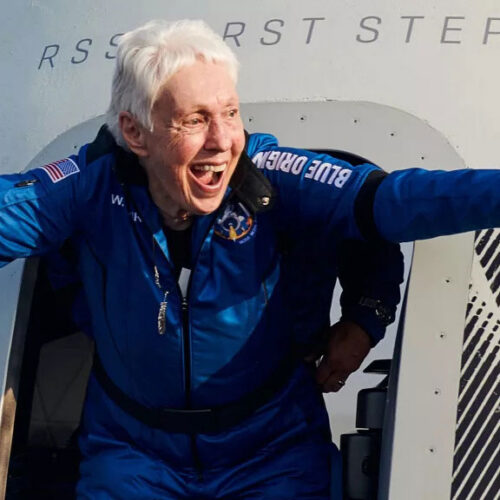
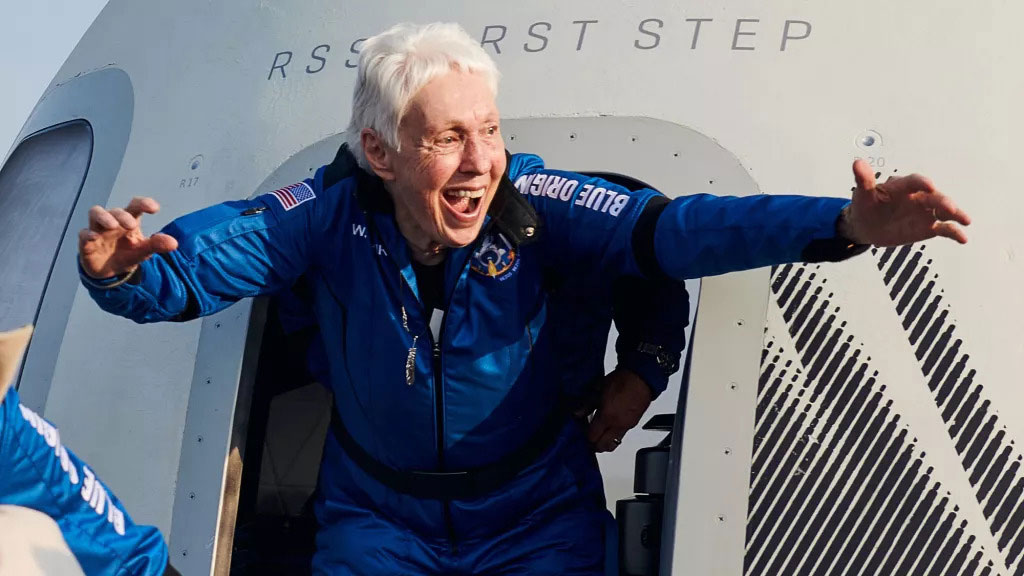
Wally Funk, who in 2021 became the oldest woman to fly into space—60 years after she and 12 other women sought the same opportunity as NASA's original astronauts—died on Wednesday at 87 years old.
Funk was the last living member of the First Lady Astronaut Trainees (FLATs, or as they were later dubbed by the media, the Mercury 13), a group of women pilots who volunteered to go through the same physical and psychological tests as the United States' first spacemen.
Despite performing as well or better than their male counterparts, though, the Lovelace Woman in Space Program was conducted separately from NASA, and the space agency required that its astronauts be test pilots with jet time. The US military, however, did not accept women into its flight programs.

 Login