❌

Reading view

Powerful deployable systems to bolster military forces’ communication for critical operations

The NATO Communications and Information Agency (NCIA) has selected a consortium led by Thales and Leonardo to deliver a new generation of secure deployable communication and information systems for the Alliance’s Allied Special Operations Forces Command (SOFCOM). The award marks the first phase of a broader NATO initiative aimed at strengthening digital connectivity, operational resilience, and command capabilities for special operations forces.

Under the contract, the two European defence companies will provide six Deployable Points of Presence for Special Operations Component Commands (DPOP SOCC), along with operator training and long-term support. These mobile headquarters are designed to give NATO Special Forces secure command-and-control capabilities that can be rapidly deployed in demanding operational environments.

Secure communications, resilient networking

The deployable systems will combine secure communications, resilient networking, high-performance computing, and advanced IT infrastructure while maintaining a reduced electromagnetic and physical signature. This design enables forces to establish operational headquarters quickly without compromising security or mobility. The systems will also support classified, multi-domain information sharing and enhanced cybersecurity, ensuring interoperability across NATO forces and partner nations.

“Thales brings end‑to‑end expertise in secure information and communication systems, deep knowledge of NATO’s reference architecture, and a long track record of delivering projects to the Alliance,” said Alexandre Bottero, Vice President, Networks and Infrastructure Systems, Thales.

“By combining this expertise with Leonardo’s capabilities, we are harnessing the best of European industry in a modular, upgradable, and field‑proven system, providing NATO Special Forces with next‑generation deployable CIS.”

A notable feature of the programme is the introduction of real-time Full Motion Video (FMV) sharing between separate deployable systems, a capability being fielded for the first time in a NATO special operations communications network. The addition is expected to improve situational awareness, intelligence sharing, and mission coordination during complex operations.

Thales and Leonardo will oversee lifecycle support

Beyond delivering the systems, Thales and Leonardo will oversee lifecycle support, upgrades, maintenance, and user training to ensure the platforms remain operational and adaptable as mission requirements evolve. The project also brings together industrial expertise from across the Alliance, with key technologies contributed by companies in the United Kingdom and Germany.

The collaboration combines Thales’ experience in secure communications and NATO network architectures with Leonardo’s expertise in deployable command post solutions. Together, the companies aim to provide NATO with a modular, scalable, and future-ready communications capability capable of supporting special operations in increasingly contested environments.

“Leonardo’s experience, developed at Italian level through the delivery of complete Regimental and Divisional Command Post capabilities, enables the introduction of modular NATO-ready systems based on fixed and expandable shelters,” said Antonio Levato, SVP Air and Land Systems Land and Sea Business at Leonardo Electronics.

“The strength of the design stems from the close collaboration between industry and the end user, who has chosen Leonardo as both the System Integrator and the Design Authority for Italian command post. This partnership among two major players of the European defence industry allows to combine Leonardo’s field proven deployable solutions with Thales experience in NATO’s secure communications programs.”

The programme underscores NATO’s continued investment in modernizing command, control, communications, and information systems as the Alliance prepares for evolving security challenges. By enhancing secure connectivity and rapid deployment capabilities, the new systems are expected to strengthen operational readiness and improve coordination among multinational special operations forces during future missions.
  •  

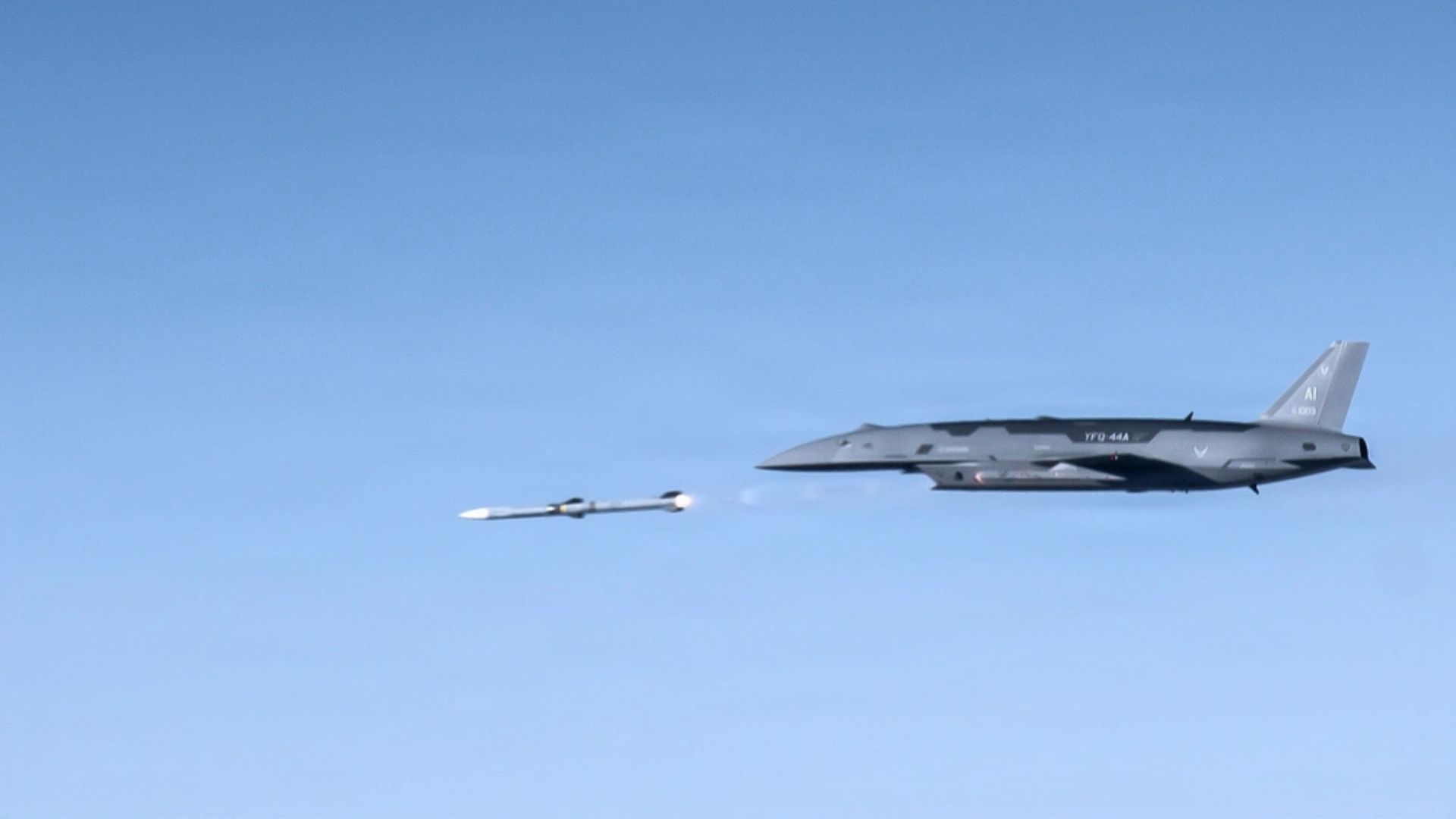
US Air Force launches first missile from Anduril’s semi-autonomous loyal wingman drone

The U.S. Air Force has carried out its first missile launch from a Collaborative Combat Aircraft (CCA), an important step in developing semi-autonomous drones that can fly with piloted fighter jets. In the test, announced on June 15, 2026, the Anduril-built YFQ-44A fired an AIM-120 medium-range air-to-air missile at a digital target over California’s Mojave Desert.

This demonstration marks another milestone in the Air Force’s ongoing testing of Collaborative Combat Aircraft. The drone managed most of the mission by itself, but a human operator gave the final approval to launch the missile, following U.S. policy that requires people to control lethal weapons.

Drone completes air-to-air engagement sequence

The test happened in restricted airspace over California’s Mojave Desert as part of the Air Force’s work to prove the YFQ-44A’s combat abilities.

During the test, the aircraft used Anduril’s Lattice software to find, track, and lock onto the target, then figure out how to intercept it. The onboard system handled these steps, and a human supervisor on the ground gave the final order to fire.

This test was different from earlier drone launches, where people on the ground controlled the flight. Here, the aircraft managed the mission steps on its own, except for the operator’s approval to release the weapon.

A key rule of the Collaborative Combat Aircraft program is still in place: the aircraft cannot fire weapons by itself. Every launch must be approved by a human operator, who stays in control during the mission.

Test follows months of phased evaluations

This live-fire test followed earlier trials this year, in which the aircraft carried dummy weapons during flight. Those tests collected data on how the aircraft performed and how it managed the extra weight.

Engineers then verified communication links between the aircraft and its weapon system. They ensured that commands from the operator were sent and executed correctly during practice runs before moving on to live-fire tests.

“Moving from inert carriage earlier in the year to this weapon release demonstrates program maturity, allowing us to validate our digital integration models with actual data,” said General. Dale White, portfolio manager for Critical Major Weapon Systems. “These tests provide operational validation that Collaborative Combat Aircraft can execute the weapon employment sequence autonomously within pilot-defined parameters, accelerating capability delivery to the warfighter.”

Air Force says capability is moving closer to deployment

The missile launch was supported by the 412th Test Wing’s Air Dominance Combined Test Force. This team includes active-duty members, government workers, and contractors who make sure models and procedures are safe for live-fire tests.

“This live-fire test is an important next step in the development of Collaborative Combat Aircraft,” said Air Force Chief of Staff Gen. Ken Wilsbach. “We’re one step closer to delivering capabilities to the warfighter.”

According to the Air Force, the CCA program’s goal is to have combat-ready, semi-autonomous aircraft that help U.S. airpower reach farther, see more, and survive better in tough situations. The Air Force is also accelerating development and testing, bringing these aircraft closer to deployment in real missions.

  •  

Space acquisition and NRO picks face SASC

Erich Hernandez-Baquero, nominated to become the Air Force’s top civilian space acquisition official, and Roger Mason, the administration’s choice to lead the National Reconnaissance Office, appeared before the Senate Armed Services Committee

The post Space acquisition and NRO picks face SASC appeared first on SpaceNews.

  •  

US military sent explosive drone boats into combat for the first time

For the first time in its history, the US military sent explosive-laden drone boats into combat by attacking an Iranian midget submarine and naval port. The unprecedented use of such kamikaze sea drones by the United States comes nearly a decade after Iranian and Houthi forces first demonstrated such weapons.

The US military shared a video showing three “one-way attack surface drones” exploding after approaching an Iranian midget submarine and ship maintenance facility at Iran’s Bandar Abbas Naval Base on the night of July 12. US Central Command, the US military combat command responsible for Middle East operations, described the strikes in a social media post as the “first time American forces have employed sea drones in combat operations.”

The US drone boats were able to “make a low-speed, uncontested approach” to their targets before exploding, according to USNI News, a news service from the nonprofit US Naval Institute. USNI News also identified one of the targets as an Iranian Ghadir-class midget submarine that was out of the water while being suspended from a gantry.

Read full article

Comments

© US Central Command

  •  
  •  

US seeks cheaper hunter-killer drones after Iran destroys $1B worth of Reapers

The US military has lost dozens of Reaper drones collectively worth more than $1 billion while carrying out surveillance and attack missions over Iran. Now the Pentagon is seeking large numbers of cheaper drones that can perform such missions despite the expectation that many will be lost in combat.

In a call for industry pitches, the Defense Innovation Unit’s notice described the US military’s current reliance on drones and crewed aircraft, each costing more than $30 million, as being “unsustainable against adversaries utilizing layered defenses enabled by increasingly low-cost antiaircraft capabilities.” It envisions deploying more “cost-effective” drones to “overwhelm enemy air defenses even while experiencing numerous [drone] losses.”

That is, in practice, what Ukraine’s military has been demonstrating with its long- and mid-range strike campaign against Russian supply lines, oil refineries, and various energy or industrial targets within Russia or occupied Ukraine. The Ukrainian campaign has been overwhelming Russia’s overstretched air defense capabilities by launching hundreds of relatively inexpensive drones and missiles on a daily basis to attack targets far behind the frontlines, while continuing to damage or destroy Russia’s most sophisticated air defense systems.

Read full article

Comments

  •  

U.S. Tests Directed-Energy Weapon as Golden Dome Missile Shield Advances—Here’s What We Know

Golden Dome
Artist’s concept of Golden Dome Constellation (Credit: Wikideas1/Wikimedia/CC 0)

Welcome to this edition of The Intelligence Brief… This week, the Pentagon announced a major milestone in the development of President Trump’s proposed Golden Dome missile defense system after successfully testing a next-generation directed-energy weapon capable of intercepting drones and cruise missiles. In our analysis, we’ll be looking at 1) what the Pentagon revealed about the new directed-energy technology, 2) how the Golden Dome aims to defend against ballistic, cruise, and hypersonic missile threats, 3) why the program has drawn comparisons to Ronald Reagan’s “Star Wars” initiative, and 4) the growing debate over what could become one of the most expensive defense projects in U.S. history.

“With Golden Dome, the War Department will defend our homeland more powerfully than ever before. Golden Dome is real, powerful, and on track.”

– U.S. Secretary of War Pete Hegseth

If you enjoy the news and perspectives offered by The Debrief, make sure that you aren’t missing our stories by making us one of your “preferred sources” on Google News. You can simply follow this link to add The Debrief to your list of favorites, and you can read more about Google’s preferred sources in our article here.


RECENT NEWS from The Debrief


Golden Dome Advances with Deployment of New Counter-Missile Capability

This week, it was revealed that the Pentagon has made significant strides with the development of its proposed Golden Dome missile defense system, with tests involving a next-generation directed-energy weapon.

Capable of destroying incoming drones and cruise missiles, the weapon has been characterized as a major step toward strengthening America’s future air and missile defense capabilities.

Planned as a multi-layer missile defense system that aims to be operational by the end of President Trump’s term, the Golden Dome aspires to be capable of spotting and destroying a range of missile threats, including ballistic, hypersonic, and cruise missiles.

With the deployment of the new directed-energy weapon this week, the Pentagon has now implemented the first use of next-generation technology that U.S. officials say will lead the way in redefining America’s future air and missile defenses.

The Pentagon’s New Directed-Energy Weapon

In a statement, U.S. Secretary of War Pete Hegseth called the recent test a “first milestone test” for the Golden Dome system.

“Cutting edge directed energy was harnessed and the Dynamic Defense Autonomous Defeat (DDAD) system flawlessly and autonomously cued, targeted, and eliminated a multitude of incoming threats,” Hegseth’s statement read. “This test was executed on schedule — and dynamically defeated every threat.”

Hegesth, who said he was present for the demonstration, “watched our elite warfighters integrate with next-generation technology to stop incoming drones and cruise missiles dead in their tracks,” crediting the advancement to Trump’s One Big Beautiful Bill, a sweeping legislative package put forward in an effort to solidify the permanence of the 2017 Tax Cuts and Jobs Act, along with enacting various other Trump administration priorities.

Hegseth said the legislation provided “the funding to deliver on the ultimate shield to protect America,” and builds on the efforts of former U.S. President Ronald Reagan’s Strategic Defense Initiative (SDI).

Few Technical Details Available

While the Pentagon did not provide technical details about the new system, Hegseth refers to the new weapon as “cutting edge directed energy” technology.

For several years, the Pentagon has been developing directed-energy systems for use in the interception of unmanned aerial vehicles and cruise missiles, with Israel previously reporting operational use of prototype laser capabilities as well.

America’s Golden Dome is partly inspired by Israel’s Iron Dome, although the U.S. counterpart’s design will aim to defend America against longer-range missile attacks—a key element which has encouraged comparisons to Reagan’s SDI.

Unprecedented Expense

The project also carries a large price tag. Presently, the Congressional Budget Office estimates that the initiative could cost as much as $1.2 trillion—an amount nearing the total requested $1.5 trillion defense budget for fiscal year 2027, making it one of the most expensive defense initiatives in U.S. history.

The high cost of the initiative is also impacted by the recent costs associated with the U.S. conflict with Iran, which, by some estimates, could exceed $200 billion. Additionally, a recent controversial memorandum of understanding aiming to halt the conflict agrees to supply $300 billion to Iran, which, as noted by some analysts, is an amount that exceeds the current Iranian defense budget by well over a dozen times.

On Wednesday, the U.S. Senate voted 47-50-1 to block a war powers resolution led by Sen. Tim Kaine that sought to limit President Trump’s authority to conduct military operations against Iran.

Although the measure narrowly advanced in an earlier procedural vote, a surprise upset resulted in a loss of support after Republican Sens. Bill Cassidy and Rand Paul changed their positions. The latest vote came just hours after a heated exchange between Trump and Cassidy, during which Cassidy challenged the president over the duration and objectives of the conflict with Iran.

Many have expressed concerns over the unprecedented U.S. defense spending under the current administration, including U.S. Senator Merkley (D-Oregon), Ranking Member of the U.S. Committee on the Budget, who rebuked a recent addition that asks Congress to spend an additional $88 billion in the form of a supplemental request.

“Padding the pockets of their defense contractor friends does nothing to help Americans get ahead,” Merkley said on Wednesday.

That concludes this week’s installment of The Intelligence Brief. You can read past editions of our newsletter at our website, or if you found this installment online, don’t forget to subscribe and get future email editions from us here. Also, if you have a tip or other information you’d like to send along directly to me, you can email me at micah [@] thedebrief [dot] org, or reach me on X: @MicahHanks.

Here are the top stories we’re covering right now…

  •  
❌