❌

Reading view

'Weirdos of the sperm whale world' appear to be evolving 2 different dialects, audio recordings suggest

An isolated population of sperm whales in the Mediterranean Sea are splitting into two distinct groups with different dialects, a new study reveals. This shift has likely been happening for thousands of years, as two groups split from an initial single population.

The findings, published Tuesday (June 23) in the journal Proceedings of the Royal Society B: Biological Sciences, are providing a rare insight into the process of different dialects emerging among non-human species.

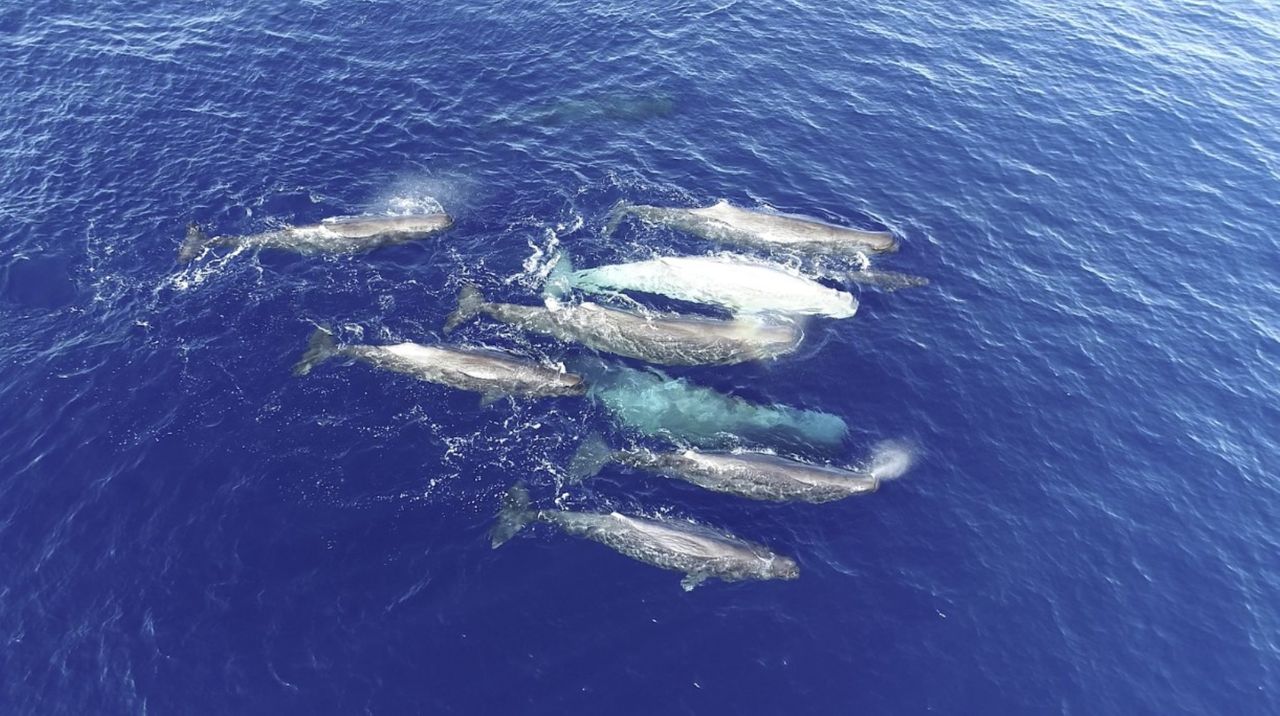
The sperm whales (Physeter macrocephalus) live in small social units of females and young, and they associate with other groups in the same area. They use social vocalizations called codas ‪—‬ shortpatterns of clicks ‪—‬ to communicate. The particular codas they use identify them as being part of the same cultural group.

Taylor Hersh, a researcher in the School of Biological Sciences at the University of Bristol in the U.K. and first author of the research, and her colleagues have analyzed codas recorded over almost 20 years in the Mediterranean, where there is a unique population of a few thousand sperm whales, to see if they all use the same dialect.

Sperm whales entered the Mediterranean via the Strait of Gibraltar about 20,000 years ago, and they have spread throughout the area. The whales rarely leave the sea ‪—‬ even males, which normally migrate. Other sperm whales don't seem to enter often, either, so the Mediterranean ones are effectively isolated from other populations and are considered an endangered subpopulation.

"The sperm whales in the Mediterranean are really cool," Hersh told Live Science. "I've always thought of them as the weirdos of the sperm whale world in that they don't leave through the Strait of Gibraltar even though they could. They are unique, and for a long time, they were also thought to be acoustically unique."

The thinking was that all the sperm whales in the Mediterranean belonged to the same clan, identified by their use of a single coda 90% of the time. This coda consists of three clicks and then a pause before the fourth and final click ‪—‬ a pattern called the three-plus-one type.

But the analysis by Hersh's team of 5,291 codas recorded between 2003 and 2021 revealed that sperm whales living in the eastern Mediterranean around the Hellenic Trench, off Greece, have a slightly different dialect from that used by animals in the western basin around Spain's Balearic Islands.

The eastern whales produce a distinct form of the three-plus-one coda. "It's a very similar pattern of clicks, but it's much, much faster," Hersh said.
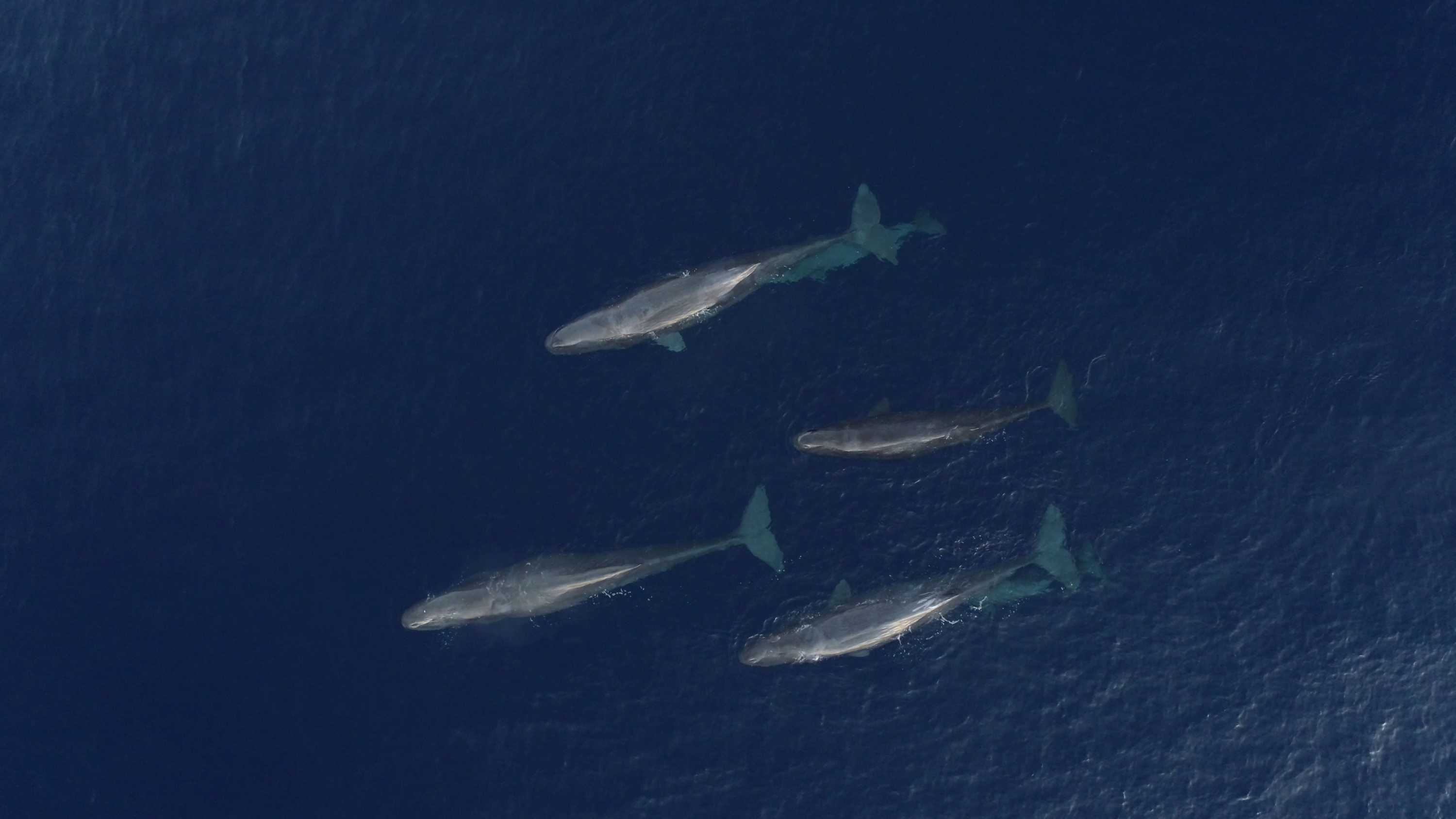
four sperm whales in the sea

Researchers found distinct dialects between the two populations, with the eastern population producing slower codas. (Image credit: Asociación Tursiops)

In some recordings, whales in the eastern Mediterranean produced the slower coda, showing they were familiar with both dialects.

"The western sperm whales religiously stick to their dialect, but there were four instances of eastern whales using the western dialect," Hersh said. "The question of why is still an open one. Their dialect seems to be a lot more diverse than we expected. They do occasionally make those slow three-plus-one codas, but they make a lot of other coda types, too."

Hersh hopes further recordings alongside records that tie individual whales to sounds and events might help elucidate why the whales switch between dialects.

"It's exciting to see this study showing different populations behaving closely, but also differently," said Gašper Beguš, linguistics lead at Project CETI, a nonprofit organization that aims to translate the communication of sperm whales.

The study paints a picture of sperm whales progressively occupying the Mediterranean from west to east, with the dialect of one group gradually changing. "The groups in the east clearly remember the western dialect because they have these 'throwback' days," Hersh said.

It's still a mystery how and why these dialects evolved.

"Every speech is a dialect; the question is how did they arise and why?" said Beguš, who wasn't involved in the new study. He said the historical change in habitat does help to show which dialect came first. "In the Mediterranean, maybe they're forming different groups, so that's why they're trying to distinguish themselves," he told Live Science, giving the parallel of young people who distinguish themselves from previous generations by coming up with new slang.

"It's possible that these two groups with repertoires that are very similar but still distinctive could represent a sort of midway phase,” Ellen Jacobs, a marine biologist at Aarhus University in Denmark who wasn't involved in the research, told Live Science via email.

"Changes in the rhythm might be a very feasible and meaningful way for coda signals to start to diverge," she said, like the way the English words "How do you do?" got mashed together until they morphed into "howdy."

The timescale on which a sperm whale dialect develops is uncertain, but it's likely a slow process, according to Hersh. "It's probably happening on the scale of hundreds and thousands of years, because sperm whales can live into their 60s and 70s. And this study is looking over 19 years of data, and that's just a snapshot of one animal's life," Hersh said.

This means the eastern whale dialect was conceivably emerging in the Mediterranean Sea as famous human civilizations were speaking different languages on the surrounding lands, including when the ancient Greeks and Romans were rising and then falling.

"Maybe if we could leave them for another 10,000 years, we would come back to find the completely separated dialects of clans," Jacobs said.
  •  

The dawn of animal evolution saw a bizarre array of sea creatures

Animals may have had a rich variety of complex body types far earlier than scientists had recently thought.

A crucial moment in the history of life on Earth was the Cambrian explosion. Starting some 539 million years ago, it marks when animals very quickly became much more diverse. How this “explosion” in diversity happened has been a mystery. But a trove of newfound fossils points to an answer.

Animals seem to have begun evolving an array of strange body types even before the famed explosion. Researchers described them April 2 in Science.

“This paper is absolutely fascinating,” says Emily Mitchell. “It provides vital insights into [pre-Cambrian] life.” Mitchell is a paleontologist who did not take part in the research. She works at the University of Cambridge in England.  

The time just before the Cambrian explosion is known as the late Ediacaran (Ee-dee-OCK-ur-ən) Period. It lasted from about 575 million to 539 million years ago. The earliest fossils that were clearly animals date to this time. But until now, they haven’t offered many details about the bodies of critters who lived back then.

What’s more, many animals seen in the Cambrian Period haven’t been found in the Ediacaran Period. This led researchers to suspect the Cambrian explosion started with very few species.

Newfound fossils unearthed in southwestern China now challenge that idea. They show that more than 539 million years ago, Earth’s oceans teemed with a zoo of weird creatures.

Soft, clarinet-shaped animals anchored themselves to the seafloor. They swayed alongside creatures that looked like worms or baskets. Those were just a few of the complex species thriving in pre-Cambrian seas.

Strange sea creatures

Paleontologist Gaorong Li led the new research. It all started in 2022. He and others were collecting fossils near Yuxi, China. Their team was on the hunt for remnants of Ediacaran algae. But that hunt turned up something odd: fossil fragments of species they couldn’t identify.

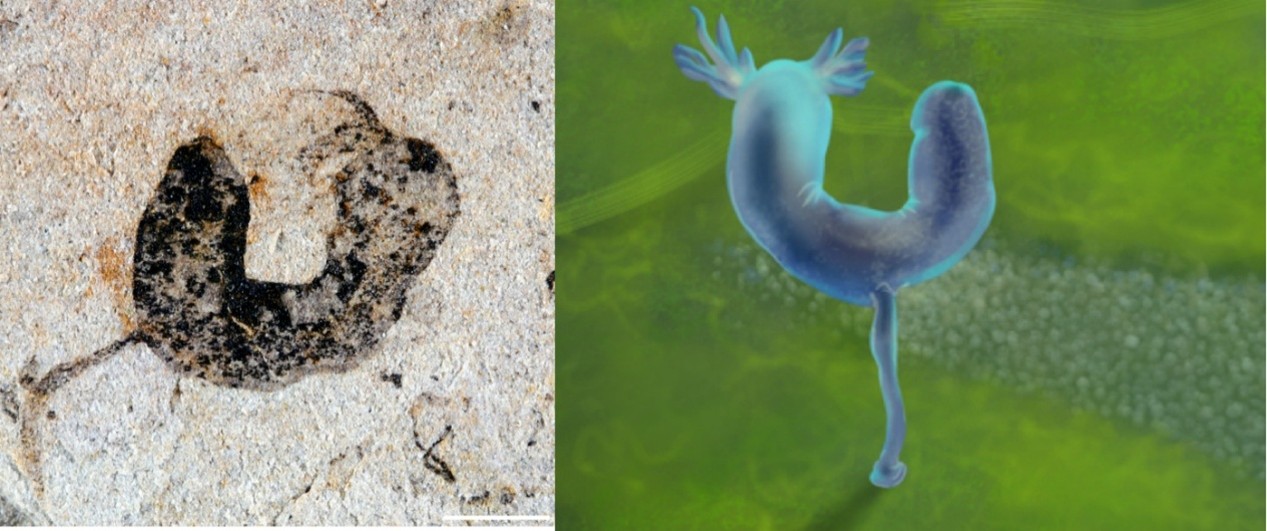
In 2023, the team discovered another surprise. They turned up fossils of bizarre, cylindrical animals several centimeters (inches) long. At one end, the critters had flat pads that could have gripped the ocean floor. At the other end were flag-shaped tentacles that appeared to extend from their mouths.

A fossil image on the left and illustration on the right of the fossilized creature on the right.
This early deuterostome (fossil at left, artist’s reconstruction at right) is related to animals like vertebrates and sea stars. It appears to have appendages on one end that may have been used in feeding. It’s also new, very early fossil evidence of animals with bilateral symmetry in the Ediacaran Period.Gaorong Li & Xiaodong Wang

Finding these “bugle worms” was a turning point, Li says. Back then, he worked at Yunnan University in Kunming, China. In 2024, his group joined forces with researchers at the University of Oxford in England. Together, they gathered roughly 700 late Ediacaran fossils.

They compared this haul to other Ediacaran fossils. They also compared the new fossils to those from the Cambrian Period.

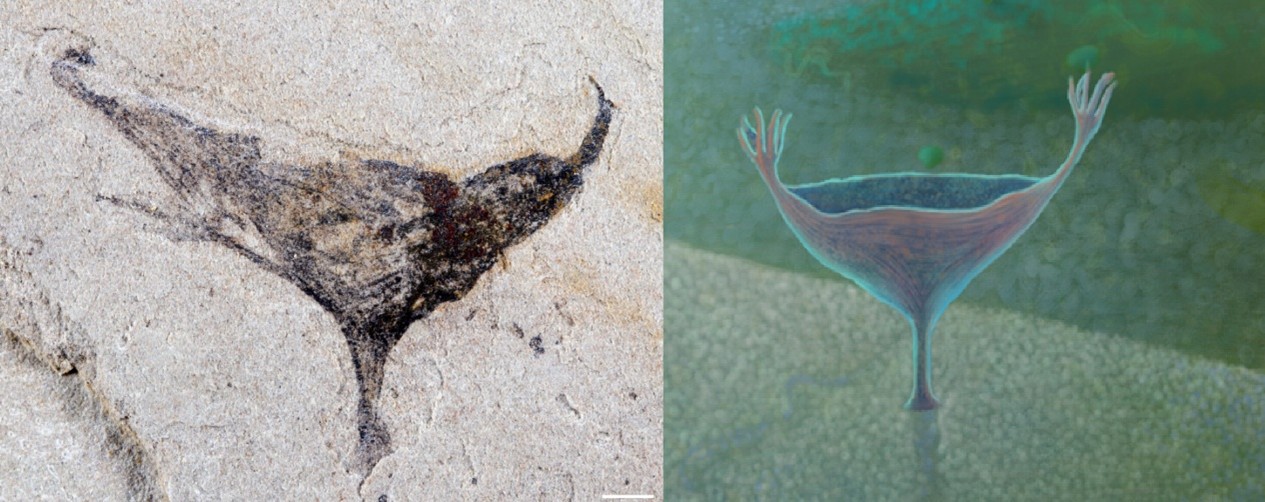
Some of the new fossils looked like Haootia — an animal that lived some 560 million years ago. Haootia and these other fossils resembled martini glasses with tentacles on the rims. Like modern jellyfish, they had body parts that spread out from a central point. This is known as having radial symmetry.

A fossil image on the left and illustration on the right of the fossilized creature on the right.
The Haootia-like animal (fossil at left, artist’s illustration at right) may have been a relative of animals such as corals, anemones and jellies.Gaorong Li & Xiaodong Wang

Bilateral bodies

The freshly collected fossils included more eyebrow-raising finds. Some had bilateral symmetry. That is, they had similar features on the right and left sides of their bodies — as humans do.

It’s rare to find such early fossils with left-right symmetry. Until now, only four species from the Ediacaran Period had shown this feature. Li and his team found more than 180 bugle worms and other fossils with this type of symmetry. Some looked like sausages on skewers with feathery bits around their mouth ends.

The sheer number of fossils with bilateral symmetry that Li’s group found is striking, says Emmy Smith. She’s a paleontologist at Johns Hopkins University in Baltimore, Md. The diversity among these fossils amazed her.

Many had special structures for feeding, Smith notes. Clearly, the animals were quite physically complex. “That strengthens the view that [animals] were already diversifying before the Cambrian,” she says.

The Cambrian explosion, it seems, didn’t come out of nowhere, Li says. Instead, animal life had been getting more complex for millions of years before that.

Do you have a science question? We can help!

Submit your question here, and we might answer it an upcoming issue of Science News Explores

  •  

Never-before-seen shark that 'walks' on land discovered off Papua New Guinea

Researchers have identified a new species of "walking shark," a rare group of small carpet sharks that use their fins to "walk" along shallow reefs.

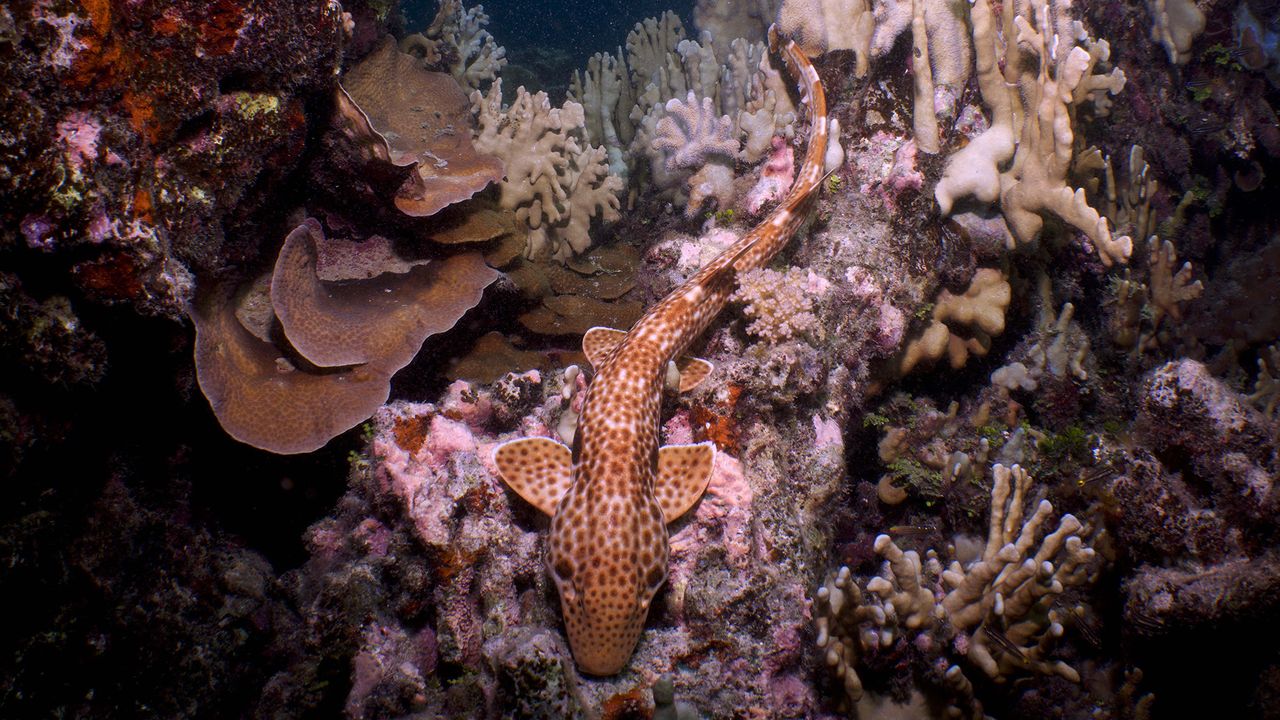
A team of divers spotted the newfound shark, which they named Hemiscyllium dudgeonae, in the dark waters around the reefs of southeastern Papua New Guinea. Gliding along the rocks was a small, brown-spotted shark that they didn't recognize.

"I was so excited. … I didn't look very closely at the pattern and quickly caught it and took it back to the boat," Christine Dudgeon, a senior research fellow at the University of the Sunshine Coast in Australia, told Live Science in an email.

Dudgeon handed the shark to Jess Blakeway, a doctoral student and first author of a new study describing the shark. Blakeway "noticed that the shark had a different pattern to the one that we were looking for and called out to me: 'Chris, it's different.'"

The new shark is named the Dudgeon's walking shark after Dudgeon, in recognition of her 20 years of researching the Hemiscyllium genus.

The new find, described June 15 in the Journal of the Ocean Science Foundation, brings the number of known walking shark species to 10, each with their own unique body pattern.

"This discovery is exciting because a lot of new fishes, and in particular, new shark and ray species, tend to be deep sea, so finding something in very shallow [less than 3 feet, or 1 meter] of water is unusual and highlights that there is potentially a lot of biodiversity that we really don't know about," Dudgeon said.

Encountering a new species

The team had been searching for another walking shark species, called Michael's walking shark (Hemiscyllium michaeli), when they encountered the unusual shark.

"Michael's walking shark has leopard prints and Dudgeon's walking shark has small white dashes and brown dots all over its body," Dudgeon said. "But with only one specimen we were not sure if this was an anomaly or a true difference."

The researchers continued surveying nearby reefs, and within two days, they had located 11 additional Dudgeon's walking sharks across three sites. These included males and females, both juveniles and adults, with all displaying the distinctive body pattern. That consistency convinced the team that they were likely looking at an undescribed species.

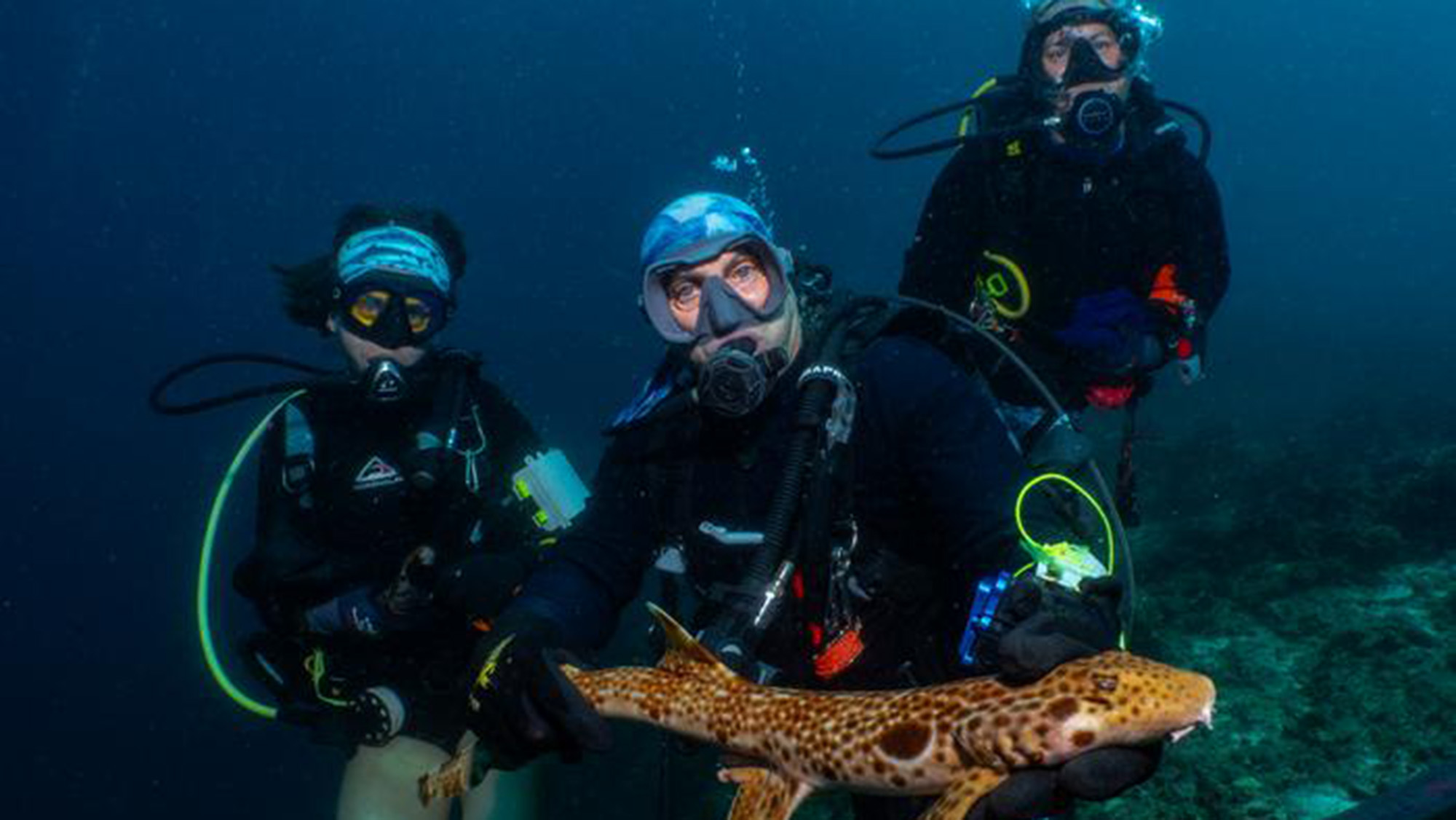
Three divers float with a brown and white shark in the ocean

Left to right: researchers Jess Blakeway, Mark Erdmann and Christine Dudgeon pose with the newly identified shark species H. dudgeonae. (Image credit: Nesha Ichida)

Dudgeon and Blakeway used genetic data to test this hypothesis at their laboratory in Australia. By comparing DNA from the newly discovered sharks with genetic samples from the other nine walking shark species, they confirmed that the population represented a new species.

Walking on land

Walking sharks are notable for their unusual biology. Unlike larger, open-ocean shark species, walking sharks spend their lives near coral reefs. Their ability to "walk" across the seafloor using their pectoral and pelvic fins is particularly useful during low tide, when parts of the reef become isolated from deeper waters. "Walking" helps the animals remain active when oxygen levels drop so that they can continue hunting prey across reef flats.

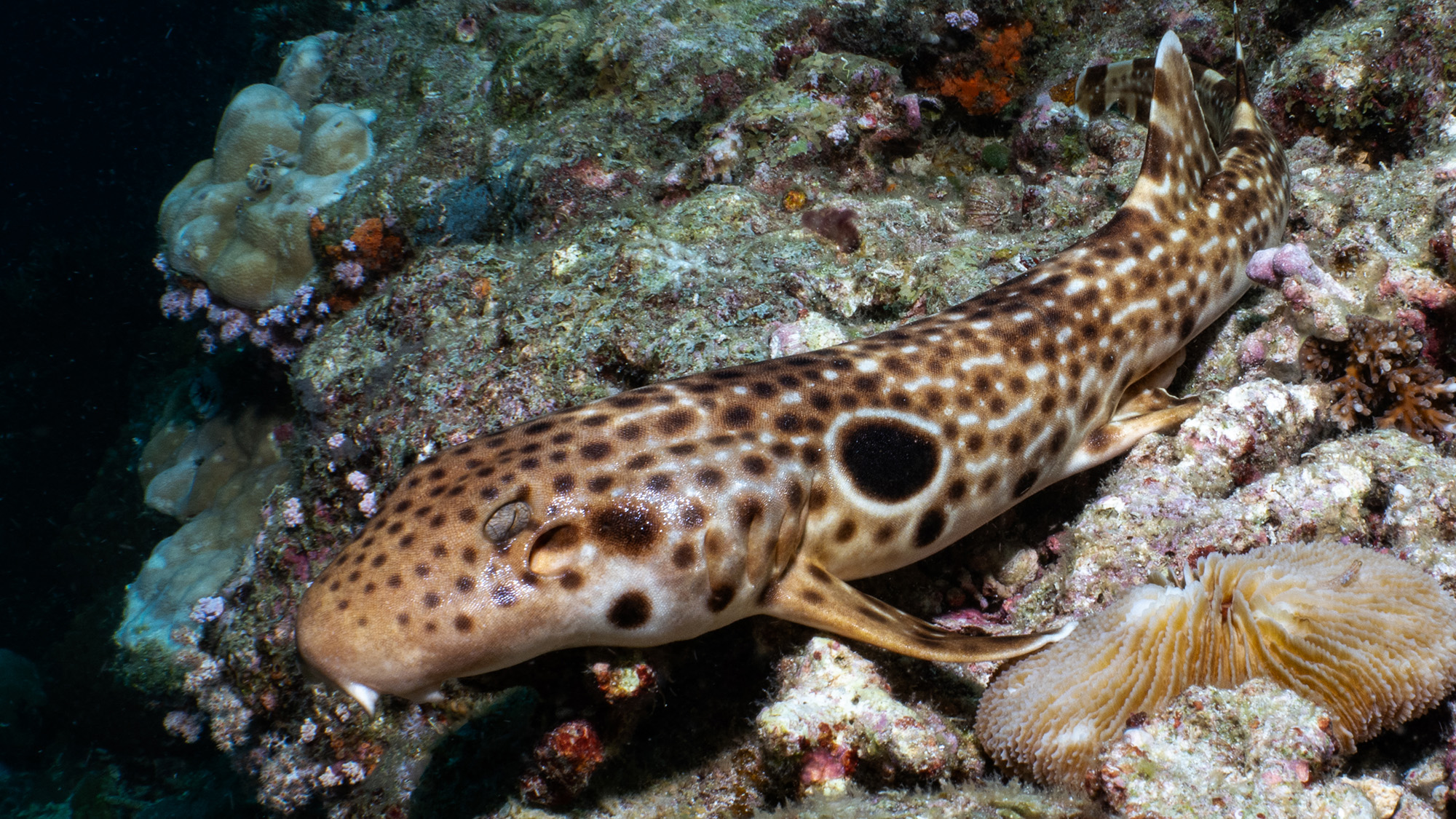
A close up of a brown and white spotted shark amidst rocks and corals

The new shark species H. dudgeonae was found in Watota, Milne Bay, off southeastern Papua New Guinea. (Image credit: Mark Erdmann)

Scientists think this ability evolved as a response to the challenging environment of tropical reef flats, where oxygen levels can shift dramatically as the tides rise and fall.

Studies indicate that some walking sharks can survive in low oxygen environments for hours, though more research is needed to understand how the sharks are able to do this, Dudgeon said.

So far, Dudgeon's walking shark has been documented at only three locations in Papua New Guinea. If future research confirms that the species has a highly restricted range, H. dudgeonae could be vulnerable to habitat degradation, climate change or overfishing.

Many walking shark species appear to stay close to the reefs where they were born, which limits their ability to recolonize damaged habitats. Species with small geographic ranges are often more susceptible to population declines because local disturbances can affect a larger portion of the total local population.

The discovery also shows how new shark species are still being found in regions that have received relatively little scientific attention. Dudgeon and her team plan to continue doing surveys in Papua New Guinea to study the new species in its home environment.

"I think many people are not aware of the wonderful diversity of sharks and their relatives, the rays, skates and chimeras," Dudgeon said. "Very few species are dangerous to humans and they are a wonderfully broad and eclectic group of animals. They continue to surprise and fascinate us."

How much of a shark fan are you? Find out with our shark quiz!

  •  
❌