❌

Reading view

AI/ML STIG Lecture Series, 29 June 2026

AI/ML STIG Lecture Series

Artificial Intelligence and Machine Learning Science and Technology Interest Group (AI/ML STIG)

Module 9: AI for Science and Engineering at NASA

AI/ML STIG about AI/ML STIG Lecture Series

Location

Virtual

Dates

29 June 2026
4:00pm – 5:00pm ET

Community

AI/ML STIG

Type

Seminar

Speaker

Steven M. Crawford, NASA HQ

Details TBA

Seminar Connection

TBA

News Straight to Your Inbox

Subscribe to your community email news list

We will never share your email address.

Privacy Policy

Sign Up
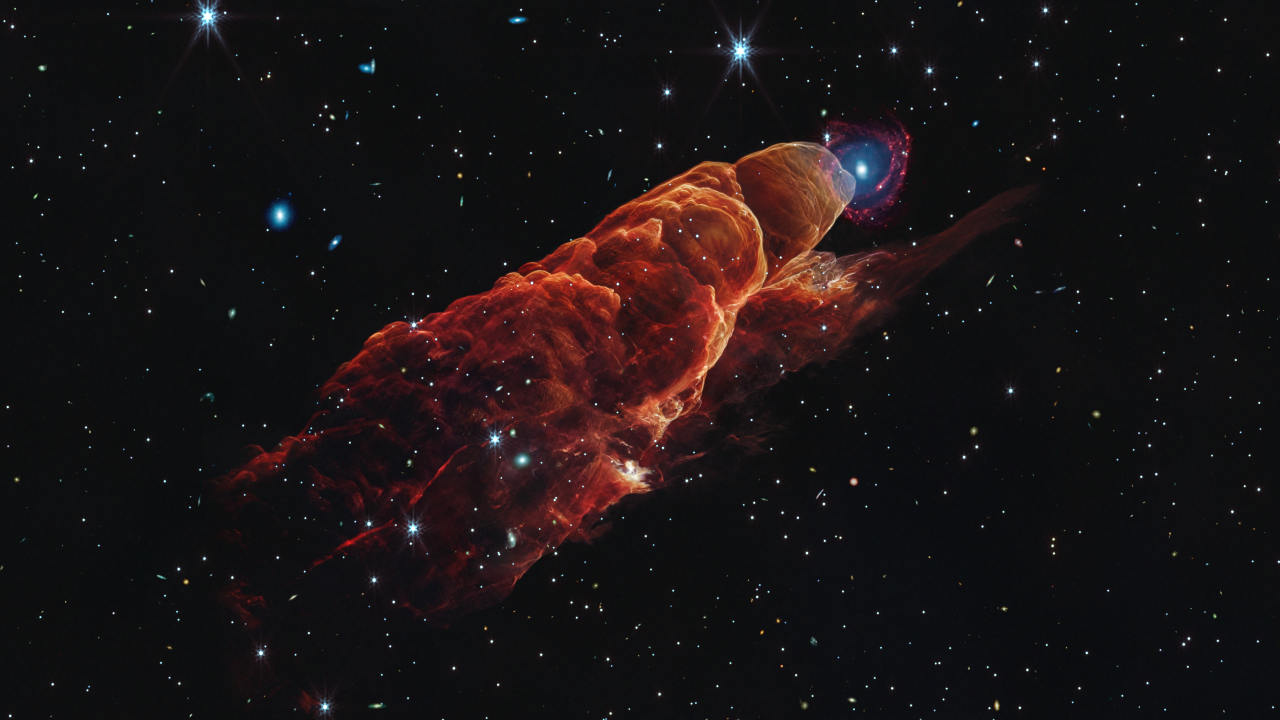
Angled from the upper left corner to the lower right corner is a cone-shaped orange-red cloud known as Herbig-Haro 49/50. This feature takes up about three-fourths of the length of this angle. The upper left end of this feature has a translucent, rounded end. The conical feature widens slightly from the rounded end at the upper right down to the lower right. Along the cone there are additional rounded edges, like edges of a wave, and intricate foamy-like details, as well as a clearer view of the black background of space. In the upper left, overlapping with the rounded end of Herbig-Haro 49/50, is a background spiral galaxy with a concentrated blue center that fades outward to blend with red spiral arms. The background of space is speckled with some white stars and smaller, more numerous, fainter white galaxies throughout.

The post AI/ML STIG Lecture Series, 29 June 2026 appeared first on NASA Science.

  •  

AMMB STIG Seminar, 1 July 2026

Astrophysics from the Moon Seminar

Astrophysics from the Moon, Mars, and Beyond Science and Technology Interest Group

AMMB STIG about Astrophysics from the Moon Seminar

Location

Virtual

Dates

1 July 2026
2:00pm -3:00pm ET
11:00am – 12:00 pm PT

community

Cosmic Origins

Type

Seminar

Why and Where Do We Want to Put Telescopes on the Moon?

Speaker

Nivedita Mahesh, CU Boulder

Abstract

The Moon is emerging as a uniquely valuable platform for astrophysics, enabling observations that neither Earth nor free-flying spacecraft can support. This talk surveys the scientific motivation across four complementary regimes. At low radio frequencies, the radio-quiet lunar farside opens a window onto the cosmological Dark Ages and the magnetospheres of exoplanets. In the mid-band gravitational-wave regime, the Moon’s low seismic activity bridges the sensitivity gap between terrestrial and space-based detectors. At ultraviolet wavelengths, its natural vacuum and long coherence times allow high-resolution stellar imaging beyond what is possible on Earth. And in the far-infrared, the cold, stable conditions of permanently shadowed regions offer a naturally cryogenic, absorption-free site for probing star and planet formation and the obscured Universe.

For each regime, I will share updates from the mission concept leads on the efforts now developing within the Astrophysics from the Moon, Mars & Beyond (AMMB) Science Interest Group. Together, these cases point to a paradigm shift: astrophysics from the Moon is becoming not just desirable but necessary.

Seminar Connection

Join the Seminar

News Straight to Your Inbox

Subscribe to your community email news list

We will never share your email address.

Privacy Policy

Sign Up
Angled from the upper left corner to the lower right corner is a cone-shaped orange-red cloud known as Herbig-Haro 49/50. This feature takes up about three-fourths of the length of this angle. The upper left end of this feature has a translucent, rounded end. The conical feature widens slightly from the rounded end at the upper right down to the lower right. Along the cone there are additional rounded edges, like edges of a wave, and intricate foamy-like details, as well as a clearer view of the black background of space. In the upper left, overlapping with the rounded end of Herbig-Haro 49/50, is a background spiral galaxy with a concentrated blue center that fades outward to blend with red spiral arms. The background of space is speckled with some white stars and smaller, more numerous, fainter white galaxies throughout.

The post AMMB STIG Seminar, 1 July 2026 appeared first on NASA Science.

  •  

AMMG STIG Seminar, July 1, 2026

Astrophysics from the Moon, Mars, and Beyond STIG Seminar

23 June 2026

2:00pm ET July 1st, 2026

Why and Where Do We Want to Put Telescopes on the Moon?

https://science.nasa.gov/astrophysics/programs/physics-of-the-cosmos/community/ammb-stig-seminar-1-july-2026

Speaker

Nivedita Mahesh | CU Boulder

Abstract

The Moon is emerging as a uniquely valuable platform for astrophysics, enabling observations that neither Earth nor free-flying spacecraft can support. This talk surveys the scientific motivation across four complementary regimes. At low radio frequencies, the radio-quiet lunar farside opens a window onto the cosmological Dark Ages and the magnetospheres of exoplanets. In the mid-band gravitational-wave regime, the Moon’s low seismic activity bridges the sensitivity gap between terrestrial and space-based detectors. At ultraviolet wavelengths, its natural vacuum and long coherence times allow high-resolution stellar imaging beyond what is possible on Earth. And in the far-infrared, the cold, stable conditions of permanently shadowed regions offer a naturally cryogenic, absorption-free site for probing star and planet formation and the obscured Universe.

For each regime, I will share updates from the mission concept leads on the efforts now developing within the Astrophysics from the Moon, Mars & Beyond (AMMB) Science Interest Group. Together, these cases point to a paradigm shift: astrophysics from the Moon is becoming not just desirable but necessary.

News Straight to Your Inbox

Subscribe to your community email news list

We will never share your email address.

Privacy Policy

Sign Up
Angled from the upper left corner to the lower right corner is a cone-shaped orange-red cloud known as Herbig-Haro 49/50. This feature takes up about three-fourths of the length of this angle. The upper left end of this feature has a translucent, rounded end. The conical feature widens slightly from the rounded end at the upper right down to the lower right. Along the cone there are additional rounded edges, like edges of a wave, and intricate foamy-like details, as well as a clearer view of the black background of space. In the upper left, overlapping with the rounded end of Herbig-Haro 49/50, is a background spiral galaxy with a concentrated blue center that fades outward to blend with red spiral arms. The background of space is speckled with some white stars and smaller, more numerous, fainter white galaxies throughout.

The post AMMG STIG Seminar, July 1, 2026 appeared first on NASA Science.

  •  

DGCE SIG Seminar, June 25, 2026

Diffuse Gas and Cosmic Ecosystems SIG Seminar

23 June 2026

4:00pm ET June 25th, 2026

Cosmic Origins Science in the New Landscape of Space Astrophysics

https://science.nasa.gov/astrophysics/programs/cosmic-origins/community/dgce-sig-seminar-25-june-2026

Speaker

Swara Ravindranath | Deputy Chief Scientist of NASA’s Cosmic Origins Program (NASA GSFC)

Abstract

Cosmic Origins Science covers a broad range of topics that are fundamental to our understanding of the evolution of structure in the Universe and the physical processes that can explain the formation of galaxies, stars, and planets that we observe today. The various space telescopes that operate across the electromagnetic spectrum have been crucial to address some of the most fundamental questions related to our cosmic origins. The landscape of Space Astronomy is evolving fast with innovative technology, industry partnerships, and new commercial launch capabilities. In this talk, I will review the Cosmic Origins Program and discuss the new opportunities that offer strategic pathways for focused-science missions.

News Straight to Your Inbox

Subscribe to your community email news list

We will never share your email address.

Privacy Policy

Sign Up
Angled from the upper left corner to the lower right corner is a cone-shaped orange-red cloud known as Herbig-Haro 49/50. This feature takes up about three-fourths of the length of this angle. The upper left end of this feature has a translucent, rounded end. The conical feature widens slightly from the rounded end at the upper right down to the lower right. Along the cone there are additional rounded edges, like edges of a wave, and intricate foamy-like details, as well as a clearer view of the black background of space. In the upper left, overlapping with the rounded end of Herbig-Haro 49/50, is a background spiral galaxy with a concentrated blue center that fades outward to blend with red spiral arms. The background of space is speckled with some white stars and smaller, more numerous, fainter white galaxies throughout.

The post DGCE SIG Seminar, June 25, 2026 appeared first on NASA Science.

  •  

Ad ASTRA Workshop Deadline Extended

Ad ASTRA Workshop Abstract and Mission Concept Deadline Extended to 1 July 2026

23 June 2026

Dear Astrophysics Strategic Technology & Research Accelerator (ASTRA) community members-

As we prepare for our Ad ASTRA Community Science workshop, we are writing to share important updates regarding workshop abstract submissions, as well as ASTRA Mission Concept submissions.

Ad ASTRA Workshop

The deadline for abstract submission for the Workshop has been extended to 1 July 2026.

Submit workshop abstracts via the workshop webpage. If you have already submitted an abstract and would like to modify it based on the guidelines above, please delete your previous contribution and send another submission. Note while talks will be focused on science and technological capability themes, we encourage participants to present their mission concepts as posters, and will offer the opportunity to present as posters any abstracts for which there is insufficient room in the parallel sessions.

ASTRA Mission Concepts

The deadline for submitting ASTRA Mission Concept Documents has also been extended to 1 July 2026.

Mission Concept Document submissions should use this Word template [DOCX], and should be submitted using this submission portal [Google Form].

We look forward to your abstract submissions and to a highly collaborative and productive workshop! 

News Straight to Your Inbox

Subscribe to your community email news list

We will never share your email address.

Privacy Policy

Sign Up
Angled from the upper left corner to the lower right corner is a cone-shaped orange-red cloud known as Herbig-Haro 49/50. This feature takes up about three-fourths of the length of this angle. The upper left end of this feature has a translucent, rounded end. The conical feature widens slightly from the rounded end at the upper right down to the lower right. Along the cone there are additional rounded edges, like edges of a wave, and intricate foamy-like details, as well as a clearer view of the black background of space. In the upper left, overlapping with the rounded end of Herbig-Haro 49/50, is a background spiral galaxy with a concentrated blue center that fades outward to blend with red spiral arms. The background of space is speckled with some white stars and smaller, more numerous, fainter white galaxies throughout.

The post Ad ASTRA Workshop Deadline Extended appeared first on NASA Science.

  •  

Review of Progress Toward the Decadal Survey

Review of Progress Toward the Decadal Survey Pathways to Discovery in Astronomy and Astrophysics for the 2020s

23 June 2026

https://www.nationalacademies.org/projects/CAST-ASA-26-01

The most recent decadal survey in Astronomy and Astrophysics (released in late 2021) identified the most compelling science goals, presented a program of ground- and space-based activities for future investment, and recommended critical actions to support the foundations of the profession as well as the technologies and tools needed to carry out the science. At the request of NASA, NSF, and DOE, this midterm assessment reviews progress towards the priorities from the decadal survey.

The National Academies of Sciences, Engineering, and Medicine (the National Academies) shall convene an ad hoc committee to review the responses of NASA’s Astrophysics program, NSF’s Astronomy program, and DOE’s Cosmic Frontiers program (hereafter the Agencies’ programs) to previous National Academies advice, primarily the 2020 National Academies decadal survey, “Pathways to Discovery in Astronomy and Astrophysics for the 2020s” (Astro2020). 

The committee’s review will include the following tasks:

  • Scientific and Technical Landscape: Identify and evaluate the most significant scientific discoveries, technological advancements that could impact implementation, changes to the facilities landscape, and relevant programmatic changes in astronomy and astrophysics since the publication of Astro2020.
  • Alignment with Decadal Priorities: Assess the extent to which the programs of the relevant agencies align with the strategies, goals, and priorities outlined in Astro2020 and other pertinent National Academies reports in the context of the Agencies’ current strategic priorities and budgets thus far allotted to them.
  • Recommendations for Maximizing Scientific Return: Considering 1 – the advice provided since the publication of Astro2020 by any Federal Advisory Committees active at the time, 2 – the Agencies’ strategic plans, and 3 – the mid-decade contingencies described in the decadal survey, recommend actions that maximize the scientific return of the Agencies’ programs.
  • Foundational and Enabling Activities: Evaluate progress and alignment with recommendations on foundational activities, including workforce development, technology maturation, and data infrastructure.

Consideration of International Partnerships and Cross-Agency Opportunities: Assess opportunities to advance the implementation of priorities outlined in Astro2020 that are presented by changes in international partnerships and cross-agency cooperative capabilities.

The review should not revisit or alter the scientific priorities or mission recommendations provided in the decadal survey and related National Academies reports but may assess progress in implementation of the recommended science and activities portfolio and on other potential activities in preparation for the next decadal survey.

News Straight to Your Inbox

Subscribe to your community email news list

We will never share your email address.

Privacy Policy

Sign Up
Angled from the upper left corner to the lower right corner is a cone-shaped orange-red cloud known as Herbig-Haro 49/50. This feature takes up about three-fourths of the length of this angle. The upper left end of this feature has a translucent, rounded end. The conical feature widens slightly from the rounded end at the upper right down to the lower right. Along the cone there are additional rounded edges, like edges of a wave, and intricate foamy-like details, as well as a clearer view of the black background of space. In the upper left, overlapping with the rounded end of Herbig-Haro 49/50, is a background spiral galaxy with a concentrated blue center that fades outward to blend with red spiral arms. The background of space is speckled with some white stars and smaller, more numerous, fainter white galaxies throughout.

The post Review of Progress Toward the Decadal Survey appeared first on NASA Science.

  •  
❌