❌

Reading view

Supermassive black holes may be surrounded by dark matter clusters, new 'echo map' technique suggests

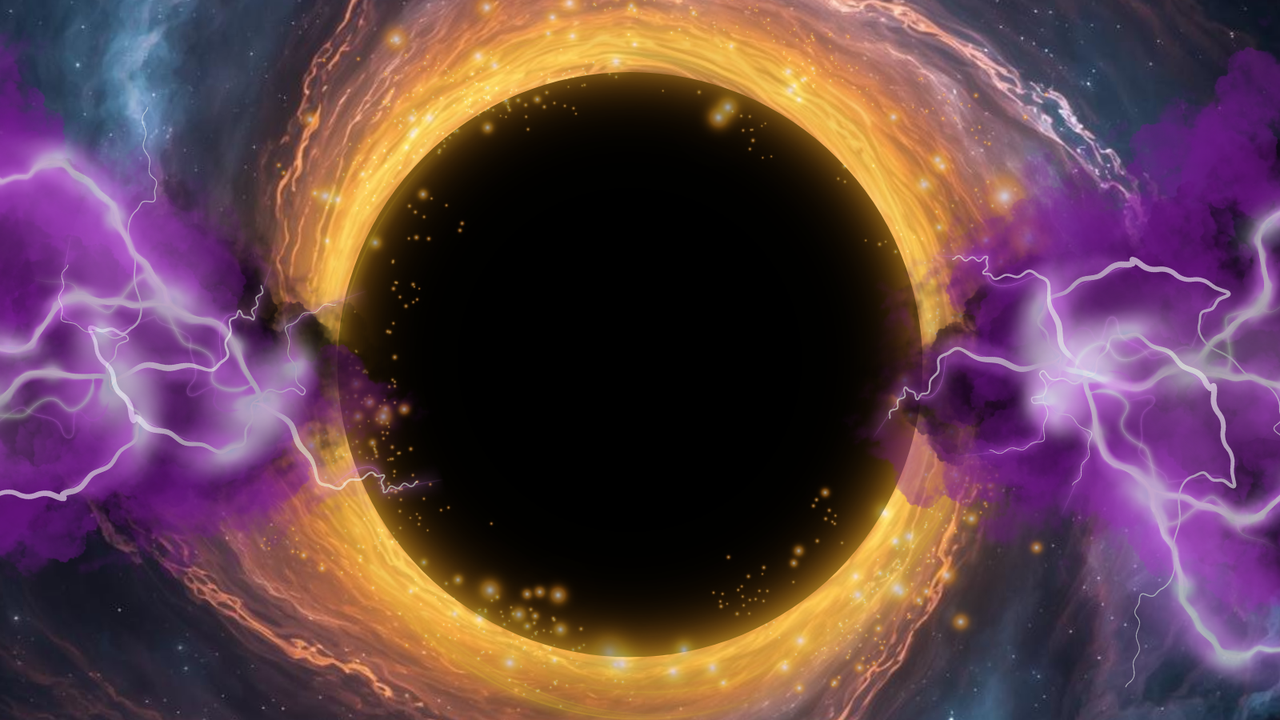
Astronomers have used a technique called echo mapping to detect hints that supermassive black holes, such as the cosmic titan at the heart of the Milky Way, known as Sagittarius A* (Sgr A*), are surrounded by dense clouds and clusters of dark matter. The research could teach us more about this mysterious substance and the environments around supermassive black holes.

Dark matter is the universe's most mysterious stuff, outweighing ordinary matter in the cosmos by a ratio of five to one — but remaining effectively invisible because it doesn't interact with electromagnetic radiation, including the light we use to see. The only way scientists can even infer the presence of dark matter is via its interaction with gravity, and the impact that this interaction has on objects made of traditional matter like stars. For instance, the gravitational effect of dark matter allows stars at the edges of galaxies to whip around at much greater speeds while not flying loose than the visible matter of those galaxies would allow.

This team decided to test the gravitational influence of dark matter at the hearts of galaxies, environments dominated by supermassive black holes which can have masses millions or even billions of times that of the sun. Ordinary matter around these supermassive black holes is often very visible, especially when spiraling into the maw of one of these cosmic titans from a flattened cloud called an accretion disk. This is because the gravitational influence of those black holes generates immense amounts of friction, causing them to grow brightly. That wouldn't work for dark matter; it can't feel friction because it doesn't interact with itself or with ordinary matter, and it can't glow because it doesn't absorb or emit light.

Clearly, dark matter can't be spotted around supermassive black holes even using the most advanced telescopes such as the Event Horizon Telescope (EHT), which has captured glowing rings of material around Sgr A* and around a more distant supermassive black hole that rules the heart of the galaxy Messier 87 (M87).

While discussing the problem of detecting dark matter around supermassive black holes, Mayank Sharma, a physics graduate student at Virginia Polytechnic Institute and State University (Virginia Tech), hit on an interesting solution.

"We could actually test this prediction using a technique in astronomy, which allows you to measure the distance to the surrounding gas by looking for echoes of light," Sharma said in a statement. The technique Sharma refers to is "reverberation mapping," and it has become a trusted method of determining the mass of black holes.

Echoes of dark matter

Reverberation mapping is based upon the fact that as matter falls into a black hole, it releases a burst of energy that causes the accretion disk it comes from to pulse. This pulse of light travels from the accretion disk to gas in the wider environment of the black hole. This gas absorbs that light and also pulses, with this secondary pulse serving as an echo of the first.

Because we know the speed of light, when astronomers see the first pulse of light and then its echo, they can use the time between pulses to estimate the distance between the black hole and the gas on the outskirts of its environment. The size of a black hole and the distance between it and outer gas clouds can be used to determine its mass, and could also be used to determine the mass of dark matter clustered around it.

The team applied their method to 14 different galaxies, finding in five cases that mass increases moving away from the central black hole in a way that couldn't be accounted for by visible matter alone. Despite the early success of this research, it far from proves that supermassive black holes are indeed gathering places for dark matter. The team's findings do point an interesting way forward for the investigation into the universe's most mysterious substance and its most mysterious regions.

"These galaxies are definitely showing a hint that there is extra material that cannot be explained by just the supermassive black hole," Sharma said. "The prospects are exciting."

The team's research was published in the journal Physical Review D.
  •  

James Webb Space Telescope Made a Salty Discovery in This Unusual Exoplanet’s Skies


James Webb Space Telescope (JWST) observations have revealed the colorful secret of the Pink Planet, the coldest object of its type ever directly observed.

A team of astronomers led by Northwestern University has revealed their findings in a recent paper published in The Astronomical Journal, finally describing the rose-colored haze covering the planetary-mass companion GJ504b, thanks to JWST data.

For over a decade, researchers have speculated that atmospheric salt clouds may create the pink planet’s strange hue, but this is the first concrete evidence for the hypothesis.

The Pink Planet

Since its discovery in 2013, GJ504b, commonly known as “The Pink Planet,” has been a bit of an astronomical mystery. Even the object’s description is imprecise: a “planetary-mass companion,” a nebulous category teetering between the size of a large planet and a brown dwarf, at roughly 25 times Jupiter’s mass. Residing 57 light-years from Earth, the object’s host star is similar to our Sun.

Faint due to extremely cold temperatures, astronomers cannot obtain clear enough observations with ground-based telescopes to perform spectroscopic analysis. However, from its vantage point beyond our atmosphere, the JWST’s advanced instruments have finally provided the necessary data to make sense of the object’s strange pink atmosphere.

The exoplanets most clearly observed are much hotter than our world, with temperatures between 1,000 and 2,000°F, creating a brilliance which can be seen across the gulf of space and through Earth’s atmosphere.

This giant planet is a mere 550°F, still hot by Earth standards, but far cooler than is normal for its type. According to the new study, GJ504b is an ancient world, some 2.5 to 4billion years old, with a slow cooling over time accounting for its decreased temperature.

Challenging JWST Observation

In addition to providing the first evidence for The Pink Planet’s elusive salt clouds, the team’s research has broader implications for studying cold objects, laying the groundwork for future JWST observations of such faint glows, too dim for ground-based telescopes.

“The Pink Planet is the coldest companion ever discovered using ground-based instruments,” according to Aneesh Baburaj, the study’s lead author. “Many teams all around the world performed follow-up observations to study its light, but it was too faint for ground-based instruments. That made it a perfect target for JWST. When we finally obtained its spectrum, it immediately looked interesting. But once we started digging deeper into the data, we realized it was not like anything we have analyzed before.”

To accurately analyze the light, Baburaj’s team used an advanced data-processing technique to remove considerable glare from the Pink Planet’s host star, improving the quality of the JWST data. Breaking light into separate colors through spectroscopic analysis allows scientists to determine the elemental composition of exoplanet atmospheres using JWST data.

“In the past, other astronomers observed the companion for an entire night with some of the biggest telescopes in the world to obtain a spectrum,” Baburaj said. “And they could not see the object. With JWST, our entire observation took around two hours, and we were successful.”

Analyzing the JWST Data

The team discovered water vapor, methane, carbon dioxide, ammonia, and other molecules in the object’s atmosphere, but these results conflicted with existing atmospheric models, which only made sense if the object had an extremely unlikely combination of physical features. However, once the team added clouds to the model, the effect of their salty formations on the light made the JWST data much easier to explain.

“We ran simulations with clouds, and the results aligned with what we know about cold planets,” Baburaj said. “We tried three different types of clouds, and salt clouds fit best. When we accounted for salt clouds, it subdued the signature of molecules hidden deeper in the companion’s atmosphere. Then, the results became physically possible.”

In addition to the salty clues, the researchers discovered an abundance of heavy metals. These may have something to do with The Pink Planet’s origins, as it may have originally formed as a star instead of a planet, but astronomers remain uncertain. In any case, the work process developed here will be essential to future JWST investigation of cold objects.

“This is the first time we’ve found that salt clouds are critical to explaining the spectrum of an object,” Baburaj concluded. “It’s a good reminder to account for clouds in our models.”

The paper, “JWST-TST High Contrast: First Direct Spectroscopy of GJ504b Reveals Clouds and Possible Metal Enrichment,” appeared in The Astronomical Journal on June 18, 2026.

Ryan Whalen covers science and technology for The Debrief. He holds an MA in History and a Master of Library and Information Science with a certificate in Data Science. He can be contacted at ryan@thedebrief.org, and follow him on Twitter @mdntwvlf.

  •  

June 20, 1955: Pingualuit Crater is discovered

On June 20, 1943, Pingualuit Crater (formerly known as Chubb Crater and as the New Quebec Crater) was first photographed by a U.S. Army Air Force crew during a meterological flight over northern Quebec. Formed approximately 1.4 million years ago by a meteorite impact, the 2.1-mile-wide (3.4 kilometers) crater has an unusually circular shape resultingContinue reading "June 20, 1955: Pingualuit Crater is discovered"

The post June 20, 1955: Pingualuit Crater is discovered appeared first on Astronomy Magazine.

  •  

Late, great singer-songwriter Elliott Smith finds immortality as an asteroid

An asteroid now bears the name of beloved musician Elliott Smith, thanks to one ambitious filmmaker.

Elliott Smith passed away at the age of 34 in 2003, but his impact and his music continue to connect with people around the world. And his influence has now extended to space, thanks to independent filmmaker Orlando Campopiano, who worked to get an asteroid named "Elliottsmith."

"I hope this introduces at least one new person to Elliott's brilliant discography, and I'm happy to see a permanent legacy in the stars! To have this tribute to him blessed by the estate and discoverers is also a great honor," Campopiano told Stereogum.

While listening to the song "Shooting Star," from Smith's album "From a Basement on the Hill," which was released in 2004 following his death, Campopiano had the idea to try and get an asteroid named after Smith, he told Stereogum.

He took this inspiration and ran with it, connecting with Smith's estate and working together to submit a proposal to the International Astronomical Union (IAU), which gives official names to cosmic objects, including asteroids. Maybe there are some Elliott Smith fans at the IAU, because the organization actually said yes.

With this positive response, Asteroid (861969) 2014 OS439 is now officially "Elliottsmith."

An illustrated visual of where asteroid Elliottsmith is in our solar system.

The asteroid Elliotsmith (861969) visualized in our solar system. (Image credit: NASA)

The asteroid was discovered back in 2014 by the Pan-STARRS 1 (Panoramic Survey Telescope and Rapid Response System) project in Hawai'i.

The IAU's announcement of the renaming reads: "Steven Paul 'Elliott' Smith (1969–2003) was an influential, Oscar-nominated American songwriter. His intricate music left a lasting impact on many musicians. Asteroid 861969 honors his birth date, August 6, 1969. Smith often used celestial motifs in his work, notably in the song 'Shooting Star,' which, in hindsight, symbolizes his brief but brilliant light."

As this classification states, this asteroid is more than just a random rock in the sky. Its previous, numerical name 861969 happens to perfectly mirror Smith's birthday. This cosmic alignment makes it feel like this naming was truly meant to be.

You can get a look at the asteroid's place in our solar system on the small-body website of NASA's Jet Propulsion Laboratory, which you can find here.

  •  
❌