
❌

Reading view

Microbes destroyed an ancient pterosaur’s wingbone, then preserved it for 100 million years

More than 100 million years ago, a flying reptile called a pterosaur flew over the oceans hunting squid and fish. Much more recently, one of its wing bones was discovered in Brazil, transformed over the eons into a fossil made of a complex assemblage of different chemicals and minerals. And in new research published in […]

The post Microbes destroyed an ancient pterosaur’s wingbone, then preserved it for 100 million years appeared first on Knowridge Science Report.
  •  

113-Million-Year-Old Pterosaur Fossil Reveals What Flying Reptiles Ate

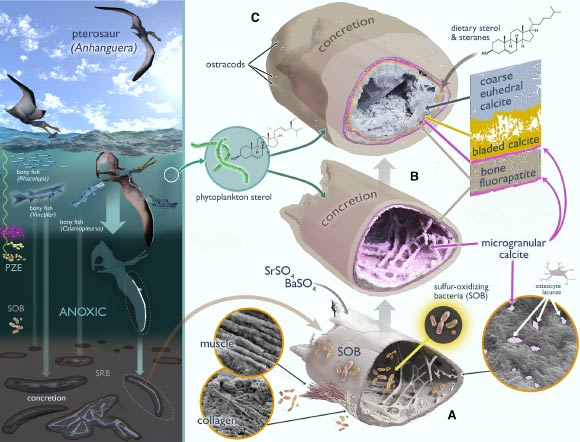
Grice et al. integrate organic geochemical analyses with high-resolution micro-mineral imaging of a three-dimensionally preserved Cretaceous pterosaur wing phalanx from Brazil to reveal steroid biomarkers and multi-stage mineralization pathways underlying its preservation. Image credit: Grice et al., doi: 10.1016/j.isci.2026.116199.

A 113-million-year-old pterosaur fossil from northeastern Brazil has yielded rare evidence of soft tissues, organic molecules and chemical traces of a diet heavy in fish and cephalopods such as squid or nautilus relatives.

The post 113-Million-Year-Old Pterosaur Fossil Reveals What Flying Reptiles Ate appeared first on Sci.News: Breaking Science News.

  •  
❌