
❌

Reading view

Three-armed kitchen robot cuts raw salmon with 95% touch-sensing accuracy
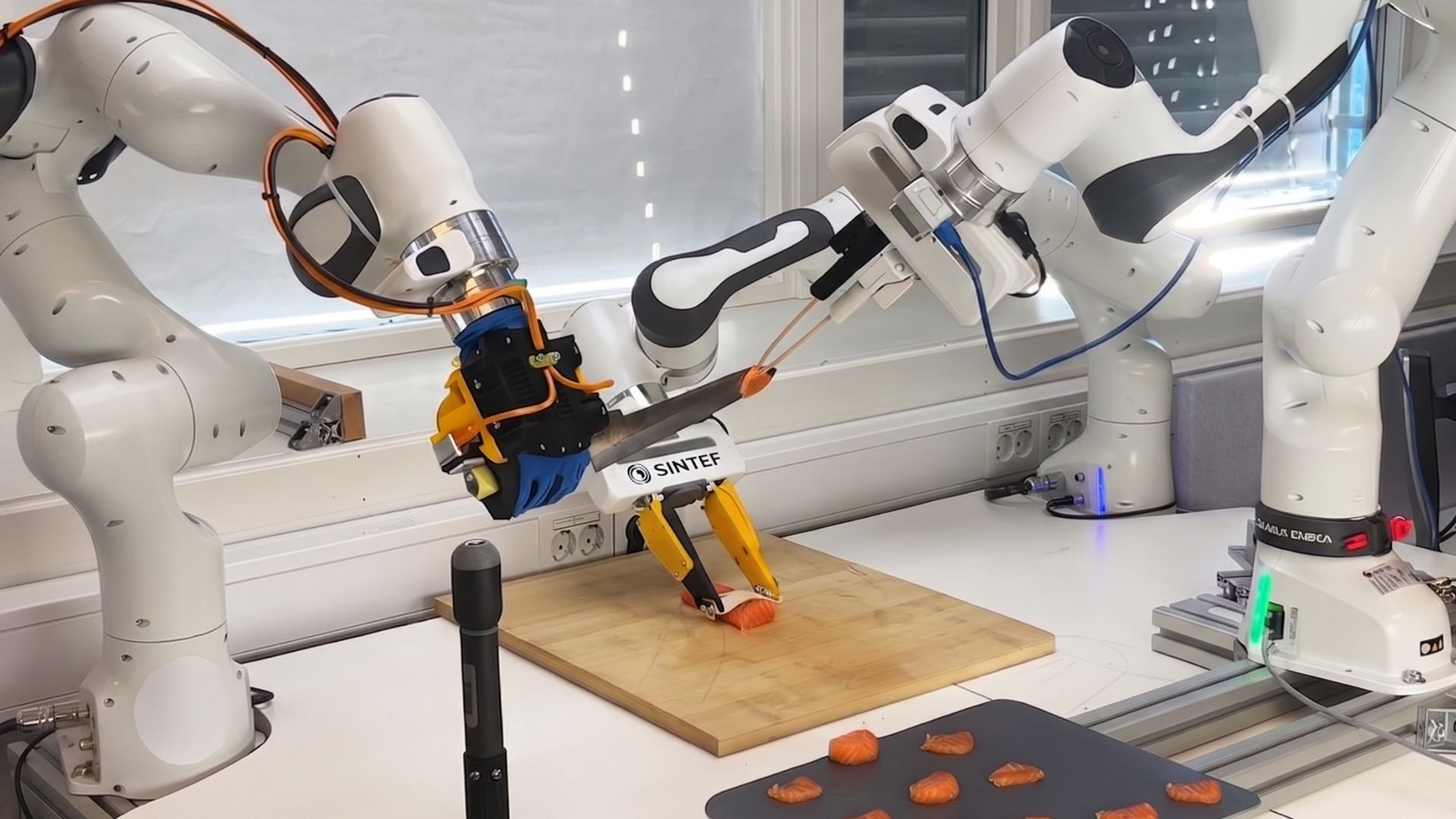
Industrial robots have mastered many repetitive tasks, but preparing sashimi remains a surprisingly difficult challenge. A piece of raw salmon rarely stays where it is placed. The fish deforms during handling, making it difficult for machines to deliver consistent cuts.

Researchers in Norway have developed a robotic system that can prepare sashimi with minimal human involvement. The machine tackles a task that has long challenged robots because raw fish constantly changes shape during handling.

The project highlights a broader goal in robotics. Engineers want machines to work with soft materials that do not behave predictably. Success in that area could benefit industries ranging from food processing to healthcare.

Built for delicate tasks

The research team at the Norwegian University of Science and Technology designed Sashimi-Bot around three robotic arms. Each arm performs a specific role. One arm stabilizes and positions the salmon before cutting begins. Another handles a chef’s knife. A third arm uses chopsticks to transfer finished slices onto a tray.

Getting the fish into the correct position proved critical. A salmon loin can shift during handling, which affects cut quality. To address that issue, the researchers trained the robot in a virtual environment. The system relied on deep reinforcement learning, an AI technique that improves performance through repeated practice. During the simulation, the robot tested countless movements and gradually learned how to arrange the fish for slicing. The researchers then transferred that knowledge to the physical robot without additional training on real salmon.

Giving the knife touch

Cutting introduced another obstacle. The robot needed to know exactly when the blade reached the cutting board. That task becomes more difficult because the knife sits inside a soft robotic gripper. Small variations in the grip can affect the blade’s position during a cut.

To solve the problem, the team equipped the system with a GelSight tactile sensor. The device uses a soft gel surface and an internal camera to detect pressure changes. Those measurements provide information similar to a sense of touch.

Researchers trained the sensing system using more than 12,000 data samples collected during 157 cutting motions. The resulting model detected contact with the cutting board with 95% accuracy. It also achieved 99% precision during testing. That feedback allowed the robot to adjust its cutting motion before driving the blade too deeply into the board.

Performance on salmon

The team evaluated Sashimi-Bot using real salmon loins. During testing, the robot produced 34 slices ranging from 6 to 16 millimeters thick. Some pieces adhered to the knife after cutting, a common issue when working with raw fish. The robot successfully recovered all six of those slices directly from the blade.

Most of the remaining pieces reached the serving tray without issue. The system successfully transferred 26 of 28 slices left on the cutting board. Only two failed transfers occurred, both involving extremely thin pieces that slipped from the chopsticks.

The study was published in the journal npj Robotics.
  •  

New vision-based safety tech lets industrial robots work safely near humans

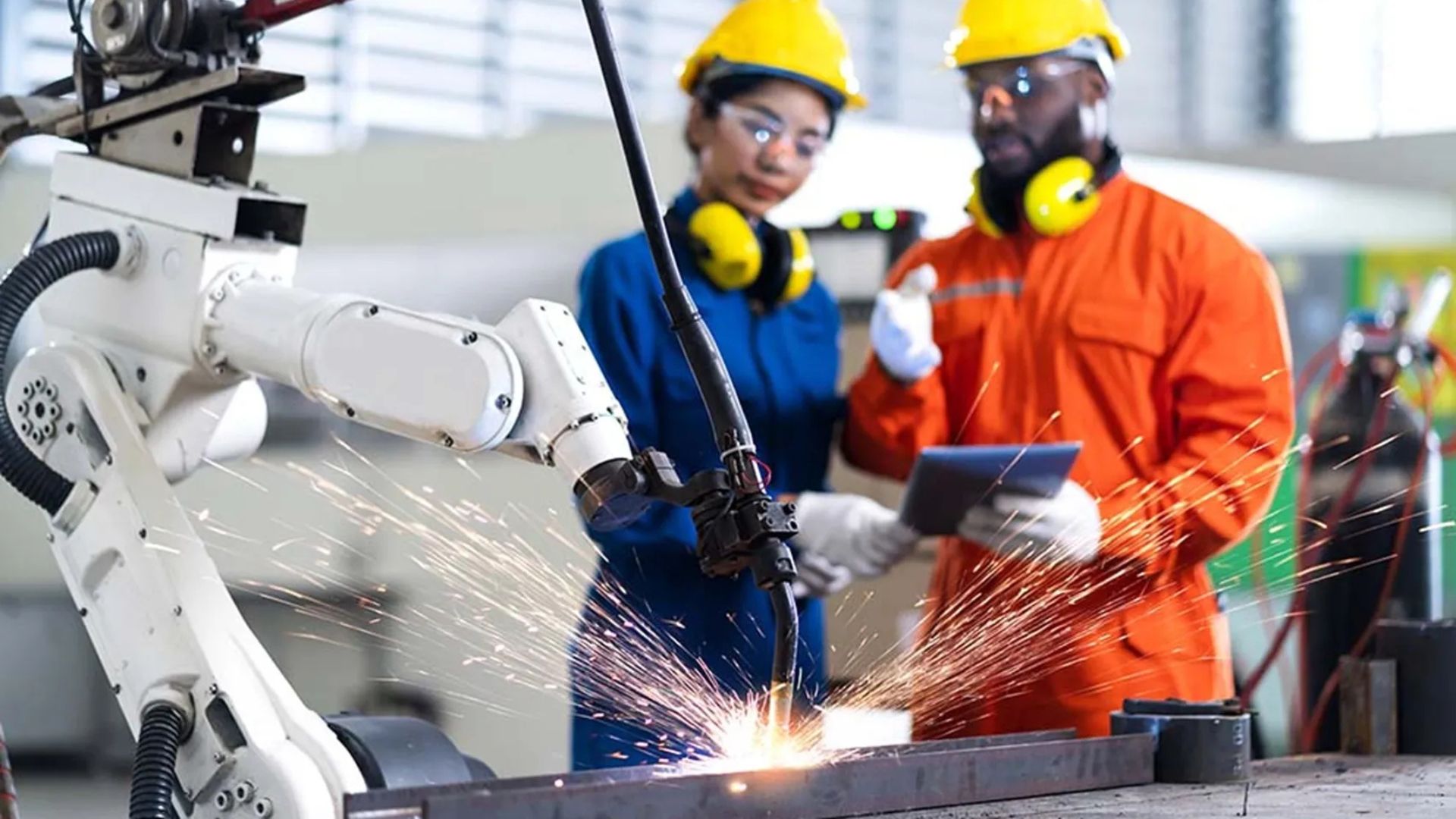
Sensory Robotics has received safety certification for a system designed to let industrial robots operate alongside people without the protective cages commonly used on factory floors. The certification clears the way for deployment of the company’s SR-1 technology in regulated manufacturing environments across the United States and Canada.

The SR-1 system combines 3D vision technology, sensors, and real-time safety software that continuously monitors the area around robotic arms. Instead of relying on physical barriers, the system creates virtual safety zones that adjust based on human movement and machine activity.

The company says the technology can be installed on existing industrial robotic production cells, potentially allowing manufacturers to retrofit current equipment rather than replace it. The goal is to enable human workers and high-speed industrial robots to share the same workspace safely.

The certification includes cULus 1740 and ISO 13849 Performance Level d validation, standards widely recognized in industrial automation and machine safety. The approvals mark the transition of the technology from development and testing into commercial deployment.

Invisible safety zones emerge

β€œWithout this safety certification, our technology doesn’t leave the lab, and it doesn’t reach the factory floor,” Sensory Robotics CEO Chris Edwards says. β€œNow, it can.”

Industrial robots have long been separated from workers by fences and cages because of the speed and force at which they operate. While collaborative robots have been designed to work closer to humans, many traditional robotic systems still require physical barriers to meet safety requirements.

Sensory Robotics says SR-1 addresses that challenge by continuously tracking people near robotic cells and adjusting robot behavior in real time.

β€œWe designed SR-1 to continuously see people and adjust robot movements in real time,” Edwards says. β€œThis UL certification now allows our technology to be purchased and installed on industrial robots, enabling them to safely operate alongside humans without physical barriers.”

According to the company, the certification process evaluated how the system responds to equipment failures, safety-function disruptions, and potential risks to workers. Such certifications are often required before technologies can be introduced into regulated manufacturing facilities.

Factory robots lose fences

The company argues that eliminating physical cages could free up factory floor space, improve workflow flexibility, and reduce production interruptions. Traditional robotic work cells often require complete shutdowns when workers enter restricted areas, creating downtime that can accumulate across large manufacturing operations.

β€œThe goal is simple,” says chief operating officer Mark Gagas. β€œKeep people safe without stopping production every time someone enters a workspace. In traditional environments, a safety interruption can require a full robot shutdown and restart, sometimes taking up to 10 minutes per incident. Add that up across a production line, and those delays compound into high operational costs.”

The company says its system is already attracting interest from sectors including automotive, aerospace, logistics, manufacturing, and defense. Sensory Robotics also received a $1.25 million Department of Defense SBIR Phase II grant and additional support through the University of Cincinnati’s innovation ecosystem.

β€œThese combined certifications are the key that unlocks real-world industrial adoption and approval for companies to purchase fenceless human-robot collaboration systems like SR-1,” Gagas says. β€œIt means regulated manufacturing environments can now trust and deploy this technology into their robots with confidence.”

  •  
❌