❌

Reading view

NASA Testing Advanced Capabilities for Moon, Mars Rovers
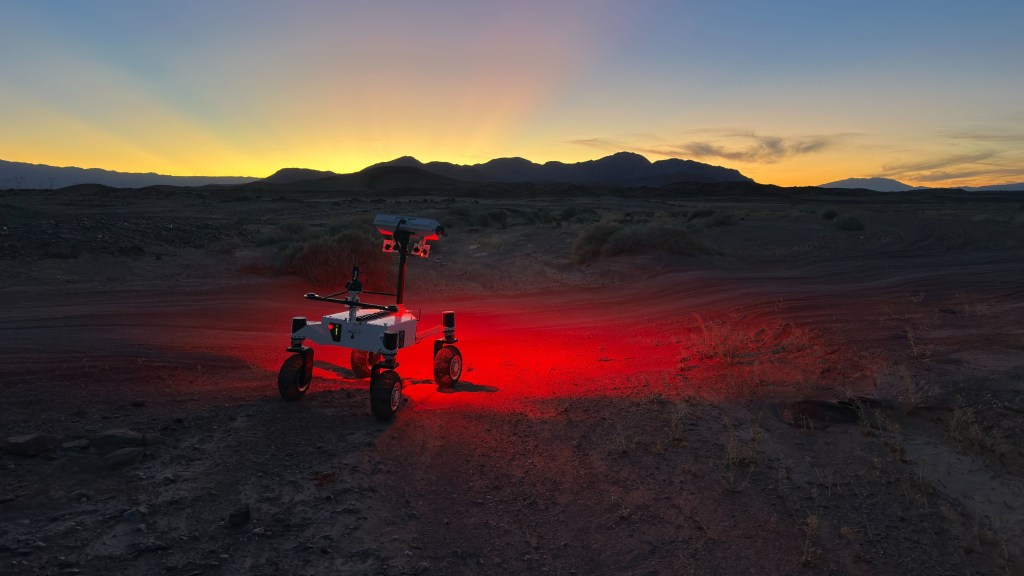
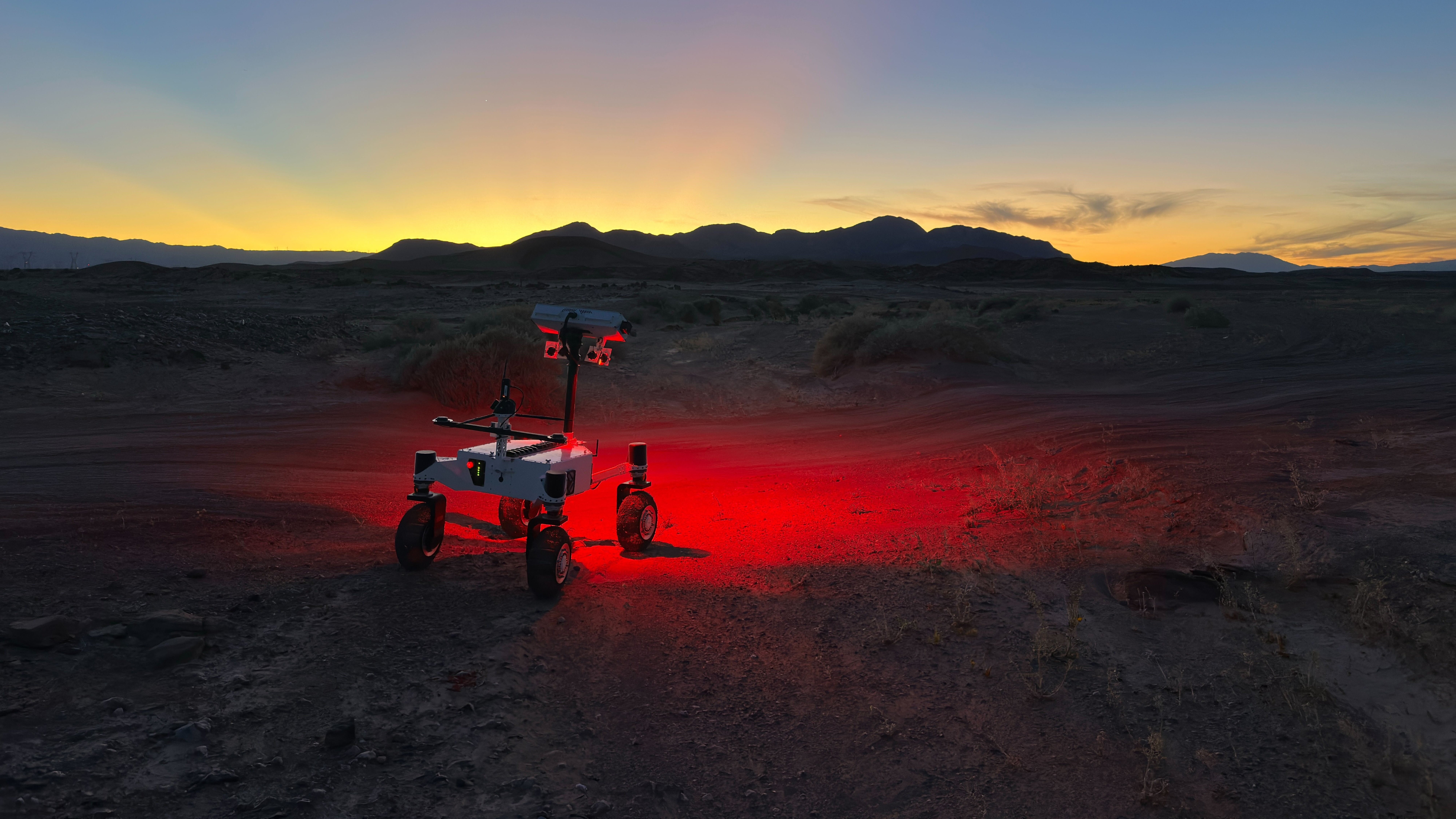
A white four-wheeled rover with a rectangular head on its mast projects a red glow onto a dark desert landscape. Pink and yellow hues indicate the sun has set behind a distant mountain range, while the top of the frame remains blue.
Developed at NASA’s Jet Propulsion Laboratory, ERNEST (Exploration Rover for Navigating Extreme Sloped Terrain) is used in a desert field test to help refine mobility hardware and autonomy software that could be used for a potential future long-range lunar rover mission.
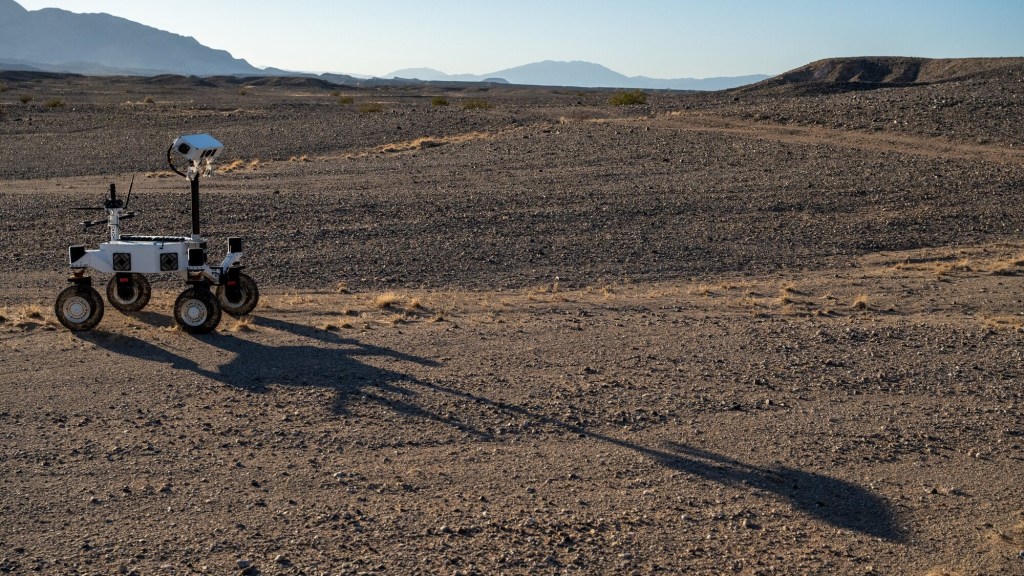
A white four-wheeled rover on the left side of the frame casts a long shadow across barren, brown ground toward the lower right. A few low, scrubby plants dot the desert landscape and mountains rise in the far distance under a pale blue sky.
During the field test, which took place in March 2026 in the Colorado Desert of Southern California, the JPL team deployed ERNEST at all times of the day — including dusk, dawn, and nighttime, when lighting conditions create long shadows like those seen on the Moon’s polar regions.

On a bleak stretch of the Colorado Desert in Southern California, a compact four-wheeled rover recently trundled about 16 miles (26 kilometers) with minimal intervention from the team of engineers trailing it. Called ERNEST (Exploration Rover for Navigating Extreme Sloped Terrain), this prototype is being used by NASA to advance both robotic autonomy and the ability to traverse challenging landscapes.

Developed at NASA’s Jet Propulsion Laboratory in Southern California, ERNEST is 4 feet (1.2 meters) long. Not only can it lift each of its mesh wheels to get past obstacles that would stymie Curiosity and Perseverance, NASA’s six-wheeled Mars rovers, but the prototype also has enhanced independent decision-making capabilities. These mobility and autonomy advances could be infused into future missions that will venture to previously inaccessible areas of the Red Planet or the Moon.

ERNEST serves as a testbed for a potential future lunar rover mission requiring high speeds and extreme distances. In a recent field test, the prototype traveled 16 miles over the course of 37 hours, going an order of magnitude above the top speed at which NASA’s current Mars rovers can navigate. Credit: NASA/JPL-Caltech

In the field, ERNEST served as a testbed for a potential future lunar mission requiring higher speeds and much greater mileage than can be accomplished by current rovers. This technology could be used to inform future designs for exploration efforts on the Moon and beyond.

“This testing is helping us refine the mobility hardware and autonomy software to navigate extreme distances across a wide range of terrain and lighting conditions anticipated on the Moon,” said Issa Nesnas, a principal technologist at JPL who led the recent testing as head of autonomy for a NASA mission concept for a potential future long-range lunar rover.

Against a pitch-black background sky in which a handful of white stars are visible, two men stand on either side of a 4.5-foot-tall white rover, which is lit up by the glow from their headlamps as they set up the illuminators on the robot’s mast.
Engineers from JPL set up illuminators after transporting ERNEST for a pre-sunrise test during a seven-day desert field campaign.
NASA/JPL-Caltech

Nesnas’ team is using ERNEST to demonstrate it is possible to build a rover that’s twice as big as the prototype and capable of a long-distance Moon mission. During the recent campaign, ERNEST traveled at speeds up to 0.6 mph (1 kph) over 37 hours of driving, across seven days of intermittent testing. That’s an order of magnitude above the top speed Perseverance and Curiosity can navigate.

“You could do a science road trip across the Moon — or Mars — with this vehicle,” said James Keane, a JPL planetary scientist working on lunar missions.

The initial goal of the team that developed ERNEST was mechanical: to design a relatively simple, low-cost rover that advances the trusted rocker-bogie suspension system featured on every Mars rover since NASA’s Sojourner. This passive system keeps relatively constant weight on all six wheels, thanks to pivot points and struts that enable each one to adapt to the changing surface.

The mobility and autonomy advances developed at JPL for the ERNEST prototype rover could be infused into future NASA missions to previously inaccessible areas of the Red Planet or the Moon. Credit: NASA/JPL-Caltech

On ERNEST, the active suspension lets the rover manage weight distribution among its wheels. Two powered joints in front articulate a gimbal that allows the rover to drive using different gaits like squirming, wheel-walking, and obstacle-climbing. With a clutch mechanism, it can switch between active and passive suspension, which is less terrain capable but more energy efficient. With four steerable wheels, it can drive in any direction, including sideways.

“We started by postulating that we could do better in designing a planetary surface robotic mobility system,” said Hari Nayar, a JPL principal technologist leading the ERNEST team. “While the rocker-bogie system has been very successful over the past 30 years, there’s been a lot of research in that time on mobility and understanding terrain interaction.”

Before arriving at today’s version of ERNEST, the team built two earlier prototypes, each about 2 feet (0.6 meters) long, to test 11 active suspension configurations. In a trailer filled with lunar regolith simulant, they ran experiments at different slope angles over several months before landing on a final design.

Then the team scaled up, including adding a rectangular head mounted on a 4.5-foot-tall (1.4-meter-tall) mast. The hardware was completed in September 2024, but the rover still needed a human operator to joystick it, sending commands to instruct the rover on how to move over obstacles.

In order to train the rover to think on its own, the ERNEST team turned to reinforcement learning, a type of artificial intelligence where the robot learns by interacting with its environment. The Dynamics and Real-Time Simulation Laboratory at JPL developed a high-fidelity virtual testing environment that replicates the rover’s behavior. The team fed the simulator data collected by engineers who documented the response of the actual rover hardware to a variety of terrain types. On a high-performance computing cluster, the team ran many simulations at once, sometimes completing thousands of hours of tests over a single weekend.

After months of virtual training, the ERNEST team was ready to see if the rover could use its new autonomous algorithms to figure out how to drive over terrain features that would halt a passive-suspension rover. They set up an obstacle course with sand ripples, rubble piles, steps, and steep slopes in JPL’s Mars Yard, an outdoor terrain proving ground. Then they watched as the rover maneuvered the terrain on its own. Since then, ERNEST has completed many such courses.

Nayar’s team is starting a new autonomy project which involves integrating the rover’s ability to determine when and how to use its active suspension with longer-range intelligent navigation. The goal is to enable ERNEST to plan an efficient path so that it can tackle surmountable obstacles and circumnavigate hazardous ones. These capabilities could contribute to potential future rover missions encountering formidable landscapes on Mars or more rugged areas of the Moon.

Work on ERNEST began in 2022 was initially supported by JPL internal research and development funds. It is currently funded by NASA’s Mars Exploration Program and the agency’s Exploration Science Strategy and Integration Office in its Science Mission Directorate at NASA Headquarters in Washington. Caltech in Pasadena, California, manages JPL for NASA.

Media Contacts

Karen Fox / Molly Wasser
NASA Headquarters, Washington
240-285-5155 / 240-419-1732
karen.c.fox@nasa.gov / molly.l.wasser@nasa.gov   

Melissa Pamer
Jet Propulsion Laboratory, Pasadena, Calif.
626-314-4928
melissa.pamer@jpl.nasa.gov

2026-040

The post NASA Testing Advanced Capabilities for Moon, Mars Rovers appeared first on NASA Science.
  •  

NASA Testing Advanced Capabilities for Moon, Mars Rovers

A white four-wheeled rover with a rectangular head on its mast projects a red glow onto a dark desert landscape. Pink and yellow hues indicate the sun has set behind a distant mountain range, while the top of the frame remains blue.
Developed at NASA’s Jet Propulsion Laboratory, ERNEST (Exploration Rover for Navigating Extreme Sloped Terrain) is used in a desert field test to help refine mobility hardware and autonomy software that could be used for a potential future long-range lunar rover mission.
A white four-wheeled rover on the left side of the frame casts a long shadow across barren, brown ground toward the lower right. A few low, scrubby plants dot the desert landscape and mountains rise in the far distance under a pale blue sky.
During the field test, which took place in March 2026 in the Colorado Desert of Southern California, the JPL team deployed ERNEST at all times of the day — including dusk, dawn, and nighttime, when lighting conditions create long shadows like those seen on the Moon’s polar regions.

On a bleak stretch of the Colorado Desert in Southern California, a compact four-wheeled rover recently trundled about 16 miles (26 kilometers) with minimal intervention from the team of engineers trailing it. Called ERNEST (Exploration Rover for Navigating Extreme Sloped Terrain), this prototype is being used by NASA to advance both robotic autonomy and the ability to traverse challenging landscapes.

Developed at NASA’s Jet Propulsion Laboratory in Southern California, ERNEST is 4 feet (1.2 meters) long. Not only can it lift each of its mesh wheels to get past obstacles that would stymie Curiosity and Perseverance, NASA’s six-wheeled Mars rovers, but the prototype also has enhanced independent decision-making capabilities. These mobility and autonomy advances could be infused into future missions that will venture to previously inaccessible areas of the Red Planet or the Moon.

ERNEST serves as a testbed for a potential future lunar rover mission requiring high speeds and extreme distances. In a recent field test, the prototype traveled 16 miles over the course of 37 hours, going an order of magnitude above the top speed at which NASA’s current Mars rovers can navigate. Credit: NASA/JPL-Caltech

In the field, ERNEST served as a testbed for a potential future lunar mission requiring higher speeds and much greater mileage than can be accomplished by current rovers. This technology could be used to inform future designs for exploration efforts on the Moon and beyond.

“This testing is helping us refine the mobility hardware and autonomy software to navigate extreme distances across a wide range of terrain and lighting conditions anticipated on the Moon,” said Issa Nesnas, a principal technologist at JPL who led the recent testing as head of autonomy for a NASA mission concept for a potential future long-range lunar rover.
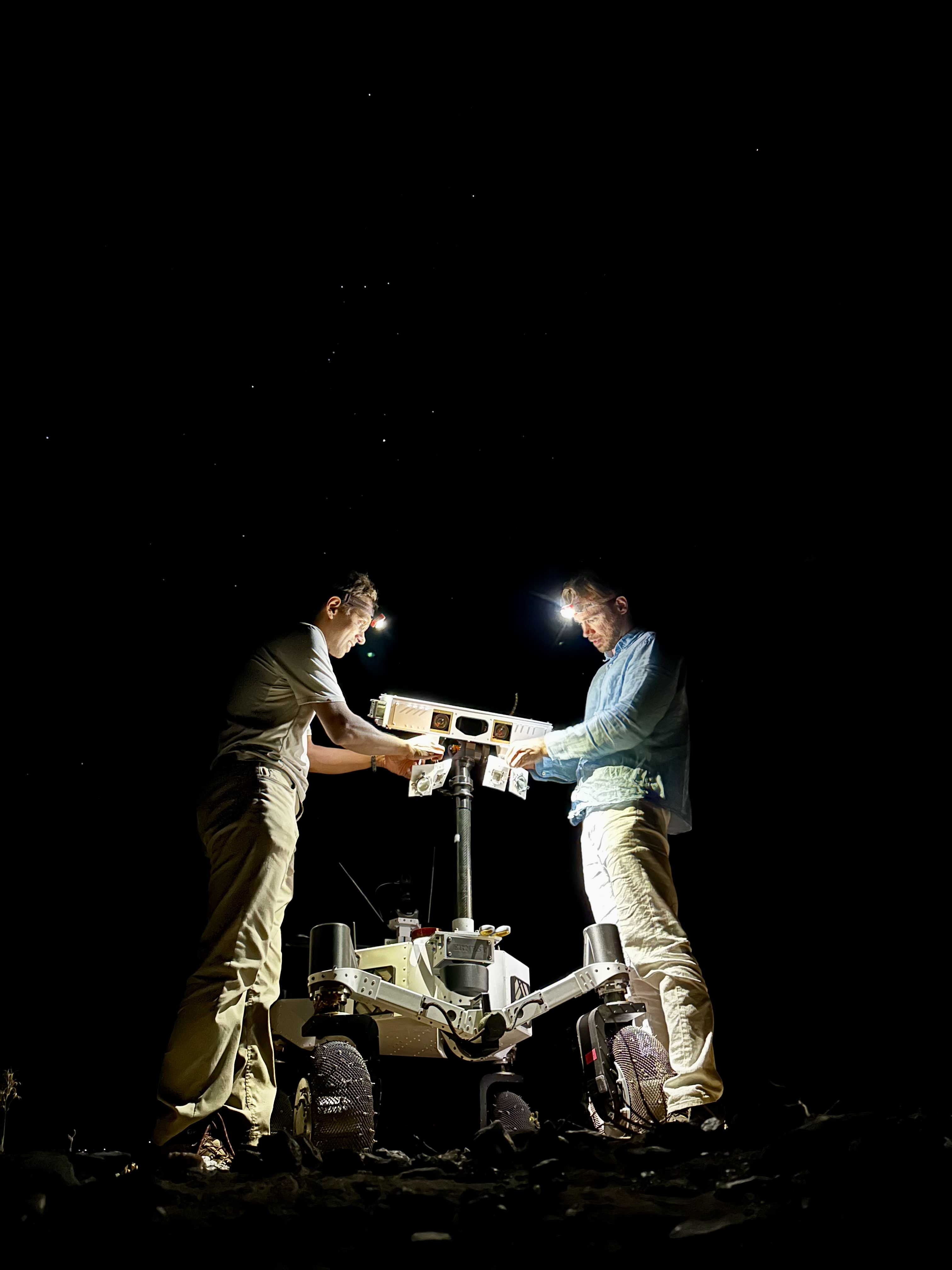
Against a pitch-black background sky in which a handful of white stars are visible, two men stand on either side of a 4.5-foot-tall white rover, which is lit up by the glow from their headlamps as they set up the illuminators on the robot’s mast.
Engineers from JPL set up illuminators after transporting ERNEST for a pre-sunrise test during a seven-day desert field campaign.
NASA/JPL-Caltech

Nesnas’ team is using ERNEST to demonstrate it is possible to build a rover that’s twice as big as the prototype and capable of a long-distance Moon mission. During the recent campaign, ERNEST traveled at speeds up to 0.6 mph (1 kph) over 37 hours of driving, across seven days of intermittent testing. That’s an order of magnitude above the top speed Perseverance and Curiosity can navigate.

“You could do a science road trip across the Moon — or Mars — with this vehicle,” said James Keane, a JPL planetary scientist working on lunar missions.

The initial goal of the team that developed ERNEST was mechanical: to design a relatively simple, low-cost rover that advances the trusted rocker-bogie suspension system featured on every Mars rover since NASA’s Sojourner. This passive system keeps relatively constant weight on all six wheels, thanks to pivot points and struts that enable each one to adapt to the changing surface.

The mobility and autonomy advances developed at JPL for the ERNEST prototype rover could be infused into future NASA missions to previously inaccessible areas of the Red Planet or the Moon. Credit: NASA/JPL-Caltech

On ERNEST, the active suspension lets the rover manage weight distribution among its wheels. Two powered joints in front articulate a gimbal that allows the rover to drive using different gaits like squirming, wheel-walking, and obstacle-climbing. With a clutch mechanism, it can switch between active and passive suspension, which is less terrain capable but more energy efficient. With four steerable wheels, it can drive in any direction, including sideways.

“We started by postulating that we could do better in designing a planetary surface robotic mobility system,” said Hari Nayar, a JPL principal technologist leading the ERNEST team. “While the rocker-bogie system has been very successful over the past 30 years, there’s been a lot of research in that time on mobility and understanding terrain interaction.”

Before arriving at today’s version of ERNEST, the team built two earlier prototypes, each about 2 feet (0.6 meters) long, to test 11 active suspension configurations. In a trailer filled with lunar regolith simulant, they ran experiments at different slope angles over several months before landing on a final design.

Then the team scaled up, including adding a rectangular head mounted on a 4.5-foot-tall (1.4-meter-tall) mast. The hardware was completed in September 2024, but the rover still needed a human operator to joystick it, sending commands to instruct the rover on how to move over obstacles.

In order to train the rover to think on its own, the ERNEST team turned to reinforcement learning, a type of artificial intelligence where the robot learns by interacting with its environment. The Dynamics and Real-Time Simulation Laboratory at JPL developed a high-fidelity virtual testing environment that replicates the rover’s behavior. The team fed the simulator data collected by engineers who documented the response of the actual rover hardware to a variety of terrain types. On a high-performance computing cluster, the team ran many simulations at once, sometimes completing thousands of hours of tests over a single weekend.

After months of virtual training, the ERNEST team was ready to see if the rover could use its new autonomous algorithms to figure out how to drive over terrain features that would halt a passive-suspension rover. They set up an obstacle course with sand ripples, rubble piles, steps, and steep slopes in JPL’s Mars Yard, an outdoor terrain proving ground. Then they watched as the rover maneuvered the terrain on its own. Since then, ERNEST has completed many such courses.

Nayar’s team is starting a new autonomy project which involves integrating the rover’s ability to determine when and how to use its active suspension with longer-range intelligent navigation. The goal is to enable ERNEST to plan an efficient path so that it can tackle surmountable obstacles and circumnavigate hazardous ones. These capabilities could contribute to potential future rover missions encountering formidable landscapes on Mars or more rugged areas of the Moon.

Work on ERNEST began in 2022 was initially supported by JPL internal research and development funds. It is currently funded by NASA’s Mars Exploration Program and the agency’s Exploration Science Strategy and Integration Office in its Science Mission Directorate at NASA Headquarters in Washington. Caltech in Pasadena, California, manages JPL for NASA.

Media Contacts

Karen Fox / Molly Wasser
NASA Headquarters, Washington
240-285-5155 / 240-419-1732
karen.c.fox@nasa.gov / molly.l.wasser@nasa.gov   

Melissa Pamer
Jet Propulsion Laboratory, Pasadena, Calif.
626-314-4928
melissa.pamer@jpl.nasa.gov

2026-040

💾

Engineers from NASA’s Jet Propulsion Laboratory are field-testing advanced capabilities for potential future Moon and Mars rovers. In the Colorado Desert nea...
  •  

More than 30 giant dust devils spotted twisting through ancient Martian canyons

The European Space Agency (ESA) has captured remarkable new images of dozens of giant dust devils swirling across an ancient canyon system on Mars. The images show more than 30 active whirlwinds moving through Mamers Valles, a vast network of valleys and canyons that formed billions of years ago. Dust devils on Mars are similar […]

The post More than 30 giant dust devils spotted twisting through ancient Martian canyons appeared first on Knowridge Science Report.

  •  

NASA’s Curiosity Uncovers New Clues to Mars’ Potential of Supporting Ancient Life


NASA’s Curiosity rover and its mission to investigate whether Mars could have ever supported microbial life have taken one step closer to achieving its goal, with one of the most significant discoveries in the ongoing search for evidence of life on the Red Planet.

While exploring Gale Crater, NASA’s robotic rover uncovered a sample in 2020 and, using a chemical technique, determined that 21 carbon-based molecules were preserved in the clay-rich sedimentary rock. This also included seven that had never been identified on Mars before. 

While the discovery does not definitively point to life on the Red Planet, it does strengthen the case that Mars has the chemical conditions to support life. 

According to scientists, the most remarkable aspect of the discovery is not the molecules themselves, but their preservation

“The actual organic components they found are not strong evidence for life,” said Texas A&M University astrobiologist and geobiologist Dr. Michael Tice in a statement. Tice acknowledged that these compounds may also have evolved through abiotic processes, including formation in meteorites or other non-biological pathways.

“These organics were likely preserved in the rocks for a very long time, possibly billions of years, despite radiation and other harsh conditions on Mars,” Tice said.

“It blows my mind.”

Building Blocks of Life

Organic molecules are critical building blocks of life, but they can also form through non-biological processes, such as geological reactions or meteorite delivery. Similar preserved compounds on Earth help scientists study ancient environments, and their discovery on Mars provides new clues about the planet’s billion-year-old history.

“Studying how those compounds vary between different rocks can tell a story of how life and environments changed,” Tice recently said in a statement issued by Texas A&M. “Finding organics stored in similar ways on Mars tells us that there could be similar stories preserved there as well.”

The findings also suggest that Martian rocks may contain evidence from a time before life began, a record of sorts that Earth’s past geology has mostly erased.

“It is even possible that some Mars rocks will tell us about times when there was no life there,” he said, with organics formed instead through prebiotic chemistry or delivered from space. “We do not have an equivalent record of such a time preserved on Earth.”

The findings build on earlier research by Tice and his team that identified possible biosignatures in Mars rocks studied by NASA’s Perseverance rover. 

Tice suggests, “When we looked even closer, we saw things that are easy to explain with early Martian life but very difficult to explain with only geological processes.”

The rocks contained organic carbon and key elements connected to microbial energy sources, along with chemical patterns that may show redox reactions (processes often associated with life on Earth).

“With the right collection, we could find the next step in evidence for past life on Mars or learn about the kinds of processes that eventually led to life on our planet.”

Tice and his colleagues will continue their work exploring the Martian land. 

“I’m continuing to study the record of early Martian evolution as part of the PIXL instrument team on the Perseverance rover,” he said.

“In addition, I’m comparing how organisms affected some of the oldest sediments on Earth — now preserved in rocks in South Africa—with the potential biosignatures we discovered on Mars.”

Additional details about Tice and his team’s work can be found in a pair of papers, “Diverse organic molecules on Mars revealed by the first SAM TMAH experiment,” which appeared in Nature Communications, and “Redox-driven mineral and organic associations in Jezero Crater, Mars,” which was published in the journal Nature.

Chrissy Newton is a PR professional and founder of VOCAB Communications. She hosts the Rebelliously Curious podcast, which can be found on The Debrief’s YouTube Channel. Follow her on X: @ChrissyNewton and at chrissynewton.com.

  •  

NASA Announces Public-Private Partnership to Advance Mars Science

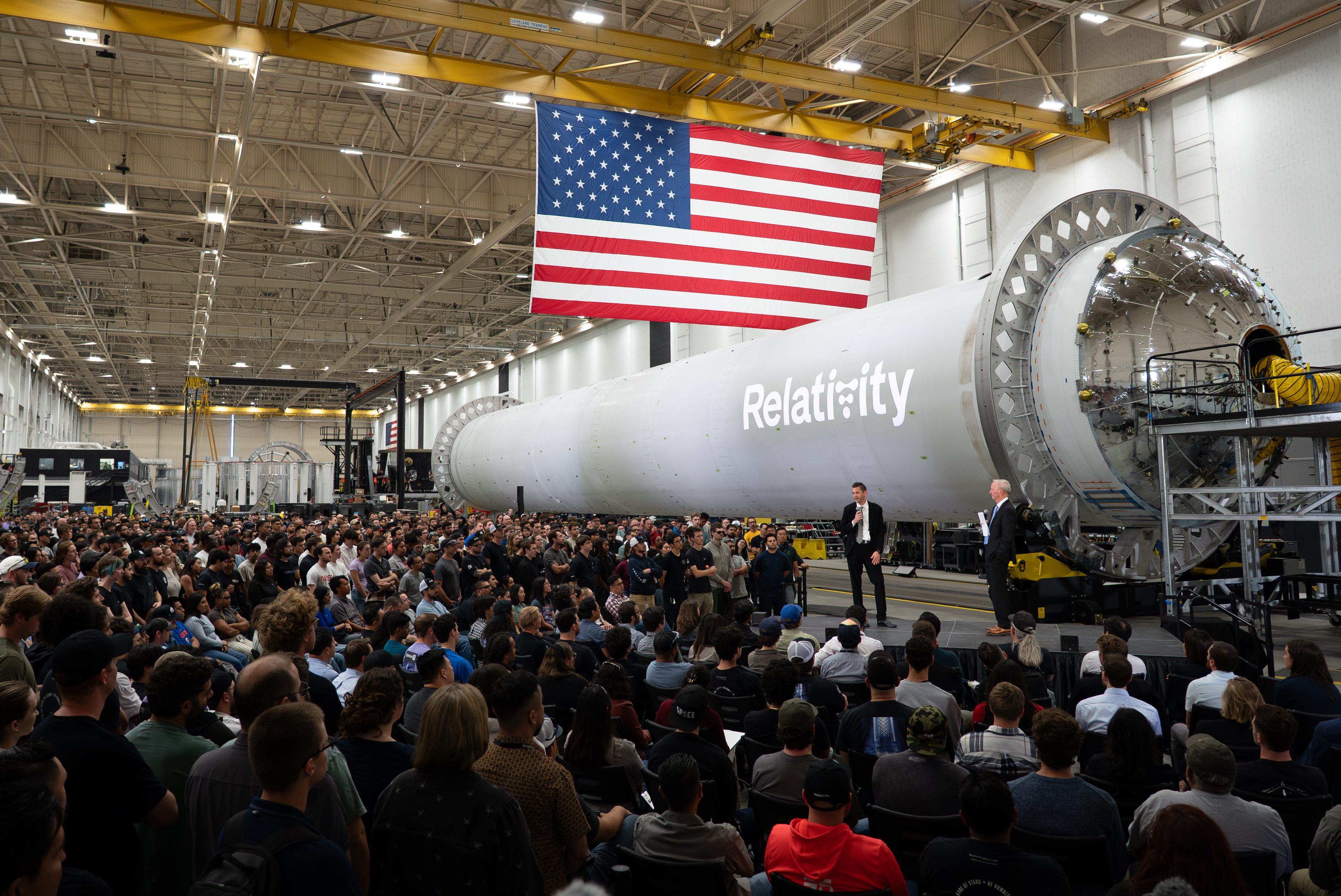
NASA Administrator Jared Isaacman stands in front of a large, cylindrical, gray spacecraft with a white Relativity logo on it and addresses hundreds of Relativity Space employees. A large American flag hangs from the ceiling.
NASA Administrator Jared Isaacman announces a public-private partnership to advance Mars science during an event at Relativity Space on June 17, 2026.
Credit: Relativity Space

NASA Wednesday announced a new public‑private partnership to advance Mars science by combining the agency’s scientific leadership with commercial innovation. Under this model, NASA will provide the Aeolus atmospheric‑science instrument payload suite, while Relativity Space supplies the spacecraft, rocket, and cruise operations necessary to deliver the instruments to Mars.

This partnership reflects NASA’s growing commitment to approaches that accelerate discovery, expand mission cadence, and strengthen the foundation for future human exploration. By leveraging commercial investment and development capacity, NASA can focus resources on high‑value science while enabling more frequent opportunities to gather critical data about Mars, data essential to safely navigating the Martian atmosphere and ultimately landing humans on the surface.

“Public-private partnerships like this are a force multiplier for science,” said NASA Administrator Jared Isaacman. “By pairing NASA’s world‑class instruments with commercial innovation and investment, we can deliver more science, more often, and reduce the time it takes to get essential data into the hands of researchers preparing for future human missions to Mars.”

Aeolus, scheduled to launch in 2028, is a NASA‑developed suite of four complementary instruments designed to provide the first integrated, daily, global view of Martian winds, temperatures, dust, and clouds. By improving models for dust, winds, temperature, and seasonal atmospheric behavior, Aeolus will generate the detailed environmental knowledge required to reduce risk for future crewed and uncrewed landings. These measurements will directly inform entry, descent, and landing systems and support safer, more predictable mission planning for astronauts.

Aeolus builds on more than two decades of NASA missions that have studied the Martian atmosphere, including orbiters such as MAVEN (Mars Atmosphere and Volatile Evolution), the Mars Reconnaissance Orbiter, and Mars Odyssey, while taking the foundation laid by earlier missions even further, continuing NASA’s tradition of expanding the frontiers of Mars science. Researchers at NASA’s Ames Research Center in California’s Silicon Valley will design, build, and integrate the payload, while Relativity Space will manage spacecraft development and mission operations.

“As NASA’s Innovation Center of Excellence, Ames is committed to delivering the technologies, capabilities, and creative partnerships that enable the agency’s boldest missions,” said Dr. Eugene Tu, center director, NASA Ames. “Aeolus reflects how innovative collaboration accelerates science and strengthens the foundation needed for one day landing humans on Mars.”

The Aeolus payload suite includes four NASA‑built instruments:

  • Doppler Wind and Temperature Sounder (DWTS‑Ozone): Measures wind and temperature profiles from the surface up to approximately 37 miles (60 km). A collaboration with GATS.
  • Thermal Limb Sounder (TLS): Provides vertical temperature profiles and observations of dust and water‑ice clouds. A collaboration with Xiomas Technologies.
  • Surface Radiometric Sensor Package (SuRSeP): Measures surface energy balance, dust, and cloud properties.
  • Wide‑Field Context Camera (WFCC): Captures daily global images of atmospheric activity.

NASA will support operations of science instruments for at least one Martian year, while Relativity Space maintains the spacecraft. As part of the agreement, NASA will develop the data‑processing pipeline needed to transform raw measurements into high‑quality, ready‑to‑use data products for broad scientific use.

This effort is supported under NASA’s first six‑year reimbursable Space Act Agreement, providing a stable framework for sustained collaboration, predictable development, and mission continuity.

Learn more about Mars science at:

https://science.nasa.gov/mars

-end-

Camille Gallo / Cheryl Warner
Headquarters, Washington
202-358-1600
camille.m.gallo@nasa.gov / cheryl.m.warner@nasa.gov

Jeanne Neal
Ames Research Center, Silicon Valley
650-604-4789
jeanne.c.neal@nasa.gov

Share

Details

Last Updated
Jun 18, 2026
Editor
Jessica Taveau

The post NASA Announces Public-Private Partnership to Advance Mars Science appeared first on NASA Science.

  •  

NASA Announces Public-Private Partnership to Advance Mars Science

NASA Administrator Jared Isaacman stands in front of a large, cylindrical, gray spacecraft with a white Relativity logo on it and addresses hundreds of Relativity Space employees. A large American flag hangs from the ceiling.
NASA Administrator Jared Isaacman announces a public-private partnership to advance Mars science during an event at Relativity Space on June 17, 2026.
Credit: Relativity Space

NASA Wednesday announced a new public‑private partnership to advance Mars science by combining the agency’s scientific leadership with commercial innovation. Under this model, NASA will provide the Aeolus atmospheric‑science instrument payload suite, while Relativity Space supplies the spacecraft, rocket, and cruise operations necessary to deliver the instruments to Mars.

This partnership reflects NASA’s growing commitment to approaches that accelerate discovery, expand mission cadence, and strengthen the foundation for future human exploration. By leveraging commercial investment and development capacity, NASA can focus resources on high‑value science while enabling more frequent opportunities to gather critical data about Mars, data essential to safely navigating the Martian atmosphere and ultimately landing humans on the surface.

“Public-private partnerships like this are a force multiplier for science,” said NASA Administrator Jared Isaacman. “By pairing NASA’s world‑class instruments with commercial innovation and investment, we can deliver more science, more often, and reduce the time it takes to get essential data into the hands of researchers preparing for future human missions to Mars.”

Aeolus, scheduled to launch in 2028, is a NASA‑developed suite of four complementary instruments designed to provide the first integrated, daily, global view of Martian winds, temperatures, dust, and clouds. By improving models for dust, winds, temperature, and seasonal atmospheric behavior, Aeolus will generate the detailed environmental knowledge required to reduce risk for future crewed and uncrewed landings. These measurements will directly inform entry, descent, and landing systems and support safer, more predictable mission planning for astronauts.

Aeolus builds on more than two decades of NASA missions that have studied the Martian atmosphere, including orbiters such as MAVEN (Mars Atmosphere and Volatile Evolution), the Mars Reconnaissance Orbiter, and Mars Odyssey, while taking the foundation laid by earlier missions even further, continuing NASA’s tradition of expanding the frontiers of Mars science. Researchers at NASA’s Ames Research Center in California’s Silicon Valley will design, build, and integrate the payload, while Relativity Space will manage spacecraft development and mission operations.

“As NASA’s Innovation Center of Excellence, Ames is committed to delivering the technologies, capabilities, and creative partnerships that enable the agency’s boldest missions,” said Dr. Eugene Tu, center director, NASA Ames. “Aeolus reflects how innovative collaboration accelerates science and strengthens the foundation needed for one day landing humans on Mars.”

The Aeolus payload suite includes four NASA‑built instruments:

  • Doppler Wind and Temperature Sounder (DWTS‑Ozone): Measures wind and temperature profiles from the surface up to approximately 37 miles (60 km). A collaboration with GATS.
  • Thermal Limb Sounder (TLS): Provides vertical temperature profiles and observations of dust and water‑ice clouds. A collaboration with Xiomas Technologies.
  • Surface Radiometric Sensor Package (SuRSeP): Measures surface energy balance, dust, and cloud properties.
  • Wide‑Field Context Camera (WFCC): Captures daily global images of atmospheric activity.

NASA will support operations of science instruments for at least one Martian year, while Relativity Space maintains the spacecraft. As part of the agreement, NASA will develop the data‑processing pipeline needed to transform raw measurements into high‑quality, ready‑to‑use data products for broad scientific use.

This effort is supported under NASA’s first six‑year reimbursable Space Act Agreement, providing a stable framework for sustained collaboration, predictable development, and mission continuity.

Learn more about Mars science at:

https://science.nasa.gov/mars

-end-

Camille Gallo / Cheryl Warner
Headquarters, Washington
202-358-1600
camille.m.gallo@nasa.gov / cheryl.m.warner@nasa.gov

Jeanne Neal
Ames Research Center, Silicon Valley
650-604-4789
jeanne.c.neal@nasa.gov

Share

Details

Last Updated
Jun 18, 2026
Editor
Jessica Taveau
  •  
❌