❌

Reading view

By the early 2030s, the United States is projected to have more adults over 65 than children under 18 for the first time in the country’s history — a demographic milestone the Census Bureau now expects to arrive around 2034 — and within the lifetime of most people reading this, the median American is likely to be approaching the median resident of Japan today

The American population pyramid is changing shape in real time, and the rate of change is accelerating. The country has always been, demographically, a relatively young society — substantially younger than most of Europe, dramatically younger than Japan, and shaped throughout its history by waves of younger immigrants and high birth rates that kept the population pyramid wide at the bottom. That configuration is now ending. The 78 million baby boomers, born between 1946 and 1964, are aging through the older brackets of the population in a single demographic wave that will not be replaced by an equivalent generation of children behind them. The youngest boomers will reach 65 in 2029. By 2030, every member of the boomer generation will be 65 or older. By 2034, on the most recent Census Bureau projections, the population of Americans aged 65 and older will, for the first time in the nation’s history, exceed the population of Americans under 18.

According to the U.S. Census Bureau’s official announcement of the 2017 National Population Projections, Jonathan Vespa, the Census Bureau demographer who led the projection work, characterised the milestone directly: “The aging of baby boomers means that within just a couple decades, older people are projected to outnumber children for the first time in U.S. history. By 2034, there will be 77.0 million people 65 years and older compared to 76.5 million under the age of 18.” The Bureau’s updated estimates have refined the crossover year slightly — earlier projections had placed it in 2035, while the current best estimate places it in 2034 — but the basic milestone is the same. Within approximately the next decade, the United States will become, in a measurable demographic sense, an old country.

The arithmetic of the crossover

Per the Census Bureau’s June 2025 release of the Vintage 2024 Population Estimates, the gap between the two populations is now closing faster than at any previous point in American demographic history. In 2020, the 65-and-older population numbered approximately 55.8 million, while the under-18 population was approximately 73.1 million — a gap of just over 20 million favouring children. By 2024, the gap had narrowed to under 12 million. The 65-and-older population had risen to 61.2 million, growing at 3.1 percent in a single year, while the under-18 population had declined by 0.2 percent to 73.1 million. The pattern is now well-established: over the four-year period from 2020 to 2024, the 65-and-older population grew by 13.0 percent, while the under-18 population declined by 1.7 percent. Working-age adults grew by just 1.4 percent over the same period.

The two trends are not symmetric. The 65-and-older population is being driven upward by two compounding forces: the boomer cohort moving sequentially into older age brackets, and the continued slow extension of life expectancy at older ages. Both forces are likely to continue operating through at least the early 2040s, with the 85-and-older population projected to grow approximately 200 percent by 2060 — from approximately 6 million today to approximately 19 million. The under-18 population is being held down by sustained sub-replacement fertility rates (currently 1.6 children per woman in the U.S., below the 2.1 needed for population replacement), combined with declining birth cohorts year over year. Without a substantial increase in either fertility or immigration, the gap between the two populations will continue closing through 2034 and then reverse.

What “older country” actually looks like

The United States is not the first developed country to experience this transition. Japan crossed the equivalent demographic threshold in the 1990s and now has approximately 28 percent of its population aged 65 or older — substantially older than the U.S. at 18 percent. Italy is at 23 percent. Germany is at 22 percent. The U.S. is now beginning the same transition that these countries have been navigating for the past two to three decades, with the corresponding challenges to social security systems, healthcare infrastructure, labour markets, and intergenerational political dynamics. The current median age of an American is approximately 39 years; the current median age of a Japanese resident is approximately 49.5 years — the oldest of any major country. The U.S. is unlikely to reach Japan’s current median age within the next two decades, but the trajectory is in that direction. Under the Census Bureau’s projections, the U.S. median age will reach approximately 44 by 2060 — older than the U.S. has ever been, though still substantially younger than Japan is today.

As documented in the Census Bureau’s 2020 Demographic Turning Points for the United States publication, the structural implications of the transition are substantial. The ratio of working-age adults to those aged 65 and older will shift from approximately 3.5 working-age adults per retiree in 2020 to approximately 2.5 by 2060. The implications for Social Security and Medicare funding, which depend on payroll taxes from current workers to fund benefits for current retirees, are direct. The U.S. will also become, beginning approximately in 2030, a country in which net international migration overtakes natural increase (births minus deaths) as the primary driver of population growth — another demographic first for the United States, and one that will substantially shape the politics of immigration policy for the rest of the century.

What has already happened

Per Population Education’s analysis of the 2020 Census results, the largest single demographic change in the United States between 2010 and 2020 was the 27 percent expansion of the population aged 55 and older — a rate of growth dramatically faster than any other age group. The under-18 population, by contrast, actually declined by 1.4 percent over the same decade. This is the configuration that produces an old country: not a single dramatic event, but a slow, accumulating divergence between the growth rates of the older and younger populations that, over decades, produces a population pyramid radically different from the one the country has always had. As of 2024, eleven U.S. states — Maine, Vermont, New Hampshire, Florida, West Virginia, and several others — already have more adults over 65 than children under 18. Nearly half of all U.S. counties (approximately 1,500 of 3,100) have already crossed the same threshold. The national milestone in 2034 will be, in effect, the moment when the rest of the country catches up to where these states and counties already are.

The transition itself is not bad or good. It is a structural fact that will reshape essentially every institution designed for a younger demographic configuration — schools, family policy, pension systems, healthcare infrastructure, the housing market, the political coalitions that have organised around generational interests, the labour markets that depend on younger workers, and the cultural assumptions of a country that has, until now, always thought of itself as relatively young. The crossover year of 2034 is not the destination but the marker. The destination is a configuration of American life in which the median citizen is substantially older than the median citizen has ever been, in a country whose institutional design was built around a demographic configuration that, by every available indication, is now ending.

The post By the early 2030s, the United States is projected to have more adults over 65 than children under 18 for the first time in the country’s history — a demographic milestone the Census Bureau now expects to arrive around 2034 — and within the lifetime of most people reading this, the median American is likely to be approaching the median resident of Japan today appeared first on Space Daily.


  •  

Viktor Frankl wrote ‘Man’s Search for Meaning’ in nine days in 1945 — and the psychiatrist argued meaning is found in serving others, not in chasing your own happiness

Young woman in checkered pajamas writing in a notebook while lying on a bed.

Viktor Frankl returned to Vienna after liberation from the Nazi camps, having lost his wife, mother, father, and brother, and he dictated the manuscript that would become Man’s Search for Meaning in a compressed period of intense work. He had been a prisoner at concentration camps including Theresienstadt and Auschwitz. The book has sold millions of copies in dozens of languages, and its central claim — that meaning is found in serving something beyond yourself, not in pursuing your own happiness — has outlasted nearly every popular psychology trend of the last eighty years.

Frankl initially considered publishing the book anonymously. His friends convinced him to add his name to the cover. He later said he was certain the book would fail.

A young man intently reading a book indoors, captured in a relaxed and leisure setting.

A manuscript carried in memory

The writing pace was not literary affectation. Frankl had been carrying the manuscript in his head for years. An earlier manuscript had been confiscated when he arrived at Auschwitz. He spent the rest of his imprisonment reconstructing it mentally and on scraps of paper, rehearsing the arguments during forced labor.

When he got back to Vienna, the words came out fast because they had been written, erased, and rewritten in his memory for nearly three years. According to accounts of the manuscript’s creation, he worked through intense sessions of dictation to produce the book rapidly.

The first edition came out in German in the mid-1940s. The English translation arrived under the title From Death-Camp to Existentialism, then was later retitled Man’s Search for Meaning. The Library of Congress named it one of the most influential books in America.

The thing he saw in the camps

Frankl was a trained neurologist and psychiatrist before the war. He had developed an approach he called logotherapy — after Freud’s psychoanalysis and Adler’s individual psychology. Drawing from the Greek word for meaning, he believed that the deepest human drive was not pleasure or power but the search for significance.

The camps gave him a laboratory he never wanted. He watched, clinically, who survived and who did not. Physical strength was not the predictor. Education was not the predictor. The prisoners who endured, he observed, were those who had something outside themselves to live for — a manuscript to finish, a child waiting in another country, a piece of work only they could do. The ones who lost that thread tended to die quickly. He described prisoners who simply lay down in their bunks one morning and refused to get up.

From this he built his core argument: meaning is not something you find by looking inward. It is something you find by looking outward — at a task, a person, a cause, a piece of suffering you have been asked to bear with dignity.

Why happiness can’t be the goal

Frankl was sharp on this point. He thought the pursuit of happiness as an end in itself was self-defeating. The more you chase it, he argued, the more it recedes. Happiness has to ensue from something else — from devotion to a cause, love for another person, or the way you carry an unavoidable burden. Chase it directly and you end up empty.

His logotherapy framework identified three routes to meaning: creating a work or doing a deed, experiencing something or encountering someone (love being the highest form), and the attitude one takes toward unavoidable suffering. The third was the one the camps had taught him. You cannot always choose what happens to you. You can always choose your response.

He often quoted Nietzsche: “He who has a why to live for can bear with almost any how.” In the camp barracks at night, he said, that sentence had kept men alive.

An adult man using a vintage typewriter in an office setting, capturing a timeless moment.

What the research has done with the idea

Decades on, the empirical literature has caught up with Frankl in ways that would have surprised him. Building on concepts of eudaimonic well-being — the deep satisfaction of living for something larger than yourself — versus hedonic well-being focused on pleasure, research on well-being suggests that purpose and meaning are not luxuries layered on top of survival but central to it.

Work from the Greater Good Science Center at Berkeley has documented that people who orient their lives toward service report higher meaning scores and lower rates of depression than those who orient toward self-improvement or pleasure.

The medical field has begun to fold this in. A 2026 paper covered by EurekAlert called on lifestyle medicine practitioners to treat meaning, purpose, and spirituality as foundational components of patient care rather than optional extras, citing their measurable effect on adherence to treatment and long-term health outcomes.

The statue of responsibility

Frankl had a proposal he repeated for the rest of his life. He thought the Statue of Liberty on the east coast of the United States should be matched by a Statue of Responsibility on the west coast. Freedom, he argued, was only half of the human story. Freedom without responsibility for something or someone else was just license, and license was not the same as meaning.

He lived this out. After the war he returned to clinical practice and lecturing. He remained active into old age.

What the intensive writing period produced

The book itself is short, with the camp memoir occupying roughly the first half and a primer on logotherapy filling the second. The prose is plain. There is almost no rhetorical flourish. Frankl describes the smell of the barracks, the way frozen feet feel inside cardboard-stuffed boots, the small economies of bread, the moment a guard’s casual cruelty could decide whether a man ate that day. And then, without warning, a sentence like: “Everything can be taken from a man but one thing: the last of the human freedoms — to choose one’s attitude in any given set of circumstances, to choose one’s own way.”

That sentence has been quoted on graduation programs, in twelve-step rooms, in hospice wards, in military training manuals, and on the walls of palliative-care clinics. It came out of a man who had watched his family murdered and had days to put what he learned into words before the grief swallowed him.

The argument that refuses to age

Self-help publishing has cycled through optimism training, mindfulness, manifestation, dopamine fasting, hustle culture, and a dozen variants of personal-happiness engineering since Frankl’s death. None of them have displaced the book. It continues to sell widely. College syllabi still assign it. Hospice workers still hand it to dying patients.

Part of the durability is the credential. Frankl was not theorizing from a comfortable office. He had run the experiment on himself in the worst laboratory ever built, and he came out the other side with a finding he was willing to stake his career on: the people who survive — and the people who live well after surviving — are the ones who have something or someone to live for outside themselves.

The book ends with Frankl’s conclusion that nothing would so effectively help one survive even the worst conditions as the knowledge that there is meaning in one’s life — a conclusion he drew from observing who survived the camps and who did not. He wrote it down in a Vienna apartment in the late summer of 1945, with the windows open and the city still in ruins, and it has not gone out of print since.

The post Viktor Frankl wrote ‘Man’s Search for Meaning’ in nine days in 1945 — and the psychiatrist argued meaning is found in serving others, not in chasing your own happiness appeared first on Space Daily.

  •  

Mihaly Csikszentmihalyi coined ‘flow’ in 1975 after interviewing artists who forgot to eat — he found the state appears only when attention points fully outward at a task, never at the self

A young girl focused on painting while wearing bright red eyeglasses indoors.

In the early 1970s, a Hungarian psychologist named Mihaly Csikszentmihalyi sat in a Chicago studio watching painters work. They had been at it for hours. Lunch came and went. The painters did not notice. One artist, asked later why he had skipped meals and let his coffee go cold, could not really explain it — he had simply been inside the canvas. Csikszentmihalyi wrote down the phrase his subjects kept reaching for: it felt like being carried by a current. In his book Beyond Boredom and Anxiety, he gave the state a name. He called it flow.

Half a century later, the finding has been diluted into a productivity slogan. That dilution obscures what Csikszentmihalyi actually discovered, and why it matters now more than ever: flow is not a kind of focus you can summon. It is what happens when attention points so completely outward that the self goes quiet — and the device in your pocket is engineered to make exactly that impossible.

The argument of this piece is narrow. The neuroscience that has emerged in the last decade does not extend Csikszentmihalyi’s theory so much as confirm its strangest claim: that the vanishing of self-monitoring is not a feeling, but a measurable redistribution of brain activity. And the conditions that produce that redistribution are precisely the ones the modern attention economy is built to prevent.

A young female artist painting on a canvas in an art studio filled with creative works.

The man with the rock

Csikszentmihalyi’s interest in absorbed states began long before the Chicago studios. As a child in wartime Europe, he watched adults around him struggle to find meaning after catastrophe, and noticed that the ones who coped best tended to lose themselves in something — chess, music, mountain climbing. He carried that observation into his graduate work at the University of Chicago.

One of his early subjects was a rock climber. Another was a chess master. Another was his own older brother, a mineralogist who could spend an entire afternoon studying a single stone. As Psychology Today recounted, the brother’s quiet absorption in a piece of quartz was one of the seeds of the entire theory.

The common thread across climbers, chess players, surgeons and painters was not the activity. It was the structure of attention.

What the painters told him

Csikszentmihalyi’s method was unglamorous. He handed people pagers, later replaced by digital devices, and beeped them at random moments during the day. When the pager went off, the subject filled out a short form: What are you doing? How hard is it? How skilled do you feel? How absorbed are you?

The data, gathered across thousands of subjects over decades, kept producing the same shape. Flow appeared when three conditions lined up at once: a clear goal, immediate feedback, and a challenge that sat right at the edge of the person’s skill — hard enough to demand full attention, not so hard that it tipped into panic. Below that edge, people reported boredom. Above it, anxiety. Inside the narrow band, the self went quiet.

The surgeons he interviewed said they forgot they had bodies. The composers said the music seemed to write itself. The climbers said the mountain seemed to move them rather than the other way around. None of them could enter the state on command. They could only set up the conditions and let it arrive.

Why the brain seems to cooperate

The behavioural finding sat unexplained for decades. Csikszentmihalyi could describe what subjects reported, but he could not say what was actually happening inside their skulls. The neuroscience of the last fifteen years has begun to fill that gap, and the pattern it has found maps closely onto what the painters told him.

The default mode network — a set of midline brain regions associated with self-referential thinking, mind-wandering and autobiographical rehearsal — was first characterised by Raichle and colleagues in 2001. It is the circuitry that hums when you are worrying about a conversation or imagining yourself from outside. A growing body of imaging work, reviewed in Frontiers in Psychology, finds that this network quiets down during tasks meeting Csikszentmihalyi’s flow conditions, while sensorimotor regions become tightly coupled to the work at hand.

The mechanics of how blood flow tracks neural activity, captured by techniques described in neurovascular coupling research, allow researchers to watch this redistribution happen in real time. In jazz pianists improvising, in expert climbers visualising routes, in writers composing fluently, the self-monitoring circuits dim and the task-relevant circuits dominate. The behavioural strangeness — the vanishing self — has a neural signature.

Recent work has gone further. A 2024 study from Washington University traced a mechanical link between body motion and fluid movement in the brain through a network of veins, suggesting that the physical engagement characteristic of flow states — climbing, playing, surgery — may shape neural conditions in ways that pure cognition cannot.

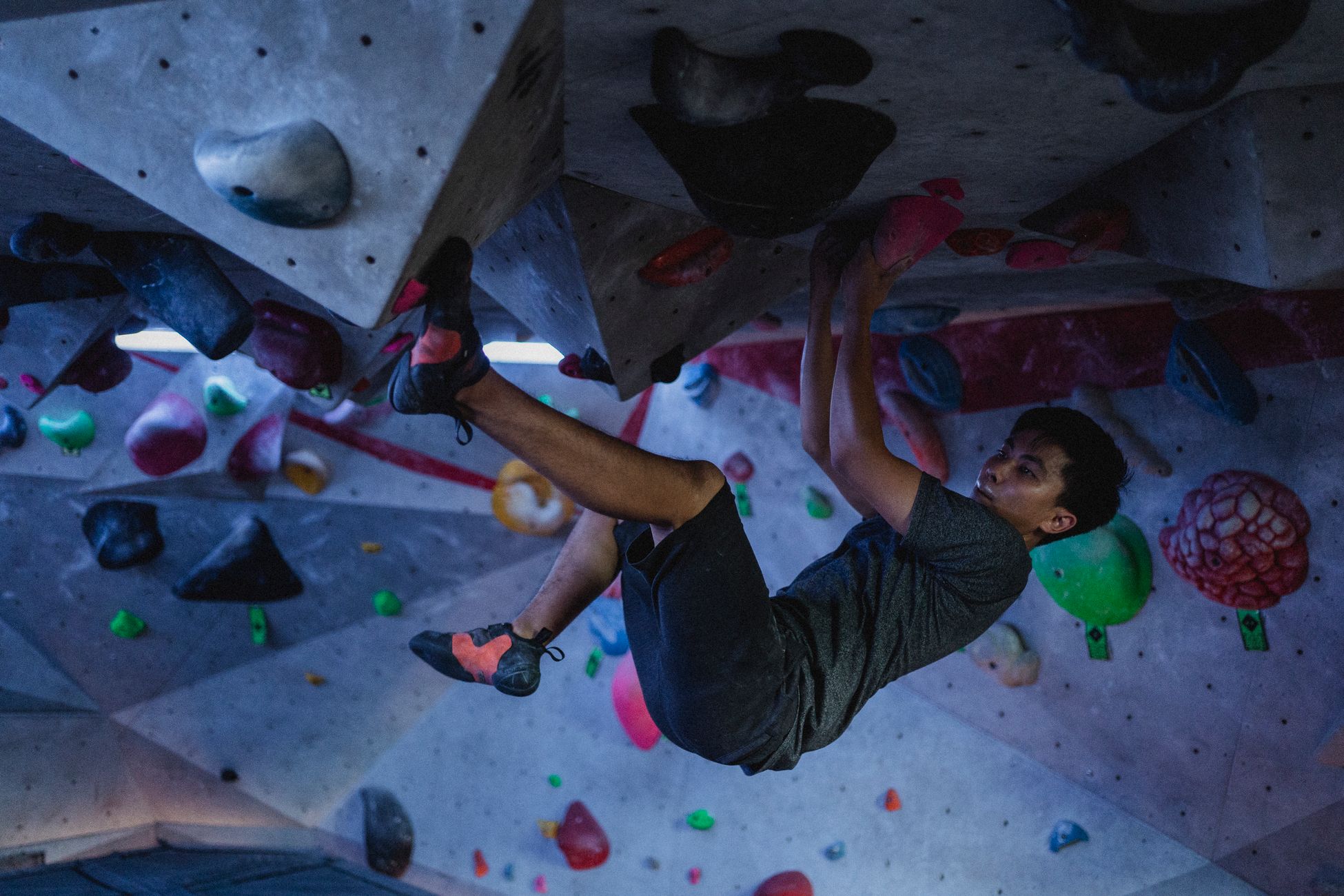
Side view of strong ethnic man practicing on climbing wall in modern bouldering center

The conditions the phone destroys

One of the most-cited findings from Csikszentmihalyi’s pager studies was that flow is not tied to any particular kind of work. Factory workers entered it on assembly lines. Mothers entered it reading to children. Accountants entered it in spreadsheets. The activity did not matter. The structure did.

What separated people who experienced flow often from those who rarely did was not their job description. It was whether they had organised their attention so that something — anything — could demand all of it.

This is where the modern problem comes into focus. People who spent their evenings flicking between apps reported the lowest flow frequencies. People who played an instrument, gardened, climbed, cooked complex meals, or wrote in journals reported the highest. The phone, with its endless drip of low-stakes novelty, sits exactly in the wrong zone: enough stimulation to keep attention from settling, not enough challenge to absorb it. It is, in effect, an anti-flow device — engineered to keep the default mode network humming, to keep the self always slightly aware of itself.

As National Geographic reported, climbers like Steph Davis describe entering a state on big walls where fear, plans, and self-talk drop away and only the next handhold exists. Free soloists in particular — climbers without ropes — describe the state as not optional but necessary. Any intrusion of self-consciousness at 600 metres above the ground is dangerous. They are, in a sense, the last group for whom the conditions are non-negotiable.

Why it cannot be forced

The paradox at the centre of the theory is that flow rewards attention pointed away from itself. The harder a person tries to be in flow, the further it retreats. Trying to be in flow is, by definition, attention pointed at the self.

Csikszentmihalyi’s advice, repeated across his books and lectures, was indirect. Set up the conditions. Choose a task with a clear goal. Match the difficulty to your current skill. Remove interruptions. Then forget about the state and do the work.

What the painters were really doing

Looking back at the studio interviews that started everything, the detail that still stands out is how mundane the painters’ answers were. They were not chasing transcendence. They were trying to solve a problem on the canvas. The colour was wrong. The composition needed something in the lower left. The hand had to move in a particular way.

The state Csikszentmihalyi named arose as a byproduct of that ordinary attention — attention so completely committed to the object in front of them that there was no spare capacity left to think about themselves. That is the part of the finding that has resisted fifty years of dilution into self-help. Flow is not a productivity hack. It is not a brand of focus that can be summoned with the right playlist. It is what happens to a mind when something outside it becomes, briefly, more interesting than the mind itself.

Csikszentmihalyi died in 2021. The painters he interviewed in Chicago are mostly gone too. The pagers have been replaced by phones, and the phones, on the whole, have made the state harder to reach. But the structure he identified has not changed, and the neuroscience has only sharpened it. A clear goal. Immediate feedback. A task at the edge of one’s skill. And then the quiet, when the self steps out of the way and the work fills the room.

The post Mihaly Csikszentmihalyi coined ‘flow’ in 1975 after interviewing artists who forgot to eat — he found the state appears only when attention points fully outward at a task, never at the self appeared first on Space Daily.

  •  
❌