
❌

Reading view

AI/ML STIG Leadership Council Nominations Are Open!

AI/ML STIG Leadership Council Nominations Are Open!

Nominate yourself or a colleague to join the leadership council of the NASA AI/ML Science and Technology Interest Group (STIG). We welcome early-career researchers (graduate students, postdocs, and early-career scientists) broadly interested in AI and astronomy. Duties are light: suggesting speakers and helping run remote seminars by sending reminders and introducing the speaker.

https://docs.google.com/forms/d/e/1FAIpQLSc5ccFmCWEw-fDmkjlldeUvSK81f6M_2DauycSif3GN3rw9tw/viewform

As we begin planning the next iteration of the NASA Artificial Intelligence and Machine Learning Science and Technology Interest Group (AI/ML STIG) seminar series, we are expanding our leadership council and would love your help. We are writing to invite you to nominate yourself or a colleague to join.

We are especially looking for early-career researchers, including graduate students, postdocs, and early-career scientists, who are broadly interested in the intersection of AI and astronomy. You do not need to be an expert across the whole field; curiosity and a willingness to help the community learn matter most.

The organizational duties are light. Council members help suggest speakers and run the remote seminars, which mainly means sending email reminders and introducing the speaker. It is a great way to meet people across the field and to help shape a series that reaches the NASA community and beyond.

Two themes will anchor next year’s series:

  1. Agentic AI for Astrophysics. How LLM agents and multi-agent systems can accelerate astronomical research, from literature and data analysis to simulation and discovery workflows.
  2. AI and Astronomy in the US: Initiatives, Funding, and Broader Impacts. The wider landscape of AI in astronomy, including national initiatives, funding opportunities, AI pedagogy, the ethics and philosophy of AI in science, and ways AI can support NASA priorities such as ASTRA.

Please use this Google form to nominate yourself or someone else by the end of next week (extended to 27 June 2026).

News Straight to Your Inbox

Subscribe to your community email news list

We will never share your email address.
Privacy Policy

Sign Up
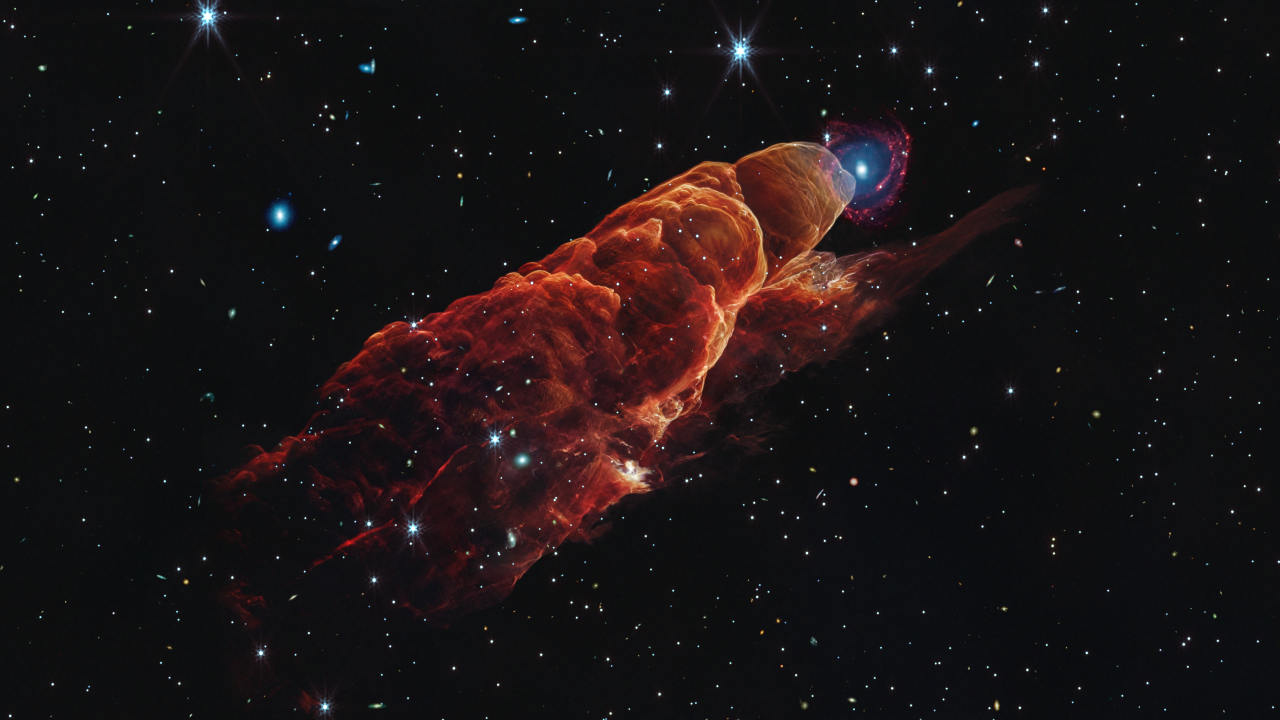
Angled from the upper left corner to the lower right corner is a cone-shaped orange-red cloud known as Herbig-Haro 49/50. This feature takes up about three-fourths of the length of this angle. The upper left end of this feature has a translucent, rounded end. The conical feature widens slightly from the rounded end at the upper right down to the lower right. Along the cone there are additional rounded edges, like edges of a wave, and intricate foamy-like details, as well as a clearer view of the black background of space. In the upper left, overlapping with the rounded end of Herbig-Haro 49/50, is a background spiral galaxy with a concentrated blue center that fades outward to blend with red spiral arms. The background of space is speckled with some white stars and smaller, more numerous, fainter white galaxies throughout.

The post AI/ML STIG Leadership Council Nominations Are Open! appeared first on NASA Science.

  •  

TODAY: Planning for the Future of Astrophysics & the ASTRA Initiative, 18 June 2026

TODAY: Planning for the Future of Astrophysics and the ASTRA Initiative, June 18th, 2026

10:00am – 11:30am PT

Dear Astrophysics Strategic Technology & Research Accelerator (ASTRA) community members this serves as a reminder for those attending AAS248. This session is in-person only.

AAS248 Block Schedule: https://submissions.mirasmart.com/AAS248/Itinerary/EventDetail.aspx?evt=70

Summary

NASA’s astrophysics fleet of observatories push the limits of human vision and understanding, exploring the most profound questions of our existence while driving innovations that transform the extraordinary into the everyday and reinforce U.S. leadership in space. This special session, organized by the NASA Astrophysics Division, will provide insight into the ASTRA Initiative, share initial findings from the May 2026 Innovation for Astrophysics Missions Workshop, and will discuss plans for the September 2026 Astrophysics community science (Ad ASTRA) workshop. Talks will be followed by a panel to address questions from the community.

TimeSessionLocation
10:00am ‑ 11:30amSpecial Session: Planning for the Future of Astrophysics and the ASTRA Initiative Pasadena Convention Center ‑ 
Ballroom G

ASTRA Initiative Special Session

TimeTopicSpeaker
10:00am ‑ 10:10amIntroduction from the NASA Astrophysics Division DirectorShawn Domagal‑Goldman, NASA HQ
10:10am ‑ 10:25amThe ASTRA Initiative: Overview & Path ForwardJessica Gaskin, NASA HQ
10:25am ‑ 10:40amInnovation for Astrophysics Workshop: Initial FindingsKendra Short, JPL
10:40am ‑ 10:55amAd ASTRA Community Science WorkshopPeter Kurczynski, NASA/GSFC
10:55am ‑ 11:30amPanel DiscussionFrancesca Civano, NASA/GSFC

Wishing you the best,

Dr Ron Gamble
Cosmic Origins Support Scientist, NASA GSFC

Dr Bernard Kelly
PhysCOS Support Scientist, NASA GSFC

News Straight to Your Inbox

Subscribe to your community email news list

We will never share your email address.

Privacy Policy

Sign Up
Angled from the upper left corner to the lower right corner is a cone-shaped orange-red cloud known as Herbig-Haro 49/50. This feature takes up about three-fourths of the length of this angle. The upper left end of this feature has a translucent, rounded end. The conical feature widens slightly from the rounded end at the upper right down to the lower right. Along the cone there are additional rounded edges, like edges of a wave, and intricate foamy-like details, as well as a clearer view of the black background of space. In the upper left, overlapping with the rounded end of Herbig-Haro 49/50, is a background spiral galaxy with a concentrated blue center that fades outward to blend with red spiral arms. The background of space is speckled with some white stars and smaller, more numerous, fainter white galaxies throughout.

The post TODAY: Planning for the Future of Astrophysics & the ASTRA Initiative, 18 June 2026 appeared first on NASA Science.

  •  
❌