❌

Reading view

Hadron patents integral pressurized-water reactor to fit Halo systems in one vessel

Hadron Energy has cleared an early milestone in its effort to commercialize small-scale nuclear power in the United States. The advanced nuclear technology company announced that the U.S. Patent and Trademark Office has published its first patent application, placing the engineering framework behind its Halo Micro-Modular Reactor into the public domain.

The patent publication marks the company’s first major intellectual property filing and provides a detailed look at the reactor design Hadron plans to advance through the U.S. licensing process. The application, published on May 7, outlines the technology behind the Halo reactor, a compact nuclear system designed to deliver 10 megawatts of electricity.

Company founder and CEO Samuel Gibson, Chief Nuclear Officer Ross Ridenoure, Christopher R. Neal, and Andrew M. Ward are listed as inventors on the application.

Integrated reactor design

The application details an integral pressurized-water reactor, a compact design that houses key nuclear systems within a single pressure vessel rather than across multiple structures.

Traditional nuclear plants typically rely on large external pipes to connect these systems. Hadron’s approach removes much of that complexity by housing them within one unit.

According to the application, the design could simplify transportation, installation, and maintenance. It also removes the large external coolant piping associated with conventional reactors.

The patent describes reactor configurations capable of producing between 6 and 60 megawatts of thermal energy. Electrical output ranges from 2 to 20 megawatts. Hadron’s flagship Halo configuration targets 10 megawatts of electricity generation.

Built for transportation

The application also focuses heavily on manufacturability and deployment. Engineers designed the reactor vessel in sections connected through circumferential flanges. This approach allows the company to assemble and test the reactor before shipping it to a project site.

Hadron says the design supports transportation by conventional road networks and even certain air transport systems. The company views transportability as a key advantage for remote locations and industrial customers that require reliable power.

The reactor uses Low-Enriched Uranium Plus fuel. Hadron selected the fuel to support multi-year operating cycles while leveraging existing domestic fuel supply infrastructure.

The filing also outlines passive safety features intended to keep the reactor core cooled for extended periods without alternating-current power under design-basis conditions.

Licensing push continues

The patent publication arrives as Hadron advances regulatory work with the U.S. Nuclear Regulatory Commission. Recently, NRC staff accepted the company’s Quality Assurance Program Description. Hadron also submitted its Principal Design Criteria white paper to regulators, another step in the licensing process.

Gibson said the patent publication establishes the technical foundation of the Halo reactor and begins what the company expects to become a broader intellectual property portfolio. He added that the filing reflects years of engineering work and supports Hadron’s long-term commercialization strategy.

Hadron intends to market Halo as a transportable source of carbon-free electricity for sites that lack reliable grid access. The company ultimately hopes to become the first developer to bring a licensed light-water microreactor to market in the United States.

While significant regulatory hurdles remain, the newly published patent offers the clearest public view yet of the technology Hadron plans to use in pursuit of that goal.


  •  

JetZero secures North Carolina’s largest $4.7B incentive deal for 50% fuel-cut Z4 jets

Zero has started building its first aircraft factory in North Carolina, betting that an unconventional airplane design can reshape commercial aviation while bringing thousands of jobs to the state. The startup broke ground on a 8 million square foot manufacturing and assembly campus in Greensboro, where it plans to produce its blended-wing Z4 passenger jet.

The project comes with $4.7 billion in planned investment and support from what North Carolina officials say is the largest incentive package ever awarded to a startup. The company expects the facility to create 14,500 jobs over the next decade, adding momentum to North Carolina’s push to establish itself as a major aerospace manufacturing hub.

JetZero aircraft factory

Different aircraft design

Unlike traditional tube-and-wing airliners, JetZero’s Z4 uses a blended-wing body design that merges the fuselage and wings into a single structure. The aircraft is designed to carry about 250 passengers over distances of up to 5,000 nautical miles. JetZero claims the design could reduce fuel consumption by as much as 50 percent compared with today’s commercial jets.

If those targets hold up in service, the aircraft could help airlines lower operating costs and reduce emissions without requiring major changes to airport infrastructure. JetZero has not yet brought the Z4 into commercial service.

The company remains in the development phase as it works toward certification and future production. The startup has previously attracted attention from both commercial and defense sectors seeking more efficient aircraft designs. North Carolina Governor Josh Stein described the investment as a major economic win for the state, pointing to its potential to transform the Piedmont Triad region through new jobs and manufacturing activity.

Digital manufacturing

JetZero also plans to build the Greensboro facility differently from traditional aircraft plants. The company will use digital design platforms from Siemens and Deloitte to create a virtual model of the factory before construction advances further.

Engineers can simulate assembly lines, test workflows, and identify bottlenecks before equipment reaches the shop floor. JetZero says the approach could shorten development timelines and make the plant easier to adapt as production expands.

Industry analysts increasingly view digital twins and AI-assisted manufacturing as critical tools for aerospace companies facing pressure to boost output while controlling costs. Major manufacturers have invested heavily in such technologies to streamline production and avoid costly delays. The approach could also help JetZero scale operations more efficiently if demand for the Z4 materializes.

Beyond commercial aviation

The Greensboro plant could eventually support more than passenger aircraft production. JetZero is developing military versions of its blended-wing platform, including tanker and transport variants. The company says the design could allow refueling aircraft to carry greater payloads or operate over longer distances than conventional alternatives.

The defense applications could broaden the startup’s revenue opportunities at a time when military planners are exploring more efficient aircraft concepts. Construction has already begun at the site, while hiring is expected to ramp up gradually over the coming years.

For North Carolina, the project represents another attempt to attract high-value manufacturing jobs. For JetZero, it is a high-stakes effort to prove that a radically different aircraft design can move beyond prototypes and into commercial production.

JetZero aircraft factory
  •  

New RapidStriker system uses 360-degree vision and automated fire to neutralize drones

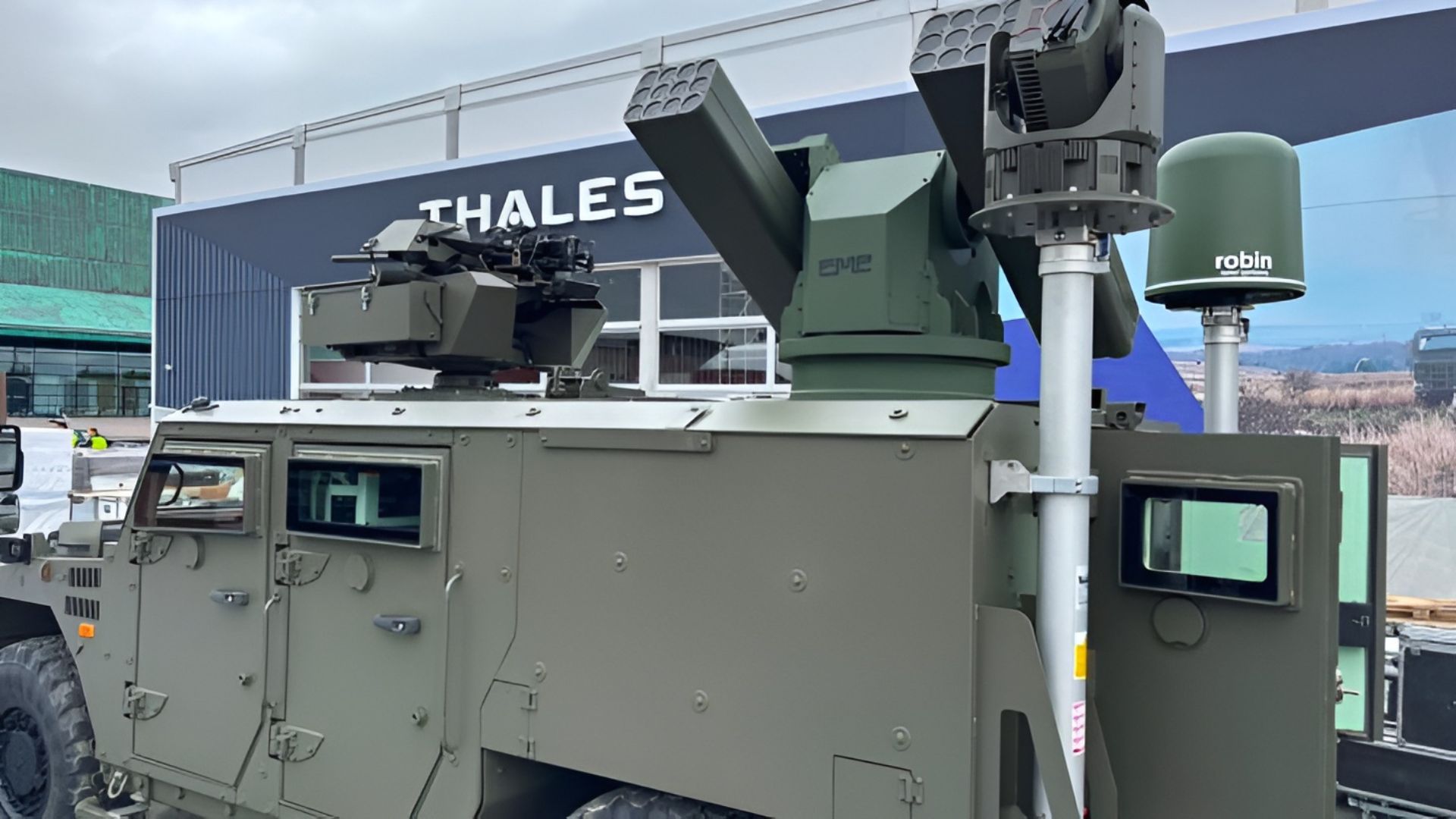
As militaries scramble to adapt to the rapid spread of battlefield drones, Thales has unveiled RapidStriker, a mobile air defense system designed to hunt and destroy aerial threats within seconds. Introduced at the Eurosatory defense exhibition in France, the new capability combines sensors, automated fire control and multiple weapon options in a package built to move alongside frontline forces.

RapidStriker can engage more than just drones. The system also provides protection against low-flying helicopters operating close to frontline forces.

Countering drone surge

Rather than relying on a single weapon, RapidStriker gives operators several ways to engage a target. The system pairs its sensors with automated fire control before cueing the most suitable effector for the mission.

Operators can deploy guided or unguided 68 mm and 70 mm rockets. Small-caliber cannons and remotely operated munitions can also be integrated depending on operational needs.

According to Thales, RapidStriker can identify a threat within seconds of detection before maintaining a track and initiating an engagement sequence. The heavy use of automation reduces the burden on crews during high-pressure situations.

That speed has become increasingly important as armed forces confront swarms of inexpensive drones designed to overwhelm conventional defenses. The rocket systems add another layer of flexibility. Beyond counter-drone missions, they support precision strikes against ground targets and provide saturation fire when troops require broader area effects.

Bushmaster upgrade

Thales designed RapidStriker to work across multiple combat vehicles instead of confining it to a dedicated platform. At Eurosatory, the company demonstrated the capability aboard the newly unveiled Bushmaster 5.6 utility vehicle from Thales Australia.

Bushmaster Mulga variant. Credit – Thales

Known as the Mulga variant, the latest Bushmaster builds on a platform already proven in combat. The vehicle can accept different mission packages based on customer requirements. One operator may prioritize surveillance equipment, while another may choose missile launchers or electronic warfare payloads.

The redesign also introduces a left-hand-drive configuration aimed at overseas buyers. Thales says the upgraded Bushmaster better reflects the realities of modern warfare, where adaptability often matters as much as protection.

Bigger network

RapidStriker was developed to plug into wider air defense architectures rather than function as a standalone asset. The company says the system remains fully compatible with SkyDefender, Thales’ integrated air and missile defense network. That interoperability allows commanders to share information across multiple assets and build a more complete picture of the battlespace.

β€œWith RapidStriker, Thales takes a decisive step forward in the fight against drones,” Julien Assoun, vice president of Vehicles and Tactical Systems at Thales, said in a statement. He said the company moved from concept to delivery within months to address urgent operational demands. The resulting system can also be adapted for use across a broad range of combat vehicles.

RapidStriker marks the latest addition to Thales’ expanding counter-drone portfolio. Earlier at Eurosatory, the company introduced a next-generation 70mm laser-guided rocket developed specifically for anti-drone missions. Together, the launches signal a growing emphasis on affordable defenses against threats that increasingly define today’s battlefield.

  •  
❌