❌

Reading view

The interstellar comet 3I/ATLAS, discovered on July 1, 2025, by a survey telescope in Chile, is now believed by astronomers at Oxford to be roughly 7 billion years old — meaning it was already drifting through the Milky Way for nearly 3 billion years before our solar system even existed — having formed in a part of the galaxy called the thick disk, where the stars are older than almost everything else humanity has ever observed
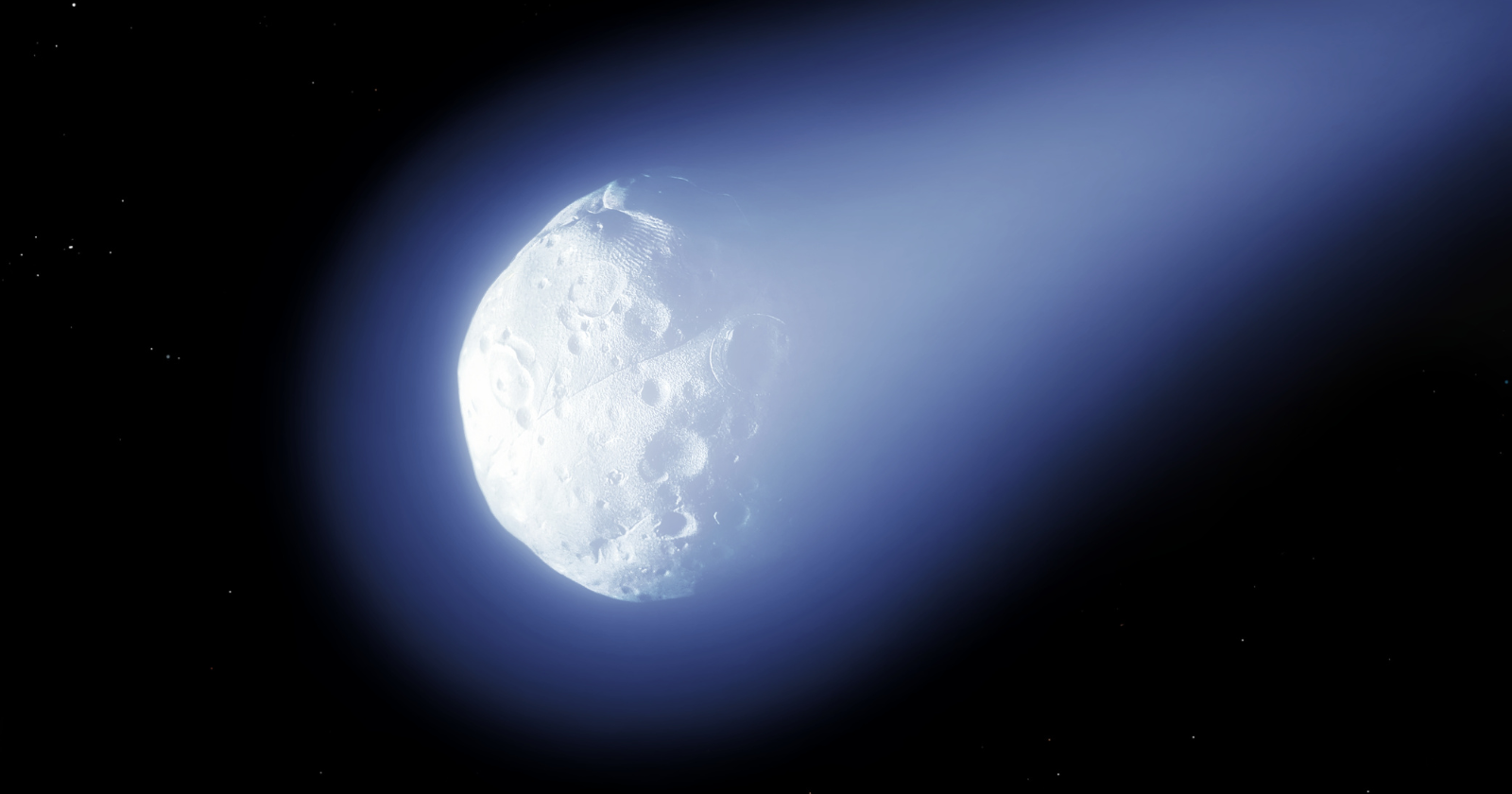
On the morning of 1 July 2025, the ATLAS survey telescope at Río Hurtado in Chile detected an unusual moving point of light against the background stars. Within a few hours, follow-up observations from other telescopes had confirmed the object’s trajectory: this was not a solar-system comet on a long elliptical orbit, but a body moving through the inner solar system on a hyperbolic path, travelling too fast and at too steep an angle to have originated from any region gravitationally bound to the Sun. The object was, in other words, an interstellar visitor — only the third such object ever confirmed, after 1I/’Oumuamua in 2017 and 2I/Borisov in 2019. It was named 3I/ATLAS in honour of the survey that detected it. By the time the discovery announcement reached the broader astronomical community, a graduate student at the University of Oxford had already started running it through a predictive model he had spent the previous several years developing — and what the model returned was, by every available indication, the most remarkable interstellar visitor humanity has yet encountered.

According to the Royal Astronomical Society’s announcement of the Oxford analysis, the graduate student was Matthew Hopkins, who had defended his PhD thesis just one week before 3I/ATLAS was discovered. Hopkins had developed, with co-author Chris Lintott and colleagues at the University of Canterbury in New Zealand, what they call the Ōtautahi-Oxford Model — a statistical framework for inferring the origin and age of interstellar objects from their orbital trajectories. The discovery of 3I/ATLAS turned out to be the first real-time test of the model on a brand-new object. Hopkins ran the analysis. The result was striking enough that Hopkins, who had been planning to start a holiday, instead spent the following days comparing the data to his model’s predictions. The headline conclusion: 3I/ATLAS has approximately a two-thirds probability of being older than the solar system, with a statistical best estimate of approximately 7 billion years — making it, by the Oxford team’s analysis, the oldest comet humanity has ever observed.

What “the thick disk” actually means

As reported by Space.com’s coverage of the Hopkins-Lintott analysis, the key piece of evidence pointing toward the extreme age of 3I/ATLAS is its steep angle of approach. The Milky Way galaxy is not a uniform structure. Most of its stars, including the Sun, sit in a relatively thin disc that rotates around the galactic centre — a flat layer of younger, metal-rich stars approximately 1,000 light-years thick. Above and below this thin disc lies a substantially larger, more diffuse structure called the thick disc — a population of older stars, typically 10 to 12 billion years old, that orbit the galaxy on inclined paths and pass through the thin disc rather than residing within it. 3I/ATLAS arrived from a steep angle that traces directly back to the thick disc population. Its trajectory was the diagnostic signature that allowed Hopkins’s team to conclude, with statistical confidence, that the comet had formed around a star far older than the Sun.

The thick disc is older than the thin disc but is not the oldest component of the galaxy. The Milky Way’s stellar halo — a much more diffuse population of stars extending well above and below the disc — contains stars approximately 12 to 13 billion years old, dating to within a billion years of the Big Bang itself. Globular clusters, which orbit the galaxy in three dimensions rather than in the disc plane, contain some of the oldest known stars. But the thick disc is the oldest component dense enough to be a plausible source of interstellar comets reaching the inner solar system on observable trajectories. The previous two interstellar objects, 1I/’Oumuamua and 2I/Borisov, both originated in the thin disc and were therefore comparable in age to the Sun or younger. 3I/ATLAS is the first sample any human telescope has ever obtained from material formed in the much older star systems that populate the thick disc.

What 3I/ATLAS is made of

Per EarthSky’s coverage of the chemical composition of 3I/ATLAS, initial spectroscopic observations have identified the comet as water-ice-rich, with apparent enhancement in volatile compounds relative to comets formed within the solar system. The chemistry is consistent with formation around an older, lower-metallicity star — one whose protoplanetary disc would have contained different ratios of light elements, carbon compounds, and water than the disc that produced the Sun and its planets. Comets are, in cosmochemical terms, frozen samples of the protoplanetary disc material from which they formed. A comet from a 7-billion-year-old star system therefore preserves, in its volatile inventory and isotopic ratios, direct evidence of what the chemistry of the galaxy looked like at a substantially earlier point in its evolution than anything previously available to direct sampling.

This makes 3I/ATLAS scientifically valuable beyond its status as a single remarkable object. The comet is, in effect, a small frozen specimen of the early Milky Way, delivered to the inner solar system by approximately 7 billion years of interstellar drift. By the time it passed closest to the Sun on 29 October 2025 and closest to Earth on 19 December 2025 — at a safe distance of 168 million miles — astronomers had used Hubble, ground-based telescopes, and several space-based instruments to gather as much spectroscopic and imaging data as the brief window allowed. The comet has now passed its closest approach and is heading back out of the solar system, never to return. The data collected during its passage will be analysed for years.

What comes next

The discovery of 3I/ATLAS is, by every available indication, the leading edge of what is likely to become a substantially larger field of interstellar-object science over the next decade. The Vera C. Rubin Observatory, currently beginning operations in Chile, is expected to detect interstellar objects at a far higher rate than any previous survey — possibly several per year rather than one every few years. The statistical case for the existence of approximately one interstellar object per year passing through the solar system was already well-established from the ‘Oumuamua and Borisov detections; most have simply been too small, too dim, or too transient to be caught by existing surveys. The Rubin Observatory’s combination of wide field of view, deep sensitivity, and rapid cadence should change this. Each future interstellar visitor will be a new opportunity to test the Hopkins-Lintott statistical framework, to compare chemical compositions across objects of different ages and galactic origins, and to assemble a substantially more complete picture of what the rest of the Milky Way is made of.

3I/ATLAS itself will not be back. Its hyperbolic trajectory carries it out of the solar system and back into interstellar space on a path that will not bring it near the Sun again. Whatever further drift it makes through the Milky Way over the next several billion years — whether it eventually encounters another stellar system, drifts indefinitely between them, or is scattered into the galactic halo — is now no longer accessible to terrestrial observation. The Oxford team’s analysis, if their two-thirds statistical confidence holds up to further scrutiny, places the comet’s formation in a galactic environment approximately 2.4 billion years older than the Sun. That number alone makes 3I/ATLAS the oldest piece of material from outside the solar system that humans have ever knowingly sampled, by a margin of approximately the entire previous age range of observed comets combined.

The post The interstellar comet 3I/ATLAS, discovered on July 1, 2025, by a survey telescope in Chile, is now believed by astronomers at Oxford to be roughly 7 billion years old — meaning it was already drifting through the Milky Way for nearly 3 billion years before our solar system even existed — having formed in a part of the galaxy called the thick disk, where the stars are older than almost everything else humanity has ever observed appeared first on Space Daily.

  •  

Roughly 100 tons of dust and small particles from outer space fall onto the Earth every single day — most of it microscopic, some of it older than our solar system — meaning the dust you find on your bookshelves and windowsills almost certainly contains, mixed in with the ordinary terrestrial dirt, a small fraction of material formed in the deaths of stars that exploded before the Earth itself was even born

The Earth, in any given 24-hour period, is being slowly snowed on by the rest of the solar system. The snow is not visible. The flakes are smaller than the width of a human hair. They arrive at interplanetary speeds, decelerate through atmospheric friction high in the upper atmosphere, and then drift downward at the speed of ordinary dust — taking weeks or months to reach the ground. By the time they arrive, they look indistinguishable from terrestrial dust to the unaided eye. Most fall on the oceans. Some fall on remote ice fields. A small fraction fall on cities, on rooftops, into gutters, through open windows, and onto the surfaces inside ordinary buildings. The total mass involved is, by various estimates, somewhere between 5,000 and 40,000 metric tonnes per year — a figure that has been actively debated in the cosmochemistry literature for several decades, and that depends substantially on which particles are being counted.

According to Astronomy.com’s reference figure on cosmic dust accretion, the traditional estimate of approximately 100 metric tonnes per day of cosmic dust entering Earth’s atmosphere has been the standard reference figure since the late 20th century, based on spacecraft measurements of interplanetary dust density and atmospheric entry data. The 100-tonne figure includes everything that crosses the boundary into Earth’s atmosphere — but the great majority of that material burns up at altitudes between 75 and 110 kilometres, producing the meteor streaks visible to the naked eye and the much larger number of microscopic disintegrations that occur invisibly every night. Only a fraction of the entering material survives the atmospheric descent intact and reaches the ground as a recoverable particle.

The Antarctic measurement

The most rigorous attempt to measure the surface-reaching fraction was completed in 2021 by a team of cosmochemists led by Jean Duprat at the French National Centre for Scientific Research. As reported by Space.com’s coverage of the Duprat et al. study, the team conducted six expeditions over twenty years near the Franco-Italian Concordia Station at Dome C in central Antarctica — one of the cleanest places on Earth, with very little terrestrial dust to contaminate the samples and very slow snow accumulation to preserve a clear chronological record of what had fallen in any given year. The team eventually recovered 1,280 unmelted micrometeorites and 808 cosmic spherules ranging in size from 30 to 350 micrometres — particles small enough that several thousand could fit on a postage stamp.

Scaling the Antarctic deposition rate to the full surface area of the planet, the team calculated that approximately 5,200 metric tonnes of interplanetary dust reach Earth’s surface each year — equivalent to approximately 14 tonnes per day, substantially less than the older 100-tonne atmospheric-entry figure but consistent with it once atmospheric burnup is accounted for. Approximately 80 percent of the surface-reaching dust originates from Jupiter-family comets — periodic comets that shed dust during their passages through the inner solar system. The remaining 20 percent comes from collisions between asteroids in the asteroid belt, which produce dust that drifts inward toward the Sun on long, slow trajectories.

The stardust subset

The vast majority of the cosmic dust falling on Earth is, by mass, ordinary solar system material — formed from the same disc of gas and dust that produced the Sun and the planets approximately 4.6 billion years ago. But a small fraction, found principally inside larger meteorites rather than in the surface dust itself, consists of grains that genuinely predate the solar system. These are called presolar grains, and they are among the most remarkable objects available to terrestrial science. Per Wiley Analytical Science’s review of presolar grain research and Project Stardust, presolar grains are small particles — typically silicon carbide, graphite, oxides, or nanometre-sized diamond — that formed in the outflows of dying stars before the solar system existed, drifted through interstellar space for hundreds of millions or billions of years, and were then incorporated into the molecular cloud from which the Sun and planets eventually condensed. Some of them survived the heat of solar system formation intact, embedded within larger meteoritic bodies, and have now been recovered from carbonaceous chondrite meteorites that have fallen to Earth.

A 2020 analysis of silicon carbide grains recovered from the Murchison meteorite — which fell in Australia in 1969 — found that several of the grains were approximately 7 billion years old, predating the solar system by roughly 2.5 billion years. Their isotopic signatures, particularly in noble gases and carbon ratios, are inconsistent with anything that could have formed within the solar system, and consistent with formation in the slow stellar winds of asymptotic giant branch stars — red giants in their late evolutionary phases that shed their outer atmospheres into interstellar space over millions of years rather than in a single explosive event, though a smaller subset of presolar grains do appear to have formed in supernova explosions. These grains are, in the most literal sense, material from the deaths of stars that ended before the Earth began.

Whether your bookshelf actually contains stardust

The popular framing — that the dust on ordinary household surfaces contains a small fraction of material from outer space, including possibly some genuine presolar grains — is partially confirmed and partially complicated by the available research. The confirmed part comes from Jon Larsen’s Project Stardust, a programme begun in 2009 by a Norwegian musician who became interested in the question after a small black particle landed on his breakfast table. Larsen developed magnetic-separation and microscopy techniques for identifying micrometeorites in urban dust, and has subsequently recovered and verified approximately 500 large micrometeorites from rooftops in Paris, Oslo, and Berlin. As documented in EarthSky’s coverage of the broader micrometeorite-collection literature, the demonstrated presence of micrometeorites in urban environments establishes that cosmic dust does, in fact, accumulate in human-built spaces — though typically on roofs and in gutters rather than on indoor bookshelves.

The complicated part is the inference from “cosmic dust on rooftops” to “presolar grains in bedroom dust.” Most household dust by mass is terrestrial — skin cells, textile fibres, soil, pollen, and various pollutants. The fraction that is genuinely extraterrestrial is exceedingly small, and the further fraction within that fraction that consists of presolar grains formed in dying stars is smaller still. The combined claim that the dust on a typical bookshelf contains material formed in stars that died before the Earth was born is, in technical terms, defensible only as a statistical probability — extremely small but not zero. The dust on the bookshelf is overwhelmingly the residue of the person who lives there. The microscopic remainder, in trace amounts that would require careful laboratory technique to isolate, includes the slow rain of cometary debris that has been falling onto the planet for the entire 4.6-billion-year duration of its existence, with a vanishingly small fraction of that debris consisting of grains that are older than the planet onto which they have, after billions of years of interstellar drift, finally settled.

The post Roughly 100 tons of dust and small particles from outer space fall onto the Earth every single day — most of it microscopic, some of it older than our solar system — meaning the dust you find on your bookshelves and windowsills almost certainly contains, mixed in with the ordinary terrestrial dirt, a small fraction of material formed in the deaths of stars that exploded before the Earth itself was even born appeared first on Space Daily.

  •  

In November 2026, NASA’s Voyager 1 spacecraft will cross a milestone no human-made object has ever reached — the point at which a radio signal traveling at the speed of light takes a full 24 hours to arrive — meaning the engineers on Earth who say “good morning, Voyager” on a Monday will not hear its response until Wednesday, in a probe still operating roughly 49 years after it launched from Cape Canaveral in 1977

Voyager 1 is, by every available measure, the longest-running and most successful piece of deep-space hardware in the history of the species. It launched at 8:56 AM Eastern Daylight Time on 5 September 1977, atop a Titan IIIE-Centaur rocket from Launch Complex 41 at Cape Canaveral Air Force Station, on what was originally planned as a four-year mission to study Jupiter and Saturn. That four-year mission was completed in November 1980 when Voyager 1 finished its Saturn flyby. The spacecraft has been continuously operating, transmitting data, and receiving commands from Earth for the 46 years since then — an unplanned bonus mission that has, by accident of engineering durability, turned into the longest-distance human technological project ever attempted. The Voyager 1 that will cross the one-light-day threshold in November 2026 is, in essential respects, the same spacecraft that left the launch pad in 1977, with the same instruments, the same power source, the same antenna, the same onboard computers, and a slowly accumulating list of small mechanical failures that the JPL ground team has, so far, managed to work around.

According to CNN’s coverage of the upcoming light-day milestone, the threshold will be reached when Voyager 1 is approximately 16.1 billion miles (25.9 billion kilometres) from Earth, which on its current trajectory will happen on 15 November 2026. Suzy Dodd, the Voyager project manager at NASA’s Jet Propulsion Laboratory, described the operational reality in concrete terms: “If I send a command and say, ‘good morning, Voyager 1,’ at 8 a.m. on a Monday morning, I’m going to get Voyager 1’s response back to me on Wednesday morning at approximately 8 a.m.” The 24-hour one-way signal time means that all communication with the spacecraft now operates on a 48-hour command-and-acknowledgement cycle. The JPL ground team can no longer have anything resembling a conversation with the probe. Each command must be sent into the dark, with the team waiting two days to find out what happened.

Why distance becomes time

For most of Voyager 1’s mission, JPL has reported the spacecraft’s distance in kilometres, then in billions of kilometres, then in astronomical units. As the numbers grew larger, they became progressively harder to interpret. At 16 billion miles, distance loses any intuitive meaning. As reported by Popular Science’s coverage of the approaching milestone, the mission team has accordingly shifted to measuring distance in terms of how long light itself takes to cross the gap. Light-hours have been the standard unit for the past several years. Light-days are now beginning. By the time Voyager 1’s mission ends, its distance will be measured in fractions of a light-week. The progression matters because radio signals travel at the speed of light, and the time light takes to reach the spacecraft is the same as the time radio signals take. The two-day command cycle that the team is now operating within is, in effect, what running a spacecraft at one light-day’s distance looks like in practice.

The spacecraft itself is travelling at approximately 38,000 miles per hour, or roughly 11 miles per second — a substantial velocity by human technological standards, but glacial compared to light. Voyager 1 covers approximately 3.5 astronomical units (the Earth-Sun distance) per year. At its current speed and trajectory, it would take Voyager 1 approximately 73,000 years to reach the nearest star to the Sun, Proxima Centauri. The spacecraft is not, in fact, heading toward Proxima Centauri. It is heading in the general direction of the constellation Ophiuchus, and will pass approximately 1.6 light-years from a faint red dwarf called Gliese 445 in roughly 40,000 years. Voyager 1 will, by every projection, be the longest-surviving artefact of human civilisation in the universe — long after the Earth itself is no longer hospitable to the species that built it.

What is still working

Per Tom’s Hardware’s analysis of the engineering challenges facing the aging spacecraft, the Voyager 1 that will cross the light-day milestone in November 2026 is a substantially diminished version of the spacecraft that left Earth in 1977. The probe was launched with eleven scientific instruments; four are still operating. The power supply, three Radioisotope Thermoelectric Generators fuelled by plutonium-238, produced approximately 470 watts at launch and now produces roughly 250 watts, declining by about 4 watts per year. The ground team has been progressively turning off non-essential instruments and heaters since the late 1990s to extend the spacecraft’s operational life. Each shutdown decision involves a trade-off: turning off a heater saves power but risks a critical component freezing in the -270°C ambient temperature of interstellar space. Turning off an instrument loses scientific data but extends the spacecraft’s communication capability with Earth.

The recent years have been mechanically eventful. In May 2022, Voyager 1’s attitude control system began sending garbled data, and the JPL team spent months diagnosing the problem from 22 light-hours away — sending commands, waiting nearly two days for responses, interpreting the results, sending revised commands. In November 2023, the spacecraft stopped sending readable science data entirely; the team spent approximately five months working out that one of the onboard computers had a faulty memory chip, and then re-routing operations around the failed component. Both problems were eventually fixed. The 49-year-old spacecraft continues to function, but each successive year produces new failures that the ground team must work around with progressively less margin for error.

The end of the mission

The Voyager 1 mission will, by most current JPL estimates, continue functioning into the early 2030s before its power supply drops below the minimum threshold required to operate any of its remaining instruments. The spacecraft will not stop existing at that point. It will continue traveling outward at 38,000 miles per hour for an effectively unbounded duration. The Golden Record bolted to its side — the gold-plated copper disc designed by a team led by Carl Sagan, containing greetings in 55 languages, music from across human cultures, scientific diagrams, and a map showing Earth’s location relative to nearby pulsars — will continue traveling outward with it, indefinitely, until some chance encounter with a star, a planet, or another civilisation many millions or billions of years from now. The light-day milestone in November 2026 is a substantially smaller event than the eventual silence of the spacecraft, but it is a real one. For 24 hours of one-way travel time, light itself becomes a unit of measurement at the scale of a thing humans have built. Voyager 2, on a different trajectory and slightly behind its twin, is currently at 19.5 light-hours and continues outward as well. By the time the second Voyager crosses its own light-day threshold, sometime in the next decade, the first will have travelled substantially beyond.

The post In November 2026, NASA’s Voyager 1 spacecraft will cross a milestone no human-made object has ever reached — the point at which a radio signal traveling at the speed of light takes a full 24 hours to arrive — meaning the engineers on Earth who say “good morning, Voyager” on a Monday will not hear its response until Wednesday, in a probe still operating roughly 49 years after it launched from Cape Canaveral in 1977 appeared first on Space Daily.

  •  

Five uncrewed Starship rockets are projected to launch toward Mars during the brief window in late 2026 when the two planets align for the closest possible journey — and depending on whether they arrive intact, the first crewed missions could follow within five to seven years, in what would be the first time human beings have traveled to another planet in the roughly 200,000-year history of our species

Every 26 months, the orbits of Earth and Mars align in a particular geometric configuration that allows spacecraft to travel between them with the lowest possible fuel expenditure. The window lasts approximately one month. Miss it, and the next opportunity is more than two years away. The next such window opens in November 2026 and closes in December. SpaceX, the private launch company founded by Elon Musk in 2002 with the stated long-term goal of making humanity a multi-planet species, has been preparing for this specific window for years. Musk has publicly committed to launching up to five uncrewed Starship V3 vehicles toward Mars during the 2026 window, carrying cargo, scientific experiments contracted by the Italian Space Agency, and a small fleet of Optimus humanoid robots built by Tesla. The robots are intended to demonstrate operational capability on the Martian surface — the first robotic ambassadors of a private company on another planet, if the mission succeeds.

According to Space.com’s coverage of Musk’s most recent Mars announcement in May 2025, Musk himself has characterised the probability of meeting the 2026 deadline as approximately 50-50. The primary technical bottleneck is orbital refuelling. Starship, the largest rocket ever built at approximately 120 metres tall fully stacked, uses essentially all of its fuel reaching low Earth orbit. To travel to Mars with usable payload, each Starship must be refuelled in orbit by additional Starship tanker flights — approximately 8 to 12 refuelling flights per Mars-bound vehicle, by current published estimates. Five Mars-bound Starships would therefore require approximately 40 to 60 launches within the brief 2026 transfer window — a launch cadence that no rocket programme in history has ever achieved, and that SpaceX itself has not yet demonstrated. Orbital propellant transfer between Starship vehicles, which is the technological prerequisite for all of this, has been tested at small scale but not yet demonstrated at the level the Mars missions would require.

The history of slipping Mars timelines

The honest framing of any prediction about a 2026 Starship Mars mission requires acknowledging Musk’s track record of slipping Mars timelines. As documented by Aerospace America’s analysis of SpaceX’s Mars plan, Musk first publicly committed to landing on Mars in 2018 — at the 2016 International Astronautical Congress, where he proposed sending a variant of the Dragon capsule to the planet within two years. That mission never happened. In 2017, he revised the target to 2022, this time using the still-nascent Starship. That mission did not happen either. By 2024, the target had moved to a 2026 uncrewed mission with crewed flights potentially following in 2028 to 2030. The pattern across the eight-year sequence is roughly consistent: Musk announces an ambitious Mars timeline approximately five years in advance, SpaceX makes substantial but not complete progress on the prerequisite technologies, the announced date arrives without the mission, and a new target is announced for the next transfer window.

The 2026 target is now within a few months. Several of the prerequisite technologies — Starship V3, orbital refuelling, heat-shield durability for atmospheric re-entry at Mars-return velocities, the autonomous Mars landing system itself — remain in active development. The Wall Street Journal reported on 6 February 2026 that SpaceX had told investors it would prioritise a March 2027 uncrewed lunar landing over Mars. Two days later, on 8 February 2026, Musk himself publicly confirmed the shift in a post on X, writing that “SpaceX has already shifted focus to building a self-growing city on the Moon, as we can potentially achieve that in less than 10 years, whereas Mars would take 20+ years.” Musk added that the company would “strive to build a Mars city and begin doing so in about 5 to 7 years,” pushing the substantive Mars settlement effort back to approximately 2031-2033 rather than 2028-2030. The 2026 Mars launches remain nominally on the company’s stated agenda, but they are no longer the near-term priority. The Moon, in Musk’s revised framing, is the faster and more strategically viable destination — partly because lunar transfer windows open every 10 days rather than every 26 months, allowing the kind of rapid iteration that Mars trajectories do not permit.

If the 2026 launches still happen

The implications of a successful 2026 mission, however unlikely on the revised SpaceX priorities, would be substantial. As reported by Daily Galaxy’s coverage of the Mars launch window and its prerequisites, the five uncrewed Starships, if they reach Mars intact in mid-2027, would represent the largest delivery of mass to the Martian surface in the history of space exploration. Every previous successful Mars mission — NASA’s Viking 1 (1976), Viking 2 (1976), Pathfinder (1997), Spirit (2004), Opportunity (2004), Phoenix (2008), Curiosity (2012), InSight (2018), Perseverance (2021), and China’s Zhurong (2021) — has delivered, in aggregate, only a few tonnes of equipment to the surface. A successful Starship landing would deliver, in a single mission, more mass than the cumulative total of all previous Mars landings combined.

Whether the 2026 attempt occurs in any form is now substantially more uncertain than it was a year ago. The February 2026 pivot to lunar priority does not formally cancel the November-December Mars launches, but it does redirect SpaceX’s engineering, financial, and political capital toward the Moon. The crewed Mars mission timeline that Musk floated in 2024 — first humans on Mars in 2028 or 2030 — is now effectively delayed by at least three to five years, with the official Musk Mars-city target now sitting in the 2031-2033 window. Whether any of this happens on anything close to Musk’s stated timeline is, by his own assessment and revised priorities, highly uncertain. Whether it happens at all within the next two decades is the more substantive question on which the various Mars-relevant technologies are now converging.

What is genuinely new

The aspect of the SpaceX Mars effort that is genuinely new, regardless of whether the November launches occur, is the institutional configuration behind it. Every previous attempt to send humans or substantial cargo to Mars has been a government programme — NASA, the Soviet space programme, or China’s space agency. The SpaceX Mars effort is, for the first time in human history, a private corporation attempting to send mass to another planet on its own initiative, with its own rockets, on its own timeline, with its own payload manifest. Per SpaceX Stock’s analysis of the 2026 Mars transfer window and SpaceX’s commercial strategy, the eventual SpaceX commercial Mars programme — whether it materialises in 2026, 2031, or later — represents a structural shift in how the species approaches interplanetary travel. Mars exploration is moving from being a government activity to being a commercial activity, with all the attendant changes in funding mechanism, accountability, regulatory framework, and pace of iteration that the shift implies.

For approximately 200,000 years, anatomically modern Homo sapiens have lived on a single planet. Twelve human beings have walked on the Moon. Approximately 700 have travelled to low Earth orbit. None have travelled to another planet. The probability that this changes in the late 2020s is now genuinely uncertain — substantially less than the original SpaceX Mars timeline suggested, with the company’s February 2026 pivot to lunar priority pushing the substantive Mars settlement effort into the early 2030s at the earliest. The first Mars-bound launches, if they occur at all in late 2026, will function less as the opening of a Mars era than as a technology demonstration for a programme whose human-scale implementation is now substantially further away than the company was claiming a year ago. Whether and when the species reaches another planet remains open. The 2026 window will clarify part of the question. The full answer will take considerably longer.

The post Five uncrewed Starship rockets are projected to launch toward Mars during the brief window in late 2026 when the two planets align for the closest possible journey — and depending on whether they arrive intact, the first crewed missions could follow within five to seven years, in what would be the first time human beings have traveled to another planet in the roughly 200,000-year history of our species appeared first on Space Daily.

  •  
❌