AirPods Pro 3 shown with an iPhone and live translation features. | Photo by Amelia Holowaty Krales / The Verge
Now that we're clear of WWDC and all of the new AI-powered features coming to Apple's platforms, Bloomberg reporter Mark Gurman has more details about rumored new hardware, like the camera-equipped AirPods he'd previously written about. He says they are currently on schedule for a late 2027 launch, and that while we're checking out beta releases for this fall's iOS 27 update, the new earbuds are internally being tested with next year's update, iOS 28.
With cameras mounted in their stems and lights to indicate when data is being uploaded to the cloud, they could give the upgraded version of Siri "visual context" about your surroundings, be …
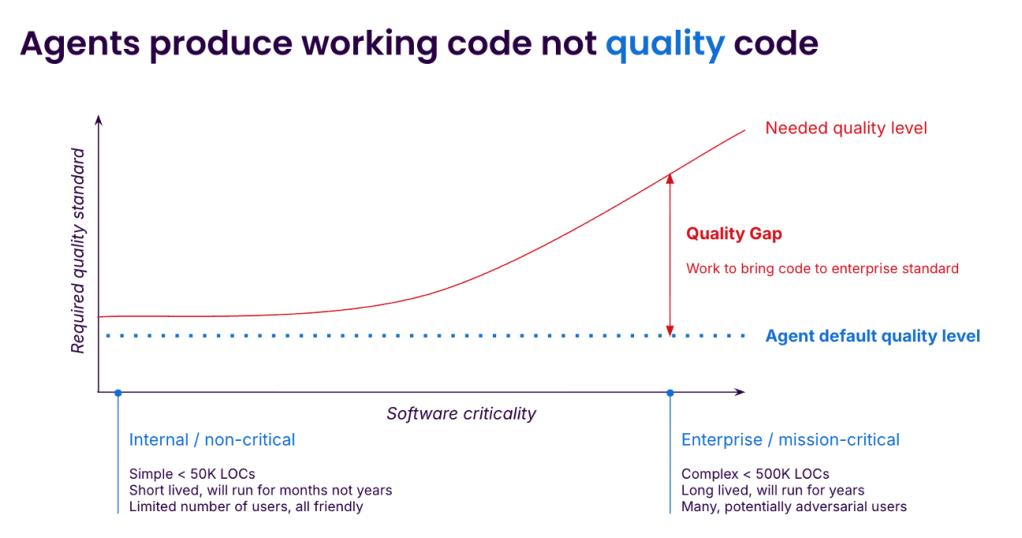
Developers are caught between the joy — or pressure — of using agents to ship 10x faster today and the dread of how they will maintain that code tomorrow. The gap between “vibe” code and code that can be deployed to millions of users is vast and easy to underestimate. Closing the gap requires care, expertise, and effort, with the payoff coming later. Agents are able to complete increasingly complex programming tasks but without the quality we need. What’s missing, and how can we fill the gap?
Sonar
Why agent-generated code degrades: the bloat problem
Enterprise code has to clear three bars: it must be maintainable, reliable, and secure. Out-of-the-box AI agents can miss all three. Let’s focus on the biggest and most visible maintainability issue, which is bloat: redundant validation, defensive checks that cannot fire, near-duplicate functions, dead code that nothing removes. A None check on a parameter typed as dict. A try/except around a call that never throws. Two functions, identical except for the negation in their return statement.
Bloat varies dramatically by model. Sonar’s LLM Leaderboard runs every frontier model through 4,400+ Java tasks and analyses the code generated. To complete the benchmark, GPT-5.4 High generated 1,159,000 lines of code at an 81.05% pass rate, while Claude Opus 4.7 Thinking generated only 336,000 lines of code to return a better than 82.52% pass rate. Different models generate dramatically different code to achieve similar outcomes.
Bloat is not just messy. Carnegie Mellon researchers studied 807 open-source projects that had adopted Cursor, matched against 1,380 controls, measured by SonarQube. A short-term velocity gain disappeared by month three, while static analysis warnings rose 30% and code complexity rose 41% — both persistent. The harder it became to change the codebase and the more bugs it contained, the more the velocity was dragged down. Any experienced developer will know how this goes: quality problems compound until the code feels impossible to change and the only option is the dreaded rewrite.
Three forces produce bloat once a model is in use:
Agents do not feel the maintenance burden. Armin Ronacher, the creator of Flask, made the point on the Pragmatic Engineer podcast in late April. Humans feel the cost of bad code over time, and as Ronacher put it, “if the pain gets too big, you as a human are incentivized to fix the cause of your pain” — so we refactor. Agents do not. They obliviously extend bad structure indefinitely. A senior engineer’s job is to say no to unnecessary abstraction. The agent has no equivalent reflex.
Training rewards apparent completeness. Pretraining corpora are full of explanatory material — Stack Overflow answers, tutorials, README snippets — deliberately self-contained and verbose. Post-training compounds the effect: human raters prefer outputs that look thorough, so models learn that “comprehensive” reads as better. When uncertain which edge case matters, the safe move is to handle all of them. Each guard is locally defensible. The aggregate is bloat.
Iterative generation has no deletion pressure. Agents add but rarely delete. Removing dead code does not make any test go green, so superseded functions accumulate alongside their replacements. SlopCodeBench, a March 2026 benchmark across 11 coding models, found rising structural complexity in 80% of trajectories and rising verbosity in 89.8%. Agents continue to patch bad code, treating every task as if it’s their last.
AC/DC: the loop that compensates
What closes the gap is a loop around each iteration of agent work. The agent does what it is good at — generating code — and our job is to wrap that with three steps the agent cannot reliably do on its own. At Sonar we call this the Agent Centric Development Cycle, or AC/DC: guide, verify, solve.
Guide
Many teams overcorrect on context. They paste the style guide, three years of architectural decisions, and the entire onboarding doc into the agent’s instructions and expect output to improve. ETH Zurich researchers tested this and found the opposite: large context files often reduced task success against no context at all, and added 20% or more to inference cost.
Keep agent-facing context short — under 200 lines is a useful heuristic — and restrict it to fundamentals that can’t easily be inferred from the code: naming conventions, architectural invariants, what has been tried and failed. However, this will only get you so far, so make sure to provide specific context for each task. If you have architectural expectations, don’t expect the agent to guess them. Software architecture tools can be used to provide additional context in the guide phase.
Task shape matters too. Break the work into steps and agree on a plan; ask the agent to provide three solutions and evaluate the impact on quality of each. There is no perfect software architecture, and you understand the trade-offs in your codebase best, so think critically about the changes before they happen. Without this, the agent will confidently pick an option, seemingly at random, and the further it goes the harder it is to “unpick.” If you want to test this, ask three instances of your preferred agent to complete a task that involves some polymorphism and watch each one confidently suggest a different solution.
Verify
The most expensive verification mistake is doing it last. Reviewing 200-line pull requests (PRs) after the agent is done is the dynamic behind the Faros/DORA figures Addy Osmani highlighted: 98% more PRs merged in high-adoption teams, review times up 91%. Verification inside the loop is different. Unit test runs, static analysis, and security scanners produce output the agent can act on. This is where AI-native tooling belongs: purpose-built for the agent to invoke, not just for humans to consult through a UI.
Human reviewers cannot keep up. When agents merge twice as many PRs per week and each one takes nearly twice as long to review, doubling the review staff still leaves you behind. Automated verification is the only response that scales. Fast feedback has always been a fundamental tenet of good software engineering. Feeding it directly back to the agent protects the developer from simple mistakes and leaves them headroom to work on the harder ones.
Solve
If verification happens within the agentic loop, the agent can fix any issues whilst the code is being generated without expensive remediation steps. Static analysis tools can guide the agent on how to resolve the issue quickly. Some cases need human judgment — a None check at a system boundary may document a real precondition. But most of the work is mechanical. Automate the obvious fixes and let engineers spend their attention on the cases that are not.
The investment that compounds
Better models will keep arriving. They may not change the mechanism of bloat or the dynamics of compounding decay. The loop is what does — bounded tasks, sharp context, in-loop verification, and a deliberate “solve” step to clear bloat before it accumulates.
The same logic governs how autonomy should expand. Reduce human interventions only when the agent’s guide, verify, and solve cycle is making them redundant. Our biases can sting us here: an agent’s ability to write code can lead us to agree with it more than we should. Don’t trust blindly; wait for the evidence.
The teams that will be shipping enterprise-quality code with AI agents in 18 months are not the ones running the “best model.” They are the ones treating workflow as the engineering investment, with the seriousness once given to build systems and CI. The model is the tool, the workflow is the discipline. That is where the durable advantage compounds.
—
New Tech Forum provides a venue for technology leaders—including vendors and other outside contributors—to explore and discuss emerging enterprise technology in unprecedented depth and breadth. The selection is subjective, based on our pick of the technologies we believe to be important and of greatest interest to InfoWorld readers. InfoWorld does not accept marketing collateral for publication and reserves the right to edit all contributed content. Send all inquiries to doug_dineley@foundryco.com.
FDEs, in case you haven’t heard, are hired by companies looking (hoping?) to successfully deploy AI tools and services. It’s one of the hotter professions in a world still trying to understand the impact of AI on careers.
So, what exactly are FDEs — are they techy lone rangers like the ones OpenAI, Google and Microsoft are hiring? Turns out it’s not so much about individual engineers who swoop in to design and roll out AI deployments; it’s more about a team of engineers working together at customer sites.
At least, that’s the view at Amazon Web Services (AWS).
In fact, according to Taimur Rashid, managing director of the AWS Generative AI Innovation Center, the FDE concept pre-dates the current generative AI (genAI) gold rush. The same kinds of engineering teams were needed for the earlier machine-learning and cloud eras to help companies with deployments.
Taimur Rashid, managing director of the AWS Generative AI Innovation Center,
AWS
Rashid recently talked about how AWS sees FDEs as a profession in a conversation with Computerworld. And he weighed in on the desired job skills the company seeks in this increasingly AI-centric era.
What is an FDE? “We view it as a team. It’s a cross-functional team that has engineers, scientists, strategists, and folks that can piece technology and business together. In some cases, we do have to have security engineers in there, too.
“I see them as anesthesiologists. They have to prep so many things, monitor things throughout. We see ourselves as a frontier deployment team helping customers adopt all forms of AI, whether it’s genAI, agentic AI, even emerging trends like physical AI. We’re helping these companies become frontier themselves.”
How does an FDE engagement begin, and how is it structured? “Where we see the forward deployed model is when customers come in — for example, we have our executive briefing center in Seattle and in Arlington, VA. When customers share what they’re trying to do, very quickly a customer’s like, “What’s the quickest way I can go and build something with you?”
“We’ll forward deploy our people in, we’ll embed them in your business and we’ll go through these 45-day sprints that we typically design. Through those successive sprints, we’re building stuff together, we’re proving value, and then they can expand that to a much broader engagement.
Where do FDEs actually sit? Client side, internally, or in-between? “It’s mixed, and it largely depends on what the customer’s preference is. We’ve seen models where the customer has been very adamant that, ‘We want your teams with us in our business.’ In those cases, we forward deploy the majority of the teams on site.
“We have models where customers are fine with you being wherever you’re based, as long as you’re still embedded virtually. And then there’s a hybrid. We deploy anywhere from five to seven people. Sometimes, the baseline is actually three.”
Will cost savings be the job of an FDE, or someone else on the team? “I expect these teams to be able to architect systems that have those cost requirements in mind, whether it’s use a different model for a different use case that doesn’t increase the per-token cost…or think about ways where you can use semantic caching. I personally think you may have a high spend in token consumption, but if you’re generating revenue, as long as the economics work out, then you’re at peace.”
What challenges have you gone through deploying FDEs in the real world? “One of the challenges worth highlighting is when customers get really excited about us forward deploying resources, what they end up realizing is [that] they’re not set up to absorb that right away. They realize they have to go through … process-related things, security access — all those operational things.
“One very good example is the Commonwealth Bank of Australia. They said: “Prioritization’s a big thing, and if you forward deploy and you’re 100% dedicated, how do we ensure that our teams are also equally 100% dedicated?’ When you’re sitting in your office, you’re distracted by your day-to-day. So they said, ‘Why don’t we create a neutral ground in Seattle? You fly your people, we’ll fly our people. We’ll give them three weeks of dedicated time so they have no distractions.’”
Have you gone into projects where they want AI but have no security or governance ready? “I’ve been through this before, certainly. We do see customers that have security processes and capabilities, but it’s not as tight as it should be in the age of AI. Governance is the biggest area where customers right now have the biggest gap. I’m talking governance around agents. In the past two months, almost 100% of the conversation around agents is not about capability. It’s all about governance.
“That is a big area right now where forward deploy teams are helping with governance education, and building the scaffolding for that.”
How does software engineering fit into the FDE model? “One of the greatest learnings is that as we forward deploy resources and get customers to take AI and integrate it into their systems, the knowledge of software engineering is so important. Today, a customer can use one of the Claude models and scan their code base and look at vulnerabilities.
“The tough part is not assessing those vulnerabilities, it’s remediating [them]. Remediating [them] requires software engineering experience, because you have got to merge code, test it, deploy it. We largely see that the frontier software development teams are smaller and they’re managing agents that are doing various tasks across the software development lifecycle.”
AWS has many models at your scale, open source, closed — it’s more complex than what other AI vendors offer. How do you nail down the talent? “It’s massive, and when you look at not only scale, it’s the complexity of the stack. We take an approach where we fundamentally do three important things: No. 1, we want to ensure people understand concepts; they have to understand pre-training, post-training, reinforcement, fine-tuning.
“Secondly, we make sure that our teams are well versed in their first-party services. The third thing is that by design, AWS has always been about choice. We say, ‘Let’s do 80-20 here. What is 20% of those specialties that we need to have, which can cover 80% of what most customers are trying to do?’”
What skills should software developers learn to move into FDE work — the top three or four things? “We look at three categories. First category is entirely functional. Are they more engineering specific? Are they science specific? Are they security specific? Our litmus test is not only knowledge of the function, but the actual hands-on work that they can do with it. Secondly is around domain. I focus on what is their domain understanding across the whole AI lifecycle? The third thing is cultural. We are looking for folks that are okay at dealing with ambiguity, being good at stakeholder management, and having that startup mindset.
“This AI transformation’s not for the faint of heart.”
There’s a rush for FDEs from OpenAI, Google, and others. What’s different about what you look for? “I don’t know entirely what the others are looking for, but I’ll tell you what we have been looking for in the past. When we hired solution architects, it was about systems level understanding. But what I see more and more is hands-on experience, cultural mindset, all these things are very important. If I had to pick one thing that is going to be very important in the talent that we either upskill or future talent that we hire, it has to be the application of AI towards software engineering and system integration tasks.
You’re upskilling AWS talent as well? “We do. You will see some publications coming out in the next couple of weeks around how do we do this across our software teams and how does that translate to customer-facing roles.”

 Login