A mine that has been operating for decades in the Peruvian Andes continues to contaminate the soil, water and air for thousands of people living nearby, according to a lawsuit filed last month. The contamination has displaced farming and livestock, the lawsuit said, while causing cognitive issues in children, among other public health concerns. Companies working at the Cerro de Pasco mine, located in Peru’s central highlands, need to be held responsible for the pollution and public health issues that have affected more than 100,000 people, according to Cerro de Pasco Mayor Julio Rupay Malpartida and public prosecutor Darwin Alejandro Ramón Yalico, who filed the injunction petition on behalf of the municipality. “[The] environmental contamination is on such a scale that it’s present in every corner of the city,” the lawsuit said, “a consequence of the accumulation of heavy metals and toxic substances.” The area has been home to mining activity since at least the 16th century, when the Spanish discovered silver deposits during colonization. More recently, the private company Volcan Compañía Minera took over the mines in 2000 and has overseen underground and open pit operations to extract silver, copper, zinc and lead, among other metals. The lawsuit also lists Volcan subsidiaries Óxidos de Pasco, Empresa Administradora Cerro and Empresa Minera Paragsha as defendants. The Cerro de Pasco mine from above. Image courtesy of SkyTruth/Flickr. CC BY-NC-SA 2.0 Some of the operation is located in the center of the city, with a population of more than 74,000. As a result, particulate…This article was originally published on Mongabay
On Sunday, April 26, Argentine officials stopped an unusual shipment arriving at an airport near Buenos Aires. Inside, they found so many dead and dying fish, octopuses and crabs that a national rescue center had to install 10 new emergency tanks to support the survivors. It was the third time in a year authorities had seized an illegal shipment of sea life at the same airport, the Associated Press reported. Marine wildlife trafficking is a growing global business, driven by demand for ornamental fish, luxury foods and traditional medicines. Much of that trade is routed through airplane luggage or airmail, where the vast majority of animals, dead or alive, go undetected. The combined use of artificial intelligence (AI) and 3D X-ray machines could change that, according to an international team of researchers. Training an algorithm on samples of seahorses, shark fins and sea cucumbers, the scientists achieved successful detection rates between 86% and 96%, according to a research paper published last week. “As it stands, our methods of detecting something that shouldn’t be in our bags on the front line is reliant on human inspection and biosecurity dogs,” Vanessa Pirotta, a marine biologist at Macquarie University in Australia and the paper’s lead author, told Mongabay. “AI could be used to complement that. It’s not a silver bullet, but an assistant and a tool.” Image from the study showing (from top to bottom) shark fin, seahorse and sea cucumber samples next to a security X-ray of each item. Image courtesy of…This article was originally published on Mongabay
NAPLES — On a warm, moonlit night in May, Maurizio Simeone sat in an ambush at his desk about 10 kilometers (6 miles) south of Naples, Italy. The marine scientist and director of the Marine Protected Area (MPA) Gaiola Underwater Park was watching the grainy live feed from cameras surveilling the MPA as poachers descended on the seafloor. “It was midnight. Here they were again,” Simeone told Mongabay. The poachers had come a few nights before to scout the area. Then a second time. This time, Simeone was waiting for them. He rushed to alert the Coast Guard. The poachers operated with ruthless efficiency, using a dangerous illegal method known as the hookah system. A compressor on a small boat pumps air through a hose to a diver, allowing them to stay underwater for hours and systematically strip the seabed. Every 20 minutes, the diver resurfaced to hand over a net full of purple sea urchins (Paracentrotus lividus), grab an empty net and then dive back down. When the authorities moved in, the two men on the boat began dumping hundreds of sea urchins and their gear into the sea, as the diver quickly resurfaced. The three men were old acquaintances of Simeone’s. “They are repeat offenders. It’s not the first time we’ve caught them,” Simeone said. Illegally harvested sea urchins seized in July 2024. Image courtesy of Maurizio Simeone. During a previous bust a year earlier, the vessel was apprehended with a staggering haul: 976 sea urchins pulled from…This article was originally published on Mongabay
In 2018, night patrol teams on Boa Vista, the third-largest island in the Cabo Verde archipelago, started noticing a change along the beaches: The loggerhead turtles were arriving in significantly larger numbers than usual. In previous years, each team, comprised of staff and volunteers from local conservation NGO Cabo Verde Natura 2000 (CVN2), encountered between five and 10 female turtles (Caretta caretta) a night. But now, the teams were each recording between 20 and 30 females a night. By 2021, that number had grown to between 30 and 40. A recent study published in Biological Conservation confirms the upward trend: An 80-fold increase in the population of loggerheads nesting at three of Boa Vista’s beaches over 27 years, from 1998 to 2024. The authors of this first long-term study of Cabo Verde’s nesting loggerheads ascribe the remarkable trend to decades-long conservation efforts at the local and national level. Loggerheads, which primarily inhabit temperate and subtropical regions of the Pacific, Atlantic and Indian oceans and the Mediterranean Sea, are long-lived, slow-maturing migratory animals. With a lifespan of 80 years or more, female loggerheads take decades to reach sexual maturity. The global loggerhead population has declined by 47% over the past three generations, according to the last IUCN Red List assessment, where it remains listed as a globally ‘vulnerable’ species. The IUCN, the global wildlife conservation authority, largely attributes this decline to anthropogenic pressures such as habitat loss, marine pollution, bycatch, poaching and multiple climate change-driven impacts. Loggerhead turtle eggs. Image by…This article was originally published on Mongabay
LIMÓN DE CHAGRES, Panama — In Panama’s Rio Indio Basin, a $1.5 billion reservoir project aims to meet water demand for the next 50 years. But the project would displace dozens of farming communities, sparking widespread opposition to the reservoir’s construction. “We will give our lives to save Rio Indio! I came from Limón de Chagres, the first community that could be flooded to make space for the dam,” shouts Maricel Sanchéz at the microphone from a stage during a May 1 march in Panama City. “Today, I’m so proud to see how united we are in our resistance.” Sanchéz, 25, is the spokesperson for the Rio Indio farmers’ assembly, which is part of Coordinadora Campesina por la Vida (Peasant Coordinator for Life), a grassroots social and community organization of farmers, Indigenous communities and civic groups in Panama. During the march, she spoke out about their mobilization against the Río Indio reservoir: a $1.5 billion project by the Panama Canal Authority (ACP), Panama’s government agency responsible for managing the canal. Rio Indio is a 98-kilometer (about 61-mile) river in central Panama, flowing through the Costa Abajo area (home to 231 farming communities) to the Caribbean Sea. Here, the ACP plans to create a reservoir to provide water to nearby Gatun Lake (the northern entrance of the Panama Canal in the Atlantic Ocean) to meet water demand for the next 50 years for human consumption and for canal operations, especially during droughts. The construction is expected to begin in 2027 and…This article was originally published on Mongabay
Tariq Mahmood was alarmed when he found 19 sacks tucked away in a railway tunnel in the Chakwal district of northern Pakistan. Their contents were extremely disturbing: 45 rotting pangolin carcasses, all devoid of their distinct, orange-and-light-brown scales. That was in 2012. “It was very difficult to see these innocent, dead bodies,” said Mahmood, a wildlife biologist at Pir Mehr Ali Shah Arid Agriculture University in Pakistan, who began studying pangolins in 2009. Finding so many slain Indian pangolins (Manis crassicaudata) alerted Mahmood to a dark truth. Poachers were paying local citizens to capture them, so the overlapping scales that cover their bodies — the pangolin’s first line of defense — could be sold into the illegal wildlife trade. “It was terrible to know that.” At the time, global conservationists were realizing that demand for pangolin was driving trade, mostly to China. “We first saw the emergence of this intercontinental trafficking around 2010, and it’s continued to take place since then,” said Dan Challender, a pangolin expert at the University of Oxford who has studied international wildlife trade for 15 years. This shy, toothless, nocturnal animal has become the world’s most-trafficked mammal. When Asia’s four species were nearly poached to extinction, traders turned to the four African species and their numbers soon plummeted. All pangolins are on the IUCN Red list: Four of them, including the Indian pangolin, are endangered, and three hang on the brink, critically endangered. Pangolin scales command substantial prices on the black market. The demand is…This article was originally published on Mongabay
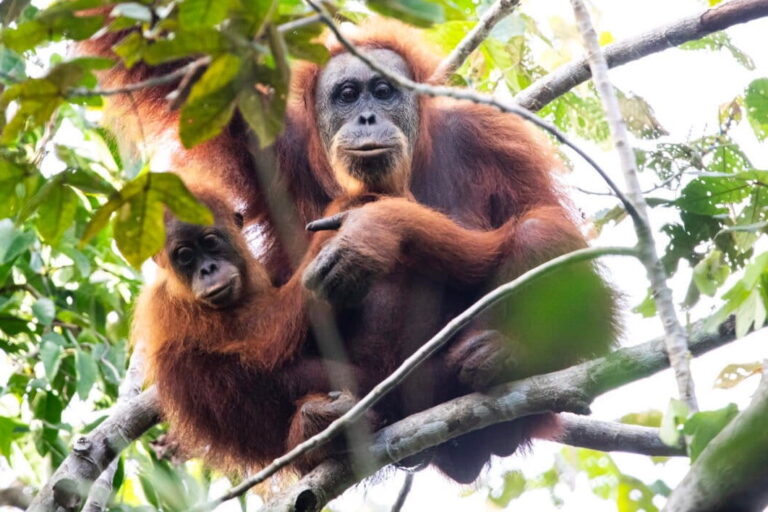
JAKARTA — Climate change has become a direct threat to the survival of the world’s rarest great ape, according to scientists, after landslides triggered by an unusually intense storm killed an estimated 58 critically endangered Tapanuli orangutans (Pongo tapanuliensis) in Indonesia’s Batang Toru ecosystem. The estimate comes from a new study published in Current Biology, whose authors say the findings may represent one of the first examples of climate change immediately threatening the survival of an entire species. The researchers found that landslides triggered by extreme rainfall associated with Cyclone Senyar in November 2025 likely killed about 7% of the estimated global population of Tapanuli orangutans, which number fewer than 800 individuals and are concentrated in the Batang Toru landscape in North Sumatra. After analyzing satellite imagery, the researchers identified more than 50,000 individual landslide scars and estimated that about 8,300 hectares (20,500 acres) of forest in the western block of Batang Toru were affected by the disaster. The western block is considered the species’ most important stronghold, hosting more than 500 orangutans and one of the three known population clusters within the Batang Toru landscape. The researchers believe most orangutans caught in the landslides died rather than being displaced because of the violence and speed of the event. While the landslides were relatively shallow, they moved extremely rapidly and transformed into channelized debris flows. With little or no warning, orangutans and other wildlife likely had little chance of escaping and may have been buried, drowned or fatally injured by…This article was originally published on Mongabay
In a forest reserve in northeastern Bangladesh, two Chinese pangolins rescued from trafficking have been given a second chance at life in the wild. As poaching pushes the critically endangered species toward extinction, the releases aim to do more than boost flagging local populations. With the help of tiny radio transmitters, scientists are tracking each individual to learn about their survival, movements and behavior. Equipped with an armor-plated body, elongated snout and sticky tongue the length of their body, Chinese pangolins (Manis pentadactyla) are beautifully adapted to a life spent grubbing out ant and termite nests and resting in burrows dug into the forest floor. However, like all eight of the world’s known pangolin species, Chinese pangolins are among the most trafficked mammals on Earth. They’re plucked from forests across their range to feed an illegal trade driven by demand in China and Vietnam for pangolin meat, and scales and other body parts used in traditional medicines. While no global population counts exist, the IUCN, the global wildlife conservation authority, classifies the species as critically endangered, due to the combined threats of poaching, habitat loss and deforestation. High poaching rates in China in the late 20th century caused local extinctions, displacing hunting pressure to other parts of the species’ range, which spans from northern India and Nepal, through Bangladesh and northern parts of Southeast Asia to southern China and Taiwan. Yet very little is known about the species in many countries, including Bangladesh, says Shahriar Caesar Rahman, co-founder and CEO…This article was originally published on Mongabay
In the American South of the late 1950s, segregation was part of the daily architecture. Airports had separate facilities. Restaurants barred Black customers or served them apart. Schools, buses, waiting rooms, and lunch counters carried the same instructions. The system depended on law, custom, and the expectation that most white people would accommodate it. Resistance often began with small acts that carried real costs. A professor might drive arrested students back to campus. A family might refuse to send its children to segregated schools. A group of faculty members might walk toward a restaurant door together and be met in the parking lot by men who intended to stop them. The work required patience, and it also required a willingness to be arrested, disliked, and misunderstood. Peter Klopfer, who died on June 5 at 95, spent nearly seven decades at Duke University as a zoologist, teacher, and builder of institutions. He helped develop behavioral ecology, studied mother-offspring bonding, and co-founded the Duke Lemur Center, which became the world’s largest collection of lemurs outside Madagascar. He was also the named plaintiff in a Supreme Court case that extended the Sixth Amendment right to a speedy trial to state courts. The civil-rights defendant and the lemur scientist were the same man, formed by the same habits of attention and conscience. He was born in Berlin in 1930 and raised in a German immigrant family in the United States. He attended Friends schools and later studied at UCLA and Yale. At UCLA he…This article was originally published on Mongabay

 Login