
❌

Reading view

TODAY! NASA’s Big Science, Small Missions

TODAY! NASA’s Big Science, Small Missions

16 June 2026

Tuesday, June 16th, 2026
1:00pm – 2:30pm

For Cosmic Origins at AAS, please visit the link below. 

https://science.nasa.gov/astrophysics/programs/cosmic-origins/community/cosmic-origins-at-aas-248-june-2026

Splinter Session: NASA’s Big Science, Small Missions

Tuesday, June 16th, 1:00pm – 2:30pm ET, 10:00am -11:30am PT (Hybrid Session)

For remote participation, please look for the “Join the Session” link above the agenda on the Cosmic Origins at AAS website.

High-Impact Science
Smarter, Faster, Together

Agenda

Organizers: Swara Ravindranath (NASA/GSFC), Emily Witt (JHU)

TimeTopicSpeaker
10:00am ‑ 10:05amWelcomeSwara Ravindranath (NASA/GSFC)
10:05am ‑ 10:15amFORTIS Sounding RocketEmily Witt (JHU)
10:15am ‑ 10:25amBlackCAT CubeSatAbe Falcone (Pennsylvania State University)
10:25am ‑ 10:35amSunRISE CubeSat ConstellationJoseph Lazio (University of Michigan)
10:35am ‑ 10:45amSPHEREx Medium Explorer MissionRoberta Paladini (IPAC/Caltech)
10:45am ‑ 10:55am Landolt Pioneer MissionPeter Kurczynski (NASA/GSFC)
10:55am ‑ 11:05amNon-Traditional Path to MissionsSanchayeeta Borthakur (Arizona State University)
11:05am ‑ 11:10amBREAK
11:10am ‑ 11:30amPanel DiscussionSwara Ravindranath (NASA/GSFC, moderator) Panelists: Drew Miles (Caltech), Pablo Saz Parkinson (NASA HQ), Joseph Lazio (University of Michigan), Abe Falcone (Pennsylvania State University), David Ardila (JPL)
American Astronomical Society

The 248th Meeting of the AAS

The 248th AAS meeting (joint with the High Energy Astrophysics and the Laboratory Astrophysics Divisions) will be held 14-18 June 2026 in Pasadena, California.

Learn More
Black line art with letters on a white background
American Astronomical Society (AAS)

News Straight to Your Inbox

Subscribe to your community email news list

We will never share your email address.
Privacy Policy

Sign Up
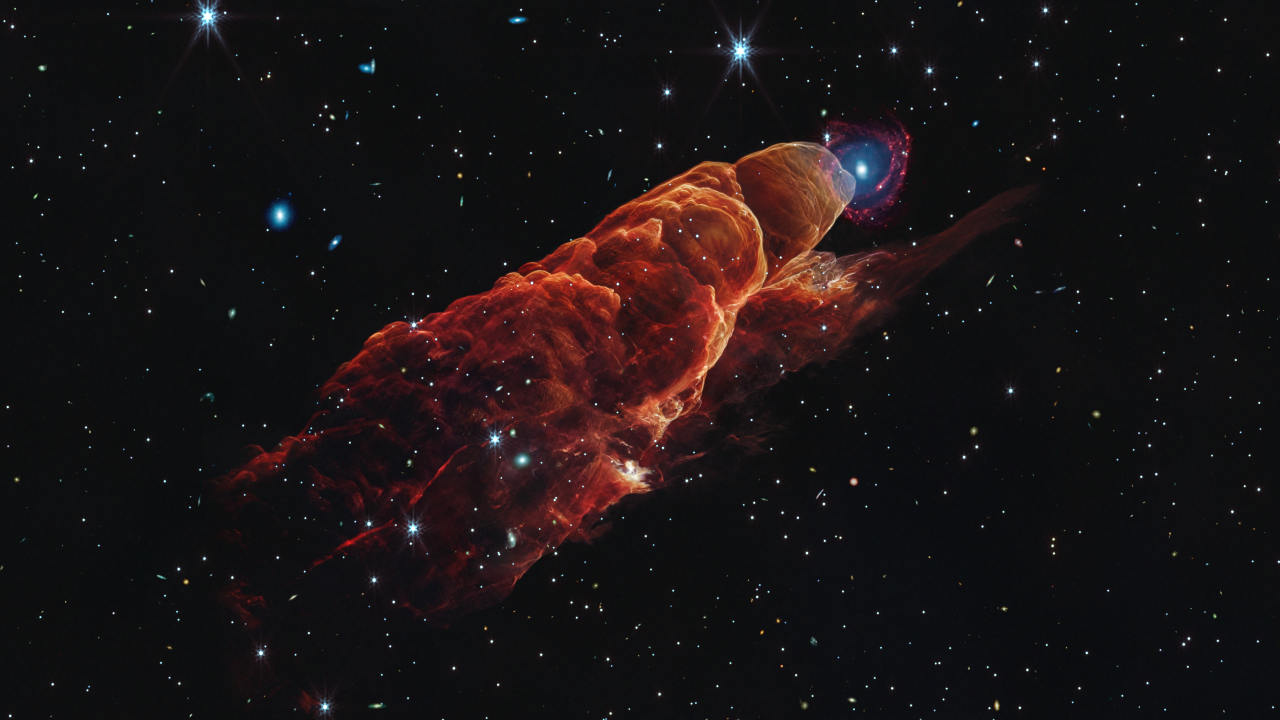
Angled from the upper left corner to the lower right corner is a cone-shaped orange-red cloud known as Herbig-Haro 49/50. This feature takes up about three-fourths of the length of this angle. The upper left end of this feature has a translucent, rounded end. The conical feature widens slightly from the rounded end at the upper right down to the lower right. Along the cone there are additional rounded edges, like edges of a wave, and intricate foamy-like details, as well as a clearer view of the black background of space. In the upper left, overlapping with the rounded end of Herbig-Haro 49/50, is a background spiral galaxy with a concentrated blue center that fades outward to blend with red spiral arms. The background of space is speckled with some white stars and smaller, more numerous, fainter white galaxies throughout.

The post TODAY! NASA’s Big Science, Small Missions appeared first on NASA Science.

  •  

Department of Health and Human Services Digital Stockpile & Manufacturing Response Network Challenge

Alexandre – stock.adobe.com

NASA’s Center of Excellence for Collaborative Innovation (CoECI) assists in the use of crowdsourcing across the federal government. CoECI’s NASA Tournament Lab offers the contract capability to run external crowdsourced challenges on behalf of NASA and other agencies.

Sponsored by the Administration for Strategic Preparedness and Response (ASPR), a division of the U.S. Department of Health and Human Services (HHS), this prize competition seeks forward-thinking solutions to strengthen the nation’s ability to rapidly produce and distribute critical medical supplies during public health emergencies and supply chain disruptions. Through three challenge phases, participants will develop an innovative conceptual systems design using technologies and frameworks that advance the future of resilient medical manufacturing, logistics, and digital coordination capabilities.

Phase 1: Participants will submit:

  • 8-page submission paper
  • 3-minute Pitch video
  • Blueprint supporting the key capabilities and structure of the solution

Submissions will be evaluated per challenge Judging Criteria. Following the Judge evaluation period, up to 8 Finalists will receive a $5,000 prize each and be invited to the hybrid (in-person and virtual) Pitch Event at ASPR headquarters in Washington, DC. Up to 3 Winners from the Pitch Event will receive a $150,000 prize each and be invited to the innovation development phase.

Phase 2: Two developmental milestones will monitor solution development and will include $75,000 additional prizes for each milestone complete (up to $150,000 in total milestone prize payments).

Phase 3: At the end of the development milestone period, up to 3 teams may be invited to the final Live Validation Event to test their solution under applicable real-world simulations and compete for a total prize purse up to $1,100,000.

‍Total Prizes: Up to $2.04 Million

Challenge Launch: June 15, 2026

Phase 1 Submissions Due: August 28, 2026

For more information, visit: https://www.expeditionhacks.com/challenges/digital-stockpile-challenge

The post Department of Health and Human Services Digital Stockpile & Manufacturing Response Network Challenge appeared first on NASA Science.

  •  

Department of Health and Human Services Digital Stockpile & Manufacturing Response Network Challenge

Alexandre – stock.adobe.com

NASA’s Center of Excellence for Collaborative Innovation (CoECI) assists in the use of crowdsourcing across the federal government. CoECI’s NASA Tournament Lab offers the contract capability to run external crowdsourced challenges on behalf of NASA and other agencies.

Sponsored by the Administration for Strategic Preparedness and Response (ASPR), a division of the U.S. Department of Health and Human Services (HHS), this prize competition seeks forward-thinking solutions to strengthen the nation’s ability to rapidly produce and distribute critical medical supplies during public health emergencies and supply chain disruptions. Through three challenge phases, participants will develop an innovative conceptual systems design using technologies and frameworks that advance the future of resilient medical manufacturing, logistics, and digital coordination capabilities.

Phase 1: Participants will submit:

  • 8-page submission paper
  • 3-minute Pitch video
  • Blueprint supporting the key capabilities and structure of the solution

Submissions will be evaluated per challenge Judging Criteria. Following the Judge evaluation period, up to 8 Finalists will receive a $5,000 prize each and be invited to the hybrid (in-person and virtual) Pitch Event at ASPR headquarters in Washington, DC. Up to 3 Winners from the Pitch Event will receive a $150,000 prize each and be invited to the innovation development phase.

Phase 2: Two developmental milestones will monitor solution development and will include $75,000 additional prizes for each milestone complete (up to $150,000 in total milestone prize payments).

Phase 3: At the end of the development milestone period, up to 3 teams may be invited to the final Live Validation Event to test their solution under applicable real-world simulations and compete for a total prize purse up to $1,100,000.

‍Total Prizes: Up to $2.04 Million

Challenge Launch: June 15, 2026

Phase 1 Submissions Due: August 28, 2026

For more information, visit: https://www.expeditionhacks.com/challenges/digital-stockpile-challenge

  •  

IR STIG PRIMA Seminar, 22 June 2026

IR STIG PRIMA Seminar

Infrared Science and Technology Interest Group

Over the next few months, our talk series will be highlighting research from PRIMA’s Working Groups, with this talk focusing on dust properties in galaxies in the nearby universe.  Stay tuned as well for overview talks this fall that highlight PRIMA’s PI science in the areas of Protoplanetary Disks and the Evolution of Dust and Metals. 

IR STIG about IR STIG PRIMA Seminar

Location

Virtual

Dates

22 June 2026
9:00am PT / 12:00pm ET

Community

IR STIG

Type

Seminar

Speaker

Bogdan Pastrav (Institute of Space Science)

Seminar Connection

Please visit the P-CAST webpage https://prima.ipac.caltech.edu/page/p-cast for a link to join and to see all of our upcoming speakers!

News Straight to Your Inbox

Subscribe to your community email news list

We will never share your email address.

Privacy Policy

Sign Up
Angled from the upper left corner to the lower right corner is a cone-shaped orange-red cloud known as Herbig-Haro 49/50. This feature takes up about three-fourths of the length of this angle. The upper left end of this feature has a translucent, rounded end. The conical feature widens slightly from the rounded end at the upper right down to the lower right. Along the cone there are additional rounded edges, like edges of a wave, and intricate foamy-like details, as well as a clearer view of the black background of space. In the upper left, overlapping with the rounded end of Herbig-Haro 49/50, is a background spiral galaxy with a concentrated blue center that fades outward to blend with red spiral arms. The background of space is speckled with some white stars and smaller, more numerous, fainter white galaxies throughout.

The post IR STIG PRIMA Seminar, 22 June 2026 appeared first on NASA Science.

  •  

AGN SIG Spotlight Series, 23 June 2026

AGN SIG Spotlight Series Seminar

Active Galactic Nuclei Science Interest Group

AGN SIG about AGN SIG Spotlight Series Seminar

Location

Virtual

Dates

23 June 2026
1:00pm ET / 10:00am PT

Community

AGN SIG

Type

Seminar

Our Spotlight Series highlights recent advances in AGN science, with a strong emphasis on participation from early-career researchers, and includes plenty of time for community discussion following the presentations. 

Central Shocks and Metal-Enriched Outflows: A New View of AGN Feedback

Speaker

Peixin Zhu (Harvard University)

Abstract

The growth of galaxies and their central supermassive black holes (SMBHs) is tightly linked. However, the exact impact of active galactic nuclei (AGNs) feedback on the host galaxy is still uncertain, with different observations suggesting AGNs enhance, suppress, or do not affect the host galaxy star formation rate. Resolving these controversies requires proper treatment of shocks, which are known to exist with AGN-driven outflow and yet are difficult to distinguish from AGN emission. In my talk, I will present a new theoretical three-dimensional diagram built for integral-field spectroscopy that cleanly separates star formation, AGN, and shock-dominated spaxels. Furthermore, these separation results can be combined with theoretical diagnostics to map the spatial distribution of gas-phase metallicity, ionization parameter, and gas pressure within these galaxies. After applying this new technique to 8 nearby Seyfert galaxies, we reveal that AGN and star formation coexist in the galaxy center, and fast shocks are present at the base of AGN outflows in some galaxies. We also find that outflowing gas is systematically metal-enhanced relative to adjacent star-forming rings. I will discuss how these results refine the picture of AGN feedback and the implications for nuclear enrichment and gas transport.

Investigating AGN Feeding and Feedback Through Circumnuclear Gas Kinematics in NGC 3079 and NGC 1068

Speaker

Dr. Ming-Yi Lin (University of Toledo)

Abstract

Studying gas kinematics in the circumnuclear regions (< 100 pc) of nearby AGNs on spatial scales of <10 pc provides insights into gas transport toward the supermassive black hole (SMBH) and the impact of AGN feedback in both radiative and kinetic forms. The kinematics of cold molecular gas are observed with radio interferometers (ALMA and NOEMA), while the warm molecular gas in the near-IR are studied using adaptive optics (AO)-assisted integral field spectrographs (IFS; Keck/OSIRIS). In this talk, I will use NGC 1068 and NGC 3079, two nearby Compton-thick AGNs, as pilot targets to discuss two distinct types of molecular outflows located at distances of ~40 pc from the SMBH: a cooling-efficient, momentum-driven outflow and a cooling-inefficient, energy-driven outflow. I will also present the discrepancy between Bondi accretion prescriptions and observationally constrained mass accretion rates.

Seminar Connection

Zoom Registration, you will receive connection details by email after registration: https://zoom.us/j/97689874465?pwd=XZNUqr19oopa1LfD7hgln1aQ2vbnT2.1

News Straight to Your Inbox

Subscribe to your community email news list

We will never share your email address.

Privacy Policy

Sign Up
Angled from the upper left corner to the lower right corner is a cone-shaped orange-red cloud known as Herbig-Haro 49/50. This feature takes up about three-fourths of the length of this angle. The upper left end of this feature has a translucent, rounded end. The conical feature widens slightly from the rounded end at the upper right down to the lower right. Along the cone there are additional rounded edges, like edges of a wave, and intricate foamy-like details, as well as a clearer view of the black background of space. In the upper left, overlapping with the rounded end of Herbig-Haro 49/50, is a background spiral galaxy with a concentrated blue center that fades outward to blend with red spiral arms. The background of space is speckled with some white stars and smaller, more numerous, fainter white galaxies throughout.

The post AGN SIG Spotlight Series, 23 June 2026 appeared first on NASA Science.

  •  
❌