
❌

Reading view

SpaceX’s planned $60 billion deal for Cursor raises questions for CIOs

When SpaceX on Tuesday officially announced its plan to purchase AI coding startup Cursor for $60 billion in stock, as it had predicted it would do in April, it presented CIOs and developers with a little good news, a little bad news and a massive pile of uncertainty. 

The details of the proposed acquisition were virtually identical to the terms announced in April, even retaining the $10 billion consolation prize for Cursor should SpaceX back out of the deal.  

But for CIOs and developers, the increasing probability of the deal happening is forcing them to make long-term decisions without many long-term answers about what is likely to happen to Cursor, which says its coding agents are used by 64% of Fortune 500 companies.

But whether the deal is good news for Cursor’s customers, or even those of its rivals, is an open question.

Arnal Dayaratna, research VP for software development at IDC, is firmly in the good news camp. He argued that the main element holding back the company, which he estimated brings in about $2 billion in annual revenue, was access to GPUs. And, he said, SpaceX’s xAI has the ability to resolve that problem.

It’s all about the GPUs

“The implication is that Cursor can get better because it will get better access to more compute, in the form of GPUs. That was what Cursor was struggling to obtain,” Dayaratna said, adding that Cursor joins both Anthropic and Google in aligning with xAI. 

“It is bad news for Anthropic,” he said, pointing out, “[Elon] Musk figured out that GPUs were the limiters, the bottleneck. Not human talent: compute. And it’s not only about GPUs. It’s about the data centers,” as well as the mechanisms needed to support data centers, including electricity access, cooling apparatus, and zoning rights.

“Zoning rights are very difficult to obtain in the United States, and Elon has been able to leverage his political capital” to obtain those rights, Dayaratna said.

Dayaratna also commented on the highly unusual tactic of a company pre-announcing an acquisition and then announcing it “officially” two months later. The reason, he suggested, is that Musk didn’t want the acquisition to delay the SpaceX IPO, but he did want potential investors to know about it. “It gave the IPO more legs, even though it was not formally a part of the IPO. He wanted to socialize it before it happened,” he said.

Jason Andersen, principal analyst at Moor Insights & Strategy, took a far more cautious approach and predicted, “enterprise customers will be very concerned.”

Time for CIO due diligence

“xAI’s models and treatment of guardrails are very different than what Cursor has stood for,” Andersen said, and the key issue involves model choice. “Will Cursor be able to point at models other than Grok? If that is the case, it could go towards helping customers be OK with things for a while,” he said. 

But Andersen stressed the words “for a while.” He argued that Cursor rivals have gotten more sophisticated, which could give enterprise CIOs more alternatives.

“The tooling options from the classic enterprise vendors have gotten really good, and also have a number of features that enable better governance and teaming. For example, Kiro from AWS is already a worthy competitor to Cursor, but there have also been major improvements from Google and Microsoft this year,” Andersen said. “I’d venture to say that Cursor was already facing a substantial competitive challenge in the enterprise, especially as the vibe coding movement lost some steam towards agents that enable so much more developer capability.”

Andersen added, “A lot of SpaceX’s valuation is pinned to xAI and there wasn’t enough IP there for it to be long-term competitive with Anthropic or OpenAI without rapidly injecting new technology.”

Shashi Bellamkonda, principal research director at Info-Tech Research Group, said the current period of due diligence gives CIOs opportunities to ask difficult questions.

“I do believe that enterprise customers will start to ask harder questions now, especially if more of the processing starts moving through Grok or xAI infrastructure,” Bellamkonda said, but he stressed that he does see a SpaceX deal helping Cursor.

“Cursor is already carrying a lot of LLM cost and if SpaceX and xAI can give it access to more compute and a faster, improved Grok model, customers could eventually get better performance at a lower cost. Grok is getting faster and more accurate, and under SpaceX there may be more enterprise appetite for xAI than xAI had on its own,” Bellamkonda said.

Questions about data privacy

But Bellamkonda also pointed to the trust issue, specifically asking whether Cursor would be allowed to continue its zero-data-retention policy under the new ownership.

“Enterprise users with sensitive codebases will want to understand exactly where their data is going, who has access to it, and whether any prompts, code, metadata, or embeddings are touching SpaceX or xAI systems,” Bellamkonda said. “Zero data retention is only valuable if customers believe the controls still apply across the new infrastructure. If they can preserve Cursor’s privacy posture while using xAI and SpaceX compute to improve the product, this could be a very strong outcome for customers. If the data governance is unclear, enterprise buyers will hesitate.”

Justin Greis, CEO of consulting firm Acceligence, echoed Bellamkonda’s concerns.

“For many enterprise customers, Cursor’s zero-data-retention policy was not simply a security feature. It was a foundational part of the procurement and approval process,” Greis said, pointing out that security teams, legal departments, compliance officers, and executive leadership all became more comfortable adopting AI-assisted development because they believed their source code, prompts, and proprietary intellectual property would not be retained, stored, or repurposed.

“Whenever ownership changes, customers naturally revisit those assumptions,” he said. “I would expect enterprise customers to immediately seek clarity on whether existing zero-data-retention commitments remain unchanged, whether those commitments continue to be contractually enforceable, and whether any future modifications could be introduced through changes to terms of service or product strategy.”

Reassessing platform risk

Another concern is whether the move will create greater vendor concentration, and whether that will increase risk exposure. 

“Many organizations are already concerned about becoming overly dependent on a small number of AI providers. If Cursor becomes more tightly integrated into a broader SpaceX technology ecosystem, some enterprises may worry about reduced flexibility and fewer alternatives. I suspect this will be a continued question with SpaceX’s recent IPO and growth plans,” Greis said.

Additionally, he pointed out, “AI coding platforms are rapidly becoming part of critical software delivery infrastructure. When organizations standardize on these tools, they are making a long-term platform decision that influences developer productivity, software quality, security processes, and engineering workflows. A change in ownership naturally prompts a reassessment of platform risk, roadmap alignment, and long-term strategic direction.”

As well, Sanchit Vir Gogia, chief analyst at Greyhound Research, noted, “zero data retention survives only where it stays contractual, auditable, enforceable and fenced from affiliate use. The deeper point is what Cursor has become. It is no longer a developer convenience. It sits inside the act of software creation, close to the intellectual-property bloodstream of the enterprise. That is a control plane, and control planes change hands rarely and consequentially.”

Gogia added that even before an acquisition, Cursor was already weakening its data guarantee. “Even now the promise is layered. Cursor’s own disclosures show that standard Privacy Mode still permits some code data to be stored for product features, while only the stricter legacy setting retains nothing. Zero is the exception, not the default.”

  •  

Shipping enterprise-quality code with AI agents

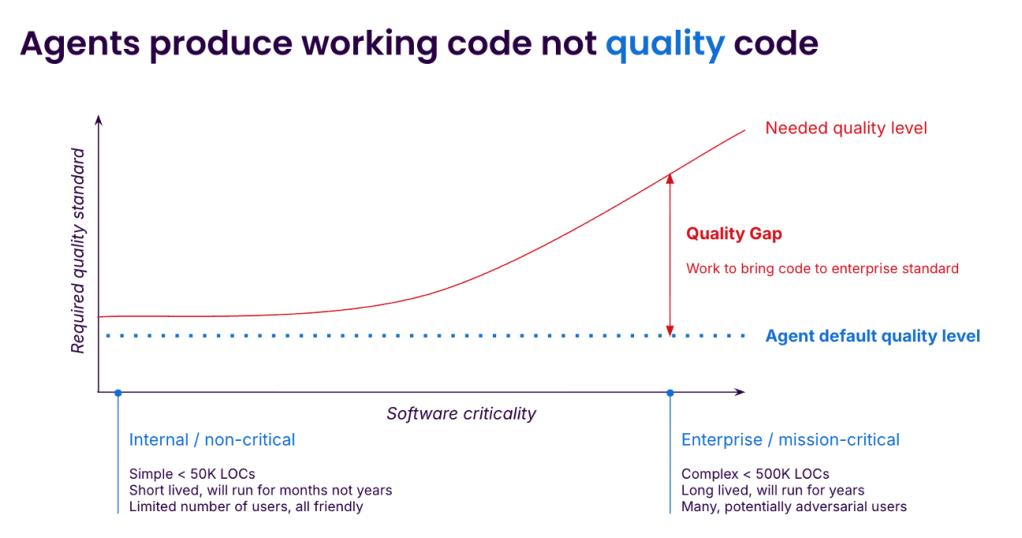
Developers are caught between the joy — or pressure — of using agents to ship 10x faster today and the dread of how they will maintain that code tomorrow. The gap between “vibe” code and code that can be deployed to millions of users is vast and easy to underestimate. Closing the gap requires care, expertise, and effort, with the payoff coming later. Agents are able to complete increasingly complex programming tasks but without the quality we need. What’s missing, and how can we fill the gap?

agentic coding quality gap - sonar

Sonar

Why agent-generated code degrades: the bloat problem

Enterprise code has to clear three bars: it must be maintainable, reliable, and secure. Out-of-the-box AI agents can miss all three. Let’s focus on the biggest and most visible maintainability issue, which is bloat: redundant validation, defensive checks that cannot fire, near-duplicate functions, dead code that nothing removes. A None check on a parameter typed as dict. A try/except around a call that never throws. Two functions, identical except for the negation in their return statement.

Bloat varies dramatically by model. Sonar’s LLM Leaderboard runs every frontier model through 4,400+ Java tasks and analyses the code generated. To complete the benchmark, GPT-5.4 High generated 1,159,000 lines of code at an 81.05% pass rate, while Claude Opus 4.7 Thinking generated only 336,000 lines of code to return a better than 82.52% pass rate. Different models generate dramatically different code to achieve similar outcomes.

Bloat is not just messy. Carnegie Mellon researchers studied 807 open-source projects that had adopted Cursor, matched against 1,380 controls, measured by SonarQube. A short-term velocity gain disappeared by month three, while static analysis warnings rose 30% and code complexity rose 41% — both persistent. The harder it became to change the codebase and the more bugs it contained, the more the velocity was dragged down. Any experienced developer will know how this goes: quality problems compound until the code feels impossible to change and the only option is the dreaded rewrite.

Three forces produce bloat once a model is in use:

  1. Agents do not feel the maintenance burden. Armin Ronacher, the creator of Flask, made the point on the Pragmatic Engineer podcast in late April. Humans feel the cost of bad code over time, and as Ronacher put it, “if the pain gets too big, you as a human are incentivized to fix the cause of your pain” — so we refactor. Agents do not. They obliviously extend bad structure indefinitely. A senior engineer’s job is to say no to unnecessary abstraction. The agent has no equivalent reflex.
  2. Training rewards apparent completeness. Pretraining corpora are full of explanatory material — Stack Overflow answers, tutorials, README snippets — deliberately self-contained and verbose. Post-training compounds the effect: human raters prefer outputs that look thorough, so models learn that “comprehensive” reads as better. When uncertain which edge case matters, the safe move is to handle all of them. Each guard is locally defensible. The aggregate is bloat.
  3. Iterative generation has no deletion pressure. Agents add but rarely delete. Removing dead code does not make any test go green, so superseded functions accumulate alongside their replacements. SlopCodeBench, a March 2026 benchmark across 11 coding models, found rising structural complexity in 80% of trajectories and rising verbosity in 89.8%. Agents continue to patch bad code, treating every task as if it’s their last.

AC/DC: the loop that compensates

What closes the gap is a loop around each iteration of agent work. The agent does what it is good at — generating code — and our job is to wrap that with three steps the agent cannot reliably do on its own. At Sonar we call this the Agent Centric Development Cycle, or AC/DC: guide, verify, solve.

Guide

Many teams overcorrect on context. They paste the style guide, three years of architectural decisions, and the entire onboarding doc into the agent’s instructions and expect output to improve. ETH Zurich researchers tested this and found the opposite: large context files often reduced task success against no context at all, and added 20% or more to inference cost.

Keep agent-facing context short — under 200 lines is a useful heuristic — and restrict it to fundamentals that can’t easily be inferred from the code: naming conventions, architectural invariants, what has been tried and failed. However, this will only get you so far, so make sure to provide specific context for each task. If you have architectural expectations, don’t expect the agent to guess them. Software architecture tools can be used to provide additional context in the guide phase.

Task shape matters too. Break the work into steps and agree on a plan; ask the agent to provide three solutions and evaluate the impact on quality of each. There is no perfect software architecture, and you understand the trade-offs in your codebase best, so think critically about the changes before they happen. Without this, the agent will confidently pick an option, seemingly at random, and the further it goes the harder it is to “unpick.” If you want to test this, ask three instances of your preferred agent to complete a task that involves some polymorphism and watch each one confidently suggest a different solution.

Verify

The most expensive verification mistake is doing it last. Reviewing 200-line pull requests (PRs) after the agent is done is the dynamic behind the Faros/DORA figures Addy Osmani highlighted: 98% more PRs merged in high-adoption teams, review times up 91%. Verification inside the loop is different. Unit test runs, static analysis, and security scanners produce output the agent can act on. This is where AI-native tooling belongs: purpose-built for the agent to invoke, not just for humans to consult through a UI.

Human reviewers cannot keep up. When agents merge twice as many PRs per week and each one takes nearly twice as long to review, doubling the review staff still leaves you behind. Automated verification is the only response that scales. Fast feedback has always been a fundamental tenet of good software engineering. Feeding it directly back to the agent protects the developer from simple mistakes and leaves them headroom to work on the harder ones.

Solve

If verification happens within the agentic loop, the agent can fix any issues whilst the code is being generated without expensive remediation steps. Static analysis tools can guide the agent on how to resolve the issue quickly. Some cases need human judgment — a None check at a system boundary may document a real precondition. But most of the work is mechanical. Automate the obvious fixes and let engineers spend their attention on the cases that are not.

The investment that compounds

Better models will keep arriving. They may not change the mechanism of bloat or the dynamics of compounding decay. The loop is what does — bounded tasks, sharp context, in-loop verification, and a deliberate “solve” step to clear bloat before it accumulates.

The same logic governs how autonomy should expand. Reduce human interventions only when the agent’s guide, verify, and solve cycle is making them redundant. Our biases can sting us here: an agent’s ability to write code can lead us to agree with it more than we should. Don’t trust blindly; wait for the evidence.

The teams that will be shipping enterprise-quality code with AI agents in 18 months are not the ones running the “best model.” They are the ones treating workflow as the engineering investment, with the seriousness once given to build systems and CI. The model is the tool, the workflow is the discipline. That is where the durable advantage compounds.

—

New Tech Forum provides a venue for technology leaders—including vendors and other outside contributors—to explore and discuss emerging enterprise technology in unprecedented depth and breadth. The selection is subjective, based on our pick of the technologies we believe to be important and of greatest interest to InfoWorld readers. InfoWorld does not accept marketing collateral for publication and reserves the right to edit all contributed content. Send all inquiries to doug_dineley@foundryco.com.

  •  

DocLang aims to make documents readable by AI, not humans

AIs struggle to understand documents designed for humans; the DocLang working group seeks to flip that imbalance with its specification for machine-readable business documents “built from the ground up for LLM tokenizers.”

The working group, founded by IBM, Nvidia, and Red Hat and hosted by the Linux Foundation’s LF AI & Data project, aims to create an open, universal, AI-native document format designed to improve how enterprises prepare, exchange, and govern document data for AI systems. ABBYY and Human Signal will also be involved in its development, and other contributors are welcome.

“Enterprises today work across a fragmented landscape of document formats, including PDFs, JPEGs, and other file types built primarily for human consumption rather than AI interpretation,” the group said in its launch announcement.

“This disconnect can introduce complexity, raise costs, and reduce reliability when extracting meaning from business documents,” as organizations increasingly rely on generative AI and agentic systems, it said.

Mark Collier, executive director of LF AI & Data, said the goal of the DocLang Specification Working Group is to “develop a vendor-neutral, interoperable standard that helps organizations prepare document data for AI more reliably, transparently, and at scale.”

DocLang defines a structured, machine-readable format for documents of any type, like JSON for data, that any tool can implement and any pipeline can consume. It builds on DocLing, a document processing toolkit hosted by LF AI & Data that can transform human-readable PDFs, word processor documents or spreadsheets into structured data.

Standards must evolve for AI

Something like DocLang is needed, said independent technology analyst Carmi Levy. “Existing document standards have done an admirable job allowing global stakeholders to confidently collaborate for decades, but it’s becoming increasingly clear that they are in desperate need of an update as AI reshapes the rules around how work gets done,” he explained.

Largely static document types, he said, “can be somewhat limiting when AI is redefining the very word, ‘document.’ In many ways. AI-age documents are far more iterative and dynamic than what they once were, and the definitions need to evolve with the times. The documents we currently live with simply weren’t designed for the AI age.”

Within that context, Levy said, “DocLang represents an early, best hope of achieving some kind of foundational baseline for document standards, one that will hopefully allow more intelligent, more efficient, lower-risk workflows than is currently the case.”

Taking an open-source, vendor-agnostic approach to the process ensures the collective will take precedence over the needs of specific vendors, he said, adding, “earlier standards-setting efforts around networking, documentation, the web, and the cloud powered the free-flowing digital landscape that defines modern life.”

An AI-centric documentation standard will carry that reality into the next generation of technology, said Levy.

A question of governance

The entire concept of LLMs, Jason Andersen, principal analyst at Moor Insights & Strategy said, “involves using natural human languages. The computer is supposed to understand us without us changing our syntax or language. Forcing a syntax on users is exactly what we have today with SEO and more advanced programming languages.”

With something like DocLang, where the standard can be applied to content ingestion, he said, “I would be OK with that being automated, which seems to be the intent. The use case I envision is that when I upload a document to an agent, a skill can be run to preprocess the document into the DocLang standard format, saving tokens.”

That makes sense, he said, adding that he thinks it’s good “if it can help generate outputs, like a visualization, that can be shared outside an AI tool. On that front, that is also why I am liking Web MCP, since you are just adding some code to the page, like CSS or JavaScript, and the consumer, in this case, an AI browser or skill, is better equipped to handle the site.”

The point, he said, is, “these standards need to preserve the fact that humans can still do what they want, and do not need to know any coding to be proficient. In terms of governance, I am not sure if it matters.”

But one analyst did foresee governance problems arising from DocLang’s use.

Yaz Palanichamy, senior research analyst at Info-Tech Research Group, said DocLang adoption will require organizations to implement and review controls in order to scale its use accountably and securely.

This article first appeared on CIO, on June 10, 2026.

  •  
❌