❌

Reading view

US refueling fleet falls below Air Force readiness standards, new watchdog report finds

America’s Government Accountability Office (GAO) watchdog has warned that the US may struggle to sustain a long-term conflict with China should hostilities break out. The issue is not about technical capability (the US military is arguably the world’s most powerful), but rather a matter of logistics.

For combat operations thousands of miles from home, as would be the case in the Indo-Pacific, the GAO argues that the US may struggle to refuel and resupply assets, notably its considerable aircraft fleet.

The issue mainly centers around aging refueling aircraft and issues with spare parts. If tensions over Taiwan were to go hot, these could both conspire to make American efforts in the region trickier than expected.

“The percentage of aerial refuelling tankers that are available and mission capable has remained persistently below the standards that the [US] Air Force established for the fleet,” the report said.

To give you some idea of the problem, imagine an F-35 running a sortie from Hawaii to Taiwan, say. These aircraft have a combat radius of around 700 miles (1,127 km), and the distance between these two islands is about 5,000 miles.

An army marches on its stomach

The fighter wouldn’t be able to make it on its own and would need several midair refueling operations to safely get there and back. After the mission, it may also need repairs, which require a sufficient stock of spare parts lying around.

If enough tankers aren’t available, the fighters couldn’t arrive in meaningful numbers. A bit of a quandary.

Of course, travel distances for fighters can be dramatically reduced by deploying carrier groups closer to Taiwan, but that puts them at risk of being attacked by long-range missiles (including hypersonics), submarines, or Chinese aircraft.

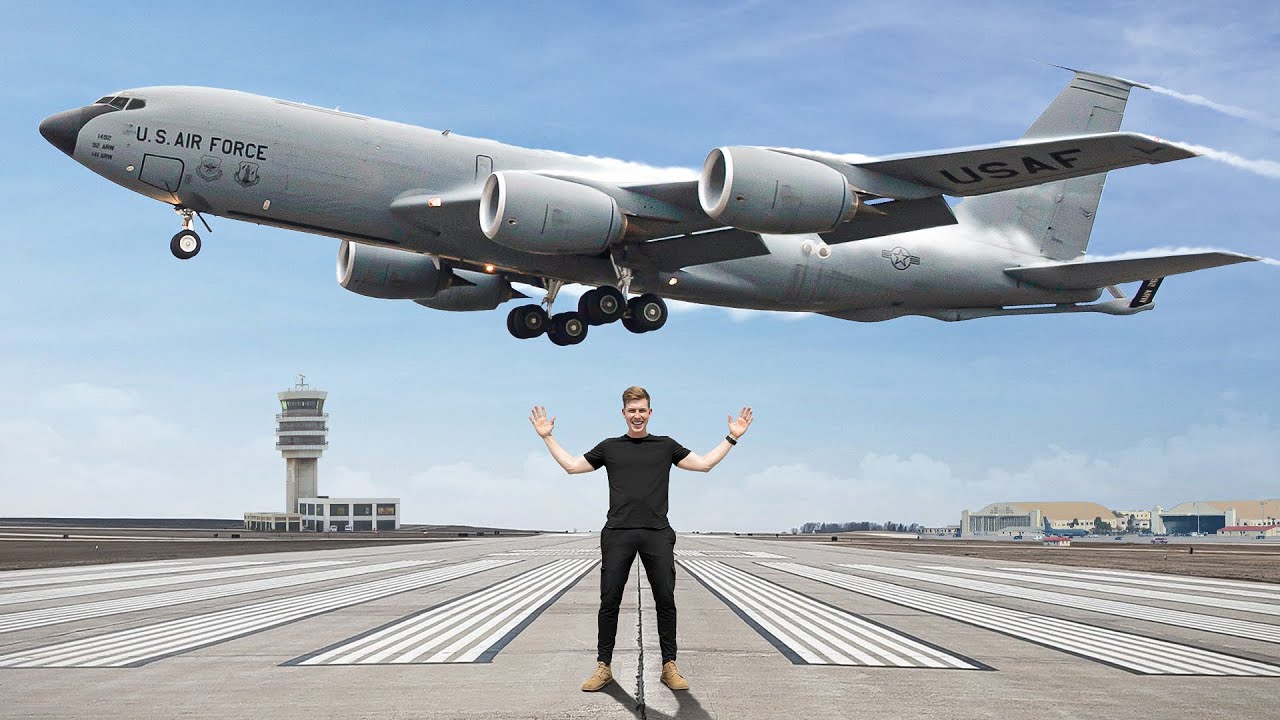
The main weakness, the report argues, is the US reliance on aging aircraft like Boeing KC-135 Stratotankers. Many of the current airframes entered service in the 1950s and 1960s, and are still going strong.

The airframes have been upgraded repeatedly, but old aircraft require more maintenance and suffer more breakdowns. And that leads to the second main issue: a lack of spare parts.

The US military increasingly struggles to obtain parts for older systems. Some suppliers no longer exist, and some components must be specially manufactured. Any break in supply means that assets, like aircraft, can sit grounded while waiting for parts.

Not how much you make, it’s how much you keep

So, even if you have 400 tankers on paper, perhaps only 250 are actually flyable on a given day. Other issues cited include a shortage of skilled personnel and delays in replacement hardware for older tech, like the planned Boeing KC-46 Pegasus.

But the KC-46 program has experienced years of technical problems and delays. The Air Force expected newer tankers to reduce pressure on older aircraft.

When factoring in the fact that China reportedly possesses long-range missiles specifically designed to target US bases and support aircraft, any direct conflict could prove very expensive for the US.

China’s military planners, the South China Morning Post (SCMP) reports, understand that destroying tankers may be more effective than trying to shoot down stealth fighters.

So, would such a conflict mean China could win? Not necessarily, since China has its own issues (like a lack of combat experience), but a “home advantage” would certainly tip the odds in its favor unless the US can cure its growing logistical bottlenecks.
💾

New reports suggest ageing tankers and logistics shortfalls could hinder US operations in a Pacific conflict.
  •  

Turkey’s AKYA heavyweight torpedo destroys target ship in major naval exercise

The Turkish Ministry of Defense reports that it has successfully tested the nation’s first domestically-produced heavyweight torpedo, the AKYA. Launched from the Preveze-class submarine TCG Sakarya, the torpedo acquired, tracked, and hit its target, reportedly breaking the target ship in two.

According to reports, the test was part of the Republic’s Denizkurdu II exercise held in the Eastern Mediterranean earlier this month. During the exercise, the TCG Sokullu Mehmet Paşa (a retired training ship) was deliberately sunk as part of a SINKEX (Sink Exercise).

Such exercises are critical for evaluating the real-world performance of weapons like torpedoes, as only so much can be learned from computer modelling. Actual sinking exercises provide valuable data on structural damage, flooding, shock effects, and sinking behaviour.

Developed by the Ankara-based defense company Roketsan, the AKYA is an impressive piece of kit, at least on paper. It has a diameter of 21 inches (53.3 cm), has a reported range of 27 nautical miles (50 km), and can travel at a speed of around 45 knots (83 kph).

Home-built for home defense

The electrically-propelled torpedo is guided using a combination of active and passive sonar, and can also track targets using wake homing. This latter capability, as the name suggests, enables the torpedo to follow the disturbance made by a ship as it moves through water.

The advantage is that it’s much harder to decoy than a torpedo, simply chasing engine noise. The torpedo doesn’t care where the ship is now; it just follows where the ship has been.

The torpedo also features autonomous or fiber-optic guidance capabilities. The latter enables the submarine to update target information, refine the attack profile, and improve accuracy throughout the engagement.

Apart from the torpedo itself, another major innovation for the Turkish navy was the use of the MÜREN Submarine Combat Management System (CMS). Also domestically developed, this system works as the submarine’s “brain.”

In modern submarines, such systems collect sonar information, track targets, and calculate firing solutions. It also manages the guidance process for wire-guided weapons and integrates navigation and tactical displays.

Previously, Turkish submarines relied heavily on foreign systems, but with MÜREN, Turkey is fast becoming less reliant on third parties for critical operations of this nature.

Made in Turkey, not imported

Apart from field testing the AKYA torpedo, the Denizkurdu II exercise also featured the testing of Turkey’s latest surface-to-surface missile, the ATMACA. Launched from the Ada-class corvette TCG Kınalıada, this domestically-produced guided anti-ship missile hit a retired open-sea tugboat, the TCG Akbaş.

Taken together, both these tests show that Turkey is making concerted efforts to reduce its dependence on foreign suppliers for military hardware. Historically, the nation relied heavily on German and American combat systems and weapons, but is increasingly replacing critical components with domestically developed alternatives.

The goal appears to be to develop an entirely national underwater warfare ecosystem where critical software, weapons, and support are under Turkish control.

For military planners, that can be as important as the weapon itself because it reduces vulnerability to export restrictions, sanctions, spare-part shortages, or political disagreements.

💾

Turkey's indigenous AKYA torpedo sinks a retired warship in a live-fire test, marking a key naval milestone.
  •  
❌