❌

Reading view

US refueling fleet falls below Air Force readiness standards, new watchdog report finds

America’s Government Accountability Office (GAO) watchdog has warned that the US may struggle to sustain a long-term conflict with China should hostilities break out. The issue is not about technical capability (the US military is arguably the world’s most powerful), but rather a matter of logistics.

For combat operations thousands of miles from home, as would be the case in the Indo-Pacific, the GAO argues that the US may struggle to refuel and resupply assets, notably its considerable aircraft fleet.

The issue mainly centers around aging refueling aircraft and issues with spare parts. If tensions over Taiwan were to go hot, these could both conspire to make American efforts in the region trickier than expected.

“The percentage of aerial refuelling tankers that are available and mission capable has remained persistently below the standards that the [US] Air Force established for the fleet,” the report said.

To give you some idea of the problem, imagine an F-35 running a sortie from Hawaii to Taiwan, say. These aircraft have a combat radius of around 700 miles (1,127 km), and the distance between these two islands is about 5,000 miles.

An army marches on its stomach

The fighter wouldn’t be able to make it on its own and would need several midair refueling operations to safely get there and back. After the mission, it may also need repairs, which require a sufficient stock of spare parts lying around.

If enough tankers aren’t available, the fighters couldn’t arrive in meaningful numbers. A bit of a quandary.

Of course, travel distances for fighters can be dramatically reduced by deploying carrier groups closer to Taiwan, but that puts them at risk of being attacked by long-range missiles (including hypersonics), submarines, or Chinese aircraft.

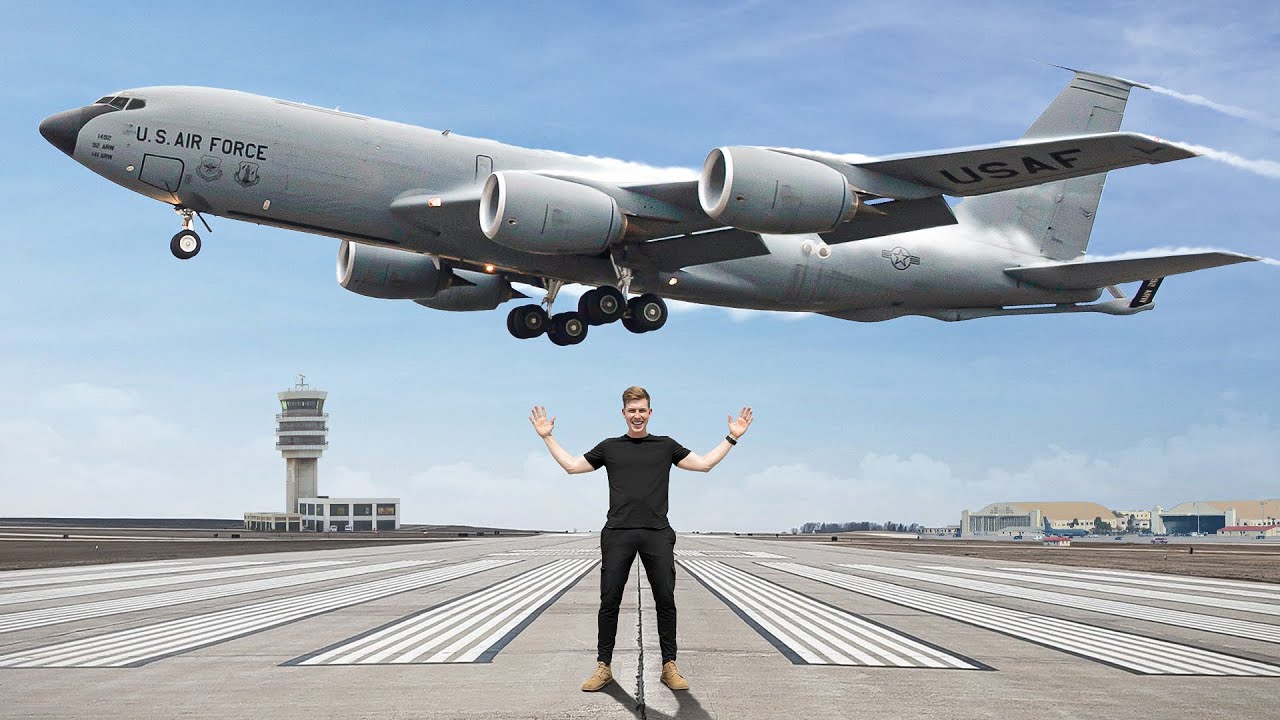
The main weakness, the report argues, is the US reliance on aging aircraft like Boeing KC-135 Stratotankers. Many of the current airframes entered service in the 1950s and 1960s, and are still going strong.

The airframes have been upgraded repeatedly, but old aircraft require more maintenance and suffer more breakdowns. And that leads to the second main issue: a lack of spare parts.

The US military increasingly struggles to obtain parts for older systems. Some suppliers no longer exist, and some components must be specially manufactured. Any break in supply means that assets, like aircraft, can sit grounded while waiting for parts.

Not how much you make, it’s how much you keep

So, even if you have 400 tankers on paper, perhaps only 250 are actually flyable on a given day. Other issues cited include a shortage of skilled personnel and delays in replacement hardware for older tech, like the planned Boeing KC-46 Pegasus.

But the KC-46 program has experienced years of technical problems and delays. The Air Force expected newer tankers to reduce pressure on older aircraft.

When factoring in the fact that China reportedly possesses long-range missiles specifically designed to target US bases and support aircraft, any direct conflict could prove very expensive for the US.

China’s military planners, the South China Morning Post (SCMP) reports, understand that destroying tankers may be more effective than trying to shoot down stealth fighters.

So, would such a conflict mean China could win? Not necessarily, since China has its own issues (like a lack of combat experience), but a “home advantage” would certainly tip the odds in its favor unless the US can cure its growing logistical bottlenecks.
💾

New reports suggest ageing tankers and logistics shortfalls could hinder US operations in a Pacific conflict.
  •  

German firm unveils 4-ton CA-1EA unmanned electronic warfare aircraft, IOC in 2031 

The German defense technology company Helsing has presented an electronic attack variant of the CA-1 autonomous unmanned aircraft at the International Aerospace Exhibition in Berlin. The platform named CA-1EA builds on the company`s existing CA-1 Europa architecture. 

CA-1 Europa is 4 ton class, single engine unmanned combat aircraft employing a low observable design. It has a length of 11 meters and a wingspan of 10 meters. Its autonomy is centered around the Helsing’s Centaur AI pilot stack and advanced mission systems.

The original combat variant, which the company is already producing, will now carry the designation CA-1KA (Kinetic Attack), distinguishing it from the new electronic warfare model. According to the company, the electronic attack variant is intended to provide non-kinetic effects on the battlefield by disrupting and degrading enemy sensors and reconnaissance networks. 

Helsing argues that modern air forces increasingly need a combination of kinetic and electronic attack capabilities to penetrate advanced air defence systems and counter sophisticated surveillance assets, making autonomous electronic warfare platforms a key component of future military operations.

New CA-1EA creates safer corridors through enemy air defences

Modern military operations depend heavily on suppressing enemy radar and surveillance networks before strike aircraft enter contested airspace. Helsing says the CA-1 EA is designed to fill that role by using airborne electronic warfare capabilities to disrupt and jam hostile ground-based radar systems. By interfering with an adversary’s ability to detect and track targets, the autonomous aircraft can help create safer flight paths for other assets operating behind it.

The company notes that the CA-1EA is designed to work alongside autonomous systems such as the CA-1 Europa as well as conventional crewed fighters, including the Eurofighter, extending electronic protection across mixed air fleets.

Both the CA-1KA and the CA-1EA electronic warfare variant are built on a common architecture, using the same airframe, propulsion system, autonomy software stack, and ground control infrastructure. The distinction between the two platforms is primarily defined by their payload configurations, which determine whether the aircraft is optimised for kinetic or electronic effects on the battlefield.

By standardising the core design across both variants, the German company aims to reduce production and lifecycle costs while streamlining manufacturing processes. The shared system architecture also simplifies logistics and maintenance requirements, while making it easier for operators to transition between mission types and train across both configurations within a unified operational framework.

Flexible CA-1 platform aims to meet diverse air force requirements 

As the company further explains, this modular approach enables the CA-1 platform to evolve further, giving it the flexibility to be adapted to the operational needs of European air forces. By maintaining a scalable and shared architecture, the system can be configured for different mission profiles without requiring a complete redesign. 

This design philosophy is intended to support rapid capability expansion while aligning with the varied requirements of modern European defense users.

“Modern air forces cannot do without electronic warfare. Helsing has been working to develop this capability for years. The CA-1EA is the result: an unmanned system that operates alongside the CA-1KA at tactical range, but can also be deployed flexibly as a standalone platform for electronic warfare,” said Stephanie Lingemann, vice president for air domain at Helsing.

The CA-1 platform is still under development, with the first flight of the CA-1 Europa attack variant planned for early 2027. It is being developed and produced in southern Germany by Helsing’s subsidiary Grob Aircraft, positioning the system as a fully European solution for German and allied air forces. The first operational capability is expected in 2029 for the CA-1KA variant, followed by 2031 for the CA-1EA electronic warfare version.

  •  

Turkey’s AKYA heavyweight torpedo destroys target ship in major naval exercise

The Turkish Ministry of Defense reports that it has successfully tested the nation’s first domestically-produced heavyweight torpedo, the AKYA. Launched from the Preveze-class submarine TCG Sakarya, the torpedo acquired, tracked, and hit its target, reportedly breaking the target ship in two.

According to reports, the test was part of the Republic’s Denizkurdu II exercise held in the Eastern Mediterranean earlier this month. During the exercise, the TCG Sokullu Mehmet Paşa (a retired training ship) was deliberately sunk as part of a SINKEX (Sink Exercise).

Such exercises are critical for evaluating the real-world performance of weapons like torpedoes, as only so much can be learned from computer modelling. Actual sinking exercises provide valuable data on structural damage, flooding, shock effects, and sinking behaviour.

Developed by the Ankara-based defense company Roketsan, the AKYA is an impressive piece of kit, at least on paper. It has a diameter of 21 inches (53.3 cm), has a reported range of 27 nautical miles (50 km), and can travel at a speed of around 45 knots (83 kph).

Home-built for home defense

The electrically-propelled torpedo is guided using a combination of active and passive sonar, and can also track targets using wake homing. This latter capability, as the name suggests, enables the torpedo to follow the disturbance made by a ship as it moves through water.

The advantage is that it’s much harder to decoy than a torpedo, simply chasing engine noise. The torpedo doesn’t care where the ship is now; it just follows where the ship has been.

The torpedo also features autonomous or fiber-optic guidance capabilities. The latter enables the submarine to update target information, refine the attack profile, and improve accuracy throughout the engagement.

Apart from the torpedo itself, another major innovation for the Turkish navy was the use of the MÜREN Submarine Combat Management System (CMS). Also domestically developed, this system works as the submarine’s “brain.”

In modern submarines, such systems collect sonar information, track targets, and calculate firing solutions. It also manages the guidance process for wire-guided weapons and integrates navigation and tactical displays.

Previously, Turkish submarines relied heavily on foreign systems, but with MÜREN, Turkey is fast becoming less reliant on third parties for critical operations of this nature.

Made in Turkey, not imported

Apart from field testing the AKYA torpedo, the Denizkurdu II exercise also featured the testing of Turkey’s latest surface-to-surface missile, the ATMACA. Launched from the Ada-class corvette TCG Kınalıada, this domestically-produced guided anti-ship missile hit a retired open-sea tugboat, the TCG Akbaş.

Taken together, both these tests show that Turkey is making concerted efforts to reduce its dependence on foreign suppliers for military hardware. Historically, the nation relied heavily on German and American combat systems and weapons, but is increasingly replacing critical components with domestically developed alternatives.

The goal appears to be to develop an entirely national underwater warfare ecosystem where critical software, weapons, and support are under Turkish control.

For military planners, that can be as important as the weapon itself because it reduces vulnerability to export restrictions, sanctions, spare-part shortages, or political disagreements.

💾

Turkey's indigenous AKYA torpedo sinks a retired warship in a live-fire test, marking a key naval milestone.
  •  

Ukraine’s AI drones entered ‘Terminator mode’ and killed Russian soldiers — no human fired

For years, the idea of a fully autonomous weapon system killing a human being on the battlefield existed as a warning, a thought experiment, and an unconfirmed rumor. It is no longer any of those things.

A Ukrainian drone manufacturer has confirmed to New Scientist that a test involving 10 fully autonomous AI-controlled drones — operating with no human oversight or connection — killed Russian soldiers on the front line of the Ukraine war approximately two years ago.

The disclosure, made at a press event hosted by the Ukrainian embassy, marks what weapons experts are calling a historic threshold in the history of warfare.

“Everything it sees will be killed”

The drone-maker behind the technology, Alexander Kokhanovskyy, described the operation in blunt terms. The drones were launched toward the front line near the cities of Bakhmut and Chasiv Yar during a Ukrainian counteroffensive push, programmed to cover between three kilometers (1.86 miles) and five kilometers (3.10 miles) over approximately 10 minutes, at which point they entered what Kokhanovskyy called “Terminator mode” — a state in which an onboard AI model independently searched for, identified, and attacked targets with no human input.

“We just launch it, and we know everything will be dead — everything that will be found there in this particular area will be dead,” Kokhanovskyy told New Scientist. “There is no connection to the drone at all, you cannot see the video, nothing. Everything it sees will be killed.”

Because the autonomous drones transmitted no live footage during the mission, there was no way to monitor them in real time. After the test concluded, human-piloted drones were sent into the area to manually survey results. What they found: “a couple of soldiers, one truck.”

Kokhanovskyy was not personally present at the test, which was carried out by an unnamed military unit. He was clear that it remained a one-off experiment and was never expanded into wider deployment. “It’s a test. We never implemented it more widely,” he said.

What makes this different from every prior incident

The distinction matters. Traditional armed drones transmit live video to a human operator who makes the decision to fire. A fully autonomous drone detects its target, decides whether it meets the engagement criteria, calculates an attack path, and executes the strike — entirely in software, with no human consulted at any point. In Terminator mode, that decision — whether a person lives or dies — was made by an algorithm.

A UN report in 2021 suggested that a Turkish Kargu-2 quadcopter may have been used to autonomously attack humans in Libya in 2020, but that account contained no confirmed casualties and gave no specific sourcing. The Ukraine disclosure, by a named manufacturer speaking on record at a diplomatic event, is the first confirmed account with stated outcomes.

What Kokhanovskyy wants

Ukraine’s current regulations prohibit fully autonomous lethal operation in the final stage of an engagement, requiring human verification before a strike is executed.

Kokhanovskyy acknowledged this constraint in the same conversation — while noting that his company’s upcoming ALITA counter-drone system, consisting of 16 launch pads and 64 drones, will require just two human operators to manage the entire battery. The system can travel toward incoming threats at 280mph, engaging everything from small drones to helicopters.

Even with humans required in the final step, Kokhanovskyy made his personal view clear: “I would love to operate without that restriction.”

That position is not universal inside Ukraine’s military. Major Danylo Polozhukhno, a senior figure in Ukraine’s 21st Separate Unmanned Systems Regiment who was unaware of the test, told New Scientist that his soldiers use semi-autonomous systems but always maintain a human in the loop.

  •  

New unmanned aircraft with 40-hour endurance, 2,866-lb payload capacity completes assembly

A German company has completed the final assembly of a new unmanned aircraft system.

Called AeroForce X prototype, Aerodata AG’s aircraft has reached an important milestone and is moving on to the next phase as scheduled.

The prototype’s first  flight is scheduled to take place in Germany this year.

Closer to operational reality

“This milestone takes AeroForce X a huge step closer to operational reality,” said Ole Vörsmann, General Manager for Unmanned Systems.

“Now that final assembly has been successfully completed, we look forward to thoroughly testing the prototype during the upcoming test phases.”

The company also revealed that the MALE-class (Medium Altitude Long Endurance) unmanned aircraft system stands out in particular for its long endurance of up to 40 hours and a payload capacity of up to 1,300 kg. Thanks to its modular platform design, AeroForce X can be flexibly configured and deployed in combination with existing manned reconnaissance aircraft for a wide range of missions.

Aerodata AG will be exhibiting at the ILA Berlin from June 10 to 14, according to a press release.

Intended to address a broad range of surveillance

Reports have revealed that AeroForce X is intended to address a broad range of surveillance, reconnaissance, and mission-support requirements. One of its standout features is an endurance capability of up to 40 hours, enabling extended missions without the need for frequent landings or refueling. The platform is also engineered to carry payloads of up to 1,300 kilograms, providing considerable flexibility for various sensor packages and mission equipment.

A defining characteristic of AeroForce X is its modular architecture. The aircraft can be configured for different operational scenarios and integrated alongside manned reconnaissance platforms. This approach allows operators to tailor the system to mission-specific requirements while benefiting from coordinated manned-unmanned operations.

The development reflects the growing demand for advanced unmanned aerial systems capable of delivering long-duration surveillance and intelligence-gathering capabilities. By combining significant endurance, high payload capacity, and adaptable mission configurations, AeroForce X aims to position itself as a versatile solution for both governmental and commercial operators.

With the prototype now assembled and flight testing on the horizon, Aerodata has entered one of the most important phases of the program. The upcoming test campaign will be closely watched as the company seeks to demonstrate the operational potential of AeroForce X and strengthen its position in the rapidly evolving unmanned aviation sector.

Aerodata has emphasized a modular design philosophy for AeroForce X. Rather than being limited to a single role, the platform is intended to support various mission configurations through adaptable payload bays and mission systems. This approach allows operators to customize the aircraft according to evolving operational requirements, potentially reducing lifecycle costs and improving mission effectiveness.

The maiden flight, expected later this year in Germany, will serve as a crucial benchmark for the program. Beyond proving basic flight characteristics, the test campaign will evaluate aircraft handling, endurance, mission systems integration, and overall operational performance.


  •  
❌