❌

Reading view

Scientists forge 24,000-atom mini universe that generates time without a single clock
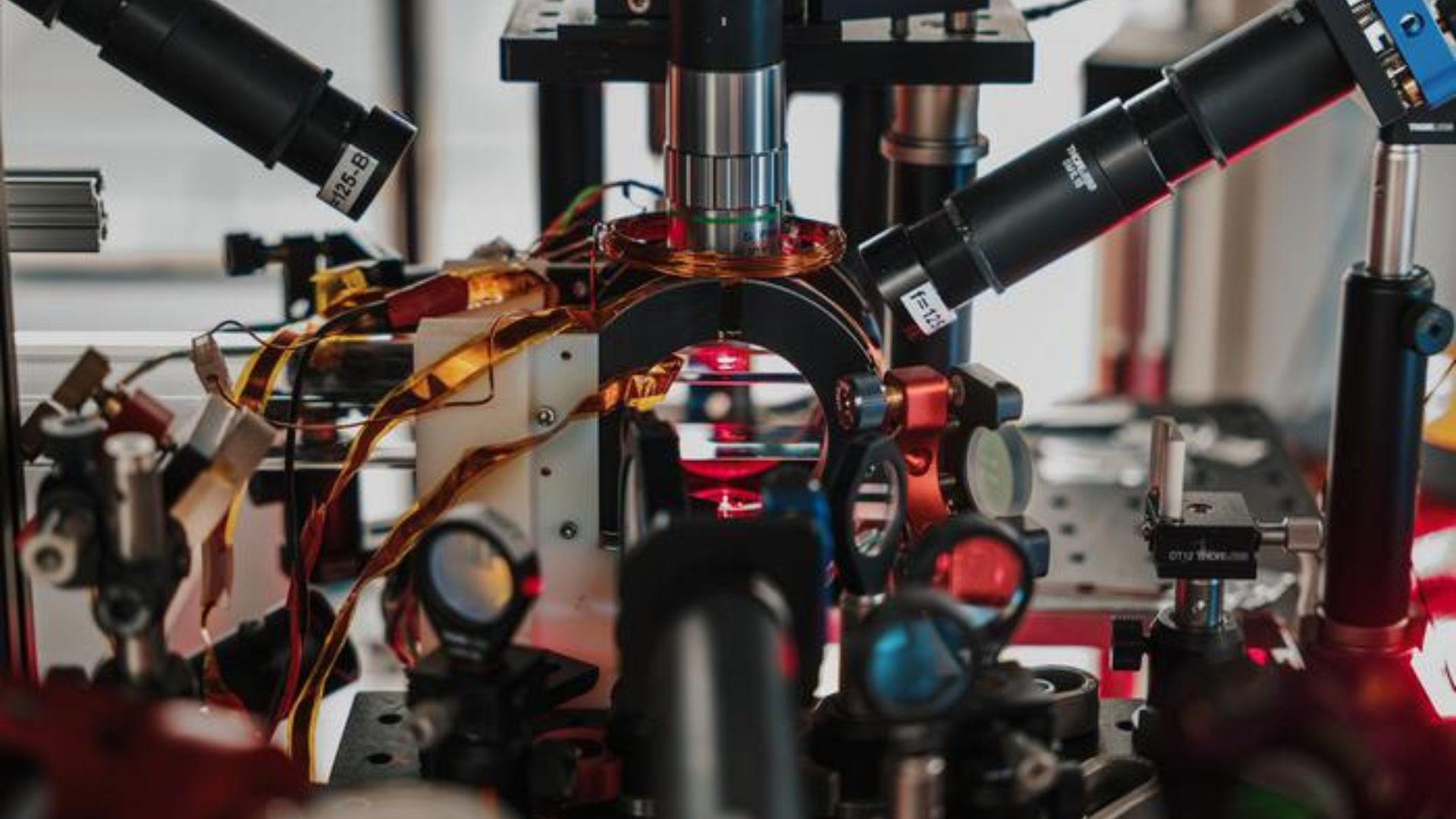
What if time isn’t woven into the fabric of reality at all? A new experiment suggests that the past-to-future march we experience every day could arise from the internal dynamics of a system. Using 24,000 ultracold atoms, scientists built a “mini universe” that allowed them to study how time might emerge without relying on clocks.

The findings, published in Physical Review Research, offer researchers a new way to test ideas that have long remained in the realm of theory. The setup could help scientists explore quantum gravity, the origins of the universe, and the fundamental nature of time inside a laboratory.

Building a mini cosmos

Professor Giovanni Barontini of the University of Birmingham and his team created the miniature universe using a cloud of 24,000 ultracold atoms. The atoms existed just billionths of a degree above absolute zero.
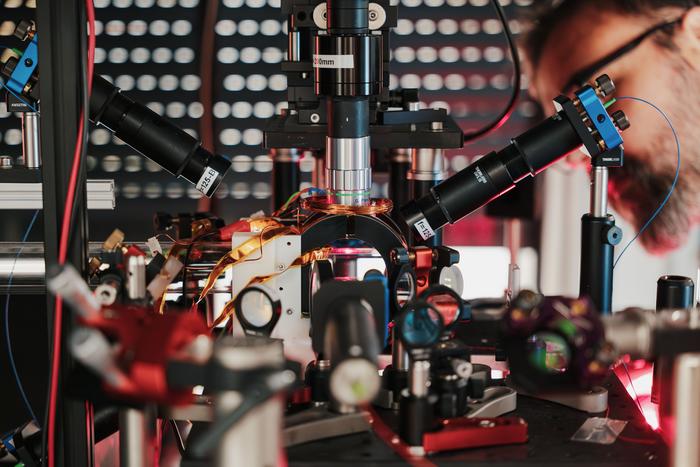
Experiment to trap and cool rubidium atoms close to absolute zero. Credit – University of Birmingham

The researchers confined the particles inside an isolated quantum system. They then used two laser beams to form a thin barrier that divided the setup into two regions. One region remained observable, or “bright.” The other stayed hidden from direct observation and became the “dark” sector.

Inside this simplified cosmos, the bright region repeatedly expanded and contracted. The cycle resembled theoretical versions of a Big Bang followed by a Big Crunch, a scenario in which the universe’s expansion eventually reverses.

Because the system remained sealed from its surroundings, scientists reconstructed the sequence of events using only changes occurring within the mini-universe. They did not need an external laboratory clock.

Time through disorder

The experiment points to a concept known as “entropic time.” Rather than treating time as an independent backdrop to reality, the researchers linked its passage to changes in entropy, or the way particles spread through the system. Atoms moved between the bright and dark regions, altering the distribution of matter.

As those distributions evolved, the system moved forward in time. When the arrangement stopped changing, time effectively stood still. The team found that this version of time flowed in a consistent direction. It also correctly ordered events, even during repeated cycles of expansion and contraction. Its pace could speed up or slow down depending on how entropy shifted within the system.

“In some theories of the universe, especially quantum gravity, time doesn’t appear as a built-in feature,” Barontini said. “Yet in everyday life, time flows from past to future. Why is this so, when most basic laws of physics work the same way forwards and backwards?”

Bringing cosmology to the lab

Barontini said the study provides controlled experimental evidence that changes within a system can define time without relying on an external clock. “It offers new insight into the nature of time in quantum gravity,” he said. “It could be used to describe dynamics just as effectively as conventional time.”

The researchers also showed that quantum mechanics remains mathematically consistent under this framework. They rewrote a version of the Schrödinger equation using entropic time, allowing predictions about how a quantum probability distribution evolves.

The work addresses a long-standing puzzle in physics: If the universe has no fundamental clock, how can events be arranged into a meaningful sequence of “before” and “after”? Perhaps more importantly, the experiment transforms abstract debates into testable science.

The platform could eventually allow researchers to investigate conditions linked to the early universe, probe competing theories of quantum gravity, and even simulate black holes under controlled laboratory conditions.

For decades, many of these questions existed mainly on chalkboards and in complex equations. This miniature universe suggests physicists may finally have a way to put some of them to the test.


  •  

UK trials compact G-size sonobuoy built for autonomous drones hunting submarines

Ultra Maritime has completed the first in-water deployment trial of its next-generation Multistatic Active Receive Sonobuoy, or MSARS, in Scotland, marking a major step in the United Kingdom’s push to modernize anti-submarine warfare.

The trial comes as NATO nations monitor growing submarine activity across the North Atlantic. Military planners increasingly seek tools that can detect quieter submarines and unmanned underwater systems operating over larger maritime areas.

MSARS aims to strengthen those capabilities. The compact sonobuoy is designed to improve the detection and localization of underwater threats while supporting both crewed and uncrewed operations.

Expanding underwater surveillance

Ultra Maritime developed the system with backing from the UK’s Defence Science and Technology Laboratory, known as Dstl. The effort supports the Atlantic Bastion program, which focuses on expanding autonomous anti-submarine warfare capabilities. The initiative seeks to bring uncrewed aircraft into submarine hunting missions while improving coordination with existing crewed assets. Those assets include the Royal Navy’s Merlin Mk2 helicopter fleet.

Unlike traditional approaches that rely heavily on crewed aircraft, Atlantic Bastion emphasizes distributed operations. Multiple platforms can share information and work together to track underwater targets across wider areas. The company said rising submarine activity has increased the urgency for improved detection technologies.

“Enhanced detection and localization of threat submarines and unmanned underwater vehicles are critical to maintaining operational advantage,” Ultra Maritime said. MSARS gives operators flexibility before deployment. Crews can configure mission settings through a built-in digital interface before launching the sonobuoy from an aircraft.

Integration with SeaGuardian

Ultra Maritime is also working with General Atomics to integrate MSARS and other G-size sonobuoys onto the MQ-9B SeaGuardian unmanned aircraft. The pairing could significantly expand anti-submarine warfare coverage.

SeaGuardian’s endurance allows it to remain on station far longer than many traditional platforms. Combined with compact sonobuoys, operators could survey larger sections of ocean without increasing crew requirements.

Ultra Maritime says the integration would extend operational reach, increase sonobuoy carrying capacity, and support distributed multistatic operations in contested environments. The company also noted that it remains the only manufacturer producing G-size sonobuoys. Their smaller form factor makes them particularly suited for unmanned aircraft missions.

Broader sonobuoy push

The Scottish trial arrives as Ultra Maritime expands its sonobuoy business through production contracts and international partnerships. Earlier this year, the company secured a U.S. Navy contract covering low-rate initial production of the AN/SSQ-125B sonobuoy. The system aims to improve the detection of increasingly quiet submarines operating in challenging acoustic conditions.

Ultra Maritime has also expanded its presence in Europe. In 2025, France selected the company to provide active and passive sonobuoys under a contract awarded by Thales on behalf of the country’s defense procurement agency.

For defense planners on both sides of the Atlantic, the latest MSARS milestone represents more than a successful trial. It highlights a broader shift toward networked and increasingly autonomous anti-submarine operations designed for a more contested maritime environment.

  •  

Halo nuclear microreactor utilizes high-fidelity simulation to speed first power

The newly public company Hadron Energy has announced that it has selected GSE Solutions to develop a full-scope, high-fidelity simulator for its Halo Micro-Modular Reactor (MMR). The simulator will prepare future operators for licensing exams and day-to-day operations. It also marks another step toward commercializing the Halo reactor design.

The agreement expands the relationship between the two companies into a strategic alliance. Hadron plans to use the simulator for its first reactor deployment and future commercial units as production scales.

Training comes first

No commercial nuclear reactor in the United States can operate without NRC-licensed personnel in the control room. Those licenses require extensive training, including simulator-based testing that reflects the actual plant operators will oversee.

GSE will oversee the simulator from development through commissioning. Built specifically for the Halo MMR, it will mimic everything from normal plant operations to emergency situations. The system will prepare the first wave of operators and technical staff responsible for bringing the reactor online.

The simulator goes beyond being a simple teaching tool. It represents a regulatory requirement that operators must satisfy before a reactor produces electricity. Without it, a plant cannot move into commercial operation.

Beyond regulatory boxes

The technology also provides engineering value long before fuel reaches the site. Teams can use it to verify procedures, assess control room interactions, and evaluate how operators respond under pressure.

Developing the simulator alongside the reactor design could help Hadron identify potential issues earlier in the process. Engineers can address operability concerns while modifications remain easier and less costly.

“You cannot commission a nuclear plant without certified operators,” Ross Ridenoure, Hadron Energy’s chief nuclear officer, said in a statement. “You cannot certify operators without a high-fidelity simulator that represents the plant they are going to operate.”

Ridenoure said involving GSE during the design phase allows the company to replicate the plant virtually as engineering work continues. That approach can expose human-factors concerns before construction advances too far.

Leveraging industry experience

GSE brings more than 50 years of simulator expertise to the partnership. The company and its predecessors built one of the first commercial full-scope nuclear simulators in 1971. Its experience now spans a broad range of reactor technologies, including pressurized water reactors, boiling water reactors, CANDU units, VVER designs, and next-generation systems.

Hadron believes that experience can reduce some of the development risks associated with first-of-a-kind nuclear projects. GSE’s background with simulator certification and industry standards could also support a smoother regulatory pathway.

The announcement follows Hadron’s recent partnership with Paragon Energy Solutions, a Mirion Technologies company, to support the Halo MMR’s instrumentation and control architecture. The simulator will ultimately mirror those same control systems during operator training.

“An advanced reactor without trained, licensed operators is not a power plant,” Ridenoure said. “It is an asset sitting idle.”

He added that bringing experienced partners into the program early reflects the disciplined execution shareholders and future customers should expect as Hadron advances toward first power. For Hadron, operator readiness now stands alongside reactor development as a defining milestone on the path to commercialization.

  •  
❌