
❌

Reading view

Chinese military study outlines strategy to target US warships from 1,800 miles away
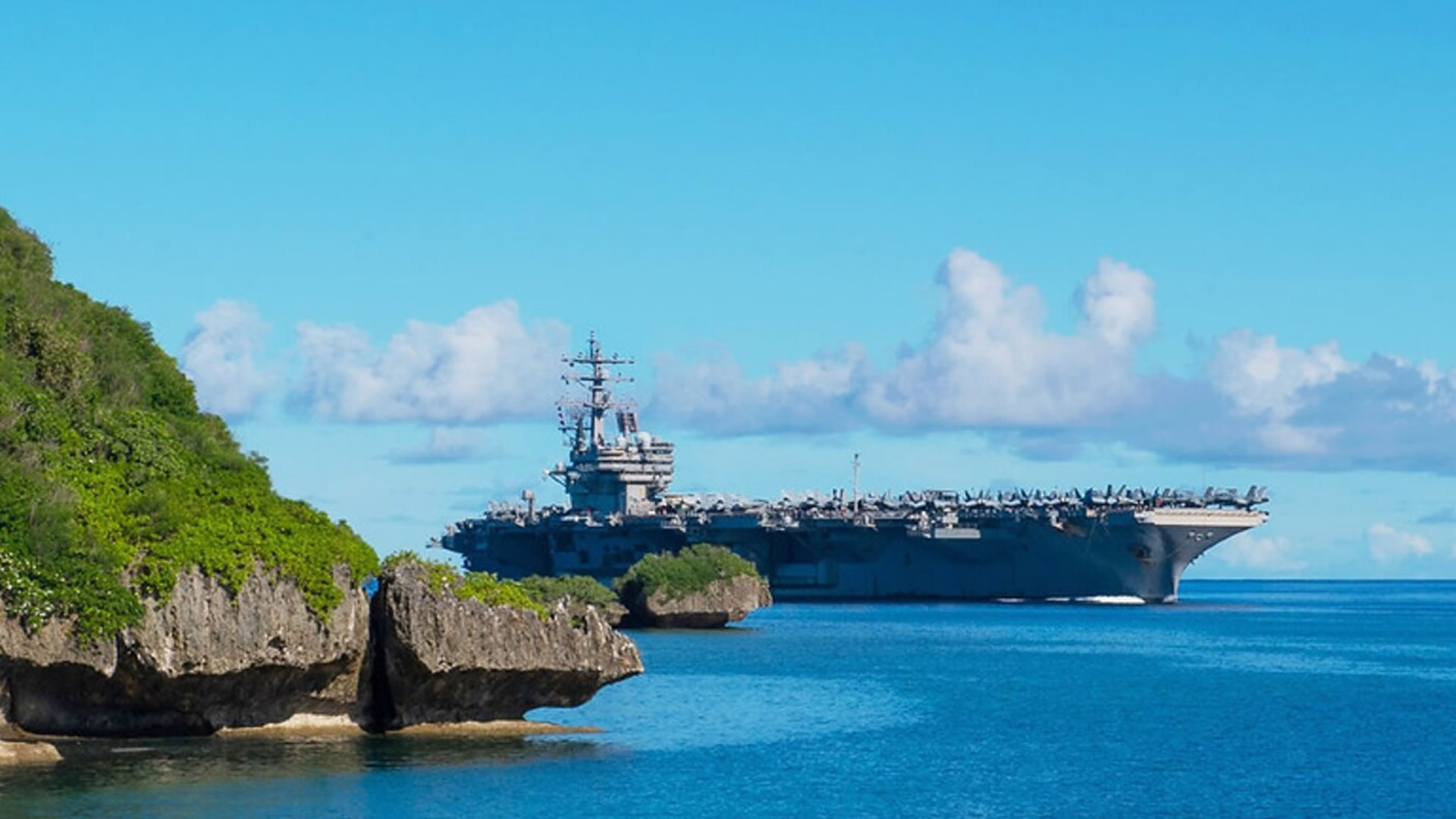
Chinese military planners have reportedly devised a plan to target US carriers in places like Guam. The strategy, published in the Chinese journal Tactical Missile Technology, claims a combination of satellites, AI, and missiles could render carrier groups vulnerable, even at distances of over 1,620 nautical miles (3,000 km).

At present, both the People’s Liberation Army (PLA) and the United States Navy know that the former can threaten critical assets like aircraft carriers close to China. To reduce that threat, the US Navy has increasingly positioned key assets farther from China’s coastline, relying on bases such as Guam and adopting more dispersed operating patterns across the Pacific.

The Navy has also been dispersing deployed ships in the region to make them much harder to find, track, and potentially attack. Not keeping their eggs in one basket, as it were.

However, as the South China Morning Post (SCMP) reports, the PLA has been working on a potential plan to threaten such ships even at great distances. Led by associate professor Gao Tianyun from the College of International Studies at the National University of Defence Technology in Nanjing, the proposal is very interesting indeed.

Dangerous game of hide-and-seek

The study, titled “Research on the effectiveness of anti‑ship missile swarm operation under distributed confrontation,” basically describes an innovative “kill-chain” solution rather than a new wonder weapon.

The idea, in a nutshell, is to first find the group using a mixture of satellites, drones, radar aircraft, ships, submarines, signals intelligence, etc. Once done, the plan would rely on near-constant tracking for long-range missiles to be targeted and launched.

With that achieved, the paper suggests firing many missiles (a mix of hypersonics and “pre-strike firepower packages”) at the target, not one or two.

Once in flight, the plan would rely on the missiles cooperating by sharing target data, sorting real ships from decoys, assigning themselves to different targets, and attacking from different angles.

According to the researchers, such a coordinated attack could overwhelm layers of US naval defense, including Aegis-equipped destroyers, interceptor missiles, electronic warfare systems, decoys, and close-in weapon systems.

So, something of a coordinated, long-range missile swarm attack. The point is to make the US defence system run out of time, interceptors, radar capacity, or correct target choices.

Means and motive

Sounds reasonable on the surface, but the plan comes with one major caveat. That being said, this is just a plan right now, not proof that China can actually do it tomorrow.

Needless to say, hitting a moving carrier group at 1,620 nautical miles distant is not an easy task. Achieving it in reality would be brutally hard because the target moves, hides, jams, uses decoys, and fights back.

The hardest part is not the missile range; it is maintaining accurate targeting data across the whole chain. While effectively just a wargame made public, the release of this information is likely intended to send a warning to the US, rather than actually boast about its technological prowess.

In effect, they are saying that hiding and dispersing your ships won’t necessarily keep you safe. We (China) have the means to get them if we want to.

💾

A new Chinese study reveals a blueprint to defeat US Navy carrier groups using AI and missile swarms.
  •  

US Navy’s nuclear-powered fast-attack submarine returns to fleet

US Navy’s Virginia-class fast-attack submarine has returned to the fleet ahead of schedule. The nuclear-powered USS Colorado (SSN 788) was undergoing scheduled maintenance at the Pearl Harbor Naval Shipyard (PHNSY) and the Intermediate Maintenance Facility (IMF).

The submarine completed its maintenance 29 days ahead of schedule on June 10. It has rejoined the fleet and is now ready to serve in the Submarine Squadron 7 to ensure dominance in the Pacific.

The nuclear-powered vessel is capable of supporting various missions, such as anti-submarine warfare; anti-surface ship warfare; strike warfare; special operations forces support; and intelligence, surveillance, and reconnaissance.

Maintenance of Navy vessels at PHNSY and IMF

The PHNSY and IMF are located in the heart of the Pacific to ensure a comprehensive fleet repair and maintenance facility. It is one of the most comprehensive facilities of its kind between the U.S. West Coast and the Far East. Its mission is to keep the US Navy’s fast-attack submarines and surface ships ‘Fit to Fight’.

Effective and timely maintenance helps keep the Navy vessels lethal, ready to defend the country, and also maximizes their lifespan. The maintenance of the USS Colorado was completed ahead of schedule by the combined efforts of the crew from the shipyard and the vessel.

“Finishing ahead of schedule is not about rushing; it’s about hard work and persistence,” said U.S. Navy Capt. Ryan McCrillis, commander of PHNSY & IMF. “It’s producing first-time, high-quality work and attacking every roadblock with urgency.”

McCrillis further said that the early completion was a result of team effort, “from the newest apprentice to senior shipyard leaders, the ship’s force, the project team, and support from the fleet and headquarters.”

More about the nuclear-powered USS Colorado submarine

USS Colorado was commissioned on March 17, 2018, at Naval Submarine Base New London. It is the 15th Virginia-class fast-attack submarine and fifth Block III submarine of the class.

Displacing approximately 7,800 tons with a length of 370 feet, Virginia is longer but lighter than the previous Seawolf-class submarines. It can sail at speeds exceeding 28.7 miles per hour (25 knots) and can operate at a maximum depth of over 800 feet.  For propulsion, it relies on a S9G reactor, which produces over 40,000 shaft horsepower (SHP).

The nuclear-powered vessel has effectively limitless range and the ability to operate submerged for months. The range is limited only by the food and supplies that the crew needs to carry.

Colorado is a part of the Virginia-class’s third, or Block III, contract, in which the Navy redesigned approximately 20 percent of the ship to reduce acquisition costs.

The submarine features a redesigned bow, which replaces 12 individual Vertical Launch System (VLS) tubes with two large-diameter Virginia Payload Tubes (VPTs), each capable of launching six Tomahawk cruise missiles. There are other design changes that reduced the submarines’ acquisition cost while maintaining their warfighting capabilities.

It also has special features to support Special Forces – which include a reconfigurable torpedo room that can accommodate a large number of personnel and their equipment for prolonged deployments.

  •  

UK trials compact G-size sonobuoy built for autonomous drones hunting submarines

Ultra Maritime has completed the first in-water deployment trial of its next-generation Multistatic Active Receive Sonobuoy, or MSARS, in Scotland, marking a major step in the United Kingdom’s push to modernize anti-submarine warfare.

The trial comes as NATO nations monitor growing submarine activity across the North Atlantic. Military planners increasingly seek tools that can detect quieter submarines and unmanned underwater systems operating over larger maritime areas.

MSARS aims to strengthen those capabilities. The compact sonobuoy is designed to improve the detection and localization of underwater threats while supporting both crewed and uncrewed operations.

Expanding underwater surveillance

Ultra Maritime developed the system with backing from the UK’s Defence Science and Technology Laboratory, known as Dstl. The effort supports the Atlantic Bastion program, which focuses on expanding autonomous anti-submarine warfare capabilities. The initiative seeks to bring uncrewed aircraft into submarine hunting missions while improving coordination with existing crewed assets. Those assets include the Royal Navy’s Merlin Mk2 helicopter fleet.

Unlike traditional approaches that rely heavily on crewed aircraft, Atlantic Bastion emphasizes distributed operations. Multiple platforms can share information and work together to track underwater targets across wider areas. The company said rising submarine activity has increased the urgency for improved detection technologies.

“Enhanced detection and localization of threat submarines and unmanned underwater vehicles are critical to maintaining operational advantage,” Ultra Maritime said. MSARS gives operators flexibility before deployment. Crews can configure mission settings through a built-in digital interface before launching the sonobuoy from an aircraft.

Integration with SeaGuardian

Ultra Maritime is also working with General Atomics to integrate MSARS and other G-size sonobuoys onto the MQ-9B SeaGuardian unmanned aircraft. The pairing could significantly expand anti-submarine warfare coverage.

SeaGuardian’s endurance allows it to remain on station far longer than many traditional platforms. Combined with compact sonobuoys, operators could survey larger sections of ocean without increasing crew requirements.

Ultra Maritime says the integration would extend operational reach, increase sonobuoy carrying capacity, and support distributed multistatic operations in contested environments. The company also noted that it remains the only manufacturer producing G-size sonobuoys. Their smaller form factor makes them particularly suited for unmanned aircraft missions.

Broader sonobuoy push

The Scottish trial arrives as Ultra Maritime expands its sonobuoy business through production contracts and international partnerships. Earlier this year, the company secured a U.S. Navy contract covering low-rate initial production of the AN/SSQ-125B sonobuoy. The system aims to improve the detection of increasingly quiet submarines operating in challenging acoustic conditions.

Ultra Maritime has also expanded its presence in Europe. In 2025, France selected the company to provide active and passive sonobuoys under a contract awarded by Thales on behalf of the country’s defense procurement agency.

For defense planners on both sides of the Atlantic, the latest MSARS milestone represents more than a successful trial. It highlights a broader shift toward networked and increasingly autonomous anti-submarine operations designed for a more contested maritime environment.

  •  

Potato-shaped UFO? Pentagon releases 72 new reports of unexplained objects

The Department of War has released a third batch of declassified records tied to unidentified anomalous phenomena (UAP), adding 72 files that describe unexplained sightings reported by military personnel, federal agents, and foreign observers.

The release is part of the PURSUE program, launched after President Donald Trump directed federal agencies to identify, review, and declassify records related to UFOs, UAPs, and potential extraterrestrial activity.

The newly released documents do not provide evidence of alien life or a government cover-up. Instead, they offer additional details about several unresolved cases that investigators have been unable to conclusively explain.

According to the Department of War, unresolved cases are incidents where available data is insufficient to determine the nature of the observed object or phenomenon.

Strange objects, few answers

One of the most detailed reports involves a February 2022 sighting near Colorado Springs, Colorado. Five US Army personnel at Fort Carson reported seeing an unusual object hovering above Cheyenne Mountain.

“The object was ‘potato’ shaped with distinct edges and appeared to look painted in a creamy/whitish opalescent color,” an FBI document states. Witnesses said the object appeared to consist of “articulating fish scales or panels that were non-symmetrical, non-overlapping and irregular shaped.”

According to the report, the object remained stationary for roughly two minutes before disappearing. No photographs or videos were captured.

Investigators later assessed with “low confidence” that the sighting may have resulted from sunlight reflecting off snow-covered terrain and illuminating clouds. However, witnesses reported clear skies, and investigators found no evidence of balloons, aircraft, or known foreign technology in the area.

Another case involved six federal law enforcement agents who reported repeatedly observing bright orange and red orbs in October 2023. According to the documents, the objects appeared above a ridgeline and, in some instances, seemed to generate additional smaller orbs.

An analysis conducted by the Pentagon’s All-Domain Anomaly Resolution Office reviewed several possible explanations, including military exercises and flare deployments occurring nearby. The report said those explanations were plausible but not conclusive and noted that the observations could involve “unrecognized technology.”

Global reports surface

The latest release also includes an FBI report describing a 2025 sighting in the northeastern United States. A witness reported seeing a bright red sphere near a wooded area.

“Inside the red sphere, at the center, there appeared to be what (redacted) described as a ‘white plasma sun’ about the size of a basketball,” the report states.

The witness said a second sphere appeared before both objects departed silently. The file includes cellphone footage showing two glowing red objects moving across the sky. The White House later shared the video online while referencing the case.

Among the older documents is a CIA report from Zimbabwe dating to 2008. Witnesses near the country’s main airport described a disc-shaped object with rotating lights.

“At one point during observation, ‘beams’ were observed emanating from the object,” the report states.

So far, the Trump administration’s disclosure effort has resulted in the release of roughly 300 UAP-related files dating back to the 1940s. The Department of War said additional records will be released in future tranches as reviews and declassification efforts continue.

  •  
❌