❌

Reading view

Archaeologists identified oldest structure at UNESCO site Hadrian’s Villa

This just in from Hadrian’s Villa: archaeologists uncovered an underground villa dating to the Republican period, the oldest construction ever found to date at the massive, imperial complex.

Archaeologists continue to make groundbreaking discoveries at 300-acre Hadrian’s Villa, under investigation since 2003. From its earliest foundations, the daily operation of its vast workforce, and the lavish palatial residence, there seems to be no end in sight to its former glory.

Between April and May this year, at the Palazzo sector of Hadrian’s Villa in Tivoli, Italy, researchers reached a new milestone, yet again, when they found a structure beneath the Palazzo’s peristyles, a residential area, that revealed an earlier foundation for the site, before Emperor Hadrian took it over to build his splendid, jaw-dropping grounds.

In this newly discovered structure, they identified a hypogeum, an underground storage chamber, according to Archaeology News. From the construction debris and pottery shards, in Hadrian’s day, the structure appeared to archaeologists to have been abandoned. All the same, the artifacts represent the only archaeological finds from the Republican era.

The oldest structure on site

Researchers from the Archaeological Seminar at Pablo de Olavide University (UPO), in collaboration with the Institute of Hadrian’s Villa and Villa d’Este, are spearheading the current archaeological excavation at the UNESCO World Heritage site.

More like a small city, larger than Pompeii, Hadrian’s Palace boasted a sprawling display of 30 monumental buildings, including palaces, libraries, baths, and theaters. It took over a decade to build, about 19 miles from Rome. He chose this location beneath the Tiburtine Hills because it’s a massive, flat valley near ancient aqueducts and the Aniene River, which helped feed and sustain the extensive pools, thermal baths, and elaborate fountains. As Hadrian dabbled in architecture, he even built structures that acted like photographs taken from his favorite locations throughout the empire.

A sight to behold, indeed, Hadrian’s Villa was astounding as a display of wealth, culture, and power. According to researchers, long before Hadrian selected this location in Italy as his grand countryside estate, these remains likely belong to an earlier villa that was incorporated into the foundations of the Palazzo, which has provided archaeologists with a glimpse into its past.

Gardens and more

Along with the hypogeum, researchers also uncovered elaborate gardens that once surrounded the Palazzo. From what archaeologists gathered, the Roman villa garden featured a flowerbed enclosed in a courtyard with rows of packed ceramic pots, as per Ancient Origins. The design was called “ingenious,’ allowing for seamless transitions between the seasons, which revealed the sophistication of their landscaping techniques. Additionally, tree pits were identified to plant shrubs and trees, so the gardens reflected a highly organized layout, and an exceptional group of intact ceramic flowerports, according to Archaeology News.

As gardens contributed to the beauty and splendor of Hadrian’s Villa, the latest discoveries offer an unprecedented insight into how these green spaces were organized and maintained. As excavations are ongoing, who knows what archaeologists might find next at Hadrian’s Villa, whose splendor and glory appear to have no end.

💾

More like a small city, larger than Pompeii, Hadrian’s Palace boasted a sprawling display of 30 monumental buildings.
  •  

First-ever: Four-legged robot dog successfully walks across treacherous Arctic ice floes

For centuries, the Arctic has remained one of the most dangerous places on Earth to explore. Beneath what looks like solid snow can lie hidden pools of icy water capable of swallowing people, vehicles, and scientific equipment without warning. 

These risks make collecting data from polar regions slow, expensive, and often dangerous. Now, a small four-legged robot promises to change this. 

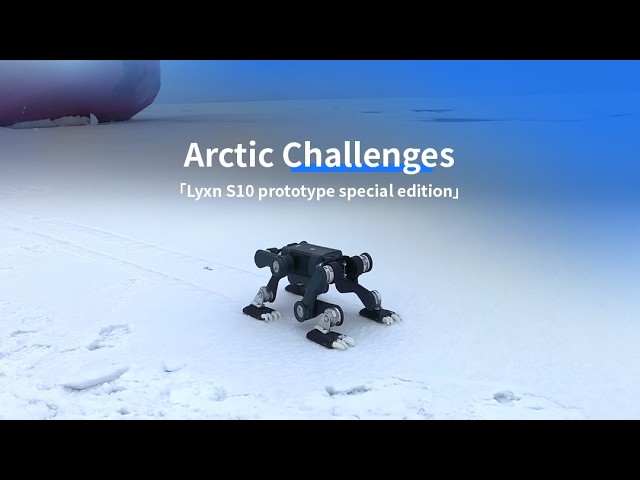
A modified version of Lynx S10, an autonomous robot developed by China-based DEEP Robotics, has become the first quadruped platform to walk on Arctic Ocean ice floes. It successfully demonstrates that autonomous machines may one day perform some of the most hazardous fieldwork in places where human access is limited. 

“The Lynx S10 enables autonomous path planning and intelligent obstacle avoidance,” the DEEP Robotics team notes.

The achievement is significant not because a robot survived the cold, but because it showed that compact autonomous systems can navigate unpredictable ice, snow, and water-filled terrain that even experienced researchers approach with extreme caution.

A compact but highly capable machine

The Arctic expedition was designed as a real-world stress test for the Lynx S10, a compact quadruped robot that weighs less than 20 kilograms even with its battery installed. 

Unlike larger robotic platforms that require extensive transport and setup, the machine can be carried and deployed by a single person. “Its compact body allows single-person portability and rapid deployment, enhancing operational mobility,” the DEEP Robotics team claims.

Despite its small size, it is equipped with sixteen precision joints that allow it to bend, twist, and maneuver through spaces that would be inaccessible to bulkier robots.

The standard version of the robot is already highly capable. According to its creators, “Equipped with a next-generation AI motion control and gait algorithm, the Lynx S10 performs a variety of extreme maneuvers.”

For instance, it can travel at speeds of up to 8 m/s on flat ground, climb over obstacles as tall as 50 centimeters, and switch between wheeled and legged movement depending on the terrain. 

When necessary, it can even rise into a bipedal stance to gain additional height and visibility.

To operate independently, the robot relies on an advanced perception system. 

Four ultra-wide-angle cameras equipped with high-dynamic-range lenses continuously monitor its surroundings, while front and rear LiDAR sensors generate detailed three-dimensional maps. This allows the machine to identify obstacles, plan routes, and navigate without constant human control. 

Its rugged design also enables operation in harsh environments. The standard platform is rated IP66 against dust and water intrusion, functions in temperatures from minus 20 to 55 degrees Celsius, carries payloads exceeding 8 kilograms, and can automatically locate and travel to a charging station when battery levels become low.

However, Arctic ice presented challenges that went far beyond the robot’s original design specifications. 

Teaching a robot to walk on floating Arctic ice

Engineers therefore modified the platform before deployment. The standard wheels were replaced with large biomimetic paws inspired by the broad feet of polar bears. These custom feet spread the robot’s weight across a larger surface area, helping prevent it from sinking into soft snow. 

Anti-slip textures improved grip on slick surfaces, while integrated crampons provided extra traction on hard ice. The robot’s sealing was also upgraded from IP66 to IP67 for greater protection against water intrusion.

Researchers introduced another unusual modification for environments where ice and water mixed together. By increasing the effective surface area of the limbs, the robot’s legs could function almost like paddles, allowing it to move through slushy conditions that would challenge conventional wheeled systems.

The Arctic tests quickly revealed why such adaptations were necessary. In several locations, snow concealed dangerous meltwater pools beneath the surface. The robot encountered terrain that appeared stable but actually floated above hidden pockets of water. 

Thanks to its redesigned feet and traction system, it maintained stability while traversing these deceptive surfaces. In one instance, it successfully glided across an area that looked like solid ice but concealed water underneath. 

Later tests pushed the machine into regions where ice and water were intermixed, and the modified limbs enabled it to continue moving through the difficult terrain.

More importantly, this was not a finished commercial product being showcased under controlled conditions. The Arctic vehicle was still an alpha-stage prototype. 

The machine matters beyond the Arctic

The broader significance of the project extends well beyond a single expedition. Environmental researchers and emergency responders often need to operate in locations that are dangerous, remote, or impossible for humans to access safely. 

Lynx S10 “confidently handles challenging environments such as dusty sites, heavy rain, and humid/foggy conditions,” the researchers at DEEP Robotics added.

This lightweight autonomous robot is capable of crossing unstable ice and moving through mixed ice-water environments. Therefore, it could help collect environmental data, monitor climate-related changes, and support search-and-rescue operations without exposing people to the same risks.

Researchers are now using the performance data gathered during the mission to further improve the design.  Hopefully, future versions will be even more capable of handling unpredictable natural environments. 

You can read more about Lynx S10 here.

💾

The Lynx S10's ability to navigate dust, heavy rain, and unstable terrain makes it a game-changer for emergency responders.
  •  

The Liberal Democrats Are No Friends of Liberty

The Liberal Democrats' intolerance of gender critical campaigners and Christians has rightly landed them in legal hot water and shown that those in charge are no friends of liberty, say David Campanale and Natalie Bird.

The post The Liberal Democrats Are No Friends of Liberty appeared first on The Daily Sceptic.

  •  

Voici la première carte mondiale d’un immense réseau vivant caché sous nos pieds

Sous nos pieds se cache l’un des plus vastes réseaux vivants de la planète. Une nouvelle étude révèle l’ampleur vertigineuse des champignons mycorhiziens, ces alliés invisibles des plantes qui transportent des milliards de tonnes de carbone chaque année et pourraient jouer un rôle clé dans la...

  •  
❌