❌

Reading view

New W-band gallium nitride chip fast-tracked from lab to market in six months
Northrop Grumman has developed a new gallium nitride (GaN) microwave chip that operates in the W-band spectrum, a high-frequency range used for advanced radar, satellite communications, and emerging wireless networks.

The company said the chip was designed, manufactured, and made market-ready in less than six months, an unusually short timeline for a high-frequency semiconductor intended for defense and commercial applications.

Built at Northrop Grumman’s semiconductor facility in Redondo Beach, California, the chip is designed to strengthen wireless signals while operating at frequencies capable of transmitting large amounts of data with low latency.

According to the company, the technology could support secure military communications, next-generation radar systems, satellite links, and future 5G and 6G wireless networks.

Faster signals, smaller hardware

The W-band occupies frequencies between roughly 75 and 110 gigahertz, offering significantly more bandwidth than lower-frequency wireless systems. The added spectrum can help enable faster data transmission, higher-resolution sensing, and more secure communications.

W-band technologies are attracting growing interest because they can handle far larger amounts of data than many conventional wireless systems. The frequencies are increasingly being explored for applications ranging from high-resolution imaging and advanced sensing to satellite communications and future mobile networks.

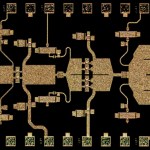
Microscope photo of the high-frequency GaN microwave chip. Credit – Northrop Grumman

However, operating at such high frequencies requires specialized semiconductor materials and designs capable of maintaining performance while managing power and heat, areas where GaN-based devices have gained increasing attention.

Northrop Grumman said the new chip fully utilizes this portion of the radio spectrum to improve signal performance while reducing the need for larger and more power-intensive equipment.

Gallium nitride has become a key material for advanced radio-frequency electronics because it can operate at higher power levels and frequencies than conventional silicon-based devices. The material is already widely used in military radars, electronic warfare systems, and satellite communications hardware.

The company said the chip can act as a signal amplifier, helping wireless systems transmit and receive data more efficiently. In military applications, that could improve secure communications and data transfer between platforms and satellites. Commercially, the technology could help support future wireless networks as demand for higher data rates continues to grow.

Defense To 6G

The project was developed through the California DREAMS hub of the Microelectronics Commons program, a public-private initiative aimed at accelerating domestic semiconductor innovation.

The program is funded by the Office of the Under Secretary of Defense for Research and Engineering and brings together industry, government, and academic partners to speed the development of advanced microelectronics technologies.

Northrop Grumman said the rapid development cycle demonstrates how collaborative manufacturing and design efforts can shorten the path from concept to deployment.

The company manufactures microelectronics at two US-based facilities and produces millions of semiconductor components annually for defense and commercial customers. Its Microelectronics Center has been involved in semiconductor development for more than seven decades.

As governments and industries seek faster communications, more capable radar systems, and advanced sensing technologies, high-frequency GaN devices are expected to play an increasingly important role in future wireless infrastructure.
  •  

US’ first vertically integrated solar factory starts production to power 1.3M homes

Qcells has begun manufacturing solar cells at its new facility in Cartersville, Georgia, bringing the company closer to operating what it says is the United States’ first and only fully vertically integrated solar manufacturing factory.

The company announced that the plant is now producing solar cells and expects all production lines to reach full capacity by the third quarter of 2026. Once fully operational, the facility will manufacture ingots, wafers, cells, and solar modules under one roof.

The start of cell production marks a significant milestone for domestic solar manufacturing, as most solar panels installed in the US still rely on imported components. Qcells said the Cartersville site will become the largest operating solar cell factory in US history.

Module assembly operations at the facility are already running at full capacity, producing about 16,700 solar panels every day.

Building domestic supply chains

When fully ramped up, the Cartersville factory will produce 3.3 gigawatts (GW) of annual capacity each for ingots, wafers, and cells, along with 3.5 GW of solar modules.

Combined with Qcells’ expanded manufacturing facility in Dalton, Georgia, the company’s total US module production capacity is expected to reach 8.6 GW annually by the end of the third quarter. According to the company, that output is enough to generate the equivalent annual electricity needs of roughly 1.3 million American homes.

“Producing the first solar cells at Cartersville is a milestone for Qcells and for American manufacturing,” said Andy Park, Global CEO of Qcells.

The company said producing key solar components domestically could provide customers with greater certainty around supply availability, pricing, and potential tariff-related disruptions.

Tax credits and jobs

Qcells said the Cartersville operation could also help project developers qualify for the federal Domestic Content Bonus tied to the Investment Tax Credit. Because major solar module components are produced in the US, developers may find it easier to meet domestic sourcing requirements.

The company added that its vertically integrated manufacturing approach allows it to claim production incentives under Section 45X of the Advanced Manufacturing Production Tax Credit across multiple stages of the solar supply chain, including ingots, wafers, cells, and modules.

The investment is also expected to support thousands of manufacturing jobs in Georgia. Together, the Cartersville and Dalton facilities are projected to employ nearly 4,000 workers, including about 3,800 direct jobs across Bartow and Whitfield counties.

Qcells said the Cartersville factory is the first US facility of its kind built in more than a decade and includes what it describes as the largest ingot and wafer production plant ever constructed in the country.

  •  

Robot hand uses touch and vision to harvest ripe fruit with near-100% accuracy

Researchers have developed a soft robotic gripper that can inspect fruit for ripeness and harvest it without causing damage, a capability that could help reduce food waste and improve harvesting efficiency.

The device uses soft silicone and polyurethane fingers equipped with multiple sensors to measure a fruit’s size, shape, color and firmness before deciding whether it is ready to be picked. The system was tested on strawberries and can remove the fruit by twisting its stem rather than cutting it.

The gripper was developed by a team that includes Anand Mishra, assistant professor in the Department of Mechanical, Materials and Aerospace Engineering at West Virginia University. The research began at Cornell University and is continuing at WVU.

The technology addresses a major challenge in agriculture: harvesting delicate fruits at the right stage of ripeness. Fruits such as strawberries and raspberries have a narrow harvest window and can bruise easily during picking, transportation and storage.

Gentle grip, smart sensing

“Our gripper’s quick, accurate inspections and harvesting can reduce spoilage of fruits and lower supply chain costs,” Mishra said.

“Fruit inspections are critical for harvesting decisions that have traditionally been made by human workers. However, using human workers for harvesting involves challenges such as labor shortages, health concerns and inaccuracies in picking.”

Agricultural robots have been proposed as a solution, but many existing systems are designed for controlled greenhouse environments rather than outdoor farms. Traditional robotic grippers can also damage soft fruit because of their rigid structures.

The new system combines tactile and visual sensing in a soft robotic design. Stretchable optical fibers embedded inside each finger act as tactile and curvature sensors, while a miniature camera and distance sensor are mounted in the palm.

The five-fingered gripper can identify a fruit’s shape, stiffness and ripeness while also detecting slippage during handling. Researchers reported that the device can open and close in less than two seconds, lift loads weighing up to one kilogram and achieve nearly 100 percent accuracy in shape prediction.

According to the team, the technology could be particularly useful for fruits that do not show obvious visual signs of ripeness. Avocados are one example, where growers often rely on touch rather than appearance to determine harvest timing.

Beyond the orchard

“My research group at WVU is called the Robiotics Lab because we focus on robots that mimic biology,” Mishra said.

“We design squishy, squeezy, rubbery robots inspired by animals.”

The gripper’s design draws inspiration from biological systems and resembles both a human hand and a starfish. Researchers say the soft structure allows it to absorb forces differently than conventional rigid robots, making it better suited for handling delicate objects.

Beyond agriculture, the sensing technology could find use in other fields that require careful manipulation.

“This system offers applications in space exploration, health care, food handling and underwater manipulation,” Mishra said.

“In biomedical robotics, for instance, the integration of curvature and tactile sensing could enhance wearable and rehabilitation devices.”

Researchers believe the combination of soft materials and integrated sensing could help robots interact more safely and effectively with both objects and their surroundings.

The study was published in the journal Nature Communications.

  •  

Trump cancels planned Iran strikes, says peace agreement could come soon

US President Donald Trump said Thursday that he has canceled planned military strikes against Iran, claiming that negotiations between Washington and Tehran have reached a stage where a broader agreement is close to being finalized.

The announcement marked a dramatic shift after days of escalating tensions that saw both countries exchange strikes and threats, raising fears of a wider conflict in the Middle East.

In a post on Truth Social, Trump said discussions had advanced significantly and received backing from multiple countries involved in the negotiations.

“Based on the fact that discussions with the Islamic Republic of Iran have been brought to the highest level of Iranian leadership and approved, I have, as President of the United States of America, cancelled the scheduled strikes and bombings against Iran this evening,” Trump wrote.

He also claimed that the final elements of the agreement had been approved by several regional and international stakeholders, including Israel, Saudi Arabia, the UAE, Qatar, Turkey, Pakistan, Bahrain, Kuwait, Jordan and Egypt.

From threats to talks

The decision came just hours after Trump issued fresh warnings against Tehran, threatening to hit Iran “very hard tonight” and suggesting the United States could take “total control” of Iran’s oil and gas markets, including the strategic Kharg Island export hub.

Despite calling off the strikes, Trump said US pressure on Iran would continue until a formal agreement is signed.

“The Naval Blockade will remain in full force and effect until this Transaction is finalized – Time and place of the signing to be announced shortly,” he wrote.

The Strait of Hormuz remains one of the world’s most important energy chokepoints, with a significant portion of global oil shipments passing through the waterway. Any disruption there has the potential to impact international energy markets and shipping routes.

Trump later told reporters that a signing ceremony could take place in Europe as early as this weekend. According to reports, Vice President J.D. Vance is expected to attend on behalf of the United States.

Hormuz remains under watch

“The strait (of Hormuz) will officially open as soon as we sign, which could be soon — very soon, maybe over the weekend in Europe,” Trump said. “I won’t be able to be there, but JD will be there.”

Iran has not officially confirmed Trump’s claims that a peace deal is imminent.

However, reports indicate that Qatari officials recently visited Tehran to discuss possible pathways toward a broader agreement aimed at reducing tensions between the two countries.

Trump has for months signaled that a breakthrough with Iran was near. The latest claims come after a week of tit-for-tat strikes that strained an already fragile ceasefire reached in April.

Meanwhile, Iran’s parliamentary speaker Mohammad Bagher Ghalibaf warned that further escalation could have long-term consequences for global energy markets.

He said that “wrong strategies and impulsive decisions” could destabilize energy supplies and “create an endless quagmire that you will be stuck in for years.”

  •  
❌