
❌

Reading view

Botany and Biology Research Wrap Up Week as Dragon Preps for Earth Return
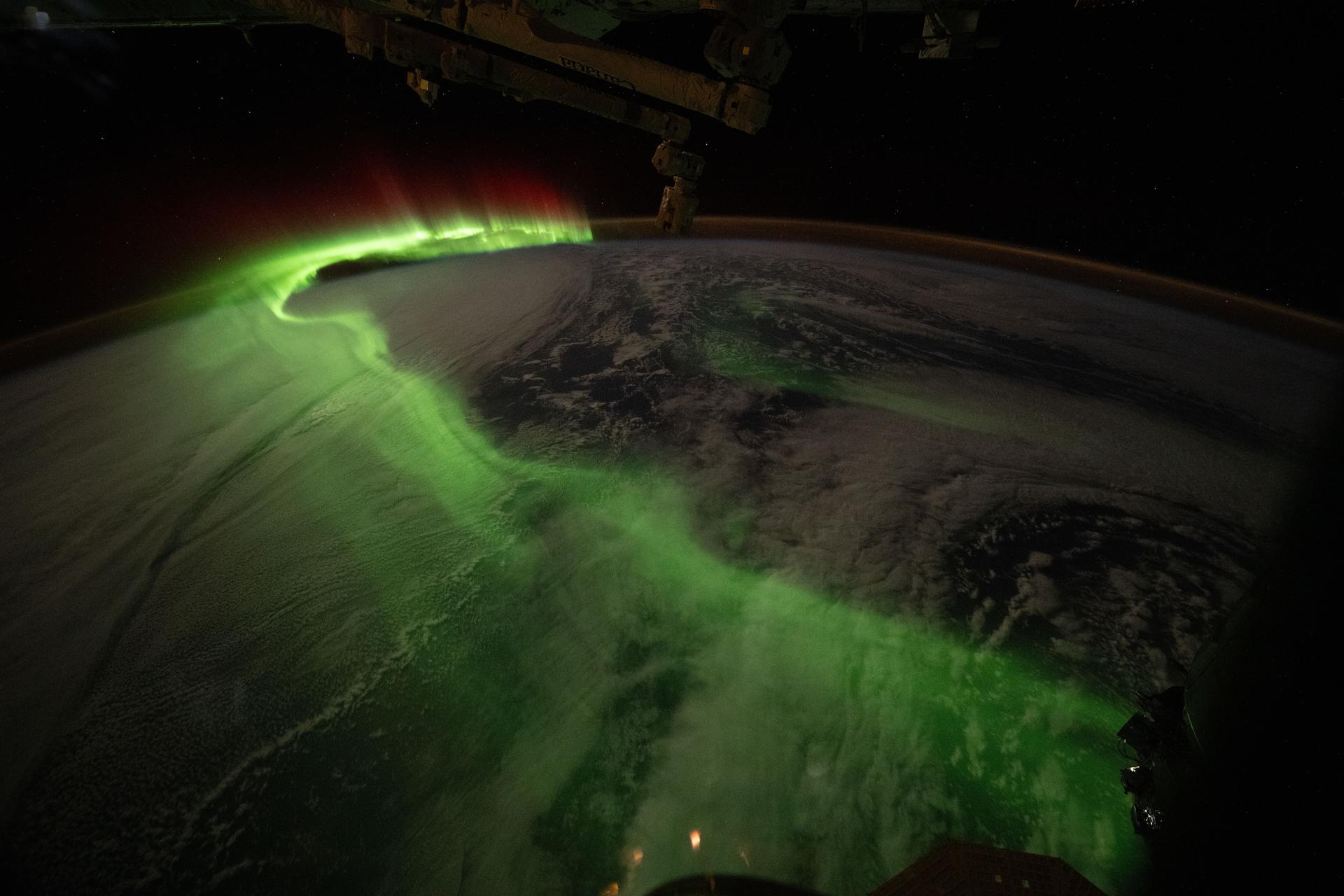
The aurora australis arcs over Earth during an active solar event in this photograph taken at approximately 11:32 p.m. local time from the International Space Station as it orbited 271 miles above the Indian Ocean southwest of Perth, Australia.
NASA/Jessica Meir

Space agriculture, stem cells, and cargo operations wrapped up the week aboard the International Space Station. The Expedition 74 crew also conducted blood tests and installed a new food processor as a U.S. cargo spacecraft nears the end of its mission.

Launching a spacecraft on Earth packed with enough food for a yearslong crew mission or sending resupply ships to replenish a crew beyond low Earth orbit is prohibitive. Therefore, growing plants aboard a spacecraft is key to sustaining crews on long-duration missions to the Moon, Mars, and beyond. As a result, NASA and its international partners have been exploring growing crops in space to enable crews to feed themselves without support from Earth. NASA flight engineer Chris Williams contributed to the ongoing space agriculture research at the end of the week and configured a microscope to observe plant cell division in microgravity. Insights may lead to improved methods of growing food in space as well as on lunar and planetary surfaces.

Low Earth orbit may also be the next frontier for biomedical manufacturing as doctors seek to overcome the limitations of gravity on the ground. NASA flight engineer Jessica Meir harvested blood stem cells inside the Kibo laboratory module’s Life Science Glovebox (LSG) that have been growing aboard the orbital outpost since the arrival of a SpaceX Dragon cargo craft on May 17. Next, she looked at the density and viability of the live cells using the KERMIT fluorescent microscope. Researchers are exploring space-designed cell therapies to treat serious medical conditions such as blood cancers and immune diseases.

Dragon is due to depart the International Space Station at 12:05 p.m. EDT on Tuesday, June 16, to return the stem cell samples, including several tons of completed science experiments and lab hardware, for analysis on Earth. Live coverage of Dragon’s undocking and departure begins at 11:45 a.m. on NASA+.

Williams and Meir also partnered with flight engineers Jack Hathaway of NASA and Sophie Adenot of ESA (European Space Agency) packing Dragon with return cargo together throughout Friday. The quartet will intensify their cargo transfers early next week when they begin loading Dragon with sensitive research samples packed inside portable science freezers for preservation, retrieval, and analysis on Earth.

Williams and Meir began their Friday shift collecting blood samples for spinning in a centrifuge then stowing in a science freezer for future analysis. Hathaway removed a research freezer from inside Kibo’s Life Science Glovebox used the day before to preserve bacteria samples for genetic and chemical analysis. Adenot also spent some time assisting Meir during the stem cell operations then tested a new food processor in the Columbus laboratory module by cooking a Mediterranean dish.

The station’s three cosmonauts, station commander Sergey Kud-Sverchkov and flight engineers Sergei Mikaev and Andrey Fedyaev enjoyed an off-duty day on Friday.

Learn more about station activities by following the space station blog, @space_stationon X, as well as the ISS Facebook and ISS Instagram accounts.

Get the latest from NASA delivered every week. Subscribe here.

The post Botany and Biology Research Wrap Up Week as Dragon Preps for Earth Return appeared first on NASA Science.

  •  
  •  

Google is held liable for false information from its AI

A German court has sparked a legal controversy by ruling that Google is responsible for defamatory comments generated by its own AI system. The search giant had argued that it couldn’t be blamed for the false results, but a Munich court has deemed that not to be the case and has ruled in favor of the two unnamed plaintiffs, both publishing companies, who the Google AI Overview inaccurately said engaged in shady business practices.

Google is required to remove the comments and ensure that they are not repeated. The case is certainly going to raise some questions globally. Will this mean that other courts are going to rule against AI vendors?

Bernhard Buchner, a partner at Lausen Rechtsanwälte, the legal firm that acted for the plaintiffs, said, “I believe it shows that online providers such as Google cannot hide behind the fact that a statement was generated by AI, but rather that they can be held liable for its output. It is an important step towards ensuring that providers of AI systems have to take responsibility for their outputs.”

So, does this mean that the decision could be replicated in the US or elsewhere? Alex Shahrestani, managing partner at Austin-based Promise Legal, said, “the short answer is ‘yes’:  the Munich ruling travels, because US courts are already making the same move.”

He explained that Section 230 of the US Communications Decency Act, which has been applied to protect online service providers like social media companies from lawsuits based on their decisions to transmit or take down user-generated content, was built for computer bulletin boards, “not for a model that writes its own answers. Once the AI is the author, the company is the publisher.”

This means, he said, “businesses now need named humans at accountability nodes, verification gates before AI output ships, and audit trails that survive discovery, because ‘the model recommended it’ is a legally empty sentence.”

Does the decision mean that other AI providers could find themselves in the same position? Buchner believes it’s possible, although, he said, the situation in this case is unusual; it does not involve a classic chatbot scenario, but one where the AI-generated statements are published as an ‘AI overview’ of a search query.

“Google’s liability here is based not so much on the fact that it operates the underlying AI, but rather on the publication of its output. However, it seems entirely conceivable to me that this could also be applied generally to inaccurate or defamatory AI,” he pointed out.

Nonetheless, said Carolyn Shelby, head of SEO at Yoast, the German ruling should ensure that companies will be more circumspect in how they handle AI in the future, to protect themselves from any legal action. The first thing they should do  is to separate low-risk use of AI from major decision-making.

“Using AI to summarize meeting notes, brainstorm campaign ideas, or create a first draft of something is very different from using it to make decisions about customers, employees, finance, compliance, health, legal claims, competitive positioning, or public communications,” she noted.

She pointed out that the effects of AI use could be devastating for companies. “The consequences could include customer complaints, reputational damage, regulatory attention, legal claims, correction costs, loss of trust, and internal disruption,” she said. “Even when a mistake does not become a lawsuit, the operational cost of correcting bad information can be significant.”

However, she noted, things may not change immediately.  “Many companies will wait until there is a high-profile court case, regulatory action, or major corporate embarrassment before they take this seriously. That is usually how governance catches up with technology. But the better-run organizations will start treating AI governance as part of normal business risk management now.”

And, said Shahrestani, after the Google decision, everything has changed. It will become more important to ensure that employees remain part of the process.

  •  
❌