
❌

Reading view

Join Us at the 248th AAS Meeting, June 2026

Join Us at the 248th AAS Meeting in Pasadena, 14 – 18 June, 2026

Special Session: Everything but Exoplanets: The Transformative General Astrophysics of the Habitable Worlds Observatory

Monday, June 15th, 1:00pm – 2:30pm ET, 10:00am -11:30am PT

Highlights from Cosmic Origins Science Interest Groups (SIGs) and Science Analysis Groups (SAGs).

TimeTopicSpeaker
10:20am ‑ 10:30amSpatially Resolved UV Spectroscopy Science Analysis Group in Support of HWOEmily Witt (JHU)
10:30am ‑ 10:40amInvestigating the NIR Discovery Space of the Habitable Worlds Observatory: Updates from the Red Limit Science Analysis GroupKyle Cooke
(University of Louisville)
10:40am ‑ 10:50amOpening the OVI Window to Reveal the Diffuse Cosmic Ecosystem with HWOSanchayeeta Borthakur (Arizona State University)
11:00am ‑ 11:10amHWO Science Interest Group: Keeping the Community Connected to HWOJessie Christiansen (Caltech/IPAC)

Splinter Session: NASA’s Big Science, Small Missions

Tuesday, June 16th, 1:00pm – 2:30pm ET, 10:00am -11:30am PT (Hybrid Session)

For remote participation, please look for the “Join the Session” link above the agenda on the Cosmic Origins at AAS website.

High-impact science.
Smarter, faster, together.

Agenda

Organizers: Swara Ravindranath (NASA/GSFC), Emily Witt (JHU)

TimeTopicSpeaker
10:00am ‑ 10:05amWelcomeSwara Ravindranath (NASA/GSFC)
10:05am ‑ 10:15amFORTIS Sounding RocketEmily Witt (JHU)
10:15am ‑ 10:25amBlackCAT CubeSatAbe Falcone (Pennsylvania State University)
10:25am ‑ 10:35amSunRISE CubeSat ConstellationJoseph Lazio (University of Michigan)
10:35am ‑ 10:45amSPHEREx Medium Explorer MissionRoberta Paladini (IPAC/Caltech)
10:45am ‑ 10:55am Landolt Pioneer MissionPeter Kurczynski (NASA/GSFC)
10:55am ‑ 11:05amNon-Traditional Path to MissionsSanchayeeta Borthakur (Arizona State University)
11:05am ‑ 11:10amBREAK
11:10am ‑ 11:30amPanel DiscussionSwara Ravindranath (NASA/GSFC, moderator)
Panelists: Drew Miles (Caltech), Pablo Saz Parkinson (NASA HQ), Joseph Lazio (University of Michigan), Abe Falcone (Pennsylvania State University), David Ardila (JPL)

Special Session: Planning for the Future of Astrophysics and the ASTRA Initiative

Thursday, June 18th, 1:00pm – 2:30pm ET, 10:00am -11:30am PT

No remote participation is available for this special session.

Agenda

TimeTopicSpeaker
10:00am ‑ 10:10amIntroduction from the NASA Astrophysics Division DirectorShawn Domagal‑Goldman
(NASA HQ)
10:10am ‑ 10:25amThe ASTRA Initiative: Overview& Path ForwardJessica Gaskin (NASA HQ)
10:25am ‑ 10:40amInnovation for Astrophysics Workshop: Initial FindingsKendra Short (JPL)
10:40am ‑ 10:55amAd ASTRA Community Science WorkshopPeter Kurczynski (NASA/GSFC)
10:55am ‑ 11:30amPanel DiscussionFrancesca Civano (NASA/GSFC)

ASTRA Office Hours at Cosmic Origins Exhibit Booth

(June 15 – 17, 2026) at 9am PT

Stop by the AAS / Cosmic Origins Exhibit booth during these times to ask questions about the ASTRA initiative, the September Ad ASTRA workshop, and developing new strategic mission concepts for astrophysics. Monday, Tuesday, Wednesday 9 am PT (Peter Kurczynski)

Best regards,
Swara Ravindranath

American Astronomical Society

The 248th Meeting of the AAS

The 248th AAS meeting (joint with the High Energy Astrophysics and the Laboratory Astrophysics Divisions) will be held 14-18 June 2026 in Pasadena, California.

Learn More
Black line art with letters on a white background
American Astronomical Society (AAS)

News Straight to Your Inbox

Subscribe to your community email news list

We will never share your email address.
Privacy Policy

Sign Up
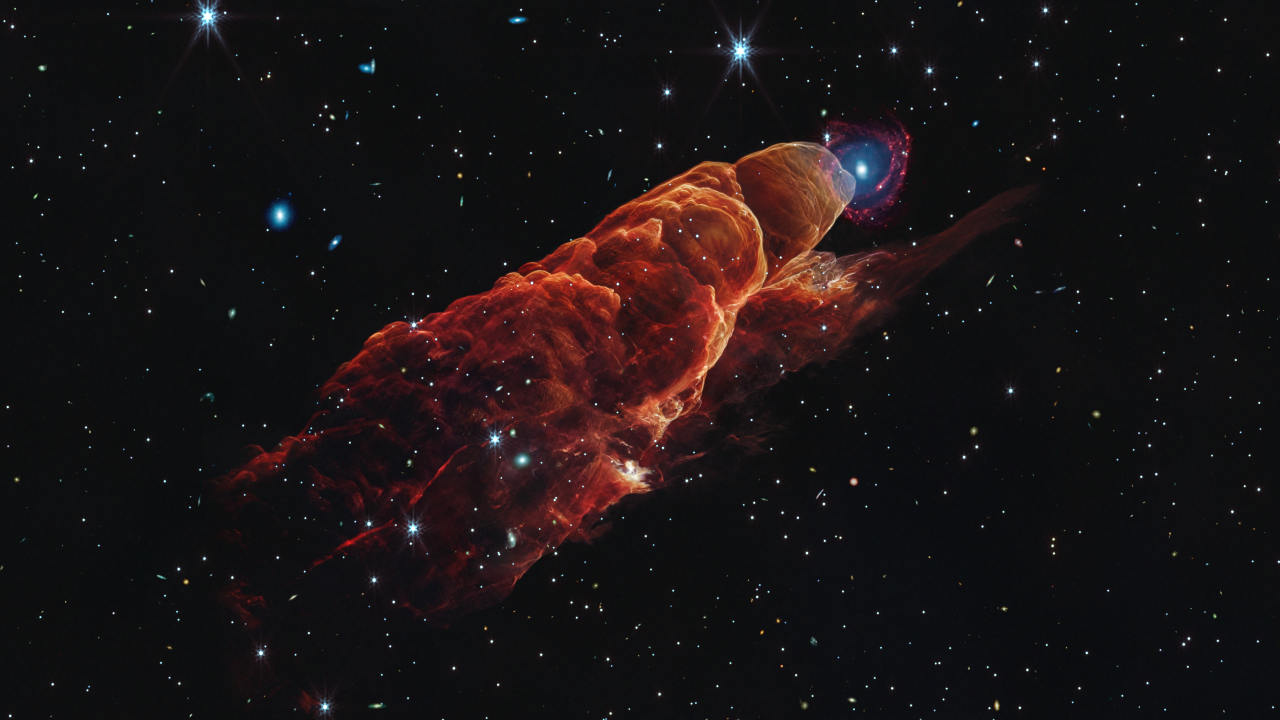
Angled from the upper left corner to the lower right corner is a cone-shaped orange-red cloud known as Herbig-Haro 49/50. This feature takes up about three-fourths of the length of this angle. The upper left end of this feature has a translucent, rounded end. The conical feature widens slightly from the rounded end at the upper right down to the lower right. Along the cone there are additional rounded edges, like edges of a wave, and intricate foamy-like details, as well as a clearer view of the black background of space. In the upper left, overlapping with the rounded end of Herbig-Haro 49/50, is a background spiral galaxy with a concentrated blue center that fades outward to blend with red spiral arms. The background of space is speckled with some white stars and smaller, more numerous, fainter white galaxies throughout.

The post Join Us at the 248th AAS Meeting, June 2026 appeared first on NASA Science.

  •  

HWO Detector System Development Study Request for Proposals

Habitable Worlds Observatory Detector System Development Study Request for Proposals

12 June 2026

Due by July 7th, 2026

Dear Colleagues,

The Habitable Worlds Observatory Technology Maturation Project Office and Columbus Technologies are excited to invite you to participate in a Detector System Development Study focused on developing critical detector technologies for the Habitable Worlds Observatory. This request for proposals seeks information from qualified organizations capable of supporting detector technology maturation studies to advance candidate technologies toward Technology Readiness Level 5. Specifically, we are seeking responses to address one or more of the following detectors categories: photon-counting detectors for visible and near-infrared coronagraph applications, far-ultraviolet detectors, and large-format detectors for near-ultraviolet and visible applications. Details regarding the call for proposals, eligibility, required deliverables, and study phases are available at the Columbus Technologies website here: https://columbususa.com/opportunities/hwo-detector-rfp/ 

Respondents located at Government agencies including the Jet Propulsion Laboratory or NASA Centers (e.g., Goddard Space Flight Center, Ames Research Center, etc.) should submit their responses directly to Daniel Kelly (daniel.p.kelly@nasa.gov).

Note: Responses are due by July 7, 2026.

News Straight to Your Inbox

Subscribe to your community email news list

We will never share your email address.

Privacy Policy

Sign Up
Angled from the upper left corner to the lower right corner is a cone-shaped orange-red cloud known as Herbig-Haro 49/50. This feature takes up about three-fourths of the length of this angle. The upper left end of this feature has a translucent, rounded end. The conical feature widens slightly from the rounded end at the upper right down to the lower right. Along the cone there are additional rounded edges, like edges of a wave, and intricate foamy-like details, as well as a clearer view of the black background of space. In the upper left, overlapping with the rounded end of Herbig-Haro 49/50, is a background spiral galaxy with a concentrated blue center that fades outward to blend with red spiral arms. The background of space is speckled with some white stars and smaller, more numerous, fainter white galaxies throughout.

The post HWO Detector System Development Study Request for Proposals appeared first on NASA Science.

  •  

Ad ASTRA Community Science Workshop Updates 

Ad ASTRA Community Science Workshop: Agenda Structure and Abstract Submissions

Dear Astrophysics Strategic Technology & Research Accelerator (ASTRA) community members-

As we prepare for our Ad ASTRA Community Science workshop, we are writing to share important updates regarding the agenda structure and instructions for abstract submissions. 

The Community Science (Ad ASTRA) Workshop is organized by the NASA Astrophysics Division to engage the community in identifying future large, strategic astrophysics missions. Structured over three thematic days—Science, Capabilities and Implementation, and Community Discussion—the workshop provides a comprehensive framework to connect scientific priorities with technological readiness and mission implementation. Across all three days, plenaries, panels, breakout sessions, and poster contributions are designed to maximize community interactions and discussion. The outcomes of the workshop will help NASA prioritize mission concepts and shape a balanced, forward-looking astrophysics portfolio that is consistent with the Astro2020 recommendations and existing and future science gaps.

To best serve the community and facilitate meaningful collaboration, we are splitting the mission concept presentations into two distinct focuses: Science on Day 1, and Capabilities and Implementation on Day 2. We are relying on you—the concept teams and the broader community—to submit abstracts for both days. We are also offering the option to present mission concepts as posters, and will offer the opportunity to present as posters any abstracts for which there is insufficient room in the parallel sessions.

Please review the detailed agenda structure and submission guidelines below:

Day 1: Science Focus

  • Science Questions: Day 1 will focus on open science priorities and questions from strategic documents (Astro 2020 Decadal Survey, Enduring Quests – Daring Visions from 2014) and more recent science questions that the mission concepts submitted to ASTRA will address. 
  • Abstract Submission: Presentations for Day 1 are not restricted to mission concept team members. We strongly encourage other scientists in the community to submit abstracts presenting important science questions and to use this opportunity to connect with concept teams.
  • Breakout Sessions: These sessions will be organized by science themes (Compact Objects and Energetic Phenomena, Cosmology, Galaxies, Exoplanets & Astrobiology, Stars and Stellar Populations). Moderators will present a summary of the panel discussions at the end of Day 1.

Day 2: Mission Concepts – Capabilities and Implementation

  • Focus: Day 2 is focused on implementation, capabilities, and technologies (software and hardware) relevant to the ASTRA submitted mission concepts. A summary of the Innovation for Astrophysics Missions Workshop (May 2026) will inform discussions regarding industry and other capabilities and opportunities that may be leveraged. 
  • Breakout Sessions: These sessions will be organized by capability groups, which will be determined once the submitted mission concept documents are reviewed.
  • Format & Goals: Breakout sessions will feature a mix of presentations and flexible discussion. The goal is for teams with concepts at varying maturity levels to collaborate, find commonalities, and strengthen their respective capability groups.
  • Abstract Submission Note: Teams may submit multiple abstracts for these sessions if their concept spans different capabilities (e.g., requiring both UV and X-ray technologies).

Day 3 & Workshop Outcome

A primary goal of this workshop is to refine a draft “science-to-capabilities” matrix, which will be built using inputs from your submitted ASTRA mission concept documents. During the Day 1 and 2 breakout sessions, moderators will capture key discussion points to present during end-of-day summary panels. On Day 3 of the workshop, we will hold a plenary discussion to recap the week and collaboratively revise the “science-to-capabilities” matrix. Together as a community, we will add, refine, and prioritize science questions, mapping them to mission concepts. 

Key Upcoming Dates:

  • 24 June 2026: Abstract submission deadline (link). If you have already submitted an abstract and would like to modify it based on the guidelines above, please delete your previous contribution and send another submission. 
  • 26 June 2026: Mission Concept Document submission deadline (template, submission portal)
  • 10 July 2026: Contributed abstracts selected for talks and posters 

We look forward to your abstract submissions and to a highly collaborative and productive workshop! 

Best regards,

The Ad ASTRA Workshop Organizing Committee

News Straight to Your Inbox

Subscribe to your community email news list

We will never share your email address.

Privacy Policy

Sign Up
Angled from the upper left corner to the lower right corner is a cone-shaped orange-red cloud known as Herbig-Haro 49/50. This feature takes up about three-fourths of the length of this angle. The upper left end of this feature has a translucent, rounded end. The conical feature widens slightly from the rounded end at the upper right down to the lower right. Along the cone there are additional rounded edges, like edges of a wave, and intricate foamy-like details, as well as a clearer view of the black background of space. In the upper left, overlapping with the rounded end of Herbig-Haro 49/50, is a background spiral galaxy with a concentrated blue center that fades outward to blend with red spiral arms. The background of space is speckled with some white stars and smaller, more numerous, fainter white galaxies throughout.

The post Ad ASTRA Community Science Workshop Updates  appeared first on NASA Science.

  •  

Announcement of Opportunity SMEX 2026

Announcement of Opportunity Astrophysics Explorers Program 2026 Small Explorer (SMEX) Final Text Released

12 June 2026

The National Aeronautics and Space Administration (NASA) Science Mission Directorate (SMD) announces the release of an Announcement of Opportunity (AO) to solicit Principal Investigator (PI)-led space science investigations for the Small Explorer (SMEX) opportunity under the Astrophysics Explorers Program. The SMD strategic goal of expanding human knowledge through new scientific discoveries in astrophysics includes the broad objective: “to understand the Sun, Earth, Solar System, and Universe.” SMD addresses this objective through astrophysics investigations that address one or more of these science goals: 

  • How does the Universe work? Probe the origin and destiny of our universe, including the nature of black holes, dark energy, dark matter and gravity.
  • How did we get here? Explore the origin and evolution of the galaxies, stars, and planets that make up our universe.
  • Are we alone? Discover and study planets around other stars and explore whether they could harbor life. 

The 2026 Astrophysics SMEX (APSMEX26) Schedule:

AO Release Date: June 9, 2026 
Preproposal Conference Date: June 30, 2026
Mandatory Notice of Intent Due Date: July 21, 2026
Proposal Due Date: September 9, 2026

The NASA Solicitation and Proposal Integrated Review and Evaluation System (NSPIRES) is the official source for the full text of the Astrophysics Explorers Program 2026 SMEX AO. To find the full, final text visit https://go.nasa.gov/APSMEX26. Alternatively, visit: http://nspires.nasaprs.com/, select ‘Solicitations’ at the top of the page, and on the next page enter solicitation number NNH26ZDA011O in the search field.

Prospective investigators from any category of organizations or institutions, U.S. or non-U.S. with some restrictions as specified in Section 4.2.1 of the AO, are welcome. Specific categories of organizations and institutions include, but are not limited to, educational, industrial, and not-for-profit organizations, Federally Funded Research and Development Centers (FFRDCs), University Affiliated Research Centers (UARCs), NASA Centers, and other Government agencies. Both U.S. and non-U.S. participation is subject to China restrictions described in Sections 4.2.2 and 5.8.1 of the AO.

All interested parties must read the final APSMEX26 AO carefully for significant changes from the draft AO (NNH25ZDA008J) and prior years’ SMD Explorers Program AOs. Of particular importance is the change in evaluation and selection to a single-step competitive process. NASA intends to select one investigation proposal from the APSMEX26 responses to proceed into a combined Phase A&B. All proposals must comply with the requirements, constraints, and guidelines contained within the AO. 

The Science Office for Mission Assessments (SOMA) will post the virtual Preproposal Conference agenda, connection information, and related information at: https://explorers.larc.nasa.gov/APSMEX26/SMEX.  SOMA hosts the official “2026 Astrophysics Small Explorer (SMEX)” website that provides further information, including the SMEX Program Library and SMEX Question & Answer (Q&A) page. Anonymity of persons/institutions who submit questions will be preserved. Proposers are encouraged to send comments and questions early so that they may be fully addressed. Questions posed at least one week before the Pre-Proposal Conference may be addressed in the Pre-Proposal Conference presentation or on the SMEXQ&A page. The deadline for other questions is two (2) weeks before the proposal due date.

All questions or comments about the Astrophysics SMEX 2026 AO shall be addressed via email to Daniel Moses, APSMEX26 Lead Program Scientist, dan.moses@nasa.gov; Hannah JangCondell, APSMEX26 Deputy Program Scientist, hannah.jang-condell@nasa.gov; and Omar Torres, Lead Acquisition Manager for the 2026 Astrophysics SMEX AO, SOMA omar.torres@nasa.gov using subject line “APSMEX26” to be properly routed.

Any costs incurred in preparing a submission in response to this notice or the full APSMEX26 AO are solely the responsibility of the submitter. 

News Straight to Your Inbox

Subscribe to your community email news list

We will never share your email address.

Privacy Policy

Sign Up
Angled from the upper left corner to the lower right corner is a cone-shaped orange-red cloud known as Herbig-Haro 49/50. This feature takes up about three-fourths of the length of this angle. The upper left end of this feature has a translucent, rounded end. The conical feature widens slightly from the rounded end at the upper right down to the lower right. Along the cone there are additional rounded edges, like edges of a wave, and intricate foamy-like details, as well as a clearer view of the black background of space. In the upper left, overlapping with the rounded end of Herbig-Haro 49/50, is a background spiral galaxy with a concentrated blue center that fades outward to blend with red spiral arms. The background of space is speckled with some white stars and smaller, more numerous, fainter white galaxies throughout.

The post Announcement of Opportunity SMEX 2026 appeared first on NASA Science.

  •  
❌