
❌

Reading view

Schrödinger’s Cat Gets Stranger: Physicists Demonstrate Quantum States No One Has Seen Before
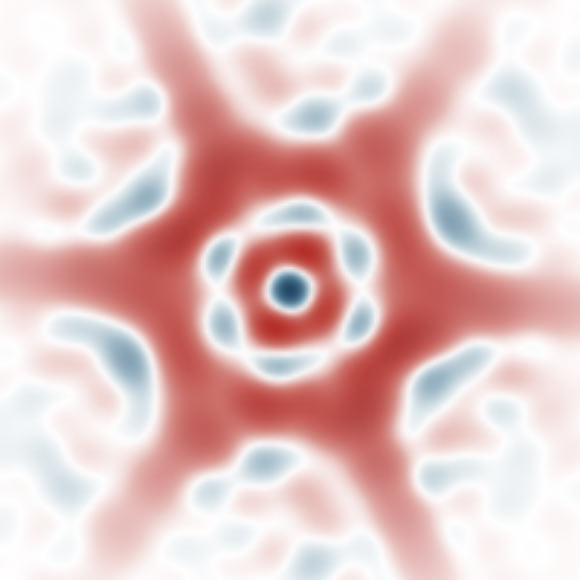
Quantum mechanics defies classical intuition, most famously through Schrödinger’s cat, where systems exist in superpositions of opposing states. Such superpositions are central to quantum technologies. Quantum ‘cat’ states have been realized in harmonic oscillators, but implementations were largely limited to Fock, displaced, or Gottesman-Kitaev-Preskill states. A different class of macroscopic superpositions, where an oscillator is squeezed along orthogonal axes so that its positional variance is simultaneously larger and smaller than the Heisenberg limit, was proposed previously but remained unrealized. Saner et al. introduce a trapped-ion hybrid spin-oscillator system enabling an experimental realization of these ‘siblings’ of Schrödinger’s cat. Image credit: Saner et al., doi: 10.1103/k1xk-yt42.

Physicists at the University of Oxford have engineered a new class of ‘cat states’ -- quantum superpositions constructed not from ordinary wave packets, but from deeply exotic, nonclassical components -- opening unexpected paths toward more resilient quantum computers.

The post Schrödinger’s Cat Gets Stranger: Physicists Demonstrate Quantum States No One Has Seen Before appeared first on Sci.News: Breaking Science News.
  •  

Earth’s Earliest Animals May Have Thrived Too Easily to Evolve

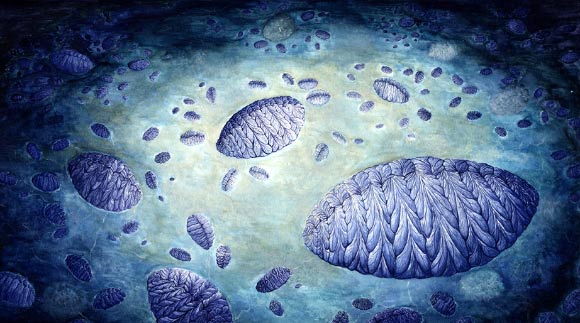
Artist’s reconstruction of the Fractofusus community: the bottom right features a large Fractofusus around which there are 5 to 8 medium specimens clustered; each of the medium specimens also has small specimens clustered around them; the small specimens therefore form an independent double cluster pattern, namely clusters of clusters. Image credit: C.G. Kenchington.

Fossils from some of the oldest-known animals on Earth, dating from 574 million years ago (Ediacaran period), suggest that cloning, not competition, dominated the Ediacaran seas, slowing evolution until environmental stress helped drive the rise of sexual reproduction and a burst of biodiversity.

The post Earth’s Earliest Animals May Have Thrived Too Easily to Evolve appeared first on Sci.News: Breaking Science News.
  •  

Lunar Meteorite Preserves Evidence of Colossal Asteroid Strike

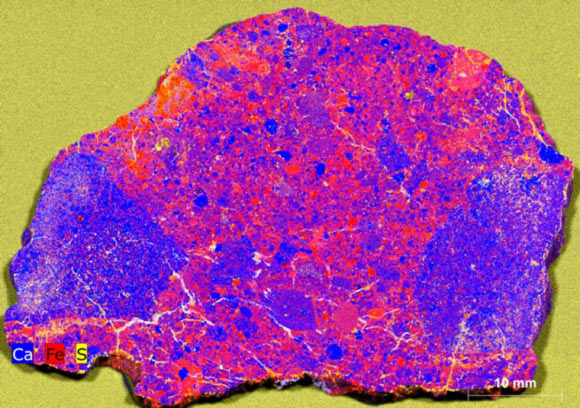
XRF map of 7.53 g slice of NWA 12593: calcium (Ca) and iron (Fe) illustrate the location and diversity of clasts; sulfur (S) highlights the location of cracks and terrestrial weathering. Image credit: Crow et al., doi: 10.1130/G54386.1.

Planetary scientists analyzing a lunar meteorite known as Northwest Africa (NWA) 12593 have uncovered evidence of an asteroid impact that occurred 3.5 billion years ago on the Moon, helping to reconstruct a period of intense bombardment that left lasting marks across the inner Solar System.

The post Lunar Meteorite Preserves Evidence of Colossal Asteroid Strike appeared first on Sci.News: Breaking Science News.

  •  
  •  
❌