Login

Donut Lab’s miracle solid-state battery found to be lithium-ion, investigation claims

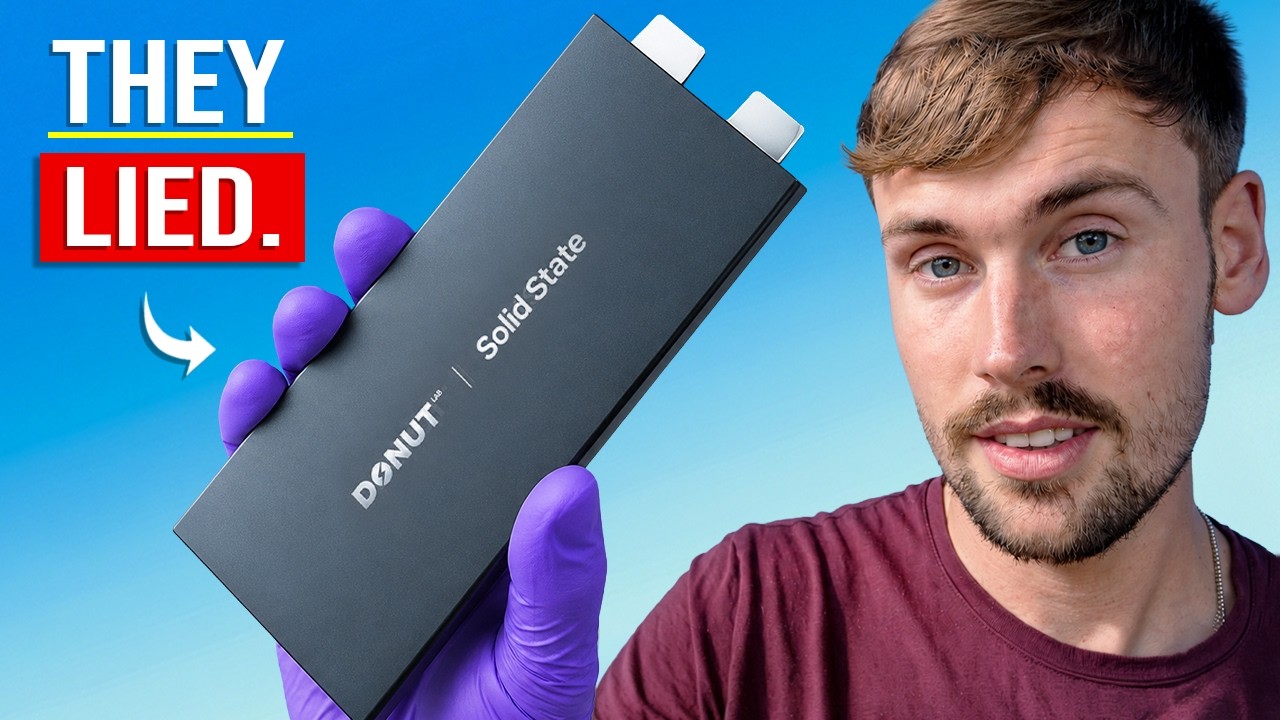
After months of investigation, more than 20 independent battery experts have found that the battery technology promoted by Finnish startup Donut Lab is not the breakthrough solid-state sodium-ion battery the company claimed. These findings raise serious questions about a technology that attracted about $25 million from over 1,300 investors and pushed the company’s value up to $1.25 billion.
The report, led by battery researcher Ziroth, looked at electrochemical tests, company records, and interviews with industry experts. All the evidence suggests the widely publicized battery is actually a regular lithium-ion cell rather than the revolutionary chemistry unveiled at CES 2026.
Experts say test results match lithium-ion chemistry
Questions surrounding Donut Lab’s claims began soon after the company announced a battery that could deliver 400 watt-hours per kilogram, last through 100,000 charge cycles, and recharge in just 5 minutes.
These numbers quickly caught the battery industry’s attention. Independent tests followed, but the main performance claims were not verified. Several tests by Finland’s VTT Technical Research Center could not confirm the advertised energy density or the long cycle life.
The latest investigation reviewed data from those tests and spoke with over 20 battery experts. The report says every expert agreed: the tested cell acts like a lithium-ion battery.
A key clue was in the voltage measurements. The battery ran at about 3.7 to 3.8 volts at 50 percent charge, which is typical for high-nickel lithium-ion batteries with nickel-manganese-cobalt chemistry. Sodium-ion batteries usually operate at lower voltages and rarely exceed 3.5 volts at the same charge.
Expansion patterns reveal the battery’s true identity
Researchers say the most convincing evidence came from measuring how the cell expanded during charging.
When a battery charges, ions move into the anode, causing it to expand. Graphite anodes have a unique expansion pattern because of changes in graphite’s layered structure. The Donut Lab cell showed this exact pattern.
This finding matters because sodium ions are too big to fit into graphite the way lithium ions do. According to investigators, the graphite expansion pattern clearly shows that lithium is the active ion in the battery.
The report described the evidence bluntly: “It’s like we have a slightly noisy fingerprint and a picture of the suspect’s face. And yet again, it’s a match.”
Based on the data, investigators estimated the battery’s energy density at about 298 watt-hours per kilogram. This is good for a modern lithium-ion battery, but far below the company’s claimed 400 watt-hours per kilogram.
German supplier emerges at center of technology chain
The investigation found that the battery technology came from the German company CT Coatings, which supplied it to Nordic Nano and Donut Lab.
In this setup, CT Coatings provided the technology, Nordic Nano was supposed to make the cells, and Donut Lab took care of selling them. Investigators said Nordic Nano has never made a battery cell for the market.
Industry experts who met with CT Coatings representatives doubted their technical skills. Julian Zanau from the Fraunhofer Research Institute recalled concerns following discussions with company officials.
“The first impression I got was that these people have no idea how a battery actually works. They were talking about no rare earth metals in their batteries and therefore no lithium, and to any chemist lithium has nothing to do with rare earth minerals.”
Former Nordic Nano executive Lauri Peltola also criticized the decision to rely solely on internal evaluations rather than independent battery experts to assess the technology.
Investor scrutiny grows as authorities investigate
The report also questions Donut Lab’s public statements about its vehicle-making efforts. The company said the first production motorcycle left the assembly line in early 2026. However, an internal video reportedly said the motorcycles would first stay in Verge’s own fleet to improve manufacturing before being delivered to customers.
Investigators argue that these vehicles should be seen as pre-production units, not products ready for customers.
More doubts came up when CEO Marko Lehtimäki reportedly admitted that the much-publicized 400-watt-hour-per-kilogram cells were not actually in the motorcycles. Leaked messages also suggested Donut Lab was still looking for proof of the battery’s advertised performance from CT Coatings.
The financial impact is significant. Over 900 shareholders reportedly hold 50 shares or fewer, indicating many are small investors. Investor messages reportedly promised big returns and encouraged more investments as excitement about the battery grew.
According to the investigation, Finnish financial regulators and criminal authorities are now looking into the case. This could become one of the most closely watched technology investment cases in the Nordic battery industry.