 Login

Dogs Could Be Humanity’s Best Friend in the Fight Against This Invasive Species
A new trick for Fido—finding spotted lanternfly eggs
The post Dogs Could Be Humanity’s Best Friend in the Fight Against This Invasive Species appeared first on Nautilus.


A new trick for Fido—finding spotted lanternfly eggs
The post Dogs Could Be Humanity’s Best Friend in the Fight Against This Invasive Species appeared first on Nautilus.

Across the stories today, a common thread emerges: the growing tension between our rapidly expanding digital world and the natural systems struggling to sustain it. From AI data centers planned for drought-stricken regions to coal plants getting emergency extensions, we’re witnessing the collision between technological acceleration and environmental limits.
The numbers tell a stark story. Two-thirds of new AI data centers are slated for areas already grappling with water scarcity, while these facilities demand massive amounts of both electricity and cooling water. Meanwhile, Florida’s coal plant—scheduled for retirement as part of a clean energy transition—gets an emergency lifeline to keep the lights on. It’s a reminder that progress and pressure often arrive together, forcing difficult choices between immediate needs and long-term sustainability.
The day’s coverage points to growing momentum around accountability, particularly in how we fund and regulate resource-intensive industries. Australian lawmakers are pushing for fair taxation of AI infrastructure, determined not to repeat what they see as mistakes with gas exports. North Carolina legislators face their own paradox, crafting bills that simultaneously curb data center expansion while boosting fossil fuel development. These policy tensions reflect a broader reckoning: how do we harness technological progress without overwhelming the ecosystems that support us?
Yet signs of genuine environmental recovery punctuate today’s more challenging headlines. Water voles have returned to an English nature reserve after four decades, while marine protected areas now cover 10% of the world’s oceans—a significant milestone toward the 30% goal by 2030. In Sumatra’s hills, coffee farmers like Sri Atmiatun are proving that conservation and community prosperity can grow together, restoring forests while securing livelihoods through innovative social forestry programs.
Behind the numbers are real communities adapting in real time. Alaska’s fishing industry faces uncertainty as critical ocean monitoring systems face budget cuts, while Arizona’s San Carlos Lake sits closed indefinitely after drought and dam releases killed all fish life. These aren’t abstract environmental statistics—they’re disruptions to ways of life, forcing entire communities to reimagine their relationships with changing landscapes.
The financial flows reveal where power and priorities truly lie. The world’s largest banks poured a record $906 billion into fossil fuels despite climate commitments, an 8% increase that environmental researchers call “unfathomable.” Meanwhile, China launched the world’s first wind-powered underwater data center, signaling that sustainable technology infrastructure is possible when political will aligns with innovation.
Perhaps most troubling is what we’re losing while focused on these larger battles. Wildfire smoke has erased four years of air quality progress across the United States, while sea levels are now rising at twice the rate recorded just a decade ago. Scientists are racing to record forest sounds before wild spaces fall silent—a poignant reminder that some losses can’t be reversed.
The day’s stories also illuminate the gap between good intentions and effective action. Louisiana legislators unanimously approved expanding their wood pellet industry despite the bill’s sponsor admitting he knows little about the sector. FIFA appears unprepared for wildfire smoke threats at upcoming World Cup venues. These moments reveal how quickly environmental challenges can outpace institutional readiness.
As the week unfolds, all eyes will be on whether emerging solutions—from underwater data centers to marine protection expansions—can scale fast enough to match the magnitude of the challenges. The central question remains: can we innovate our way toward sustainability, or will the pace of environmental change force more fundamental reckonings with how we live and build in a resource-constrained world?
The post Florida Coal Plant Keeps Running Past 2025 Closure, Decade of Wildfires Erases US Air Quality Gains — Today’s Environmental Briefing for Tue, Jun 9 2026 first appeared on EnviroLink Network.
A small Greek island on the eastern edge of the Mediterranean has revealed a new species inside a man-made tunnel carved into a hillside.
During a survey of Kastellorizo in the Dodecanese, researchers found a previously unknown cave cricket inhabiting an artificial underground passage on Mount Vigla. The species, described in the Journal of Orthoptera Research, is part of the genus Dolichopoda. These cave-dwelling crickets occur throughout southern Europe and the eastern Mediterranean, and often form distinct species when populations become isolated in separate underground habitats.
These cave-dwelling crickets throughout southern Europe and the eastern Mediterranean and often form distinct species when populations become isolated in separate underground habitats.
The team named the species Dolichopoda balrogi after the Balrog, the ancient fire-demon who resided beneath the mountains in the Mines of Moria in J.R.R. Tolkien’s The Lord of the Rings. In Tolkien’s story, the Balrog remained hidden underground until disturbed by the Dwarves.
Kastellorizo covers about nine square kilometers, making it one of the smallest inhabited islands in Greece. The island is actually located closer to the Turkish coast than to the Greek mainland. The landscape also lacks any accessible natural caves. The only underground environment available for survey was a single man-made tunnel, which explains why the cricket remained undiscovered until now.
Morphological analysis of both male and female specimens showed that D. balrogi has a unique combination of physical features. The structure of the male epiphallus, the shape of the tenth tergite, and the form of the female ovipositor set it apart from other Dolichopoda species.
Molecular analysis confirmed this. DNA barcoding showed that the Kastellorizo population belongs to an evolutionary lineage alongside southwestern Anatolian Dolichopoda species, especially D. sbordonii and D. lycia. However, this is the first time an Anatolian Dolichopoda lineage has been documented within European territory.
Kastellorizo’s location already makes it a unique case in the eastern Mediterranean. Although it is officially part of Greece, the island sits just a few kilometers from the Turkish mainland, and its plants and animals reflect this proximity. The discovery of D. balrogi fits this pattern since its closest relatives are not found on other Greek islands but along the coast of Anatolia.
This finding also adds to the evidence that Kastellorizo acts as a biogeographic bridge, hosting species with roots and connections that set them apart from the rest of the Aegean islands.
“These findings remind us that biodiversity discoveries are not limited to remote tropical forests or deep oceans,” added lead researcher Konstantinos Kalaentzis. “Even familiar landscapes and human-made structures can harbour species that have remained unnoticed.”
Cave-adapted organisms such as Dolichopoda crickets are particularly vulnerable. Their entire known range may extend only to a single tunnel, cave, or hillside. D. balrogi appears to only exist in this single man-made passage. Construction, flooding, or other disturbances to that habitat could eliminate the species before researchers fully understand it.
The authors note that documenting hidden subterranean fauna is a necessary first step toward protection, and that artificial underground environments should receive more attention as possible refuges for specialized cave-dwelling species.
The Greek islands are among the least studied archipelagos in the Mediterranean in terms of biodiversity. The discovery of a new species with Anatolian evolutionary roots in a single tunnel on a nine-square-kilometer island suggests that the region’s unexplored caves and crevices may harbor many more undiscovered species.
Austin Burgess is a writer and researcher with a background in sales, marketing, and data analytics. He holds an MBA, a Bachelor of Science in Business Administration, and a data analytics certification. His work focuses on breaking scientific developments, with an emphasis on emerging biology, cognitive neuroscience, and archaeological discoveries.
A multi-institutional team of researchers led by University of Connecticut Professor Zhe Zhu has developed a method for measuring the dynamic, real-time activity of urban environments from space, which they are calling an “Urban Pulse.”
The research team behind the novel urban activity metric said that monitoring a city’s Urban Pulse could help mitigate uncontrolled urban sprawl or decay and enable environmentalists and urban planners to intervene before disasters become unavoidable.
Although environmentalists and urban planners have a wide range of tools to measure the activities within a city, Zhu notes that scientists have spent decades merely capturing the “outcome of urbanization,” such as a finished road or a newly completed home. However, the researcher and lead author of a study detailing the Urban Pulse methodology added that, even with all the current tools, “you don’t really see the dynamics within an urban area.”
According to a statement detailing the new approach, a city’s pulse is determined by all construction activity within it. Along with new construction, the metric includes repairs, infrastructure improvements, or expansion into previously undeveloped green spaces. When used correctly, the researchers said that it can help determine “if and where their city is not doing well.”
“This would allow (authorities) to be proactive rather than conducting a metaphorical autopsy after the decay of an area is evident,” the team explained.
To test their approach, the team evaluated the Urban Pulse of six cities: Seattle, Shenzhen, Lagos, Mumbai, Dubai, and Mexico City. This involved a deep examination of what the team termed “decades of dense time-series data” collected by NASA’s Harmonized Landsat and Sentinel-2 (HLS) satellites for physical transformations in an urban environment, such as new construction, measurable infrastructure improvements, and demolition.
Instead of analyzing each city’s changes manually, the team evaluated the above changes on what they called “the neighborhood level” using a deep-learning and time-series-analysis approach called CAPES, developed by former UConn postdoctoral researcher Ji Won Suh. The team said that, by observing these “high-frequency rhythms of development” from a broad ‘outer space’ perspective, their approach “bridges the gap between abstract urban theories and measurable, real-world data.”

After examining CAPES’ results, the team found several key markers within the Urban Pulse. For example, the view from space revealed that growth within cities is not smooth and steady. Instead, Zhu and colleagues said that development happens in “abrupt, intense, and episodic bursts of construction.”
CAPES also revealed that the rhythms of an urban environment are cyclical. For example, while a city may show relatively steady growth on a broader level, individual neighborhoods go through “dramatic boom-and-rest cycles” of expansion and dormancy that don’t appear to follow predictable annual seasons.
The third pattern revealed by measuring the six cities’ Urban Pulse from space was that cities are “asynchronous,” meaning a single city does not ‘beat’ in unison. The team noted that neighborhoods “pulse at completely different times.” When it functions properly, this “uncoordinated rhythm” helps prevent the city’s infrastructure and labor markets from “overheating.”
Unlike previous methods for tracking a city’s evolution, the team noted that their Urban Pulse approach can help researchers “visualize a city’s reaction to global shocks.” For example, the team said that their analysis captured “the exact moment the COVID-19 pandemic triggered a widespread, synchronized ‘cardiac arrest’ in urban development worldwide.”
However, their new tool also revealed what the researchers termed “profound inequalities” in how individual cities recovered from the dramatic halt to urban growth. For example, the team said that the Urban Pulse of Shenzhen revealed synchronized ‘dips’ in activity, followed almost immediately by “rapid, policy-driven rebounds.” However, the same Orban Pulse analysis showed that the reactions in Mumbai and Mexico City were much more “muted.”
“It’s like in human beings,” Zhu explained. “When you get a disease, it’s not going to show up exactly the same in different people.”
Although the Urban Pulse metric offers a tantalizing tool for academics, the team noted real-world benefits for global policymakers, urban planners, and environmentalists, adding that “it serves as an early warning system.”
“By monitoring the rhythm, rate, and amplitude of neighborhood pulses, governments can identify early signs of urban decay or unsustainable sprawl and intervene before crises become entrenched,” they explained.
The team also suggested that making Urban Pulse data publicly available could “revolutionize how everyday people interact with their cities.” For example, an urban family considering a move to a new city or a new part of their current city could track a target neighborhood’s pulse to spot early warning signs of decay or early indicators of positive-trending growth. The same data could help business owners plan new locations or expanded service routes, depending on the business profile and the local Urban Pulse trends.
“This is going to be a very impactful tool influencing not only top-down policy decisions from governments but also bottom-up decisions from everyday people navigating their cities,” Zhu explained.
In a recent study, “The Urban Pulse: Diagnosing the urbanization process as spiky, cyclical, and asynchronous” was published in the Proceedings of the National Academy of Sciences.
Christopher Plain is a Science Fiction and Fantasy novelist and Head Science Writer at The Debrief. Follow and connect with him on X, learn about his books at plainfiction.com, or email him directly at christopher@thedebrief.org.
Third of world’s energy needs should come from electricity by 2035, says Murat Kurum, as priorities set out for this year’s UN climate summit
The world should aim to meet a third of its energy needs from electricity within a decade to cut greenhouse gas emissions, the host of the next UN climate summit has said.
While about a third of global electricity generation already comes from renewable sources, other energy-intensive sectors – chiefly transport, heating and industries – have lagged behind. Close to four-fifths of final energy still comes from fossil fuels, as a result.
Continue reading...
© Photograph: Images By Tang Ming Tung/Getty Images

© Photograph: Images By Tang Ming Tung/Getty Images

© Photograph: Images By Tang Ming Tung/Getty Images

As the United States grapples with record-breaking drought conditions across much of the country, the booming artificial intelligence industry appears to be on a collision course with water scarcity. New analysis reveals that approximately two-thirds of planned AI data centers are slated for construction in areas that have experienced some of the most severe drought conditions over the past year.
This concerning trend highlights a fundamental conflict between technological advancement and environmental sustainability. AI data centers are notorious for their enormous water consumption, requiring vast quantities of water for cooling systems to prevent the massive server farms from overheating. These facilities can consume millions of gallons of water daily, putting additional strain on already stressed water resources in drought-affected regions.
The timing couldn’t be worse for many communities already struggling with water shortages. The current drought has shattered previous records, leaving reservoirs at critically low levels and forcing water restrictions in numerous states. Yet the AI industry’s expansion continues largely unabated, with companies apparently prioritizing factors such as energy costs, tax incentives, and connectivity over water availability when selecting locations for new facilities.
This development raises serious questions about the sustainability of AI expansion and whether current planning approaches adequately consider long-term environmental impacts. As public concern grows over the water demands of AI infrastructure, communities and policymakers are increasingly calling for more responsible site selection and water-efficient technologies in data center development.
The post Two-Thirds of New AI Data Centers Planned for US Drought Zones Despite Massive Water Requirements first appeared on EnviroLink Network.

San Carlos Lake in Arizona has been closed to all public access after experiencing a catastrophic environmental disaster that wiped out its entire fish population. State wildlife officials announced the indefinite closure following what they describe as a “major fish kill” that affected 100% of the lake’s aquatic life.
The devastating loss of marine life resulted from a combination of severe drought conditions and water releases from an upstream dam. These factors created lethal conditions in the lake ecosystem, leaving no survivors among the fish population that once thrived in these waters. The lake, which previously served as a popular destination for recreational fishing and boating, now sits as a stark reminder of how extreme weather and water management decisions can devastate local ecosystems.
Wildlife officials have not yet announced a timeline for when the lake might reopen to the public. The closure affects not only recreational activities but also the local economy that depends on tourism and outdoor recreation. Restocking efforts will likely be necessary once conditions improve, but the recovery process could take months or even years depending on water levels and overall ecosystem health.
This incident highlights the broader challenges facing Arizona’s water resources as the state grapples with ongoing drought conditions and competing demands for limited water supplies. The complete fish kill at San Carlos Lake represents one of the most severe environmental impacts of the region’s water crisis to date.
The post Arizona Lake Closed Indefinitely After Drought and Dam Releases Kill All Fish first appeared on EnviroLink Network.

Animal welfare organizations are calling for collaborative talks to gradually phase out a traditional hunt that has taken place on Scotland’s remote Hebridean islands for over four centuries. The annual practice involves harvesting young gannets, known locally as “guga,” which campaigners describe as inhumane.
OneKind and the League Against Cruel Sports have emphasized the need for respectful dialogue rather than immediate prohibition, recognizing the deep cultural significance of the hunt for local islanders. The Hebridean community views the annual gannet harvest as both a cherished cultural tradition and a form of sustainable food procurement that has sustained their ancestors for generations.
The conservation challenge highlights a familiar tension between animal welfare concerns and indigenous cultural practices. The organizations acknowledge that any changes must come through meaningful consultation with the island communities, who have maintained this practice as part of their heritage and subsistence lifestyle.
The debate raises broader questions about how modern conservation efforts can balance animal protection with respect for traditional ecological knowledge and cultural preservation. While campaigners argue the hunt methods are outdated and cruel, islanders maintain that their practices represent sustainable harvesting that has coexisted with gannet populations for centuries without threatening the species’ survival.
The post Animal Welfare Groups Seek Dialogue to End Centuries-Old Scottish Gannet Hunt first appeared on EnviroLink Network.

A remarkable underwater encounter has provided hope for one of the Mediterranean’s most endangered apex predators. During a marine cleanup mission in the waters between Tunisia and Sicily, divers captured what is believed to be the first footage of an adult great white shark swimming freely in its natural Mediterranean habitat.
The extraordinary sighting occurred while environmental teams were working to remove abandoned fishing nets from the Strait of Sicily. The cleanup mission, organized by multiple conservation groups including the Healthy Seas Foundation, Ghost Diving, and the Society for Documentation of Submerged Sites, highlights the ongoing efforts to restore marine ecosystems by removing dangerous debris that threatens sea life.
Great white sharks have become critically rare in the Mediterranean Sea, with populations pushed to the brink of regional extinction. Marine conservationists point to overfishing as a primary threat, which has decimated both the shark population directly and the fish species they depend on for food. The reduction in prey species, combined with accidental capture in fishing operations, has created a perfect storm for the species’ decline in these historic waters.
This unprecedented footage offers a glimmer of hope that great whites may still maintain a presence in Mediterranean waters, though their numbers remain perilously low. The video serves as both a celebration of marine biodiversity and a stark reminder of the urgent need for stronger conservation measures to protect these magnificent predators and their ocean habitat.
The post Divers Capture First Underwater Video of Great White Shark in Mediterranean Waters first appeared on EnviroLink Network.

A growing grassroots movement in Australia is demanding that technology companies pay their fair share of taxes if they plan to establish energy-intensive AI data centers across the country. The campaign draws parallels to Australia’s experience with gas exports, where critics argue the nation failed to capture adequate revenue from companies extracting and exporting natural resources.
Over recent months, tens of thousands of Australians have contacted their representatives advocating for a 25% tax on gas exports, with more than 2,200 citizens funding billboard campaigns to promote the initiative. This momentum reflects broader concerns about ensuring foreign corporations contribute appropriately to public coffers when utilizing Australia’s natural resources and infrastructure.
The debate now extends to artificial intelligence infrastructure, as tech giants eye Australia for data center expansion. These facilities require enormous amounts of electricity, water for cooling systems, and land – all drawing heavily on public resources and utilities. Environmental advocates worry that without proper taxation frameworks, Australia could repeat past mistakes where resource extraction generated substantial corporate profits while providing minimal returns to taxpayers.
Proponents argue that fair taxation of AI data centers would not only generate revenue for public services and infrastructure but also ensure that the environmental costs of these energy-intensive operations are properly accounted for. As the AI industry continues rapid expansion globally, Australia faces a critical decision about how to balance economic opportunities with fair compensation for the use of national resources.
The post Australian Lawmakers Push for Fair Taxation of AI Data Centers to Avoid Repeating Gas Industry Mistakes first appeared on EnviroLink Network.
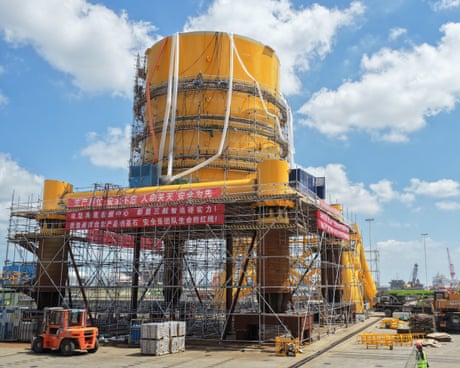
Datacentre off Shanghai coast uses less power and water than land-based equivalent
The world’s first wind-powered underwater datacentre has started operations off the coast of Shanghai, as China presses forwards with solutions for energy challenges created by the country’s artificial intelligence boom.
The Shanghai Lingang undersea datacentre demonstration project, which launched in May, has a capacity of 24 megawatts. It is a joint effort between HiCloud Technology and China Communications Construction, a state-owned company.
Continue reading...
© Photograph: AFP/Getty Images
© Photograph: AFP/Getty Images

© Photograph: AFP/Getty Images
