❌

Reading view

US firm unveils 26-cell battery monitor that detects faults before batteries fail

Semiconductor maker Texas Instruments has introduced a new battery monitoring chip designed to give electric vehicles and energy storage systems earlier warning of battery failures while reducing the number of components required inside battery packs.

The company announced the BQ79826Z-Q1 on Tuesday, calling it the industry’s highest-cell-count battery monitor with an integrated electrochemical impedance spectroscopy (EIS) engine. The device is designed to provide real-time insight into battery health and detect conditions that could lead to failures such as thermal runaway.

The new monitor supports up to 26 battery cells per device, allowing engineers to track more cells with fewer monitoring chips. According to TI, the device can monitor up to 44 percent more channels than previous-generation solutions, helping reduce system complexity, board space requirements, and overall battery pack costs.

The launch comes as automakers and energy storage developers look for ways to improve battery safety, extend battery life, and lower system costs while scaling production of EVs and large-scale storage systems.

Early fault detection

A key feature of the BQ79826Z-Q1 is its integrated EIS engine. The technology measures a battery’s electrochemical behavior in real time, giving engineers a view into changes occurring inside individual cells.

“Just as an electrocardiogram (EKG) monitors the heart, EIS monitors a battery,” the Dallas-based company said in a release.

The company says the technology can identify fault conditions earlier than conventional monitoring approaches by detecting changes from within battery cells. This could help battery management systems flag safety risks before they develop into more serious issues.

“The electrification of transportation and the rapid expansion of energy storage are redefining what battery performance must deliver, and as a leader in battery management technology, TI is uniquely positioned to meet that challenge,” said Wenjia Liu, vice president and general manager of battery management systems at TI.

Liu added that the technology helps “shine a light” inside battery cells and provides chemical-state data that software can use to make real-time decisions on battery safety and performance.

Fewer chips required

Beyond safety, TI says the higher cell count could simplify battery pack architecture. By supporting 26 cells per device, the monitor can reduce the number of monitoring components needed across a battery pack.

The company claims the chip supports eight more cells than competing solutions, enabling designers to lower bill-of-material costs while maintaining reliability.

The monitor can also be paired with TI’s BQ79881-Q1 pack monitor and communications bridge, allowing developers to use the same architecture across different battery chemistries, module sizes and mechanical designs.

TI says the device delivers voltage accuracy of less than 2 mV across temperatures ranging from -40°F to 257°F. The company also claims its EIS measurements are five times faster than previous solutions, helping improve state-of-charge calculations and battery health monitoring.

The BQ79826Z-Q1 complies with Automotive Safety Integrity Level D requirements and ISO 26262 functional safety standards. TI is showcasing the technology at the Power Conversion, Intelligent Motion Expo and Conference (PCIM) 2026 in Nuremberg, Germany.

  •  

Florida Coal Plant Keeps Running Past 2025 Closure, Decade of Wildfires Erases US Air Quality Gains — Today’s Environmental Briefing for Tue, Jun 9 2026

Coal-fired power plant with smokestacks emitting steam against cloudy sky

Across the stories today, a common thread emerges: the growing tension between our rapidly expanding digital world and the natural systems struggling to sustain it. From AI data centers planned for drought-stricken regions to coal plants getting emergency extensions, we’re witnessing the collision between technological acceleration and environmental limits.

The numbers tell a stark story. Two-thirds of new AI data centers are slated for areas already grappling with water scarcity, while these facilities demand massive amounts of both electricity and cooling water. Meanwhile, Florida’s coal plant—scheduled for retirement as part of a clean energy transition—gets an emergency lifeline to keep the lights on. It’s a reminder that progress and pressure often arrive together, forcing difficult choices between immediate needs and long-term sustainability.

The day’s coverage points to growing momentum around accountability, particularly in how we fund and regulate resource-intensive industries. Australian lawmakers are pushing for fair taxation of AI infrastructure, determined not to repeat what they see as mistakes with gas exports. North Carolina legislators face their own paradox, crafting bills that simultaneously curb data center expansion while boosting fossil fuel development. These policy tensions reflect a broader reckoning: how do we harness technological progress without overwhelming the ecosystems that support us?

Yet signs of genuine environmental recovery punctuate today’s more challenging headlines. Water voles have returned to an English nature reserve after four decades, while marine protected areas now cover 10% of the world’s oceans—a significant milestone toward the 30% goal by 2030. In Sumatra’s hills, coffee farmers like Sri Atmiatun are proving that conservation and community prosperity can grow together, restoring forests while securing livelihoods through innovative social forestry programs.

Behind the numbers are real communities adapting in real time. Alaska’s fishing industry faces uncertainty as critical ocean monitoring systems face budget cuts, while Arizona’s San Carlos Lake sits closed indefinitely after drought and dam releases killed all fish life. These aren’t abstract environmental statistics—they’re disruptions to ways of life, forcing entire communities to reimagine their relationships with changing landscapes.

The financial flows reveal where power and priorities truly lie. The world’s largest banks poured a record $906 billion into fossil fuels despite climate commitments, an 8% increase that environmental researchers call “unfathomable.” Meanwhile, China launched the world’s first wind-powered underwater data center, signaling that sustainable technology infrastructure is possible when political will aligns with innovation.

Perhaps most troubling is what we’re losing while focused on these larger battles. Wildfire smoke has erased four years of air quality progress across the United States, while sea levels are now rising at twice the rate recorded just a decade ago. Scientists are racing to record forest sounds before wild spaces fall silent—a poignant reminder that some losses can’t be reversed.

The day’s stories also illuminate the gap between good intentions and effective action. Louisiana legislators unanimously approved expanding their wood pellet industry despite the bill’s sponsor admitting he knows little about the sector. FIFA appears unprepared for wildfire smoke threats at upcoming World Cup venues. These moments reveal how quickly environmental challenges can outpace institutional readiness.

As the week unfolds, all eyes will be on whether emerging solutions—from underwater data centers to marine protection expansions—can scale fast enough to match the magnitude of the challenges. The central question remains: can we innovate our way toward sustainability, or will the pace of environmental change force more fundamental reckonings with how we live and build in a resource-constrained world?

The post Florida Coal Plant Keeps Running Past 2025 Closure, Decade of Wildfires Erases US Air Quality Gains — Today’s Environmental Briefing for Tue, Jun 9 2026 first appeared on EnviroLink Network.

  •  

Emergency Order Extends Florida Coal Plant Operations Despite Planned 2025 Retirement

Emergency Order Extends Florida Coal Plant Operations Despite Planned 2025 Retirement

A Florida coal-fired power plant scheduled for closure in 2025 will continue operating under a federal emergency order, disrupting the Orlando Utilities Commission’s transition to renewable energy. The utility had planned to retire the facility as part of its commitment to achieve net zero emissions by 2050, replacing coal generation with solar and other clean energy sources.

The emergency directive cites energy supply concerns linked to a shortage of power generation facilities and the rapid expansion of data centers throughout the region. This growing digital infrastructure has significantly increased electricity demand, creating strain on the existing power grid. Data centers, which house the servers powering cloud computing and internet services, require massive amounts of continuous electricity for both operations and cooling systems.

The decision represents a setback for Florida’s clean energy goals and highlights the tension between immediate energy security needs and long-term climate commitments. The Orlando Utilities Commission ranks as the state’s second-largest municipal utility, making this coal plant extension particularly significant for regional emissions targets.

The emergency order reflects broader challenges facing the energy sector as electricity demand surges due to technological growth while utilities simultaneously work to phase out fossil fuel generation. This situation underscores the complex balancing act between maintaining reliable power supplies and meeting environmental objectives, particularly as data center development continues accelerating across the Southeast.

The post Emergency Order Extends Florida Coal Plant Operations Despite Planned 2025 Retirement first appeared on EnviroLink Network.

  •  

‘Electrify daily life’, urges Cop31 host

Third of world’s energy needs should come from electricity by 2035, says Murat Kurum, as priorities set out for this year’s UN climate summit

The world should aim to meet a third of its energy needs from electricity within a decade to cut greenhouse gas emissions, the host of the next UN climate summit has said.

While about a third of global electricity generation already comes from renewable sources, other energy-intensive sectors – chiefly transport, heating and industries – have lagged behind. Close to four-fifths of final energy still comes from fossil fuels, as a result.

Continue reading...

© Photograph: Images By Tang Ming Tung/Getty Images

© Photograph: Images By Tang Ming Tung/Getty Images

© Photograph: Images By Tang Ming Tung/Getty Images

  •  

Australian Lawmakers Push for Fair Taxation of AI Data Centers to Avoid Repeating Gas Industry Mistakes

Australian Lawmakers Push for Fair Taxation of AI Data Centers to Avoid Repeating Gas Industry Mistakes

A growing grassroots movement in Australia is demanding that technology companies pay their fair share of taxes if they plan to establish energy-intensive AI data centers across the country. The campaign draws parallels to Australia’s experience with gas exports, where critics argue the nation failed to capture adequate revenue from companies extracting and exporting natural resources.

Over recent months, tens of thousands of Australians have contacted their representatives advocating for a 25% tax on gas exports, with more than 2,200 citizens funding billboard campaigns to promote the initiative. This momentum reflects broader concerns about ensuring foreign corporations contribute appropriately to public coffers when utilizing Australia’s natural resources and infrastructure.

The debate now extends to artificial intelligence infrastructure, as tech giants eye Australia for data center expansion. These facilities require enormous amounts of electricity, water for cooling systems, and land – all drawing heavily on public resources and utilities. Environmental advocates worry that without proper taxation frameworks, Australia could repeat past mistakes where resource extraction generated substantial corporate profits while providing minimal returns to taxpayers.

Proponents argue that fair taxation of AI data centers would not only generate revenue for public services and infrastructure but also ensure that the environmental costs of these energy-intensive operations are properly accounted for. As the AI industry continues rapid expansion globally, Australia faces a critical decision about how to balance economic opportunities with fair compensation for the use of national resources.

The post Australian Lawmakers Push for Fair Taxation of AI Data Centers to Avoid Repeating Gas Industry Mistakes first appeared on EnviroLink Network.

  •  

Commercial launch providers shortlisted for China’s low-cost cargo spacecraft

A wide aerial view of a rocket launch site in a desert landscape at sunset. A tall white rocket stands vertically on a launch pad near the center-right, surrounded by service towers and low buildings. A long rectangular assembly building and crane structure sit nearby, connected by paved roads. The surrounding terrain is flat, sandy, and sparsely developed, with distant mountains visible on the horizon under a warm orange sky.

China is expanding the role of its commercial rocket companies by shortlisting four such entities for launches of a new space station cargo transport system.

The post Commercial launch providers shortlisted for China’s low-cost cargo spacecraft appeared first on SpaceNews.

  •  

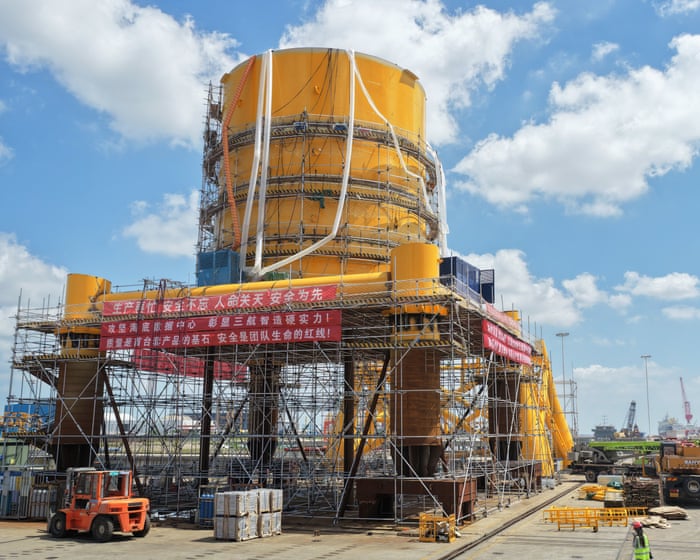
World’s first wind-powered underwater datacentre starts operating in China

Datacentre off Shanghai coast uses less power and water than land-based equivalent

The world’s first wind-powered underwater datacentre has started operations off the coast of Shanghai, as China presses forwards with solutions for energy challenges created by the country’s artificial intelligence boom.

The Shanghai Lingang undersea datacentre demonstration project, which launched in May, has a capacity of 24 megawatts. It is a joint effort between HiCloud Technology and China Communications Construction, a state-owned company.

Continue reading...

© Photograph: AFP/Getty Images

© Photograph: AFP/Getty Images

© Photograph: AFP/Getty Images

  •  

Australian homes lead the world in solar. But businesses are falling behind

Australia leads world in residential solar per capita with 22GW installed but commercial and industrial sector has deployed only a quarter of that

Australia’s revolution in rooftop solar has left behind commercial and industrial buildings, where installations have lagged far behind homes, according to new analysis.

Australia leads the world in residential solar on per capita terms, with 22GW installed as of last December. But businesses have only installed about a quarter of that – 5.6GW – despite consuming more electricity than households, a report from the Institute for Energy Economics and Financial Analysis (IEEFA) has found.

Continue reading...

© Photograph: Bloomberg/Getty Images

© Photograph: Bloomberg/Getty Images

© Photograph: Bloomberg/Getty Images

  •  
❌