❌

Reading view

Nextcloud adds Euro-Office to Hub workplace suite, expands AI assistant

MUNICH — Nextcloud has integrated Euro-Office into its workplace application suite, one of several updates to Nextcloud Hub unveiled on Tuesday that include a new compliance app for large organizations and a program to support developers building for its platform.

The announcements came during the company’s Nextcloud Summit 2026 here.

Euro-Office, announced in March, is billed as an open source, sovereign alternative to Microsoft Office for European organizations keen to reduce their reliance on US tech providers. It consists of four browser-based applications: a document editor, spreadsheet program, presentation tool, and a PDF editor — each enabling collaborative editing. Euro-Office documents can also be opened directly from the Nextcloud Files mobile app.

Nextcloud is one of several European companies that support Euro-Office, which is built on the open-source code base of OnlyOffice and distributed under the GNU Affero General Public License v3 (AGPL v3).

The integraton means Nextcloud users can now choose between two options in Nextcloud Office: Euro-Office and the existing Collabora integration. 

“Euro-Office uses a different architectural approach that can result in a better performance in the browser, a different user experience…, so it’s important that this option is available,” Jos Poortvliet, Nextcloud co-founder and vice president of communications, said at the Tuesday event.

Other changes in the Nextcloud Hub 26 Spring release include updates to Nextcloud‘s Talk video and voice meeting app, including AI noise suppression and the ability to start a call from any Nextcloud Hub app – an addition that will make collaborative editing easier, said Poortvliet. 

For Nextcloud Assistant, there are new AI agent capabilities. In addition to existing capabilities such as managing calendars and tasks, AI agents can now create cards in Nextcloud’s Deck task management app and update information in the Forms app.

There are also improvements to the AI assistant’s interface, which can be moved around to avoid blocking other applications and allow users to copy and paste text more easily without opening another tab. To meet EU AI Act requirements, Nextcloud will make it easier to see which  provider supplies the large language model (LLM) the Assistant runs on.

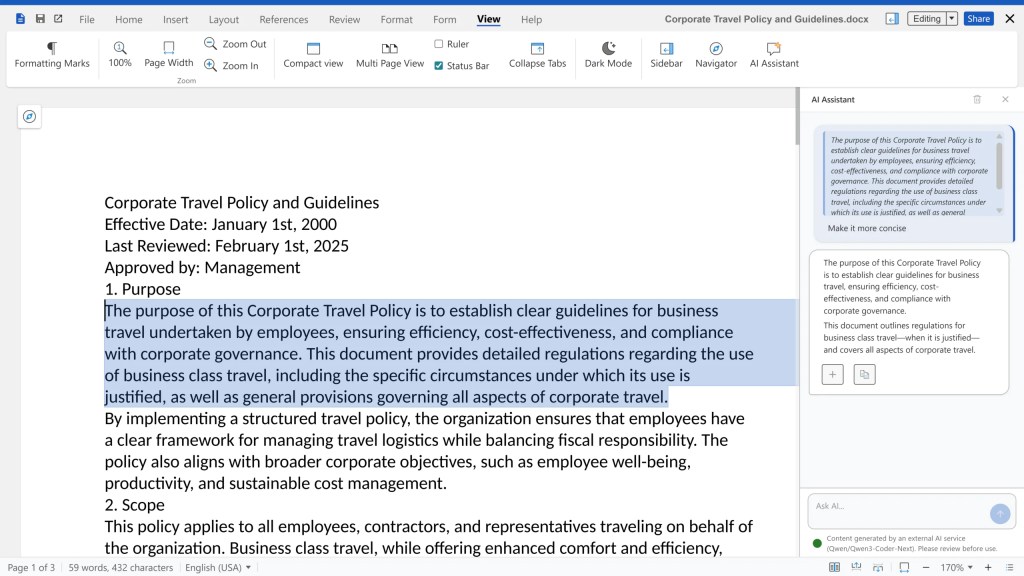
Nextcloud will also integrate the AI assistant directly into its Nextcloud Office suites via a sidebar chat interface, allowing users to address problems such as errors in the spreadsheet app.

NextCloud AI chat assistant

NextCloud’s AI chat assistant is integrated into the company’s Office suites.


NextCloud

There’s also a new Governance app that helps large organizations — particularly governments and highly regulated industries — meet regulatory requirements with compliance tools to manage data held in Nextcloud Hub. It contains several features,  including sensitivity labels to control access rights; data retention and archive capabilities; and a legal hold option that preserves documents for legal purposes such as a court case.

The Governance app includes a Compliance Manager that provides a compliance score based on an organization’s regulatory requirements, and measures progress towards certain targets. Admins can also search and review documents shared by employees and generate audit reports for compliance. The Governance app is available to Nextcloud Enterprise customers.

Nextcloud also launched a program to support independent software providers interested in building apps on its platform. 

With AI making it easier for developers to build software that integrates with its platform, Nextcloud expects a 10-fold increase in the number of available apps — from 600 now to 6,000 over the next 12 months, according to Nextcloud CEO Frank Karlitschek.

Nextcloud promised to promote apps developed by partners in its App Store and sell subscriptions as part of the ISV program, as well as provide documentation and technical help to customers. In return, developers would provide guarantees to customers around security processes and long-term support.

“We can strengthen our ecosystem, the developers also make some money — because obviously we do a revenue share here — and we leverage the dynamics that we expect from AI coming very soon,” said Karlitschek.

Editor’s note: NextCloud paid for Matthew Finnegan’s travel and hotel costs for NextCloud Summit 2026, but had no editorial role in the creation of this story.

  •  

Apple’s AI plans show promise, but proof of success still to come — analysts

WWDC26 felt like a defining platform moment. Apple is no longer simply promising that AI will arrive eventually; it is arguing that Apple Intelligence and Siri AI should become central to the future of its ecosystem. If that works, the company will have turned AI from a perceived weakness into a new reason to stay inside Apple’s world.

Still, the bigger question is execution. Apple did not present AI as a lab experiment; it presented a polished, consumer-ready experience. That raises expectations. 

Apple must deliver this time

Users will not judge Apple Intelligence by model architecture or parameter counts. They will judge it by whether Siri understands them, whether actions work reliably, whether personal context feels useful rather than intrusive, and whether the experience is consistent across devices.

Since Monday’s announcements, we’ve learned that some features will not work on all devices — and there’s speculation Siri AI may not fully escape beta until 2027. “Until Apple puts a stake in the ground and says when the new Siri features will be available, the debate remains: Does Apple actually have the chops in personalized AI? The demo suggests yes. The lack of timing suggests maybe,” wrote analyst Gene Munster.

Optimists argue that Apple has regained momentum by presenting a coherent AI story, one built around privacy, integration and everyday utility rather than spectacle. Skeptics counter that many of the features resemble capabilities already available elsewhere, and say the company still needs to prove it can ship them at scale and make them a meaningful reason for consumers to upgrade.

What the analysts say

That balance is visible in analyst reaction. In a client note seen by Computerworld, Erik Woodring of Morgan Stanley described the keynote as clear progress on Apple’s AI roadmap and said it suggested monetization opportunities could arrive earlier than expected — even if the overall journey will be “a marathon, not a sprint.”

UBS, in contrast, said the privacy-focused AI additions are useful but unlikely to be a material driver of iPhone demand in the near term, while Barclays called the changes interesting but incremental, and not enough to drive an upgrade cycle.

Ben Wood, chief analyst at CCS Insight, argued that Apple had to answer concerns about its AI shortcomings and now has to prove that its privacy-led, integration-first approach translates into a meaningfully better everyday experience. “Consumers will not judge Apple Intelligence by model sizes, partnerships or technical architecture,” Wood told me. “They will judge it by whether Siri understands them, whether actions work, whether personal context feels useful rather than intrusive, and whether the experience is consistent across devices.”

Dipanjan Chatterjee, vice president principal analyst at Forrester, said Apple’s strength lies in shifting the focus from the underlying technology to outcomes such as usefulness, simplicity and trust, while warning that the company still has skeptics to win over after its stop-start AI rollout. “The lesson for brands is clear: market the value, not the ingredients,” said Chatterjee. “After stumbling with the Apple Intelligence roll-out, Apple’s success will hinge on delivering the new Siri experience quickly, and ensuring it works as promised for iPhone users at scale.”

What about Apple developers?

While many are infuriated about Europe’s inability to build compromise, Apple’s developer army otherwise seems positive about what the company has accomplished. 

“On the AI front, it never made sense to me for Apple to develop their own LLM, so focusing on powerful, fast and private for implementation of Apple Intelligence seems to be an effort that is progressing rather nicely.  In all, a pretty good Keynote, I’d say,” Rich Siegel, founder and CEO of Bare Bones Software, said in an interview.

“It’s great to see Apple continue to pursue a vision of AI that leverages local systems, preserves privacy, and integrates with third party tools,” said Ken Case, CEO of the Omni Group. “A lot of our work around the Apple Foundation Models and automation, App Intents, and adopting Swift look to be fruitful investments, but it’s clear there’s more to do starting this summer. It’s also welcome to see them refine Liquid Glass, giving customers more control and listening to feedback they’ve heard over the past year.”

“I expected that this year’s Siri revamp would be the biggest personal assistant update Apple has ever done, and that’s exactly what we got,” said Sergii Kryvoblotskyi, director of AI and research at MacPaw. “Since Apple acquired Siri back in 2010, it has lacked one thing: real intelligence. Behind the great speech recognition service it provided, the tech was not ready to provide real value to users.”

“Most notable for me was Siri AI and the push towards on-device and more capable models that can do more with user context,” Matt Vlasach, Jamf senior vice president, enterprise products and solutions engineering,” said in an interview. “While obvious for consumer use cases, as illustrated in the keynote, the opportunity to evolve this to the work context using a more advanced Apple Intelligence framework is an exciting evolution.”

“OS 27 feels like a deliberate reset, less about new features and more about polish and quality-of-life improvements, which most users will welcome,” said John Richards, general manager, IT products, at Iru. “The new capabilities are focused entirely on Apple Intelligence and Siri AI, and what’s encouraging is how much Apple leaned into privacy with the Gemini partnership. That combination of capability and privacy-first design is the right instinct.”

“The single biggest request I made at Apple’s Foundation Models workshop in Madrid was opening Private Cloud Compute to third-party developers,” said Serhii Popov, senior software Eengineer at CleanMyMac. “It’s here and free for apps under 2 million users. That’s a real breakthrough and a huge opportunity for a lot of great apps.”

How will integrated AI change things?

Joel Rennich, senior vice president for product management at JumpCloud, looked ay how on-device AI will transform other paradigms. For starters, it shifts identity from simple authentication to governing what actions an AI agent is allowed to take.v“Enterprises will need identity frameworks that govern both human and non-human actors consistently,” he said.

“iOS 27 and Apple Intelligence point toward an operating system that does not just launch apps, it executes intent,” Rennich said. “Instead of users navigating between tools, the OS increasingly mediates outcomes directly through AI. This changes how work is initiated and completed on devices.

“With Apple Intelligence integrated across core experiences like Siri, Safari, and system services, AI is no longer an overlay but infrastructure. The separation between where data lives and where it is used becomes increasingly invisible to the user. Intent becomes the primary input, not app selection.”

I also spoke with Hexnode CEO Apu Pavithran, who pointed to some of the concerns enterprise users might have following WWDC: “The keynote didn’t speak much to admins,” he said. “The features that matter most at the management layer, such as how Apple exposes Siri AI through MDM APIs, whether IT gets granular per-app controls for Apple Intelligence, how shared device deployments handle the new assistant — these will be answered in the developer documentation. This week, that’s where IT teams should be looking.”

“Admins should dig in immediately and see what’s changed. Watch the developer docs, audit how Apple Intelligence interacts with existing device policies, and remember that the keynote is only a part of the story for enterprises,” he said.

Making AI great again

“Rebuilt from the ground up, Apple is trying to make AI feel native, useful and invisible across the devices people already use every day,” Francisco Jeronimo, vice president for client devices at IDC, said in an interview. “This matters, because the winning AI experience for consumers will not be the loudest or most technically complex. It will be the one that understands context, respects privacy, works reliably across apps, and reduces friction without forcing users to change behavior.”

“[Apple] is also clearly seeking to differentiate through its privacy promises,” said CCS Insight’s Wood. “This looks like a step in the right direction, but there is no room for complacency, and Apple still has a long AI journey ahead.”

Pavithran reflected on something more. “Overall, it’s hard not to think of this year as a deliberately measured keynote, one that’s intentionally playing it safe and seeking to rewrite the AI narrative,” he said. “I won’t be surprised if this ends up setting the stage for a much bigger installment next year with incoming CEO John Ternus hitting the ground running with some ‘wow’ features like new hardware or agentic AI at scale.”

That we can now seriously consider that possibility shows the extent to which Apple has regained momentum in AI on its platforms.

You can follow me on social media! Join me on BlueSky,  LinkedIn, Mastodon and The Core.

  •  

Beware of the genAI token trap

Enterprises are moving aggressively into generative AI. On the surface, that seems like the right call. The technology is powerful, accessible, and increasingly embedded in how businesses build applications, automate processes, and support decision-making. A development team can connect an application to a large language model in days. A product team can add AI features in weeks. Business leaders see quick wins, faster innovation, and a path to modernizing nearly every part of the company.

These are the upsides everyone is talking about. The part we don’t discuss enough is the economic trap forming underneath all this convenience.

Most enterprises think of tokens as a technical billing detail. They are not. Tokens are the unit of economic dependency in generative AI. Every prompt, response, summarization, retrieval step, workflow action, and agent decision is measured and monetized through tokens. Tokens are not just part of the plumbing. They are the tollbooth between your enterprise and a provider’s intelligence platform. The more AI becomes central to your operations, the more power that tollbooth holds over your future costs.

Tokens are not just a pricing unit

A token is usually described as a chunk of text processed by a model. That is accurate enough for developers, but it misses the bigger issue for CIOs, architects, and corporate boards. In the enterprise, tokens are the mechanism by which AI capabilities are rented. They are the meter attached to the intelligence itself.

That distinction matters because token usage grows faster than most companies anticipate. A simple user prompt rarely remains simple in production systems. It can trigger retrieval from internal knowledge stores, multiple model calls, tool use, post-processing, policy checks, and agent loops. What appears to be a single transaction to the user may involve several layers of token consumption behind the scenes. As a result, enterprises often underestimate the true operating cost of AI-enabled systems, especially as those systems mature and spread across departments.

Today, those costs still feel manageable. In many cases, they feel surprisingly low. That is exactly why the trap is so dangerous.

The market is in a subsidy phase

Current token pricing is giving enterprises a false sense of comfort. Many remote LLM providers are aggressively competing for market share. They want developers building on their APIs. They want enterprise applications tightly coupled to their platforms. They want AI agents, copilots, workflows, and customer experiences to depend on their models. To make that happen, pricing remains highly attractive relative to the value delivered.

That does not mean the economics of generative AI are stable. It means the market is still being shaped by investor capital, strategic pricing, and growth expectations. Providers are racing to establish position, and enterprises are benefiting from that race. But no market stays in that phase forever. At some point, investors will expect durable profitability. At some point, weaker providers will disappear, consolidate, or retreat. At some point, the survivors will have more leverage and much less reason to price primarily for adoption.

That’s when the token trap closes.

Enterprises that build deep dependence on remote models during the subsidy phase may find that what seemed inexpensive at pilot scale becomes punishing at enterprise scale. The application that costs $1,000 per month today may cost 10 or 20 times that amount a few years from now, not only because usage has increased, but also because the market has repriced the dependency.

Easy to adopt, expensive to exit

Cloud computing followed a similar path, with many enterprises mistaking short-term convenience for long-term economics. In the early years, the case was compelling and largely accurate. Move faster, reduce friction, avoid capital spending, and scale with ease. Those benefits were real. Many organizations made architectural decisions that prioritized speed over leverage. They became dependent on managed services, provider-specific tools, and operating models that were easy to adopt but expensive to unwind.

Years later, many enterprises discovered that their cloud bills were much higher than expected and their exit options much narrower than advertised. That was not because the cloud failed. Architectural dependency eventually became financial dependency.

Generative AI is repeating that pattern, only faster. The integration barrier is lower, the pressure to adopt is higher, and the pace of enterprise experimentation is far greater. As a result, companies are wiring remote LLMs into applications, workflows, and agentic systems with very little thought about how these costs will behave in the next five to 10 years.

Agentic AI makes things worse

The more enterprises move from simple prompt-response systems to agentic architectures, the more dangerous the token trap becomes. Agents are not single-call systems. They plan, deliberate, retrieve information, invoke tools, evaluate results, retry steps, and often coordinate with other agents. Each of those actions consumes tokens. Costs no longer rise in a neat linear fashion. They compound.

This matters because agentic AI is increasingly being presented as the future of enterprise automation. It’s true in many cases. But if an enterprise builds agentic systems primarily on remotely hosted intelligence, it is also building future business processes on top of someone else’s pricing model. That is a major strategic risk. The more successful those systems become, the harder they are to replace. The harder they are to replace, the more pricing power shifts to the provider.

This is how businesses end up operationally dependent on a cost structure they do not control.

The appeal of AI sovereignty

The answer is not to reject public models or pretend that external providers play no role. They clearly do. There will always be cases where renting frontier AI capabilities makes sense. But enterprises need to stop assuming that renting is the default for every workload.

AI sovereignty is the alternative that deserves much more attention. That means building, tuning, deploying, and governing models inside the enterprise for use cases where long-term control matters more than access to the absolute frontier. Enterprises need to recognize that most business applications do not need a world-class general-purpose model. They need a model that is good enough for a specific purpose, aligned to the enterprise’s data, governed by the enterprise’s rules, and operated at a predictable cost.

It’s a very different way of thinking.

A self-hosted or enterprise-controlled model may not match the rich feature set of the largest public offerings. It may lack the same breadth, polish, or marketing appeal. But for many internal business tasks, those factors do not matter.

Here’s the most critical question to guide your architectural direction: Can a sovereign AI model solve the problem reliably, securely, and economically over time? If the answer is yes, owning that capability may be far more strategic than forever renting something with more power than you need. In effect, the enterprise becomes its own provider for the workloads that matter most.

Prepare for changing markets

Too many companies still treat generative AI architecture as a tactical IT issue. It is not. These decisions directly affect cost structure, operating flexibility, data control, and long-term competitiveness. If AI becomes a force multiplier across the business, the economics of AI become strategic to the business itself.

The companies that get this right will not necessarily be the fastest adopters. They will understand the difference between experimentation and dependency. They will use external models when it makes sense, but they will also invest in sovereign capabilities where ownership matters. They will think like architects, not consumers.

Here’s the takeaway: Cheap tokens come with strings. They are a gateway to a dependency model that will typically look very different once providers stop pricing for growth and start pricing for leverage. Enterprises cannot keep mistaking today’s bargain for tomorrow’s reality. Boards and executive teams need to act now to get ahead of this issue. The key question is not whether generative AI creates value. It clearly does. The real question is whether the enterprise can still afford and control the value it creates once the market matures.

  •  

Trump’s new AI order — hallucinations aren’t just for LLMs

Years ago, right-wingers coined the phrase “Trump Derangement Syndrome” (TDS) to describe people who hate US President Donald J. Trump. (I think it better describes the president’s outlandish, truth-challenged statements and the followers who think he can do no wrong.) What’s really deranged is his recent AI executive order.

First, a little history. As you may recall, Trump often (and loudly) trashed his predecessor’s Executive Order 14110, which had demanded “safe, secure, and trustworthy” AI. That Biden Administration order was replaced last year by Trump’s own “Removing Barriers to American Leadership in Artificial Intelligence” directive; it basically let US AI companies do whatever they wanted in the name of innovation.

Then, a little thing called Anthropic Mythos came along — and scared the pants off even AI’s biggest fans. Seemingly in response, someone in the federal government decided that letting AI companies do whatever they want might not be the brightest policy. 

Or, did they?

True, the new order creates a process under which AI companies can give US  government access to “covered frontier models” for up to 30 days before public release so experts can probe for vulnerabilities and test how the systems could be abused. It also directs agencies to set evaluation standards, establish an “AI cybersecurity clearinghouse,” and harden federal networks against rapidly advancing AI‑enabled attacks. 

Some people, like Graham Brookie, vice president for technology programs and strategy at the Atlantic Council, think the order is great. “The administration’s executive order on Advanced AI Innovation and Security is a serious policy with support from necessary stakeholders across party lines and industry to ensure the government is evaluating the cybersecurity risks posed by frontier AI models. It’s a policy that can be built on.”

Really? I’m not sure Brookie read the same document I did — if, indeed, he read it at all.

I quote:

“Nothing in this section shall be construed to authorize the creation of a mandatory governmental licensing, preclearance, or permitting requirement for the development, publication, release, or distribution of new AI models, including frontier models.

“In addition, ‘This order is not intended to, and does not, create any right or benefit, substantive or procedural, enforceable at law or in equity by any party against the United States, its departments, agencies, or entities, its officers, employees, or agents, or any other person.’”

In other words, AI companies won’t be required to do much of anything. And if they do  submit a project for review, get the government’s blessing for it, and something goes badly wrong, it’s not the government’s fault. 

So, exactly why would AI companies even mess with this performative AI security theater?

Beyond those concerns, who exactly will be judging AI projects in 30 days? In theory, it would be a cybersecurity clearinghouse made up of people from the National Security Agency, the US Treasury Department, and the Cybersecurity and Infrastructure Security Agency (CISA). Most likely, CISA would do the bulk of the heavy-lifting — it’s their job, after all. But there’s this wee problem; Trump’s so-called Department of Government Efficiency (DOGE) last year gutted CISA. There’s virtually no one left to do the work, and certainly not in 30 days.

There’s also the question of funding for the new initiative.  According to the order, “The Director of OMB, in coordination with the National Cyber Director and the Director of CISA, shall determine whether any Federal grant programs have available and relevant funding that can be directed toward applicants developing advanced AI vulnerability detection.”

Spoiler: There’s no money set aside for this purpose.

Leaving aside whether the Executive Order has any teeth at all — the Brennan Center for Justice argued that under the Constitution, it doesn’t; the closer you look at the document, the less substance you’ll find.

Besides, in an industry where success is all about releasing the latest Large Language Model (LLM) as fast as possible to garner attention and investor dollars, who exactly would want to put their AI models on ice for even 30 days? (Short answer: No one.) These companies are always going to be focused first on getting the word out about their latest model as fast as humanly — Uh, AI-ly — possible. 

Still, some people seem to think this executive order really will make a difference. For example, Paul Benda, the American Bankers Association executive vice president for risk, fraud, and cybersecurity, sees it “as a constructive step toward strengthening the nation’s approach to managing the cybersecurity risks and opportunities associated with advanced artificial intelligence [because it ] can help better protect critical infrastructure, including the financial sector.”

Oh, please. I’m so tired of people who skim the titles of Trump’s executive orders and then assume there’s anything real about them. 

This AI order is meaningless garbage, and anyone telling you otherwise is either lying or wants to be on the Trump regime’s good (?) side. Or, both — it could always be both. 

  •  
❌