
❌

Reading view

South Korean device cuts required components by 75%, boosts data processing speed by 4x

Researchers have developed a transistor technology that enables a single semiconductor device to perform multiple circuit functions simultaneously.

Developed by the Pohang University of Science and Technology, the new approach significantly simplifies circuit design and increases data processing speed by fourfold compared with conventional methods. As the number of functions increases, so do the number of circuits and transistors required.

Implementing complex circuit functions

Researchers also revealed that one of the key challenges in the semiconductor industry is integrating more functions into smaller chips. As the number of functions increases, so do the number of circuits and transistors required. However, when adding new functions to previously fabricated semiconductor chips, back-end-of-line (BEOL), processing must be conducted at temperatures below 400°C to protect the existing chip structure.

“This study demonstrates the possibility of implementing complex circuit functions at the level of a single device,” said Professor Byoung Hun Lee.

“We expect this technology to be widely applicable to the development of ultra-compact AI devices and three-dimensional integrated, highly-density semiconductor systems.”

The research team focused on zinc oxide(ZnO) and tellurium(Te). Both materials can be fabricated as thin, uniform films at temperatures below 200°C, making them promising candidates for next-generation semiconductor materials. By combining the two, the team created a ZnO–Te heterojunction transistor, according to a press release.

Team successfully realized double negative differential transconductance

The device controls current flow in a highly distinctive way. Unlike conventional semiconductors, in which current generally increases as voltage rises, this device exhibits negative differential transconductance(NDT), in which current decreases over a certain voltage range. The team successfully realized double negative differential transconductance(D-NDT), in which this phenomenon occurs twice in succession within a single device. In simple terms, the technology allows a single device to handle tasks that would normally be divided among multiple devices, thereby reducing circuit complexity, as per the release.

The multi-functional ZnO–Te heterojunction device exhibiting double negative differential transconductance (D-NDT) characteristics is presented, according to the study published in Advanced Functional Materials. The results suggest that the ZnO–Te D-NDT device offers a promising pathway for realizing area-efficient and multi-functional integrated circuits for future electronics.

Using this device, the team implemented a frequency quadrupler that converts one input signal into four output signals. This function would typically require multiple transistors, but the new technology achieves it with a single device, reducing the number of required transistors by 75%. In actual circuit experiments, the researchers also confirmed that data processing speed increased fourfold within a single input signal cycle.

The device controls current flow in a highly distinctive way. Unlike conventional semiconductors, in which current generally increases as voltage rises, this device exhibits negative differential transconductance(NDT), in which current decreases over a certain voltage range. The team successfully realized double negative differential transconductance(D-NDT), in which this phenomenon occurs twice in succession within a single device. In simple terms, the technology allows a single device to handle tasks that would normally be divided among multiple devices, thereby reducing circuit complexity.


  •  

US firm’s next-gen aerospace composite set to deliver exceptional strength, durability

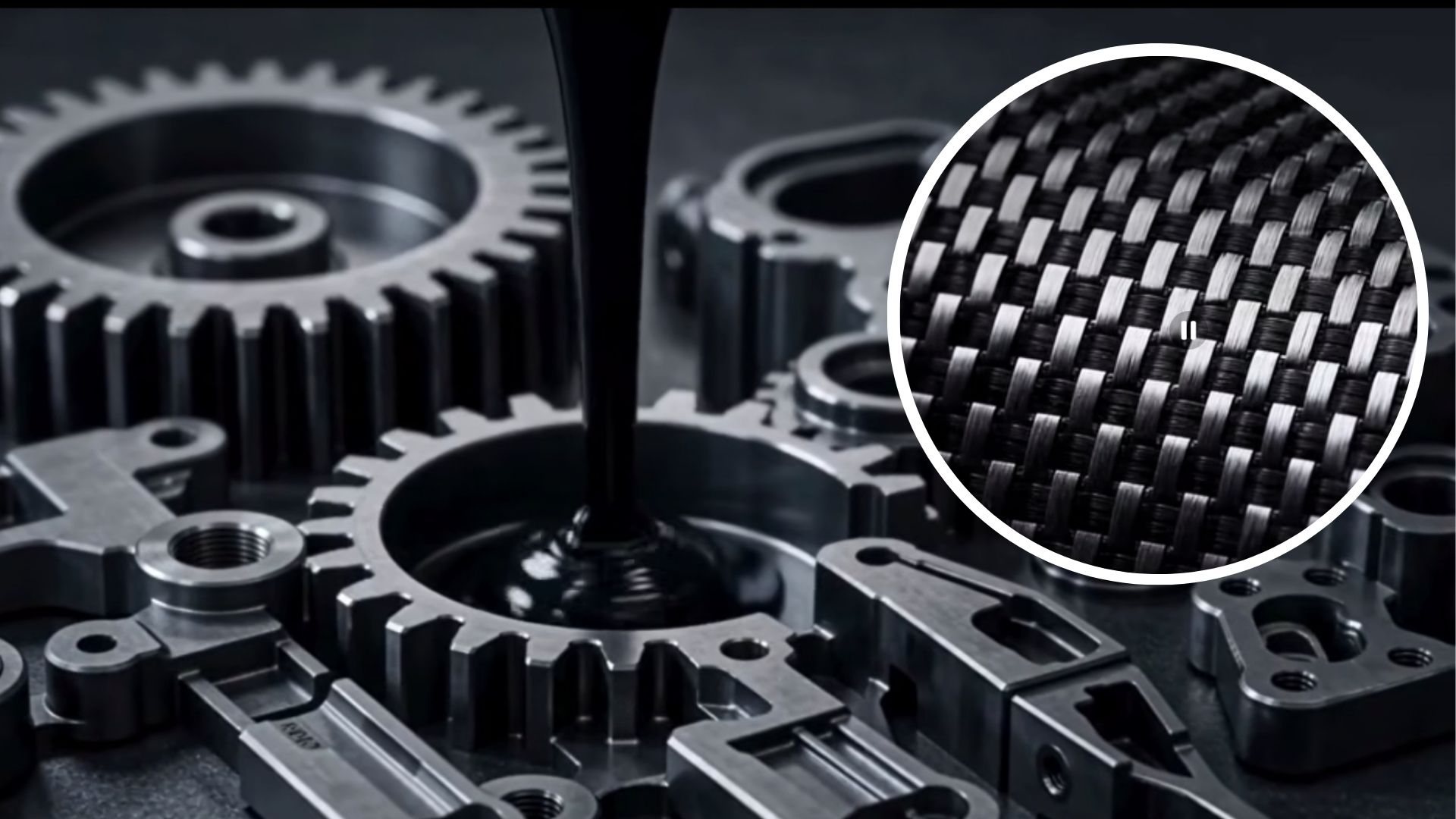
A Texas-based firm has filed patent for its next-generation self-lubricating aerospace composite. Carbon Fiber Max GX-F delivers exceptional strength, durability, wear resistance, and manufacturability for demanding aviation, aerospace, defense, and industrial applications.

The material expands the company’s intellectual property portfolio and establishes the foundation for a new family of advanced materials designed to bridge the gap between traditional engineering plastics and conventional carbon fiber composites.

Proprietary architecture utilizes carbon nanotubes

Developed by Carbon Fiber Max, the GX-F incorporates a proprietary architecture utilizing carbon nanotubes, tungsten disulfide nanotubes, graphene nanoplatelets, and advanced thermoplastic matrices to create lightweight, high-performance composite systems that can be injection molded into complex geometries while maintaining exceptional mechanical and tribological properties.

“The filing of this provisional patent represents a major milestone for Carbon Fiber Max™ and our long-term vision of redefining what advanced materials can achieve,” said Milton Arch, CEO of Carbon Fiber Max.

“GX-F is more than a new formulation. It is a platform technology designed to unlock opportunities across aerospace, defense, electric aircraft, robotics, advanced mobility, and next-generation manufacturing.”

Designed with scalability and manufacturability

The company also revealed that unlike many traditional composite materials that require labor-intensive manufacturing processes, Carbon Fiber Max GX-F has been designed with scalability and manufacturability in mind, allowing for efficient production of components across multiple industries.

It’s also claimed that the GX-F has the potential to address longstanding challenges associated with traditional composite materials, including wear, friction, manufacturability, complexity, and lifecycle durability.

As global demand increases for lighter, stronger, and more efficient materials, Carbon Fiber Max believes GX-F positions the company to pursue opportunities with aircraft manufacturers, defense contractors, advanced mobility developers, robotics companies, and industrial OEMs seeking alternatives to conventional composites, according to a press release.

The filing also opens the door to future licensing opportunities, strategic partnerships, joint development programs, and industry-specific formulations tailored to the requirements of aerospace, defense, transportation, and advanced manufacturing markets, as per the release.

A defining feature of the GX-F platform is its nanoengineered design philosophy. By incorporating advanced nanoscale reinforcement technologies into the composite structure, Carbon Fiber Max aims to improve mechanical strength, thermal resistance, and long-term durability.

The new composite platform may also find applications in hypersonic systems, advanced drones, military aircraft, and space-related technologies where lightweight, high-performance materials play a decisive role in mission success. The patent filing underscores Carbon Fiber Max’s ambition to position itself as a key supplier of advanced composite solutions for both commercial and defense markets.

The provisional patent filing marks another step in Carbon Fiber Max’s broader intellectual property strategy. Securing patent protection allows the company to safeguard its innovations while continuing development and commercialization efforts.


  •  
❌