❌

Reading view

A Black Hole’s Puzzling X-Ray Bursts

illustration of a stellar-mass object crashing through the accretion disk around a supermassive black hole

In 2019, a supermassive black hole in a galaxy 300 million light-years away woke up. Now, it’s puzzling astronomers with an unexpected slowdown in its X-ray bursts.
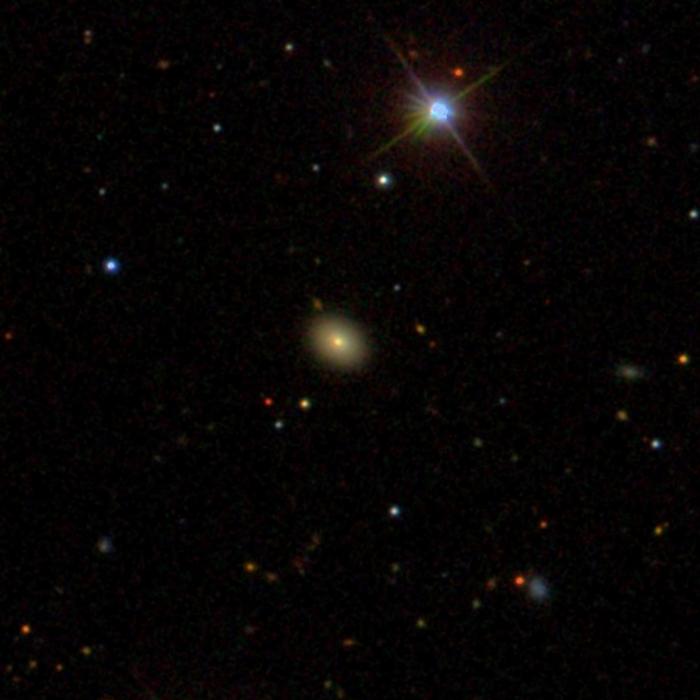
ZTF19acnskyy host galaxy

The fuzzy yellow galaxy at the center of this image is home to ZTF19acnskyy. [Sloan Digital Sky Survey]

Ansky Awakens

Nearly seven years ago, the Zwicky Transient Facility saw the galaxy SDSS J133519.91+072807.4 suddenly brighten at optical wavelengths, with the source given the moniker ZTF19acnskyy or “Ansky.” Within the next few years, Ansky brightened at other wavelengths, possibly signaling the first recorded case of a slumbering supermassive black hole grumbling to alertness.

In 2024, Ansky entered a new phase of behavior, exhibiting a series of semi-regular X-ray flares called quasi-periodic eruptions. The leading explanations for these flares, which have been detected from several nearby galaxies, involve a star-sized object spiraling toward a supermassive black hole. The repeating X-ray flares arise when the object crashes through an accretion disk around the black hole, or when the object loses mass each time it passes closest to the black hole. In either scenario, the time between flares is expected to decrease over time — but as new work shows, Ansky is behaving in ways that fail to fit existing theories of quasi-periodic eruptions.

An Unexpected Slowdown
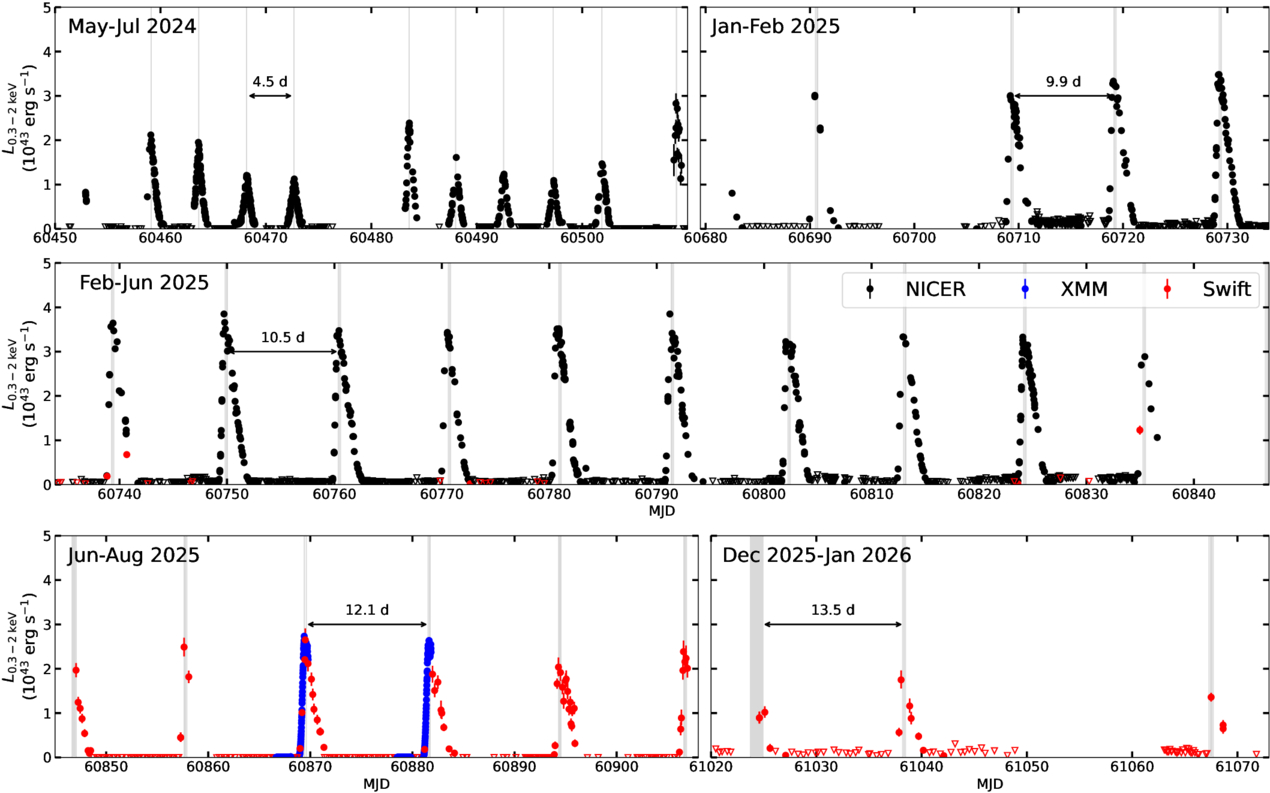
plot of Ansky's X-ray flares

Soft X-ray observations of Ansky’s bursts from 2024 to 2026. These plots clearly show that in 2025 and 2026, the peak luminosities of the bursts have remained roughly constant while the time between bursts has increased. Click to enlarge. [Chakraborty et al. 2026]

Astronomers first reported on Ansky’s strange behavior in 2025, finding evidence that the time between eruptions was increasing rather than decreasing as expected. To investigate this emerging trend, Joheen Chakraborty (Massachusetts Institute of Technology) and collaborators analyzed data from the Neil Gehrels Swift Observatory’s X-ray Telescope, XMM-Newton, and the Neutron star Interior Composition Explorer (NICER).

This X-ray monitoring campaign spanned from January 2025 to January 2026 and captured 23 bursts, including 19 consecutive bursts — the most seen from a quasi-periodic eruption source to date. The bursts each lasted about three days, and the burst luminosity and total energy remained roughly constant, but the time between bursts increased smoothly from 9.9 days in January 2025 to 13.5 days in January 2026.

Possible Explanations

What physical process can produce X-ray bursts that are roughly consistent in energy and peak luminosity, last for approximately three days, and become more spaced out over time? The team considered five possibilities:

  1. A star orbiting a black hole could transfer a bit of mass to the black hole each time it draws close… but it’s not clear whether the energy of each burst would remain the same as the star loses mass, nor is it clear how a three-day eruption duration could be achieved.
  2. A star partially disrupted by a black hole could be kicked progressively farther from the black hole due to asymmetric mass loss or the reformation of its core… but this scenario cannot explain the bursts’ consistent energies and luminosities.
  3. An object orbiting a black hole with an accretion disk could be experiencing general relativistic precession… but no combination of known sources of precession can reproduce Ansky’s behavior.
  4. A second supermassive black hole could cause reflex motion of the inner black hole, changing how far the signal must travel… but even though this scenario can increase the time between bursts, the rate of increase is three orders of magnitude too small.
  5. Instabilities in the black hole’s accretion disk could trigger recurrent bursts of accretion… but it’s not yet clear how an instability scenario could produce such predictable behavior.

While none of these models can fully solve the mystery of Ansky’s slackening X-ray flares, this work provides new avenues for exploration. In the meantime, we may get new clues simply from waiting to see what this source does next!

Citation

“A Positive Period Derivative in the Quasiperiodic Eruptions of ZTF19acnskyy,” Joheen Chakraborty et al 2026 ApJL 1001 L6. doi:10.3847/2041-8213/ae548b

The post A Black Hole’s Puzzling X-Ray Bursts appeared first on AAS Nova.

  •  

A Potential New Piece of the “Little Red Dot” Puzzle

X-ray dot

Editor’s Note: Astrobites is a graduate-student-run organization that digests astrophysical literature for undergraduate students. As part of the partnership between the AAS and astrobites, we occasionally repost astrobites content here at AAS Nova. We hope you enjoy this post from astrobites; the original can be viewed at astrobites.org.

Title: The X-Ray Dot: Exotic Dust or a Late-Stage Little Red Dot?
Authors: Raphael E. Hviding et al.
First Author’s Institution: Max Planck Institute for Astronomy
Status: Published in ApJL

What Are Little Red Dots?

One of the most intriguing results produced by JWST was the serendipitous discovery of a new class of object: “little red dots” (LRDs). These objects started popping up everywhere in our early universe observations. Surprisingly, they look like compact (little) red dots in imaging data (astronomers are an incredibly creative bunch). The number of LRDs we observe drops drastically at redshifts less than about z = 4 (about 12 billion years ago), implying that LRDs are likely evolving into something else entirely. The luminous, compact nature of LRDs, paired with their disappearance from the cosmic stage, has continuously puzzled astronomers in recent years.

At least part of the LRD population has routinely been explained as a new class of active galactic nuclei (AGN). AGN are the central engines of many galaxies — luminous regions powered by actively accreting supermassive black holes. Recent evidence has increasingly pointed towards LRDs being a new class of AGN: black hole stars, or black holes surrounded by dense cocoons of gas. Naturally, this raises questions surrounding the placement of LRDs in our understanding of supermassive black hole and galaxy evolution across cosmic time.

A hallmark of typical AGNs is their X-ray brightness. X-rays are one of the most energetic types of electromagnetic radiation, and they are primarily produced by the most extreme astrophysical situations (think neutron star mergers). One of the key challenges in explaining the nature of LRDs has been their lack of X-ray emission. Their lack of emission in this regime is a piece of evidence pointing towards a black hole star scenario — dense gas can block the X-rays being produced by the black hole. However, the lack of LRDs in the present-day universe implies that they likely shed their cocoons at some point. Catching an LRD in the act of shedding its cocoon would thus provide an important piece of evidence surrounding their nature and evolution. Thankfully, today’s authors may have done exactly that! They report the discovery of what they call the “X-ray dot” (XRD): an LRD-like object that is also X-ray luminous at a redshift of approximately z = 3.28.

New JWST Observations of the XRD

While archival observations of the XRD with the Hubble Space Telescope, the Canada France Hawaii Telescope, the Spitzer Space Telescope, and the Chandra X-ray Observatory existed, new spectral data from JWST were needed to study the system in depth. Spectral data have a huge advantage over photometric observations when it comes to modeling the system. With a good quality spectrum, astronomers can use sophisticated modeling tools to try and pin down the physical nature of the emission we’re observing, and thus understand its intrinsic nature.

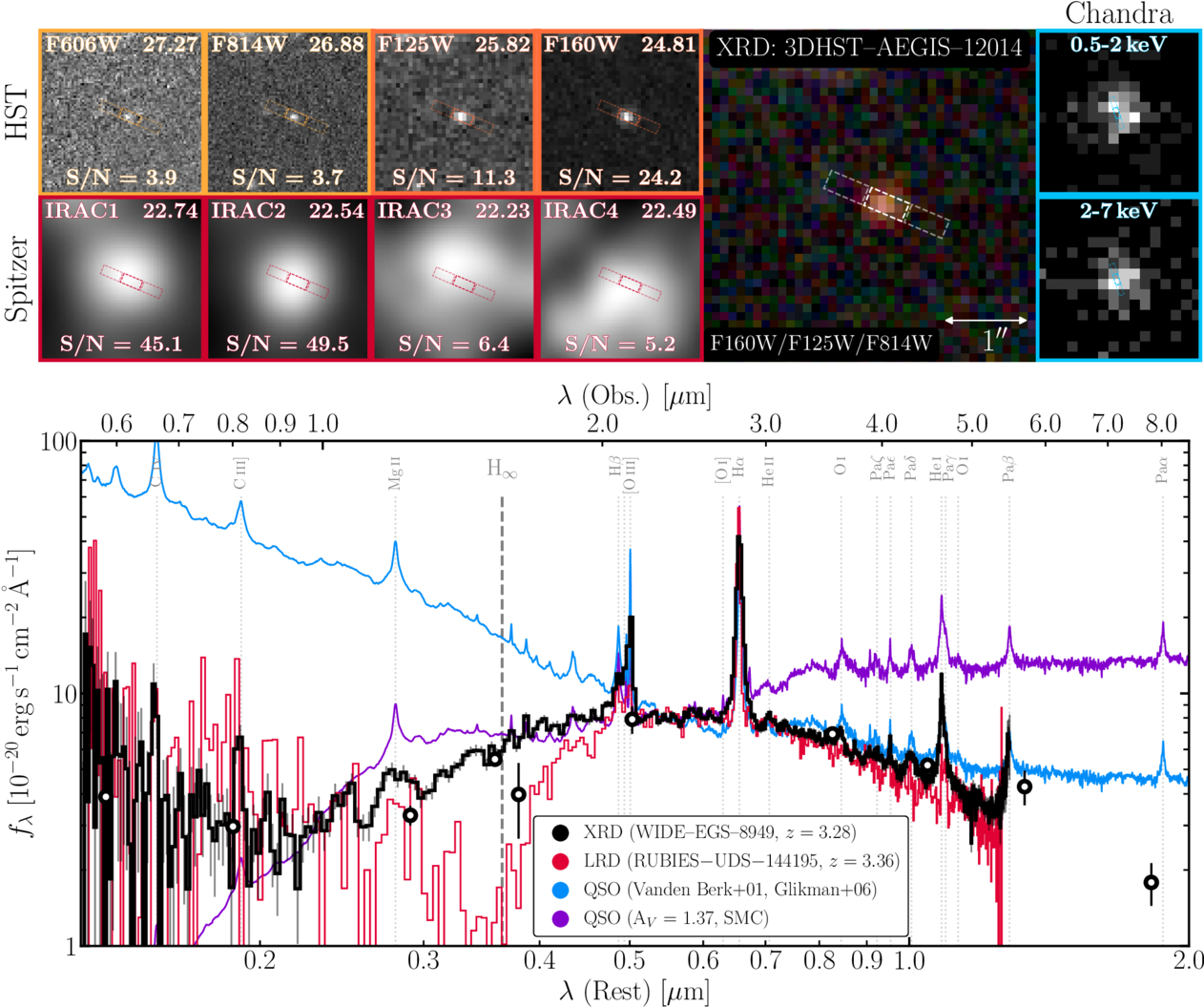
Figure 1 showcases the archival data from Hubble, Spitzer, and Chandra, along with the XRD’s spectrum from JWST (black curve, bottom panel). Photometric observations of the source indicate that it is incredibly compact (radius ≲ 250 pc, about 100 times more compact than the Milky Way) and shows similarities to LRD spectra, but with some key differences. (An example LRD spectrum is shown as the red curve in Figure 1.) The impressive X-ray luminosity of the XRD — typical of standard AGNs — is another key difference between it and standard LRDs.

A figure showing image cutouts from HST, Spitzer, and Chandra, of the XRD. The bottom panels also shows its spectrum alongside a typical LRD spectrum.

Figure 1: Top: Image cutouts from various Hubble, Spitzer, and Chandra observations of the XRD. Bottom: The spectrum of the XRD (black) shown alongside a similar LRD spectrum (red) and two quasar spectra (blue and purple), one of which has been reddened due to the presence of dust (purple). [Hviding et al. 2026]

So…What’s the Deal with the XRD?

To understand the nature of the XRD, the authors fit a variety of models describing a wide range of physical systems to the available data. Surprisingly, their best-fit models indicate that if the XRD is simply a typical AGN heavily obscured by astrophysical dust, its dust properties are drastically different from those of typical galaxies and AGN. Instead, trying to explain the system as an AGN embedded in a cocoon of gas (the black hole star model) provides better results (more aligned with observed LRDs), but it still isn’t perfect.

Notably, the emission in the ultraviolet-to-optical regime of the electromagnetic spectrum differs greatly from that of LRDs. In LRDs, this emission is indicative of a single dense gas component around the supermassive black hole, while in the XRD the authors find evidence suggestive of a patchier, less uniform distribution of gas. However, in order for this explanation to match the data, physical conditions of the model must be finely tuned, suggesting that this model may need to be refined further. These factors seem to suggest that the XRD is poorly understood in the context of our current paradigm of models describing AGNs and LRDs. The potentially patchy nature of the XRD’s gas envelope could suggest that this object is an LRD in the process of shedding its outer envelope, evolving into a typical AGN.

Regardless of its true nature, the XRD opens up new doors in our understanding of AGNs and LRDs. It provides an exciting glimpse at AGN evolution in action — a transitional fossil for early universe black holes. With a new piece of the puzzle slotted into our picture of AGN evolution, it’s only a matter of time before astronomers fully contextualize the stubbornly enigmatic LRDs.

Original astrobite edited by Ansh R. Gupta.

About the author, Drew Lapeer:

Drew is a first-year PhD student at the University of Massachusetts Amherst. They are broadly interested in the evolution of galaxies, with a focus on the impact of cosmic feedback on the galactic ecosystem. In their free time, they enjoy reading, rock climbing, hiking, and baking!

The post A Potential New Piece of the “Little Red Dot” Puzzle appeared first on AAS Nova.

  •  

A Mysterious Spectral Feature Could Help Crack the Case of Neutron Star Structure

Artist's impression of a pulsar

Neutron stars are composed of some of the most extreme material in the universe, and their internal properties are challenging to determine. Recently, researchers investigated an unusual spectral feature that may help to probe the interiors of neutron stars.

Examining Extreme Matter

supernova remnant 1E 0102.2-7219

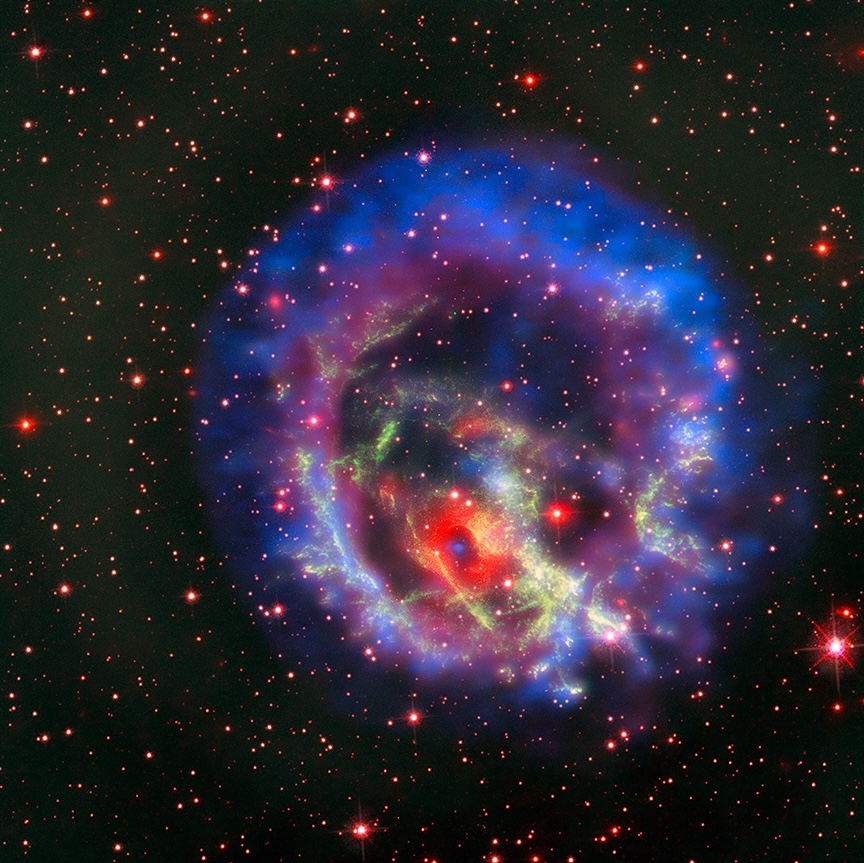
This composite X-ray and optical image shows the supernova remnant 1E 0102.2-7219. The blue source at the center of the bright red ring inside the remnant is a neutron star that was created in the supernova explosion. [X-ray (NASA/CXC/ESO/F.Vogt et al); Optical (ESO/VLT/MUSE & NASA/STScI)]

When a massive star expires in a supernova explosion, it can leave behind its condensed core in the form of a neutron star: an exceptionally dense sphere roughly as wide as Manhattan is long, composed almost entirely of neutrons. Neutron stars represent an extreme state of matter and contain some of the densest and strongest material in the universe.

By observing neutron stars, astronomers attempt to pin down their equation of state, or the relationship between their interior density and pressure. In a recent research article led by Rosario Iaria (University of Palermo) described a promising way to probe the interior of a neutron star.

This method relies on measurements of a spectral line that originates near the neutron star’s surface and is gravitationally redshifted as it escapes from the intense gravitational pull of the star. The gravitational redshift provides a direct measurement of the compactness of the neutron star, or the ratio of its radius to its mass. Despite the promise of this method, definitive identification of gravitationally redshifted absorption lines has been challenging.

Directly Measuring Compactness

Iaria’s team identified potential evidence of this phenomenon in Neutron star Interior Composition Explorer (NICER) observations of 4U 1820-30, a close binary system containing a neutron star that is accreting matter from a white dwarf companion. (4U 1820-30 is famous for having one of the most rapidly rotating neutron stars known, with a blistering rate of 716 rotations per second.)

MAXI observations of 4U 1820-30

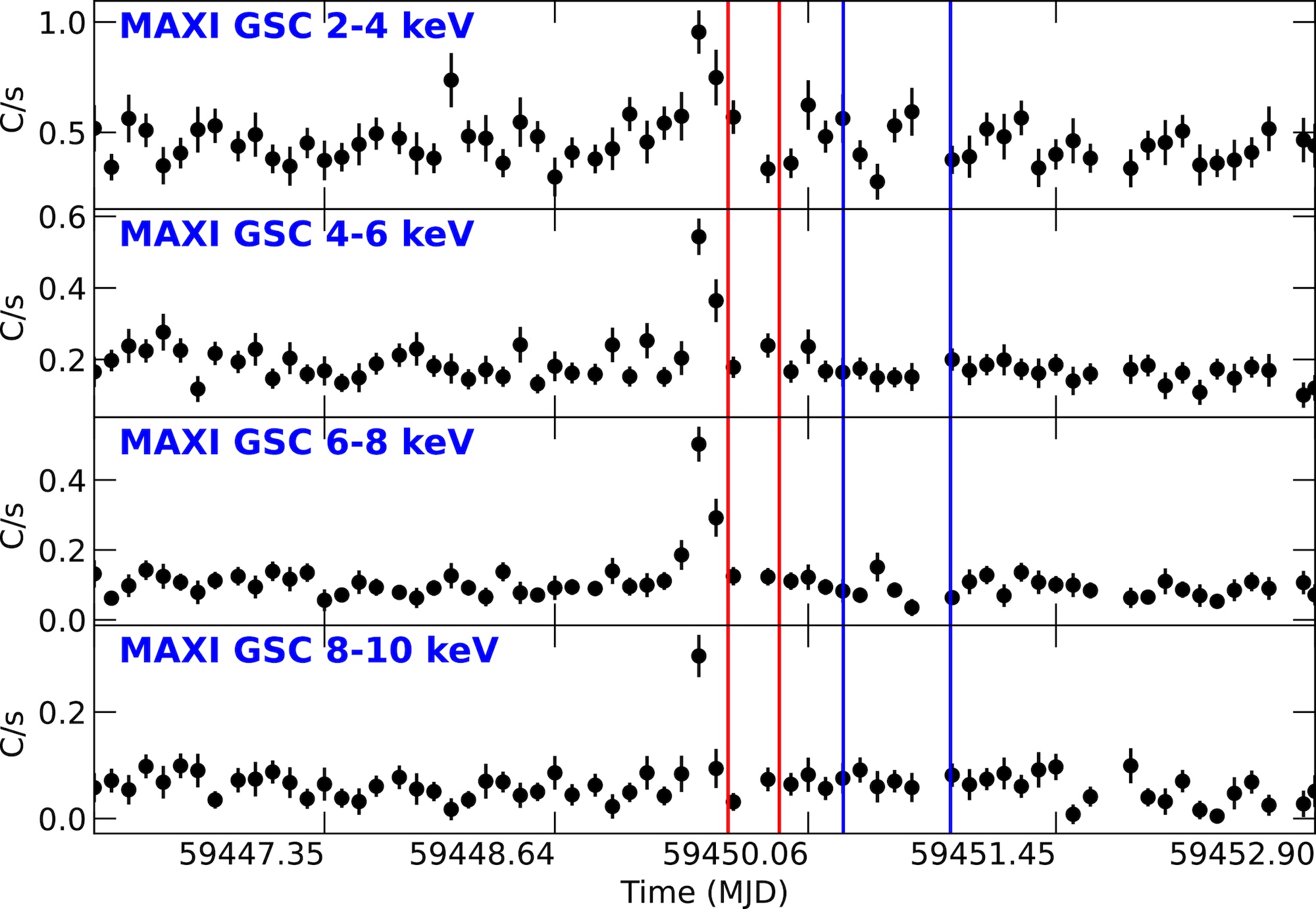
Observations of 4U 1820-30 from the Monitor of All-Sky X-ray Image (MAXI) showing the sudden increase in counts during the superburst, which was followed by two observing epochs by NICER, marked with red and blue vertical lines. Click to enlarge. [Iaria et al. 2026]

Iaria and collaborators focused on a strong iron absorption line at 3.8 keV, which arose three hours after a carbon superburst: a rare burst of high-energy radiation from thermonuclear burning of carbon deep in the neutron star’s atmosphere. The signal persisted for nearly 17 hours before subsiding.

The team proposed that the rare superburst paved the way for the gravitationally redshifted absorption line to appear. During the superburst, a powerful radiation-driven wind swept away most or all of the neutron star’s corona, a diffuse cloud of plasma floating above and below the accretion disk. After the superburst ended and the wind subsided, but before the obscuring corona reformed, the tell-tale absorption line was visible for a short time.

Cracking the Mystery of Neutron Star Structure

By interpreting the 3.8 keV absorption feature as a gravitationally redshifted spectral line arising near the neutron star’s surface, Iaria and collaborators measured a redshift of 1 + z ≅ 1.72. This corresponds to a compactness of 4.46 kilometers per solar mass, which translates to a radius of 6.4 km for a typical mass of 1.4 solar masses or a mass of 2.2 solar masses for a typical radius of 10 km.

The interpretation of the 3.8 keV absorption line as a gravitationally redshifted iron line is still tentative. Further measurements with NICER, or with future facilities like the Advanced Telescope for High-ENergy Astrophysics (Athena) X-ray observatory (planned launch in 2037) or the enhanced X-ray Timing and Polarimetry (eXTP) mission (planned launch in 2030), may help to advance the study of neutron star interiors using this technique.

Citation

“A Mysterious Feature in the NICER Spectrum of 4U 1820-30: A Gravitationally Redshifted Absorption Line?” R. Iaria et al 2026 ApJ 998 58. doi:10.3847/1538-4357/ae2758

The post A Mysterious Spectral Feature Could Help Crack the Case of Neutron Star Structure appeared first on AAS Nova.
  •  

Investigating the Most Luminous Known Fast Blue Optical Transient

luminous fast blue optical transient

Fast blue optical transients are a rare class of emerging transients, the source of which is not yet known. A recent study of the most luminous known object in this class, AT2024wpp, reveals clues about their identity.

A New Class of Transients

In 2018, a network of robotic survey telescopes spotted a new transient source toward a galaxy 200 million light-years away. It was bright and getting brighter rapidly, rising in just a few days to become 10–100 times brighter than the brightest supernovae.

That transient, AT2018cow, was the first of now tens of known sources like it that are too blue, too rapidly evolving, and too luminous to be ordinary supernovae. Despite the growing number of luminous fast blue optical transients (FBOTs) discovered, exactly what causes them is still up for debate.

Brightest of the Bright

Enter AT2024wpp: the most luminous known fast blue optical transient to date. In about a month and a half, this record-breaking event radiated away more than 1044 Joules — which is roughly equivalent to the Sun’s radiative output over 8 billion years. Nayana A. J. (University of California, Berkeley) and collaborators carried out an extensive multi-wavelength observing campaign to track the behavior of AT2024wpp from 2 to 280 days after it was first discovered, making it only the second FBOT to undergo such detailed study. This research article describes the team’s findings at radio and X-ray wavelengths.

X-ray behavior of AT2024wpp

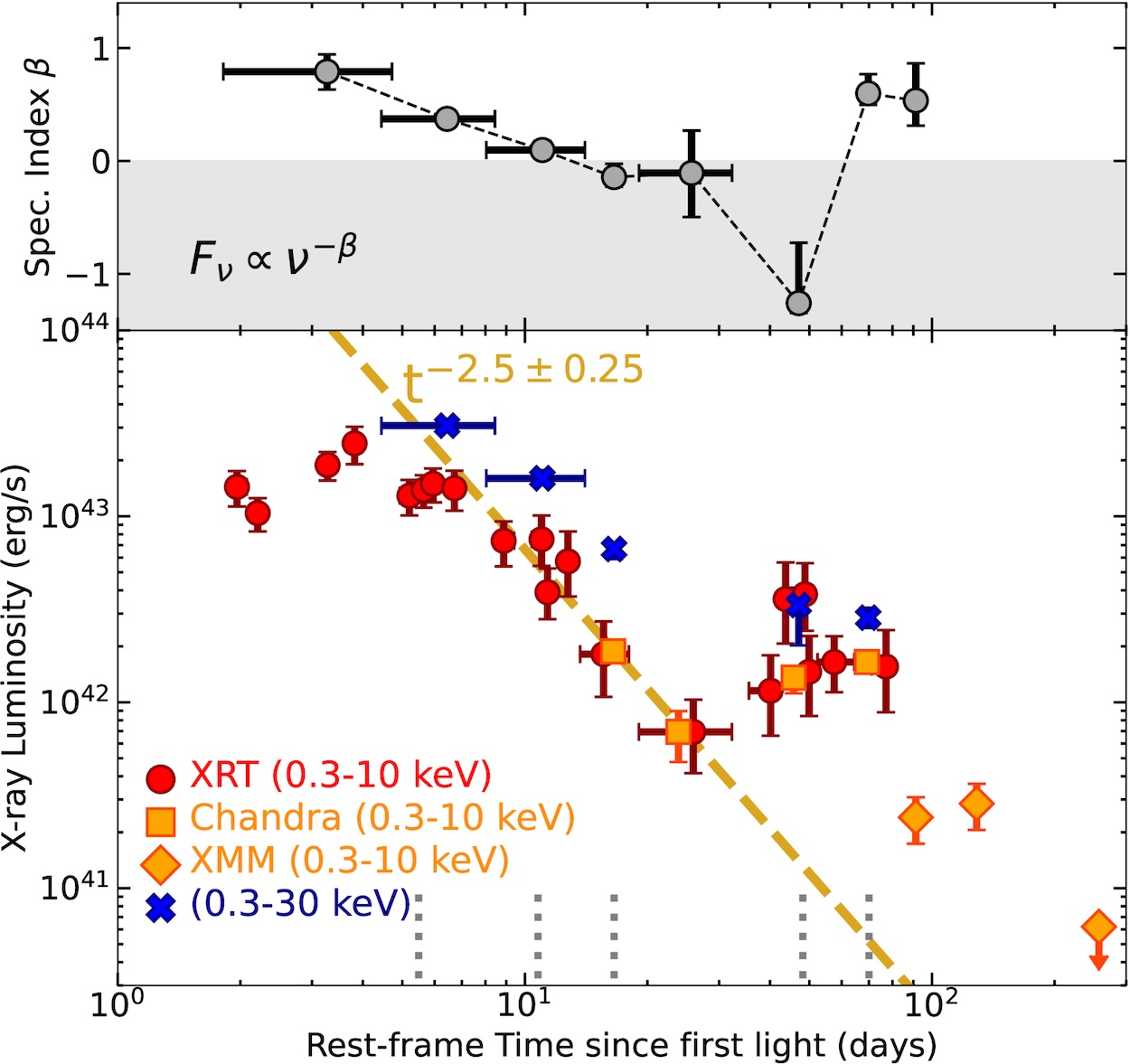
X-ray behavior of AT2024wpp. The top plot demonstrates the hardening of the spectral index (i.e., shifting toward higher energies) around the peak at 50 days. Click to enlarge. [Nayana A. J. et al. 2025]

The team enlisted the Atacama Large Millimeter/submillimeter Array, the Australian Telescope Compact Array, the Allen Telescope Array, the MeerKAT array, and the Giant Metrewave Radio Telescope to survey the source from 0.25 to 203 GHz. On the opposite end of the spectrum, they collected observations from the Neil Gehrels Swift Observatory, the Chandra X-ray Observatory, XMM-Newton, and NuSTAR to probe AT2024wpp’s X-ray emission from 0.2 to 79 keV.

These observations revealed that AT2024wpp’s X-ray emission remained bright and constant for 7 days before plummeting until day 30. The emission then rocketed up again, peaking at day 50, and shifted toward higher energies. Finally, things settled down to a lower brightness around day 75. In the radio, AT2024wpp’s behavior was complex, showing a never-before-seen meteoric rise at millimeter wavelengths around 17–32 days.

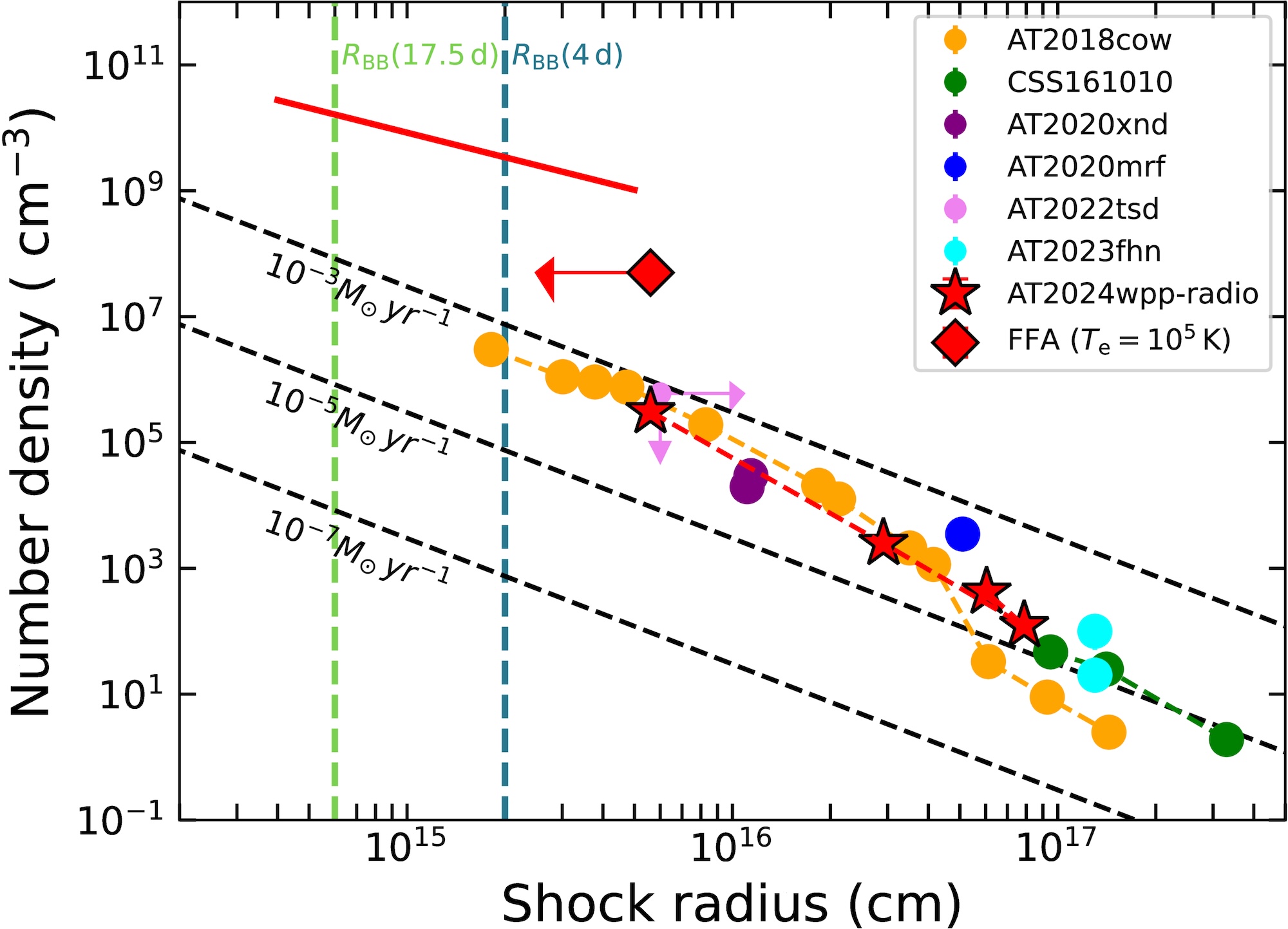
Comparison of the density of the material surrounding AT2024wpp and other FBOTs

Comparison of the density of the material surrounding AT2024wpp (red stars) and other FBOTs. Click to enlarge. [Nayana A. J. et al. 2025]

Possible Scenarios

Based on these observations, the team favors a scenario involving a central compact object — a black hole or a neutron star — that is rapidly accreting matter from its surroundings. This accretion powers outflows that accelerate to more than 40% the speed of light and send a shock through dense material around the system. Notably, the team found that the density of the surrounding material is similar among FBOTs that have bright radio emission, including AT2024wpp. This suggests that similar processes are responsible for setting up these events.

The team pointed to two scenarios from the literature that are compatible with their data. In the first, a newborn neutron star or black hole collides with a stellar companion, ripping the star apart and accreting its remains. In the second, a Wolf–Rayet star (a massive star that has shed much of its atmosphere and is nearing its eventual end as a supernova) is tidally disrupted by a neutron star or a black hole. Though it’s not possible to narrow the possibilities further, the immense energies involved tilt things in favor of a black hole rather than a neutron star.

Though FBOTs remain mysterious, additional multi-wavelength studies like this one can help to illuminate their origins. And with the Ultraviolet Transient Astronomy Satellite (ULTRASAT) and UltraViolet EXplorer (UVEX) missions slated to launch within the next five years, we can expect many more FBOT discoveries in the near future.

Citation

“The Most Luminous Known Fast Blue Optical Transient AT 2024wpp: Unprecedented Evolution and Properties in the X-Rays and Radio,” Nayana A. J. et al 2025 ApJL 993 L6. doi:10.3847/2041-8213/ae0b4d

The post Investigating the Most Luminous Known Fast Blue Optical Transient appeared first on AAS Nova.
  •  

Do X-Rays Help or Hurt Massive Black Hole Formation?

Illustration of a supermassive black hole enveloped in gas

Editor’s Note: Astrobites is a graduate-student-run organization that digests astrophysical literature for undergraduate students. As part of the partnership between the AAS and astrobites, we occasionally repost astrobites content here at AAS Nova. We hope you enjoy this post from astrobites; the original can be viewed at astrobites.org.

Title: Massive Black Hole Seed Formation in Strong X-Ray Environments at High Redshift
Authors: Kazutaka Kimura, Kohei Inayoshi, and Kazuyuki Omukai
First Author’s Institution: Tohoku University
Status: Published in ApJ

Environments of Massive Black Holes

Astronomers have found that nearly every observable galaxy hosts a central supermassive black hole (SMBH) — a black hole more than a million times more massive than the Sun. Using JWST, they have peered back into the early universe to observe some of the earliest galaxies, and these early galaxies also contain SMBHs. In fact, many of these galaxies seem to contain SMBHs that are more massive than we expected them to be this early in the universe.

We believe that most black holes form at the ends of the lives of massive stars, which collapse under their own gravity when they run out of fuel. We expect that this happened to the first stars too, forming “light” (as in “lightweight”) seeds of SMBHs with masses up to about 100 solar masses. Astronomers also think that the right conditions in the early universe could lead to the formation of a “heavy” seed with a mass on the order of 104 solar masses or more; this kind of black hole is called a direct-collapse black hole (DCBH).

In order to form a DCBH, a gas cloud needs to collapse without fragmenting to form star clusters and stars — if stars form, there won’t be enough mass funneled to the center of the cloud to form the DCBH. One important criterion for this to happen is the absence of coolants, like metals and molecular hydrogen (H2), which cause fragmentation. One way to eliminate H2 is with a particular type of ultraviolet light called Lyman-Werner radiation, which can destroy H2 molecules. However, recent results from the Hydrogen Epoch of Reionization Array (HERA) suggest that early galaxies emitted more X-rays than expected, which would increase the amount of H2 and make it less likely for DCBHs to occur. Today’s authors investigate the feasibility of forming DCBHs in these X-ray-bright environments.

Modeling Black Hole Formation

Today’s authors model the collapse of gas in dark-matter halos that have a nearby neighboring halo. This neighboring halo emits radiation like ultraviolet light and X-rays that impact the formation of molecules like H2, which affects the gas chemistry. This radiation is typically emitted by hot gas in star-forming regions. The authors also track quantities like the gas density and temperature as the gas collapses. Once the gas collapses enough, a star forms at the center and continues to accrete surrounding material. Once this star evolves and reaches the end of its life, it becomes a black hole.

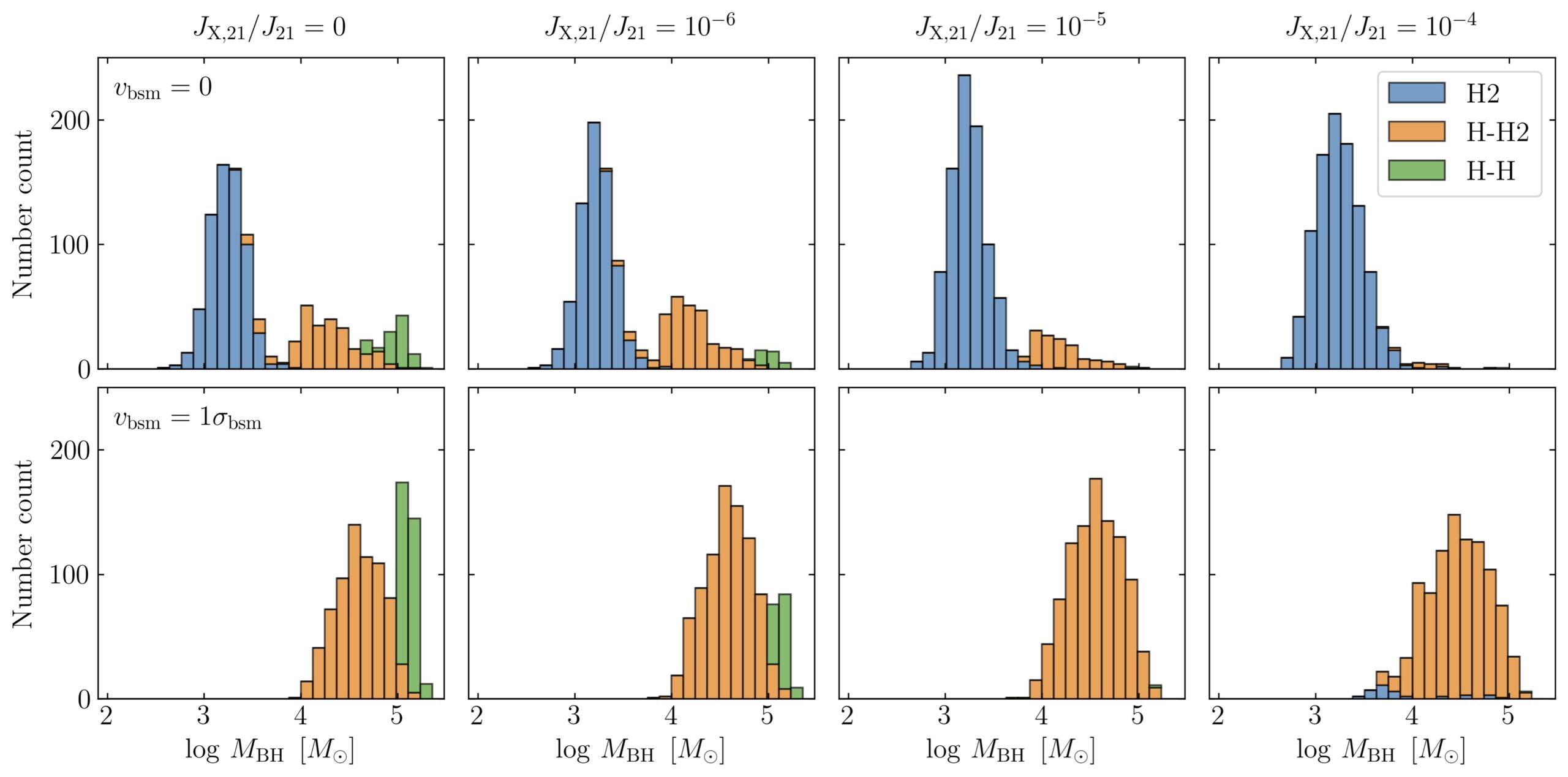
The authors considered different intensities of X-ray radiation relative to a critical value of Lyman-Werner radiation believed to destroy enough H2 to form a DCBH, which is called J21. They explore values of the X-ray intensity Jx relative to J21, considering ratios of 0, 10-6, 10-5, and 10-4.

Another important consideration was the baryonic streaming velocity. This is the relative bulk velocity between baryonic (i.e., “normal”) matter and dark matter in the early universe. Higher streaming velocities can delay the collapse of gas in dark-matter halos, which affect gas properties like density, temperature, and chemistry. The streaming velocity depends on the redshift, z, which is given by σbsm = 30 km/s (1+z)/(1+z0), where z0 = 1,100. This “standard” relationship has been calibrated with measurements from observations. The authors consider two cases for the streaming velocity: vbsm = 0 and vbsm = 1σbsm, which are denoted in the figures below.

X-Rays and Seed Suppression

The first main results are shown in Figure 1. The authors find that a large number of intermediate-mass seeds form from H2 cooling, shown in blue, regardless of the X-ray intensity. A smaller number of higher-mass seeds form from H–H2 and H–H cooling, but these cooling processes become suppressed as the X-ray intensity increases. This is because the increased X-ray intensity converts more H to H2. Interestingly, accounting for the streaming velocity all but wipes out black hole formation via H2 cooling except at very high X-ray intensities.

histograms of seed black hole mass

Figure 1: Mass distributions of seed black holes. The top row uses a baryonic streaming velocity of 0 and the bottom row uses the standard streaming velocity. Columns represent increasing X-ray intensities (left to right). Colors represent the dominant cooling mechanisms: H2 (blue), atomic hydrogen H transitioning to H2 (orange), and solely H (green). [Kimura et al. 2025]

Another main set of results are the black hole mass functions (that is, the number density of black holes for a given black hole mass), shown in Figure 2. Note that this differs from Figure 1 because we are now accounting for the number density of black holes, not just the number, and we are no longer categorizing black holes based on their cooling mechanism. As before, we see that most massive black holes are eliminated with a high X-ray intensity and no streaming velocity, but a higher streaming velocity tends to produce more massive black holes regardless of the X-ray intensity. These black hole mass functions provide a useful comparison to observational results from telescopes like JWST.
histograms of seed black hole number density

Figure 2: Seed black hole mass functions for low and high X-ray intensities (left and right columns, respectively). Rows are the same as in Figure 1. [Kimura et al. 2025]

In summary, today’s authors find that a high X-ray intensity leads to less-massive black holes due to the increased amount of H2, but accounting for the baryonic streaming velocity can produce massive black holes even with a large amount of X-rays. The number densities of these black holes appear to agree with observations from JWST, meaning that this could be a promising formation mechanism for the observed SMBHs in the early universe.

Original astrobite edited by Sparrow Roch.

About the author, Brandon Pries:

I am a graduate student in physics at Georgia Institute of Technology (Georgia Tech). I do research in computational astrophysics with John Wise, using machine learning to study the formation and evolution of supermassive black holes in the early universe. I’ve also done extensive research with the IceCube Collaboration as an undergraduate at Michigan State University, studying applications of neural networks to event reconstructions and searching for signals of neutrinos from dark matter annihilation.

The post Do X-Rays Help or Hurt Massive Black Hole Formation? appeared first on AAS Nova.

  •  

Chandra Spies a Supernova Shock Front Speeding Along

Supernova remnant N132D

Beautiful bubbles of hot ionized gas, supernova remnants trace the dying days of massive stars. A recent study uses the Chandra X-ray Observatory to detail the motion and understand the origins of one supernova remnant.

Retracing Supernova Remnants

Massive stars, about 8 solar masses or larger, will end their short lives in violent core-collapse supernovae. These explosions barrel into any surrounding interstellar medium, carving out low-density cavities and blowing material outward. Appearing as a bubble or shell of hot gas, a supernova remnant carries the signatures of the type of star that produced it and the ways that star shaped its environment throughout its life. 

Nearby, in the Large Magellanic Cloud, is the 2,500-year-old supernova remnant N132D — the most X-ray luminous supernova remnant within the Local Group. Though N132D’s size, likely progenitor mass, and chemical composition are well constrained, astronomers have yet to nail down the velocity of the X-ray shock front — the outer edge of the supernova remnant that rams into the interstellar medium. This measurement is critical to understanding the local conditions the supernova first encountered and how its expansion will continue to impact the interstellar medium over time.

Chandra Observations of N132D

Determining the shock front velocity requires astronomers to focus on the thin outer edge of the soaring supernova remnant — how do we measure the motion of such a narrow strip of gas? X-ray spectroscopy of N132D yields a measurement from a single epoch of observations, but it cannot isolate the narrow shock front, making a reliable velocity measurement difficult to attain.

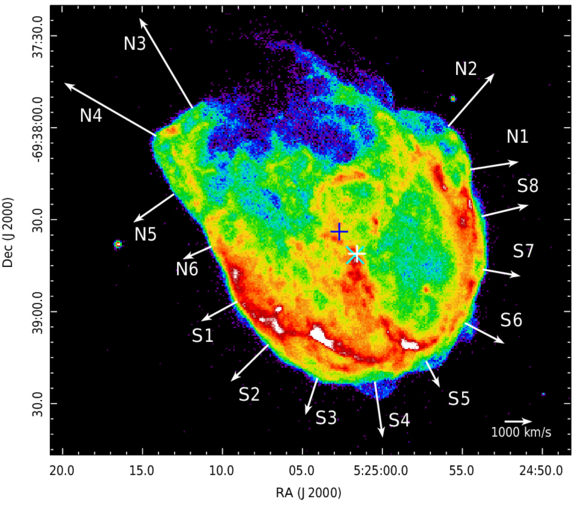
supernova remnant velocity

The expansion of supernova remnant N132D around the rim for each of the regions analyzed in this study. The arrow lengths are proportional to their estimated expansion velocities. Click to enlarge. [Long et al 2025]

Circumventing the challenges of spectral analyses, Xi Long (University of Hong Kong) and collaborators used two sets of X-ray observations of N132D from the Chandra X-ray Observatory taken about 14.5 years apart to measure the motion of the shock front across the sky over time. This measurement, known as proper motion, compares the location of the foreground supernova remnant to stationary background stars to estimate its angular speed. 

The authors focus on small regions on the very edge of the supernova shock front, six northern and eight southern, to carefully measure the motion of the shock between the two sets of observations. In separating the shock front into smaller regions, the authors can determine any variations in speed along the shock front. The southern edge of N132D moves with the same expansion rate of 1,620 km/s. The northern edge has an average expansion rate of 3,820 km/s, but its speed is more varied, which isn’t unexpected given its blown-out appearance.

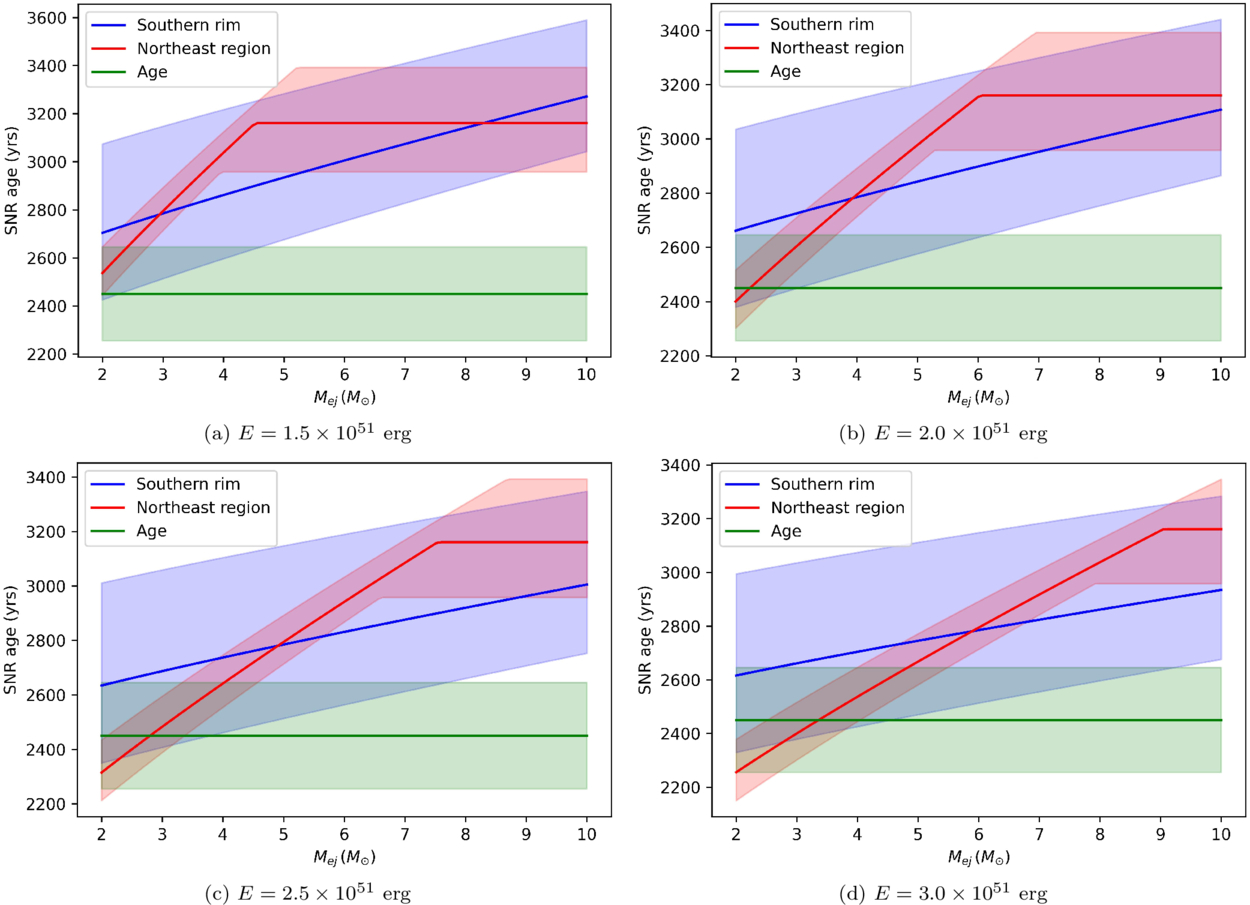
Modeling results showing the supernova age versus ejecta mass for the northern (red) and southern (blue) regions compared to the age estimate from an optical study of N132D. For the explosion energies and estimated ejecta masses between 2 and 6 solar masses, the models are consistent for all three. Click to enlarge. [Long et al 2025]

Comparing to Prior Studies

In addition to determining the velocity of the forward shock, the authors model the evolution of the supernova remnant to estimate the initial conditions of N132D including progenitor star mass, explosion energy, and ejecta mass. Their results agree with other studies that suggested N132D originated from a roughly 15-solar-mass star that exploded 2,500 years ago into a low-density cavity. 

This study showcases the unique ability of Chandra’s high-resolution instruments to carefully measure the evolution of supernova remnants, and further studies will continue to determine the detailed characteristics of supernova remnants across the Local Group.

Citation

“Chandra Large Project Observations of the Supernova Remnant N132D: Measuring the Expansion of the Forward Shock,” Xi Long et al 2025 ApJ 993 136. doi:10.3847/1538-4357/ae07c7

The post Chandra Spies a Supernova Shock Front Speeding Along appeared first on AAS Nova.
  •  

Blown Away by the Winds of NGC 4151

NGC 4151

Astronomers have known about NGC 4151’s X-ray-emitting active galactic nucleus since the 1970s. Now, observations from the X-Ray Imaging and Spectroscopy Mission (XRISM) show it in a whole new light.

Getting Feedback

illustration of active galactic nucleus winds

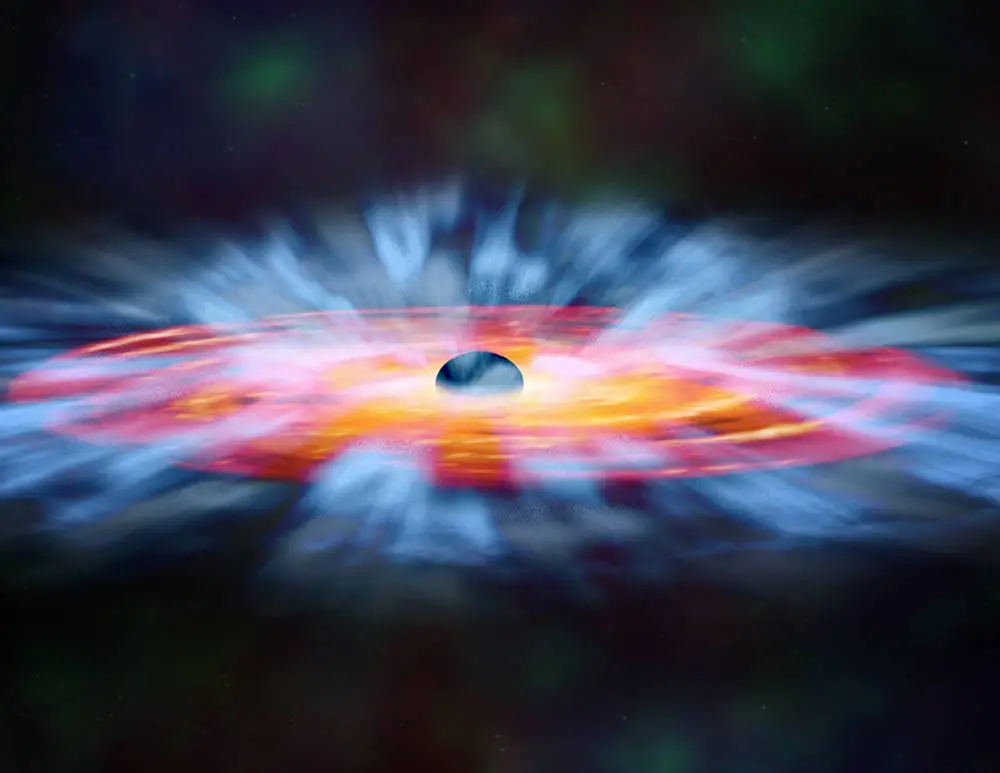
Illustration of the winds and accretion disk of an active galactic nucleus. [NASA, and M. Weiss (Chandra X -ray Center)]

Active galactic nuclei (AGNs) are extremely luminous galactic centers powered by accretion of matter onto a supermassive black hole. These nuclei provide a venue for galaxies and their supermassive black holes to interact. This interaction goes both ways, with the galaxy providing fuel to the supermassive black hole, and the AGN injecting material, momentum, and energy back into the surrounding galaxy in a process known as feedback.

AGN feedback can dramatically reshape a galaxy’s star formation and evolution. One of the most powerful ways an accreting supermassive black hole can influence its host galaxy is through ionized winds, which can scour the surrounding galactic bulge clear of star-forming material. There is much still to learn about these winds, including how they are structured and what physical processes drive them.

New Insights from XRISM

NGC 4151 provides an excellent opportunity to learn about active galactic nucleus winds. Only about 60 million light-years away, NGC 4151 hosts an accreting 34-million-solar-mass black hole that is luminous, highly variable, and shows a complex absorption spectrum that suggests that the AGN’s intense radiation is filtering through outflowing winds.

XRISM spectrum of NGC 4151

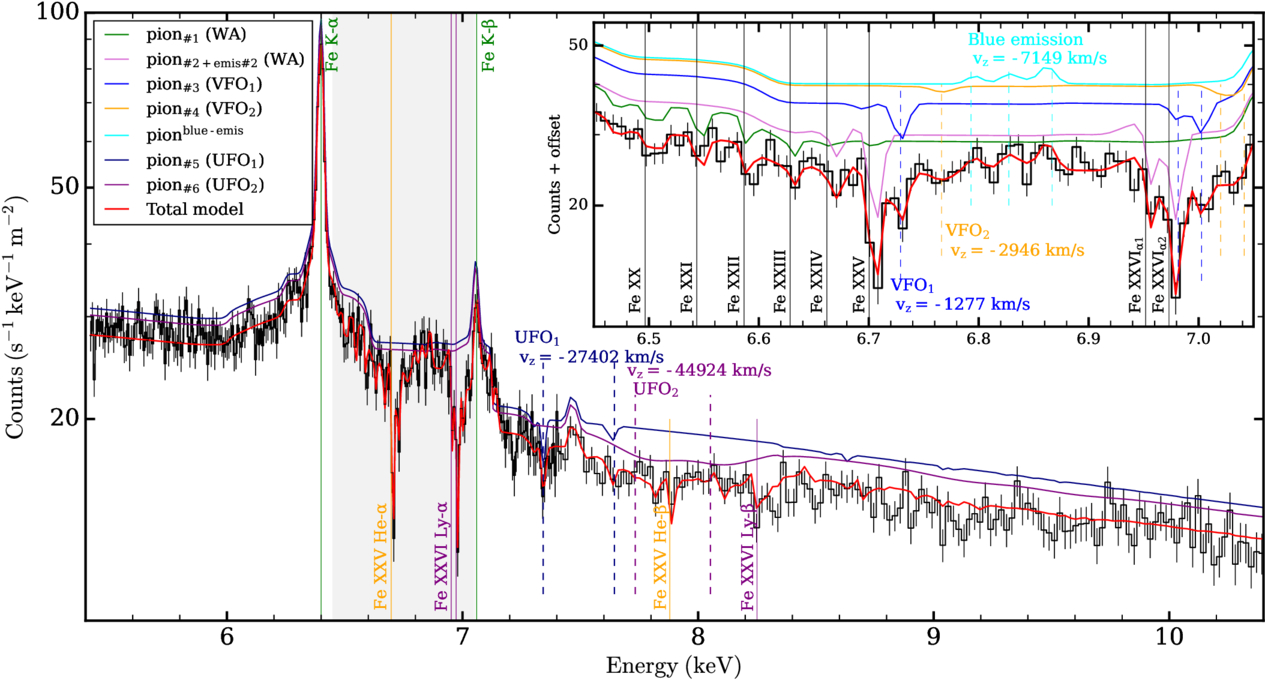
XRISM spectrum of NGC 4151, showing the multi-component model fit. Click to enlarge. [Xiang et al. 2025]

To study the winds of NGC 4151, a team led by Xin Xiang (University of Michigan) obtained X-ray spectra of NGC 4151 from XRISM on five dates spanning a period of about 6 months.

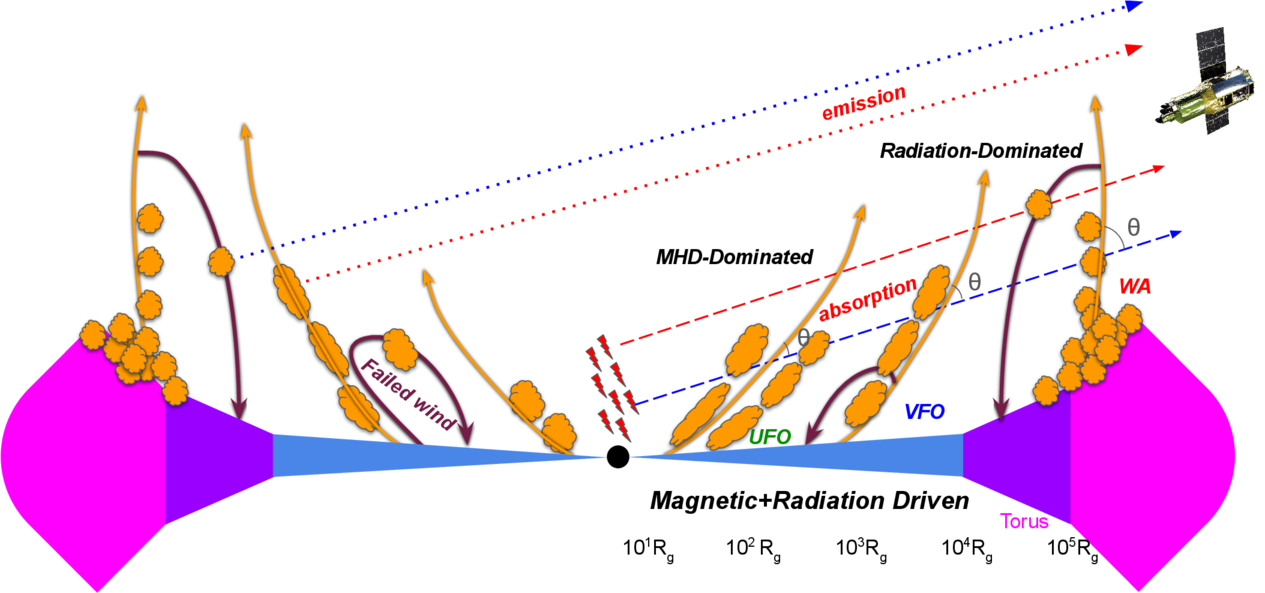
Xiang’s team modeled the array of absorption and emission lines in the XRISM spectra to tease out the properties of NGC 4151’s winds. They found that the best match to the spectra required up to six layers of absorbing material, showing that NGC 4151’s winds are highly structured. These absorbing layers took the form of slow warm absorbers (velocities between 100 and 1,000 km/s), very fast outflows (1,000–10,000 km/s), and ultra-fast outflows (10,000–100,000 km/s; up to one-third of the speed of light). While most of these components carry away mass as fast as or faster than the black hole accretes, some appeared to lack the oomph to escape the oncoming accretion flow, suggesting that they might be “failed” winds that curl back toward the AGN.

Being Blown Away

The data showed that the winds are likely magnetocentrifugally driven, meaning that material is lifted and accelerated from the surface of the disk along magnetic field lines as the disk rotates. For some of the wind components, especially warm absorbers emerging farther from the black hole, radiation pressure may be a driver as well.

Diagram of the multiple wind components of NGC 4151

Diagram of the wind components of NGC 4151, including ultra-fast outflows (UFOs), very fast outflows (VFOs), and warm absorbers (WAs). [Xiang et al. 2025]

Altogether, the modeling paints a picture of a complex, asymmetric, time-variable, and clumpy set of winds that carry significant mass away from the AGN. Several fast-moving outflow components appear to exceed the threshold luminosity necessary to blow star-forming gas out of the galactic bulge, suggesting that star formation in NGC 4151’s galactic bulge may someday be halted entirely by these winds.

Citation

“XRISM Spectroscopy of Accretion-Driven Wind Feedback in NGC 4151,” Xin Xiang et al 2025 ApJL 988 L54. doi:10.3847/2041-8213/adee9b

The post Blown Away by the Winds of NGC 4151 appeared first on AAS Nova.
  •  

XRISM Spies the Remains of a Galactic Donut

Messier 81

New X-ray observations reveal the potential remnant of a dusty torus in the galaxy Messier 81. These observations help to advance our knowledge of low-luminosity active galactic nuclei, a population of accreting black holes that is still poorly understood.

Understanding Accretion

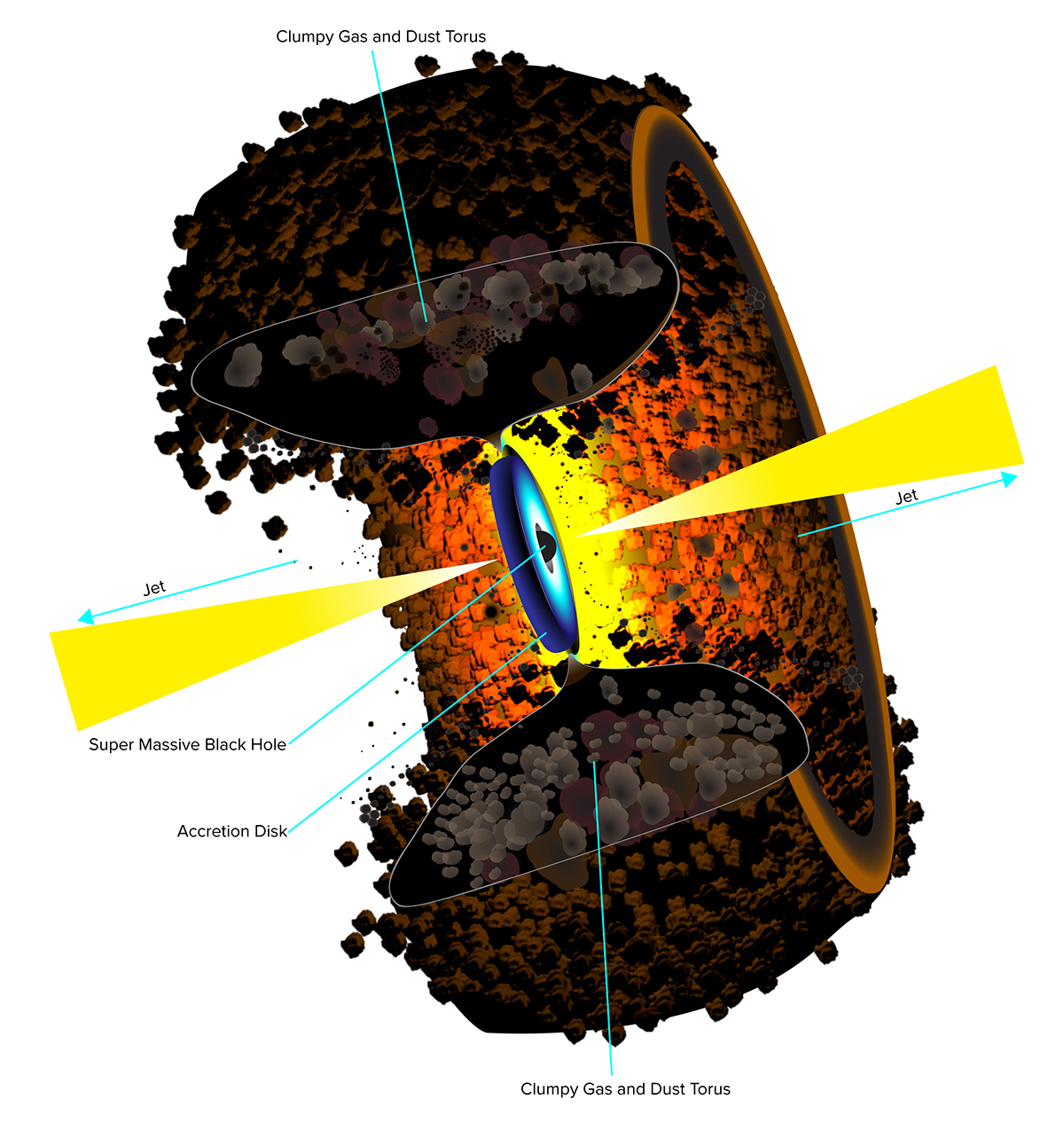
diagram of the unified model of active galactic nuclei

A diagram of the unified model of active galactic nuclei, showing an accretion disk, dusty torus, and jets. It’s not yet clear if LLAGNs conform to this model. [B. Saxton NRAO/AUI/NSF; CC BY 4.0]

Nearly all galaxies in our universe harbor a supermassive black hole. Many of these black holes are actively accreting matter from their surroundings, and these active galactic nuclei are powerful producers of radiation, winds, and jets. Roughly 40% of galaxies host a black hole that accretes matter at only a modest rate, which translates into a low-luminosity active galactic nucleus, or LLAGN.

Given how common it is for black holes to occupy this low-luminosity state, it’s critical to understand whether these systems are structured according to the typical picture of an active galactic nucleus, with a compact accretion disk surrounded by a dusty, donut-shaped torus. To probe the details of the LLAGN state, a team led by Jon Miller (University of Michigan) has turned to one of the best-studied — but still poorly understood — objects in this class.

Meet Messier 81

Just 12 million light-years away, the spiral galaxy Messier 81 is home to the nearest and brightest LLAGN. Messier 81’s central black hole was selected for observation during the 6-month Performance Verification phase of the X-ray Imaging and Spectroscopy Mission (XRISM), which launched in 2023. Messier 81 is the first LLAGN to be observed with a microcalorimeter, a type of instrument that detects photons by measuring minuscule changes in the temperature of the detector.

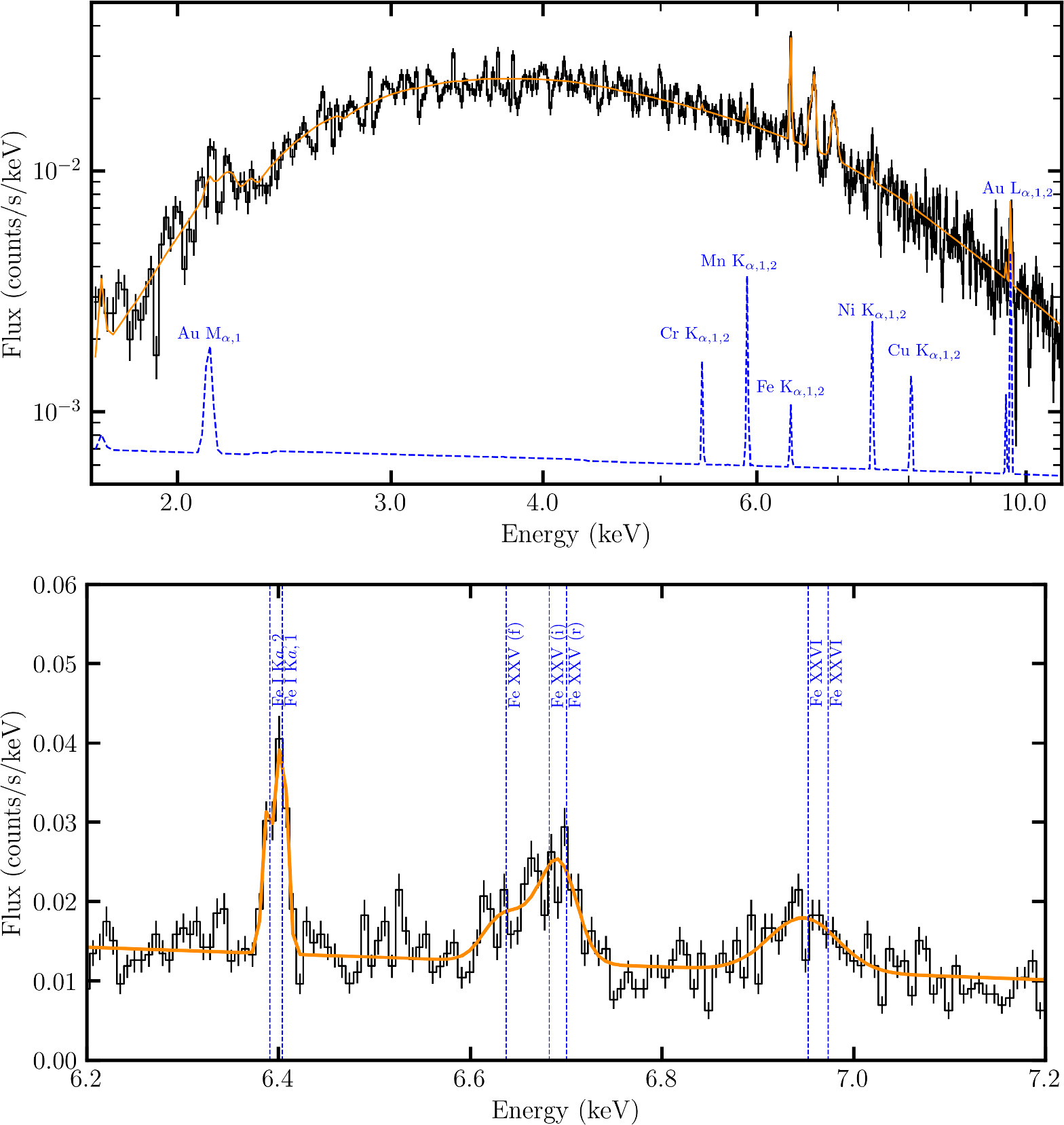
XRISM spectrum of Messier 81

XRISM spectrum of Messier 81’s nucleus (black line). The blue line shows the expected non-X-ray background. The bottom panel zooms in on the iron Kα line and several lines from highly ionized iron. Click to enlarge. [Miller et al. 2025]

Miller and collaborators focused on XRISM’s observations of several spectral lines from iron: the iron Kα emission line at 6.4 keV, which arises when neutral iron atoms in the vicinity of the active galactic nucleus reflect X-rays generated through accretion, and several emission lines from iron atoms stripped of all but one or two electrons.

Investigating a Diagnostic Line

The iron Kα line appears in the spectra of many active galactic nuclei, and it’s key to understanding whether LLAGNs like this one have the same accretion disk and torus structure as more vigorously accreting active galactic nuclei.

Modeling of the XRISM data suggests that the iron Kα line arises from material no closer than 27,000 gravitational radii from the black hole — a large distance compared to a typical compact accretion disk that closely rings the black hole. Miller and collaborators suggest that the likeliest explanation for the origin of the iron Kα emission is the remnant of a dusty torus that is only lightly obscuring the central accretion disk. This is in line with the hypothesis that LLAGNs are winding down from a higher-luminosity state, and that they maintain certain structures (i.e., a torus) from that highly active state as their accretion rate slows.

The team found that it’s also possible for the emission to arise from an accretion disk whose inner edge lies far from the black hole, in agreement with the predictions of an accretion model called radiatively inefficient accretion flow. The XRISM data didn’t place strong constraints on another possible accretion model, the magnetically arrested disk model. Future observations that either probe more deeply or attempt to detect variability could better illuminate the structure surrounding the black hole.

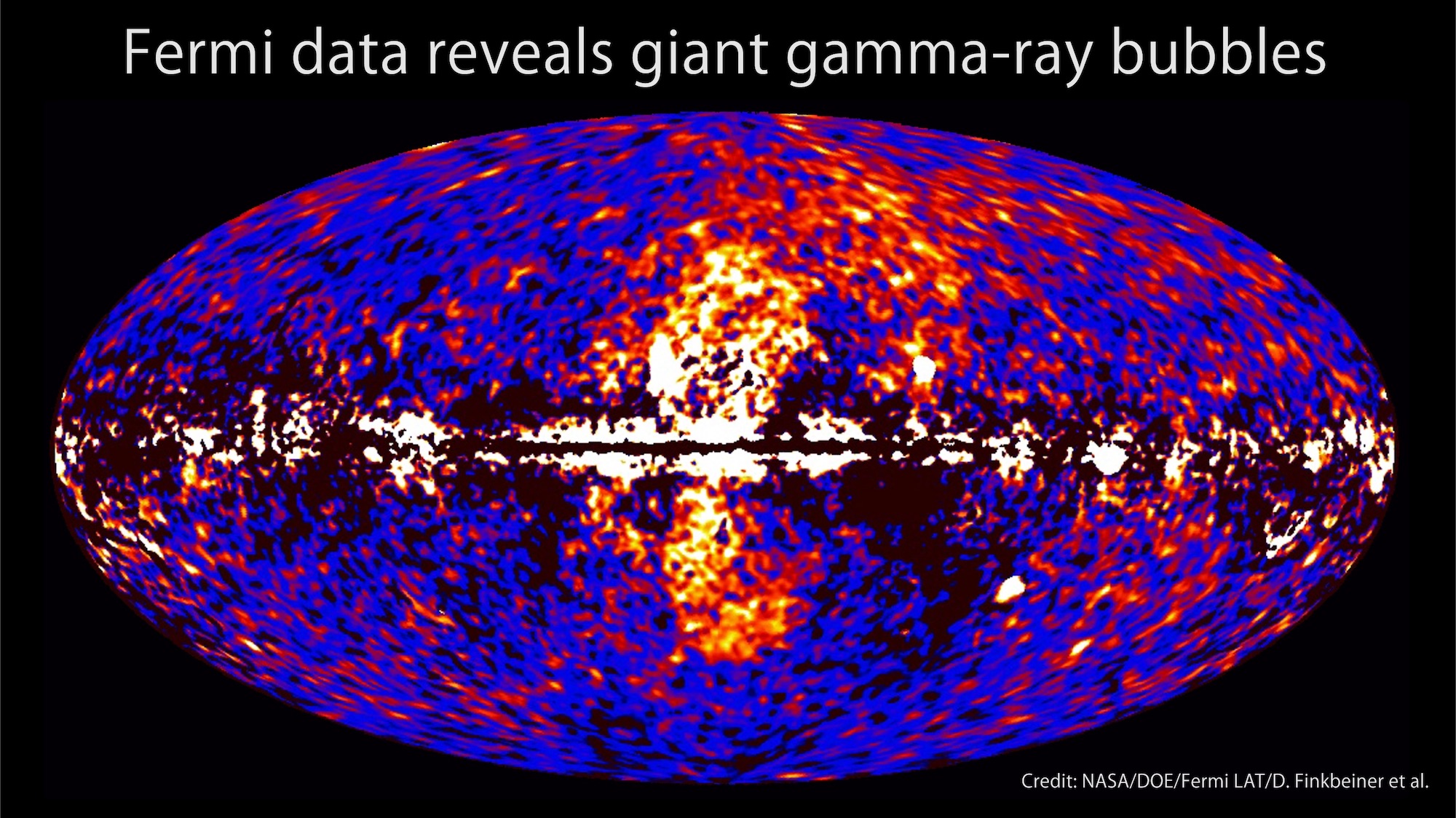
Fermi bubbles

Processing of data from the Fermi Gamma-ray Space Telescope reveals a dumbbell-shaped structure emerging from the center of the Milky Way. [NASA/DOE/Fermi LAT/D. Finkbeiner et al.]

Finally, a note about the emission lines from ionized iron: these might be due to a wind blowing outward from the accreting black hole, but Miller’s team suggests that they could also indicate the beginning of a feature similar to the so-called Fermi bubbles seen to extend on large scales from the center of the Milky Way.

Citation

“XRISM Reveals a Remnant Torus in the Low-Luminosity AGN M81*,” Jon M. Miller et al 2025 ApJL 985 L41. doi:10.3847/2041-8213/add262

The post XRISM Spies the Remains of a Galactic Donut appeared first on AAS Nova.
  •  
❌