❌

Reading view

Germany builds world’s tallest wind turbine, reaches nearly 1,200 feet height

A wind turbine standing nearly 1,200 feet tall has reached its full height in eastern Germany, creating a new approach to capturing wind energy at elevations where winds are stronger and more consistent. 

Developed by German engineering company GICON for the Federal Agency for Disruptive Innovation, or SPRIND, the pilot turbine in Schipkau is designed to test whether going dramatically higher can produce substantially more electricity from the same amount of wind infrastructure.

The structure reaches 1,197 feet, including its blades, making it Germany’s second-tallest structure after Berlin’s TV tower. GICON says the design could eventually generate roughly twice as much electricity as a conventional turbine with the same rotor diameter, although that estimate still needs to be demonstrated in operation.

A wind turbine built to reach higher

The main idea behind GICON’s design is to go where the wind is better. Wind speeds generally increase with altitude, while higher elevations can also provide more consistent wind conditions. Hence, a turbine operating hundreds of meters above the ground has access to a larger and potentially more reliable energy resource than a conventional turbine.

The Schipkau pilot has a rated capacity of 3.8 megawatts, while future versions are expected to exceed 7 MW. The company’s projected doubling in energy output refers to electricity generated over time, rather than the turbine’s maximum rated power.

Reaching that altitude, however, required GICON to rethink how such a turbine could be constructed. Instead of using a conventional crane capable of reaching the top of the tower, the company used a telescoping tower design. 

A specialized lifting mechanism raised the inner tower through a surrounding lattice structure before securing it at its final height. GICON founder and CEO Jochen Grosmann described reaching 1,197 feet as a major milestone for the project, which began as a concept before becoming a full-scale pilot facility.

Adding power without new wind farms

One of the more interesting possibilities is that high-altitude turbines could eventually be added to existing wind farms rather than requiring entirely new sites. GICON and SPRIND envision the systems operating as a second tier of wind generation, with the taller turbines positioned above conventional wind turbines. Therefore, their rotors would operate at higher elevations while existing turbines continue generating electricity below.

According to the current assessment, Germany could potentially accommodate as many as 4,000 high-altitude turbines within existing wind farms. If the concept works as expected, that could allow additional electricity generation without expanding wind farms into new areas, while also making better use of existing grid connections and developed wind-energy sites.

While the completion of the structure marks an important achievement, the more important test is still ahead, as official commissioning is planned for November, after the remaining construction work is completed. 

Once operational, the turbine will provide the data needed to determine whether the additional height delivers the expected increase in energy production and whether the benefits justify the additional engineering complexity.


💾

A 1,197-foot wind turbine has reached its full height in Germany, making it the world’s tallest wind turbine.
  •  

How everything-to-grid tech could turn your EV and home into part of giant power grid network

For more than a century, the electricity grid has mostly worked in one direction. Power plants generate electricity, grids deliver it, and homes, factories and businesses consume it. That model is starting to look a little dated.

As solar panels, batteries, electric vehicles and connected devices spread, millions of things that consume electricity can also store it, shift when they use it or, in some cases, send it back. “Everything-to-grid” is the emerging idea of coordinating those resources so they become active parts of the power system rather than simply sitting at the end of the network. The World Economic Forum included the concept among its Top 10 Emerging Technologies of 2026.

What exactly is everything-to-grid?

The simplest way to think about it is to imagine the grid gaining millions of tiny batteries, generators, and adjustable loads. An electric vehicle plugged into a charger is normally a consumer. But with bidirectional charging, its battery can potentially send electricity back to a building or the grid. 

A building with solar panels and batteries can generate, store, and supply electricity. A factory could shift some electricity-intensive processes away from peak-demand periods.

Instead of asking only, “How much electricity do we need?”, an everything-to-grid system also asks, “What can we move, store, or temporarily switch off right now?” That flexibility can be valuable when electricity demand suddenly rises, or renewable generation fluctuates.

Your car could become a grid asset

Electric vehicles are one of the most obvious pieces of this puzzle because their batteries can store substantial amounts of electricity while the vehicles are parked for much of the day. Vehicle-to-grid, or V2G, technology allows compatible vehicles and chargers to exchange electricity with the grid rather than simply charging the battery. 

Software can decide when a vehicle should charge, pause charging, or discharge electricity, while accounting for factors such as grid conditions and the owner’s need to drive.

The U.S. Department of Energy has been examining V2G as a way of integrating EVs into the wider power system. However, widespread deployment still depends on compatible vehicles, chargers, communications systems, regulations, and business models. In other words, your car could spend the afternoon being a car and the evening moonlighting as a very expensive power bank.

Buildings become more than electricity consumers

Buildings are another major part of the concept. A grid-interactive building combines energy efficiency, smart controls, communications and distributed energy resources such as solar panels and batteries. Heating, cooling, water heating and other systems can be adjusted according to electricity prices, grid conditions or the availability of renewable power.

The U.S. Department of Energy describes these buildings as flexible energy resources that can help reduce peak demand and make better use of periods when electricity is plentiful. The IEA similarly describes grid-interactive buildings as “prosumers” that can produce, consume, store, buy, and sell energy.

Why renewables make this more important

Solar and wind power are increasingly important sources of electricity, but their output varies with weather and time of day. Solar generation, for example, can fall rapidly as evening demand rises.

That makes flexibility increasingly valuable. The IEA expects renewables to overtake coal in global electricity generation in 2026 and says modernizing grids and improving system flexibility will be critical as wind and solar expand. Everything-to-grid systems could help absorb surplus electricity when renewable generation is high and reduce demand when the grid is under pressure.

The catch: somebody has to coordinate the chaos

Making millions of independent devices behave like one useful power resource is considerably harder than installing a solar panel or plugging in an EV. It requires communication standards, smart inverters and chargers, control software, electricity-market rules, and cybersecurity. 

The more connected the grid becomes, the more important it is to protect those connections from failures and attacks. The DOE specifically identifies cybersecurity as an important consideration for increasingly connected grid-interactive buildings. There are also practical questions around battery degradation, consumer compensation, privacy, and who gets to control an asset in someone’s home.

Everything-to-grid, then, isn’t about turning every appliance into a miniature power station overnight. It is about changing the architecture of electricity itself, from a system where consumers mostly take power from the grid into one where millions of connected assets can help manage it.

The grid of the future may still have giant power plants and transmission lines. But alongside them could be millions of cars, buildings, batteries and machines quietly doing their part. That is a much more complicated grid. It could also be a much more flexible one.

  •  

US team to shield advanced nuclear reactors from damage with $1 million push

Advanced nuclear power holds a clear promise: round-the-clock, low-carbon electricity with far better fuel efficiency than conventional plants. Yet the next generation of reactors faces an atomic-scale obstacle. When uranium atoms split to generate energy, they leave behind troublesome chemical byproducts that degrade equipment and frustrate recycling efforts.

A research team led by Pennsylvania State University has received $1 million from the US Department of Energy to tackle this precise problem. Their goal is to track and control three stubborn fission products—samarium, europium, and tellurium—in molten salt reactors and advanced recycling systems.

Standard commercial reactors are cooled by pressurized water. But molten salt systems use liquid salts. These reactors can squeeze more energy out of nuclear fuel and allow used materials to be recycled. However, the chemical soup inside them is notoriously harsh.

Each of the three targeted elements presents its own challenge. Samarium and europium are unwanted in recycled fuel because they can interfere with reactor performance and fuel recycling processes, noted researchers. 

“Tellurium, on the other hand, can react with metals used in molten salt reactors and fuel-recycling systems, contributing to corrosion and materials degradation,” added the researchers. 

Understanding the fundamentals

To solve this, researchers need to understand how these elements behave at a fundamental level.

“We will study the oxidation states of these elements, which describe how many electrons an atom has gained or lost and strongly influence how they behave chemically,” said lead investigator Hojong Kim, professor of materials science and engineering at Penn State.

The team will examine how these byproducts interact with reactor materials during pyroprocessing, a high-temperature recycling method based on molten salts. Working alongside specialists from the University of Nevada, Reno, and Idaho National Laboratory, researchers will combine computer modeling with direct laboratory experiments.

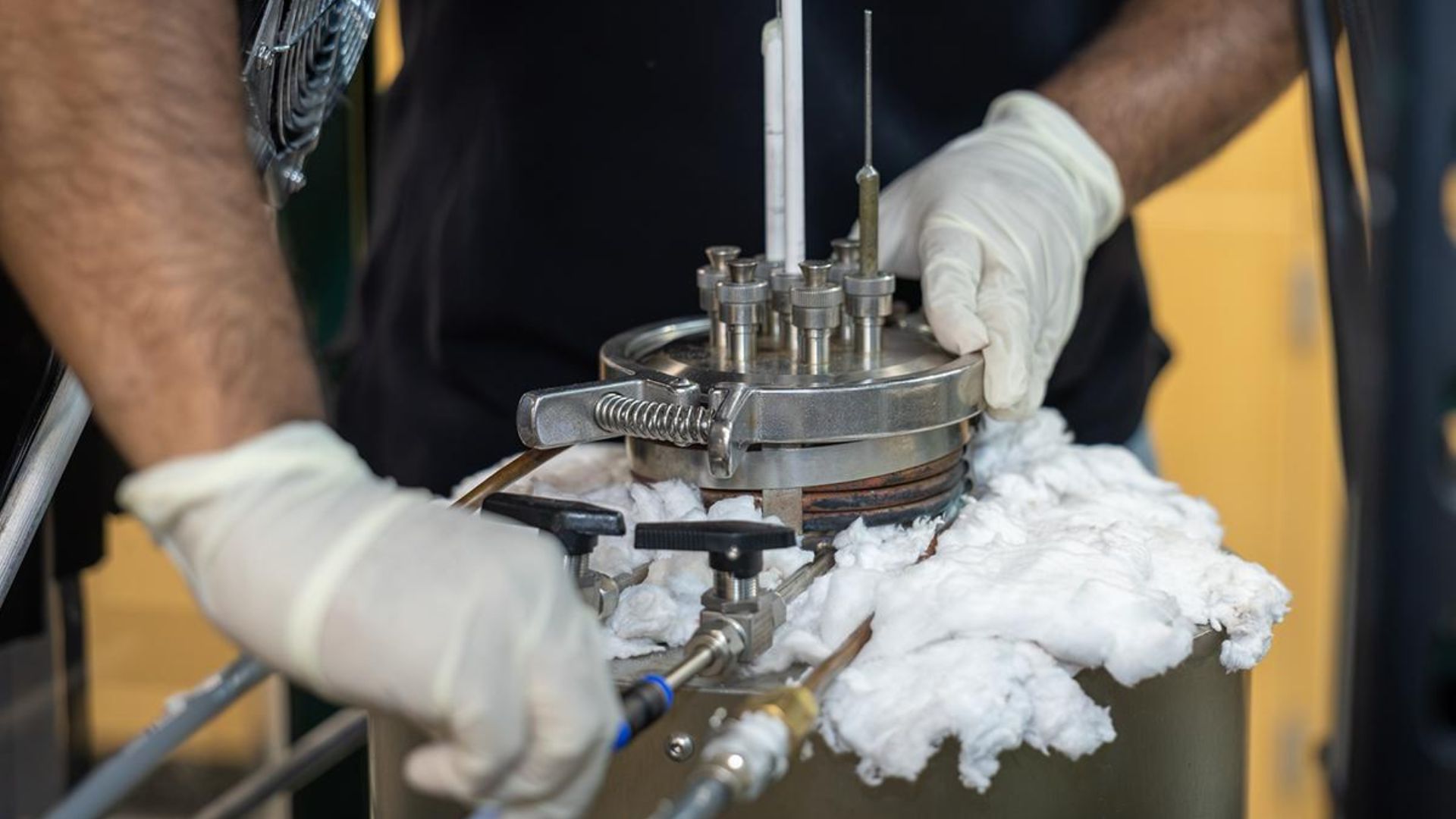
In the lab, doctoral researcher Alok Pandey will dissolve the three elements in molten salt solvents and run electrical currents through the mixture. By varying the applied potential, he can observe how the elements shift oxidation states.

“This will allow us to understand the elements’ electrochemical properties,” concluded Pandey. “It could help improve strategies for their recovery and management during nuclear fuel recycling.”

Solving the recycling puzzle

The project also revives an earlier, unresolved puzzle. Kim previously attempted to analyze samarium under a 2018 federal grant. That effort stalled because the element existed in tiny concentrations and behaved unpredictably compared to related rare-earth metals. Armed with newer diagnostic methods, the team believes it can now crack the problem.

Their solution relies on an unexpected ally: liquid bismuth. Kim’s laboratory previously discovered that molten bismuth can act like a chemical sponge, cleanly capturing rare-earth elements out of liquid salts.

If the current trials succeed, the technique could unlock more sustainable fuel cycles. By removing corrosive and performance-choking byproducts, engineers can keep advanced reactors running longer, extract more energy from every grain of uranium, and significantly reduce long-lived nuclear waste.

  •  

Hurricane Polo Explodes in Pacific, UK Aphid Swarm Wipes Out 30 Million Lettuces, Glasgow Braces for Rubbish Pileup — Today’s Environmental Briefing for Thu, Sep 24 2026

Satellite view of Hurricane Polo swirling over the Pacific Ocean with visible eye structure

Across the stories today, a common thread emerges: the planet is speaking in signals — some subtle, some deafening — and the question is whether our institutions can listen fast enough to act.

Start with the signals themselves. El Niño has surged to record strength weeks ahead of schedule, and its fingerprints are already visible — from Hurricane Polo’s explosive intensification in the Pacific to the climate volatility rippling through global weather systems. In the UK, an aphid outbreak wiped out 30 million lettuce heads almost overnight, a small but telling example of how shifting conditions can upend food systems in ways no one budgets for. In Malawi, an unexplained weed overgrowth has choked Chia Lagoon, stranding farmers and fishers in flooded fields nearly seven months after the rains should have drained. These aren’t isolated oddities. They’re the planet’s early warning system, written in crop yields and clogged waterways.

Then there’s the human response — uneven, but not absent. Germany’s landmark pledge to phase out fossil fuels by 2045 marks a rare moment of policy catching up to urgency, moving beyond vague “carbon neutrality” language toward something more concrete. The UK’s decision to declassify a once-suppressed intelligence report — warning that climate breakdown is a direct threat to global security — suggests governments are quietly acknowledging what scientists have said for years, even if political will lags behind. And at UN climate talks in New York, amid what The Guardian describes as a genuinely grim mood, solar power’s continued growth offered rare, tangible hope. As Al Gore noted twenty years after An Inconvenient Truth, he’s surprised by the ferocity of fossil fuel pushback — but still believes, cautiously, that the fight can be won.

Behind the numbers are real communities adapting in real time. In the Andes, villagers near Villa de Arma are turning to ancient wetland systems as glaciers they once walked across vanish into bare rock. In Guam, resident Leevin Camacho learned his family’s water contained a pesticide banned since 1987 — a stark reminder that militarization and environmental cost are often intertwined, especially in the Pacific. And in Sarawak, Indigenous communities are still reckoning with displacement from the Bakun megadam three decades later, a cautionary tale as the world races toward a “clean” energy future that doesn’t always ask who pays for it.

It’s a reminder that progress and pressure often arrive together. Endangered birds on South Australia’s Eyre Peninsula won last-minute protection from a rocket launch site — a genuine conservation victory — even as a Norfolk Broads housing levy was quietly slashed, raising fears that environmental safeguards elsewhere are eroding. Meanwhile, olive ridley sea turtles nesting for the first time ever on California beaches offer something rarer: wonder. A signal, too, but one that invites curiosity rather than alarm — proof that the natural world is still capable of surprising us.

As the week unfolds, all eyes will be on whether momentum from Climate Week — bolstered even by a monster from Sesame Street reminding children it’s okay to feel both fear and courage — translates into follow-through. The data, the disasters, and the small human stories all point the same direction: the era of asking “if” is over. What remains is the harder work of “how fast,” and “for whom.”

The post Hurricane Polo Explodes in Pacific, UK Aphid Swarm Wipes Out 30 Million Lettuces, Glasgow Braces for Rubbish Pileup — Today’s Environmental Briefing for Thu, Sep 24 2026 first appeared on EnviroLink Network.

  •  

Amid Climate Gloom at UN Talks, Solar Power Offers a Rare Ray of Hope

Amid Climate Gloom at UN Talks, Solar Power Offers a Rare Ray of Hope

As climate experts gather in New York this week for another round of high-stakes negotiations, the mood is grim. This year is on track to set a new global temperature record, and next year could break it again as El Niño intensifies. The planet has lurched from one disaster to the next: deadly European heatwaves, catastrophic flooding in Nepal that has erased entire communities, and unsettling new research suggesting the Atlantic Ocean’s major current systems may be approaching a dangerous tipping point. Despite the mounting evidence and urgency, political will to act remains stubbornly weak.

Yet amid this bleak landscape, there is one source of genuine optimism: solar power. Unlike political negotiations, which move at a glacial pace, solar technology has advanced rapidly and become dramatically cheaper, making clean energy more accessible than ever before. Advocates are now pushing world leaders to commit to an ambitious but achievable goal — bringing solar power to every corner of the globe by 2030.

The road ahead won’t be easy. Confronting entrenched fossil fuel interests and inertia among the powerful takes courage. But there’s a unifying truth that cuts through the complexity of climate politics: every person on Earth lives under the same sun. That shared reality, advocates argue, can become a source of collective strength — a reminder that the tools to address the climate crisis already exist and are within reach, if only the political will can catch up with the technology.

The post Amid Climate Gloom at UN Talks, Solar Power Offers a Rare Ray of Hope first appeared on EnviroLink Network.

  •  

Space Force Chief Admits the US Is Actively Utilizing Orbital Weapons

Since the debut of Garrett P Serviss’ 1898 novel “Edison’s Conquest of Mars,” space-based warfare was relegated to the imagination — but no longer.

In an address on the “State of the Space Force” on Tuesday, reported by Space.com, chief of space operations for the US Space Force General Douglas Schiess informed the public that the Pentagon has definitively deployed active space-based weapons platforms.

“Let me be crystal clear: today, Guardians operate on-orbit weapons that can defend the joint force against space-enabled attacks,” Schiess said. “Space is both a battlefield and the backbone of our joint force.”

Schiess stopped short of providing any details about the weapons, instead sharing a war story of one Space Force operator named “Specialist Gray.”

“Even as alarm red sirens were blaring and incoming missiles targeted her site, she courageously held the line, protecting forces, denying adversary capability, and delivering space effects until her commander had to literally pull her from the console to safety,” Schiess recounted with a dramatic flair. “She locked onto the target, optimized her weapon system and waged electromagnetic warfare against a determined adversary.”

As Space.com notes, those descriptive elements may point to a kind of non-physical platform, like a signal jammer or a microwave emitter, though it’s anyone’s guess what weapon “Specialist Gray” was supposed to be operating.

The news came just ahead of the Space Force’s request for over $71 billion in additional funding for 2027, adding to the over $100 billion it’s already been allocated, independent journalist Ken Klippenstein reported.

Evidently, the orbital-weapons announcement was meant to give that absurd request some extra oomph — which, if granted, it would represent the single highest one-year budget adjustment received by any US military branch since 1952.

More on space: NASA’s Powerful New Space Telescope, Just Cleared for Launch, Was Developed by an Intelligence Agency to “Spy on America’s Adversaries”

The post Space Force Chief Admits the US Is Actively Utilizing Orbital Weapons appeared first on Futurism.

  •  

Tories challenge chancellor to rule out tax rises in budget as Badenoch labelled ‘embarrassment’ for Bank of England gaffe – UK politics live

The Conservatives want to brand Burnham’s administration as a ‘traditional tax and spend socialist government’

In a news release issued ahead of his speech this morning, Andrew Griffith, the new shadow chancellor, gave details of some of the questions he wants the experts he has asked to review small business regulation to address. (See 8.58am.) He said:

[Craig Mackinlay and Robert Colvile] will produce a report taking evidence from small business and self-employed organisations. While they will have a wide remit, they will consider in particular these key questions, and report in December:

-Why have past attempts to reduce the regulatory and compliance burden on small business and the self-employed failed, and what specifically should be done to reduce the burden successfully?

This is staggering. Our socialist Chancellor has dished out a big Bank of England finance job to a socialist union boss who knows nothing about finance.

Clearly, trade union donations not only buy your way into government policymaking, but also onto the Bank of England’s board. This is cronyism in plain sight.

Continue reading...

© Photograph: Anadolu/Getty Images

© Photograph: Anadolu/Getty Images

© Photograph: Anadolu/Getty Images

  •  
❌